Gemini Can Now Edit Websites Directly: Do Enterprises Still Need Traditional CMS Backends When Building Their Websites with We0.ai?
Here’s the bottom line: Many corporate websites may no longer need the “heavy backend” of a traditional CMS. This doesn’t mean CMS is useless, or that a backend can be completely discarded. Rather, when your website’s goals shift to “showcase, growth, and lead generation,” the way the backend exists has already changed.
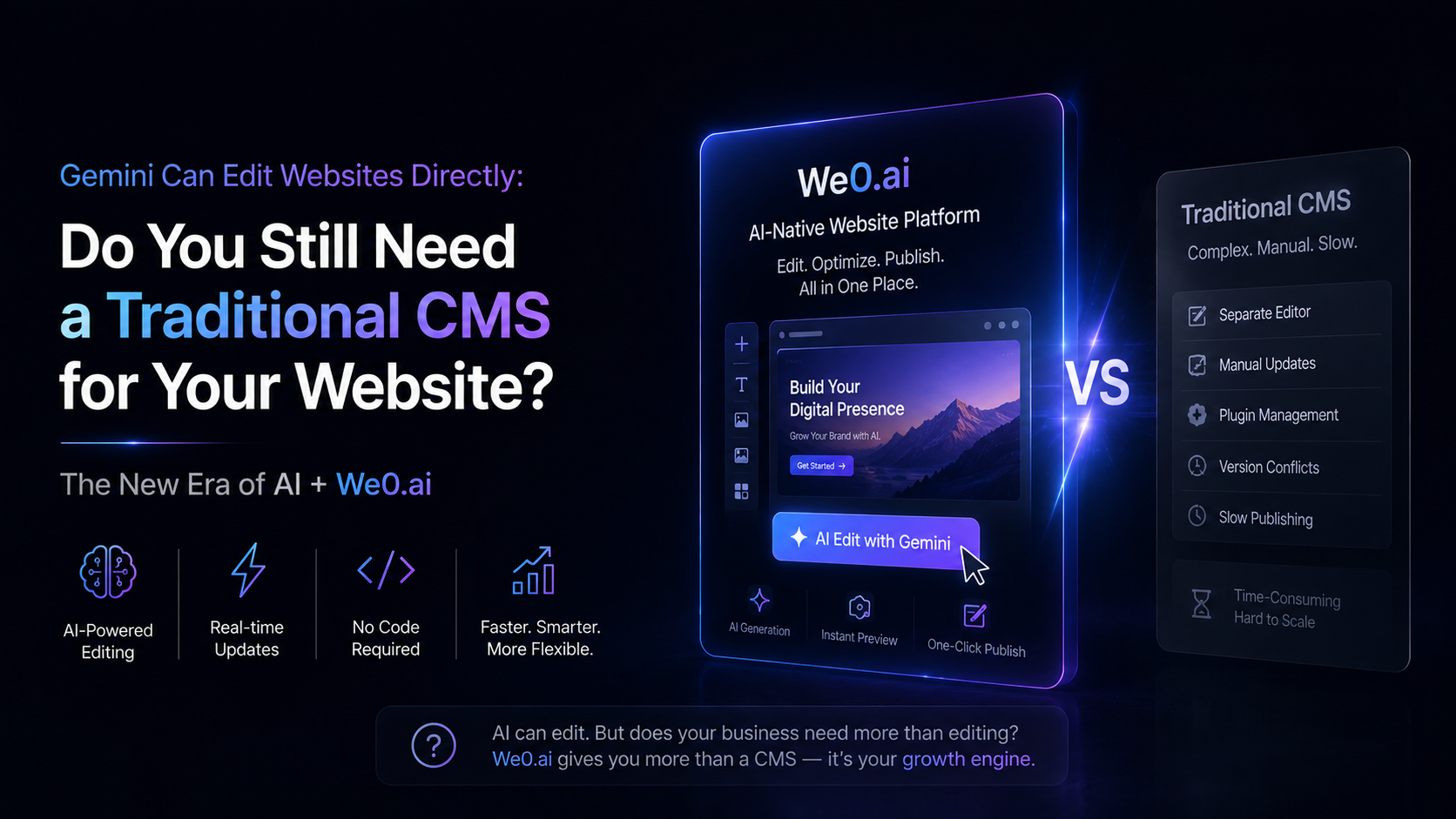
Gemini can now directly edit websites: Do companies building their official sites with We0.ai still need a traditional CMS backend?
Let's get straight to the point: Many company websites no longer necessarily need the "heavy backend" of a traditional CMS.
This isn't to say CMS is useless. Nor is it to say backends can be eliminated entirely.
Rather, when your website's goal becomes "showcase, growth, and lead generation," the way a backend should exist has already changed.
In the past, building an official website followed a simple logic:
First build the pages, then set up a backend, then have operators fill in the content.
Now it's different.
AI tools like Gemini are turning "modifying a website" into a more direct action:
You don't find a developer first, submit a request, and wait for scheduling;
You directly tell the AI—change this copy, adjust this section, add this module.
Editing a website is starting to feel like editing a document.
Once that becomes the norm, many of the reasons for having a traditional CMS will need to be reconsidered.
Don't take sides too quickly: The question isn't "Do you need a CMS?" but "What is your website actually for?"
When many people hear this topic, their first reaction is:
- Without a backend, how do we update content?
- Without a CMS, how do we do SEO?
- Without an approval workflow, how does the team collaborate?
- Without an asset library, how do we operate going forward?
These are all valid concerns.
But their premise is often that you treat your official website as a "content repository."
Yet today, more and more companies' websites are not repositories—they are showcase entry points designed for continuous lead generation.
This changes the criteria for evaluation.
| Your Website Type | Degree of Traditional CMS Need | More Suitable Approach |
|---|---|---|
| Brand showcase site | Low to medium | AI website builder + structured editing |
| Product website | Medium | AI editing + lightweight content management |
| Service-oriented website | Medium | Modular page management |
| Large content site | High | Traditional CMS / Headless CMS |
| Multi-role publishing platform | Very high | Full CMS workflow |
If your website essentially consists of just a few core pages—homepage, product pages, case study pages, FAQ, contact page—a traditional CMS may already be overkill.
But if your website requires multiple people to publish content daily, role-based approvals, and complex section management, then a CMS is still highly valuable.
What capabilities like Gemini change isn't "whether you can build a website"—it's "how much it costs to change one"
In the past, the most frustrating part of modifying a website wasn't creating it—it was changing it.
Even a small copy edit might require:
Requirement confirmation → Design adjustment → Frontend modification → Testing → Deployment.
That pipeline is far too long.
So long that many official websites end up being "launched and then never touched again."
Once AI can directly modify websites, that changes.
You'll become increasingly accustomed to operations like these:
- Making a specific module clearer
- Rewriting pricing copy to feel more like a sales page
- Reordering the case study section
- Expanding the FAQ into a more SEO-friendly version
- Turning landing pages into better ad-ready versions
A website is no longer a static project—it's more like a growth page that can be adjusted at any time.
This is also why many companies are starting to rethink:
Do they really need a "backend," or do they need "content capabilities that are fast to change, quick to deploy, and easy to iterate"?
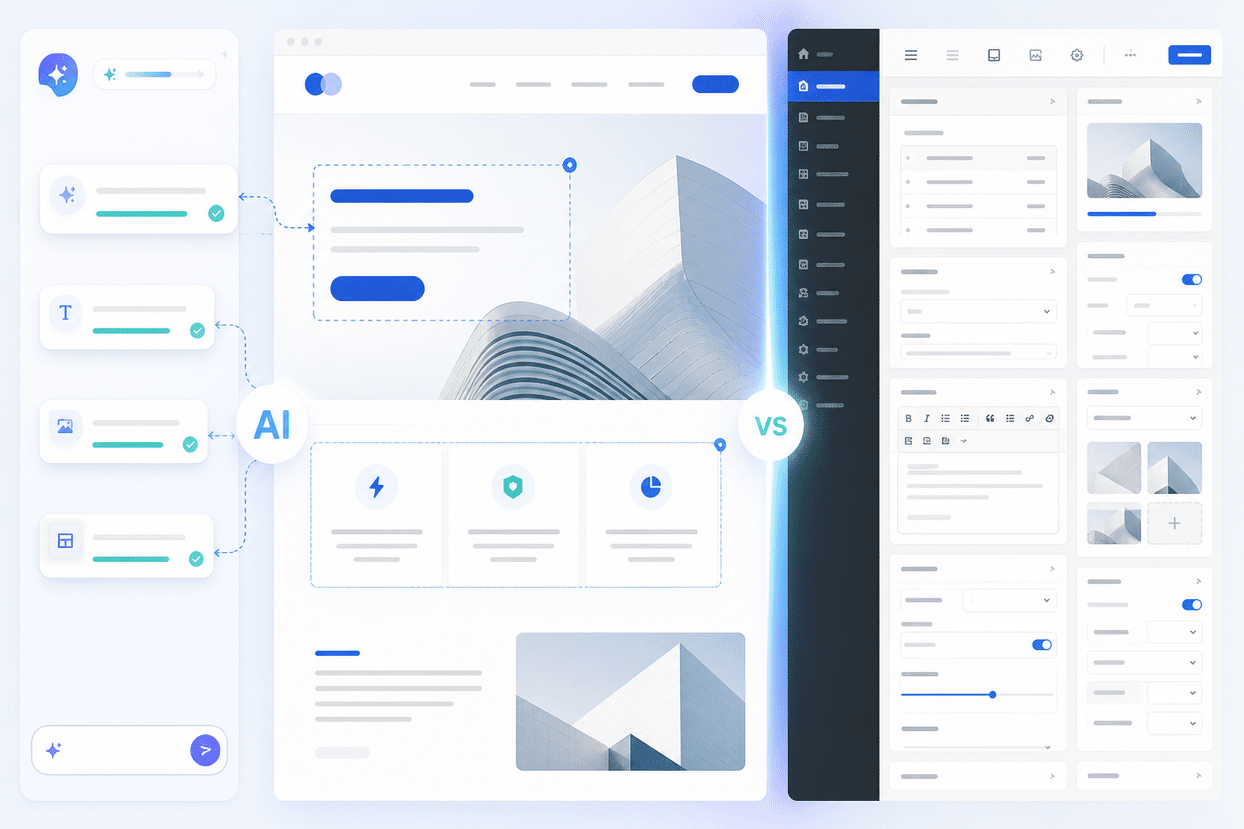
Is the traditional CMS still important? Yes. But the important parts have changed.
Traditional CMS platforms won't disappear—at least not right away.
That's because they still solve three very real problems:
- Content archiving and permission management
- Multi-person collaboration and approval workflows
- Long-term maintenance of complex content structures
These remain critical for large sites, content sites, media sites, and community platforms.
But for many corporate websites, the "heaviness" of a CMS is starting to feel like poor value.
Especially in these scenarios:
- The website only has a small number of core pages
- Content isn't updated frequently
- The main goals are collecting inquiries, showcasing the brand, and driving conversions
- No one on the team is dedicated to publishing articles in the backend daily
In these cases, what you really need isn't a big, all-encompassing backend—it's:
A website system that can be changed quickly, deployed reliably, and continuously optimized around SEO and conversions.
What We0.ai solves isn't "building a website"—it's "turning a website into an asset"
This is also the biggest difference between We0.ai and a traditional CMS.
We0.ai isn't just a page generator.
It's more like a growth platform built for showcase-oriented websites.
It doesn't just focus on:
Build → Getting the website up
It also covers:
Showcase → Presenting products, services, case studies, and work clearly
Grow → Improving SEO, GEO, content, and page performance
Leads → Ultimately generating real inquiries and customers
This pipeline matters.
Because many company websites don't die from "never being built"—they die from "being built and then ignored."
We0.ai's approach is precisely better suited for company websites, product pages, service pages, case study pages, inquiry pages, and waitlist pages.
In other words, it focuses on whether the website can continue to grow after launch.
A more direct judgment: Do you need a backend, or do you need results?
This may sound a bit harsh, but it's practical.
Many companies say they need a CMS, but what they actually need is:
- The ability to change content anytime
- Not having to always chase down developers
- Stable SEO structure
- Fast page deployment
- Clear conversion paths
See—what you actually want isn't the "backend" itself.
What you want is the outcome.
And if an AI website-building platform can already offer:
- Structured page editing
- Modular content management
- Continuous updates after launch
- Basic SEO / GEO configuration
- Data monitoring and optimization recommendations
Then the necessity of a traditional CMS drops significantly.
The backend isn't the goal. Growth is.
A comparison: AI direct website editing vs. Traditional CMS
| Dimension | AI Direct Website Editing | Traditional CMS Backend |
|---|---|---|
| Editing speed | Very fast | Depends on the workflow |
| Learning curve | Low | Medium to high |
| Content collaboration | Sufficient | More powerful |
| Complex permissions | Average | Strong |
| SEO adjustments | Great for rapid iteration | Better for systematic management |
| Best suited for | Showcase and conversion sites | Content-heavy, multi-collaborator sites |
| Long-term operations | Requires platform support | Natively more complete |
This table already tells the story.
It's not that CMS is being eliminated—it's that it's no longer suitable for every website.
The most common mistake for company websites: Confusing "manageable" with "growth-capable"
This is the most common problem today.
Many official websites have very complete-looking backends,
yet their pages don't grow, content doesn't convert, SEO doesn't gain traction, and leads don't come in.
Why?
Because "a complete backend" doesn't equal "an effective website."
If an official website has:
- Messy page structure
- No keyword strategy
- No content update cadence
- Unclear CTAs
- No one looking at the data
Then no matter how big the backend is, it's just a more complex empty shell.
So the real question a company should ask isn't:
"Do I have a CMS?"
It's:
"Can my website continuously bring me traffic, inquiries, and customers?"
This is why We0.ai is more like a "growth team + website-building platform."
It doesn't just help you create pages—it pushes your website toward results.
So when would we still recommend keeping a traditional CMS?
Yes, there are cases—there definitely are.
If you fit any of the following scenarios, a traditional CMS or Headless CMS is still worth keeping:
- You run a content/media site with frequent article updates
- You have multiple editor, reviewer, and operator roles
- You need complex categories, tags, and archiving systems
- Your website has lots of dynamic content and access controls
- You need cross-site, cross-language, cross-team content distribution
But if your situation looks like this:
- SaaS / AI product website
- Standalone showcase page
- Agency service page
- Foreign trade product page
- Personal brand site
Course / Consultation / Portfolio Site
In that case, what you should prioritize even more is:
Being able to go live quickly, iterate quickly, test quickly, and capture leads quickly.
At this point, traditional CMS platforms are often not the first choice.
My take: For many corporate websites in the future, the front end will matter more, and the back end will fade further into the background
That's not to say the back end has no value.
Rather, the back end will increasingly stop appearing in the form of a "traditional CMS."
It may instead become:
- A lighter content management layer
- A more structured page data layer
- A more automated update workflow
- An operations dashboard that's more aligned with business goals
In other words, users no longer care how complex your back end is. They only care about how fast you can make changes, how stable your launches are, whether your SEO works, and whether your conversions are high.
That's the dividing line between AI-powered website building and traditional CMS.
The former solves "how to make changes fast";
the latter solves "how to manage with precision."
And for most corporate websites, what's needed first is the former.
Conclusion: Most corporate websites don't need the "heavy back end" of a traditional CMS, but they do need the ability to grow sustainably
Let me put it plainly.
AI capabilities like Gemini have made "directly editing your website" the new normal.
What We0.ai solves isn't just how a website gets built—it's how that website keeps growing after it's live.
So the answer isn't "should CMS disappear entirely."
The answer is:
- If you're building a content-heavy platform, CMS still matters
- If you're building a showcase site, product site, or service site, the heavy back end is becoming less necessary
- If your goal is customer acquisition, what matters isn't the back end—it's whether the website can keep being optimized, growing, and converting
The next stage for corporate websites isn't a heavier back end—it's stronger results.
If you're building a website that's truly meant to win customers, an approach like We0.ai is closer to reality:
Not just getting the site built, but turning it into a customer-acquisition asset that keeps running.
FAQ
1. Can Gemini completely replace traditional CMS?
Not entirely. For showcase sites and low-complexity corporate sites, AI-driven editing is more than sufficient; for large content sites and multi-role collaboration platforms, CMS is still important.
2. Will a corporate website without CMS hurt SEO?
Not necessarily. SEO isn't about "having a CMS or not"—it's about page structure, content quality, internal linking, speed, and update mechanisms.
3. What's the biggest difference between We0.ai and traditional CMS?
We0.ai places greater emphasis on building + showcasing + growing + acquiring customers, not just solving content management.
4. What type of business is best suited to skip a heavy CMS?
SaaS, AI products, service providers, foreign trade companies, personal brand sites, and portfolio sites are usually better off with a lightweight approach.
5. Will the back end disappear in the future?
No. But the back end will become lighter, more invisible, and turn into a tool that serves growth—not the center of the website itself.
Related Tools
References
- Google Gemini
- Google Blog: Upload and edit your images directly in the Gemini app
- Contentful: Headless CMS explained
- Storyblok: Headless CMS explained
- Framer: AI design agent
Ready to get started?
If your website isn't just about "looking the part" but is meant to genuinely capture traffic, inquiries, and customers, We0.ai is better viewed as a growth tool, not just a website builder.
Conclusion
In the future, most corporate websites won't die from "having no back end"—they'll die from "having no sustained growth."