Gemini Makes Vibe Coding Products Fast — So Why Do So Many AI Products Still Launch Without Users?
Gemini has made building products faster, but “building it” doesn’t mean “people will use it.” This article breaks down the real reasons AI products end up with no users after launch — and how to turn a showcase product into an asset that acquires customers, drives growth, and sustains ongoing operations.
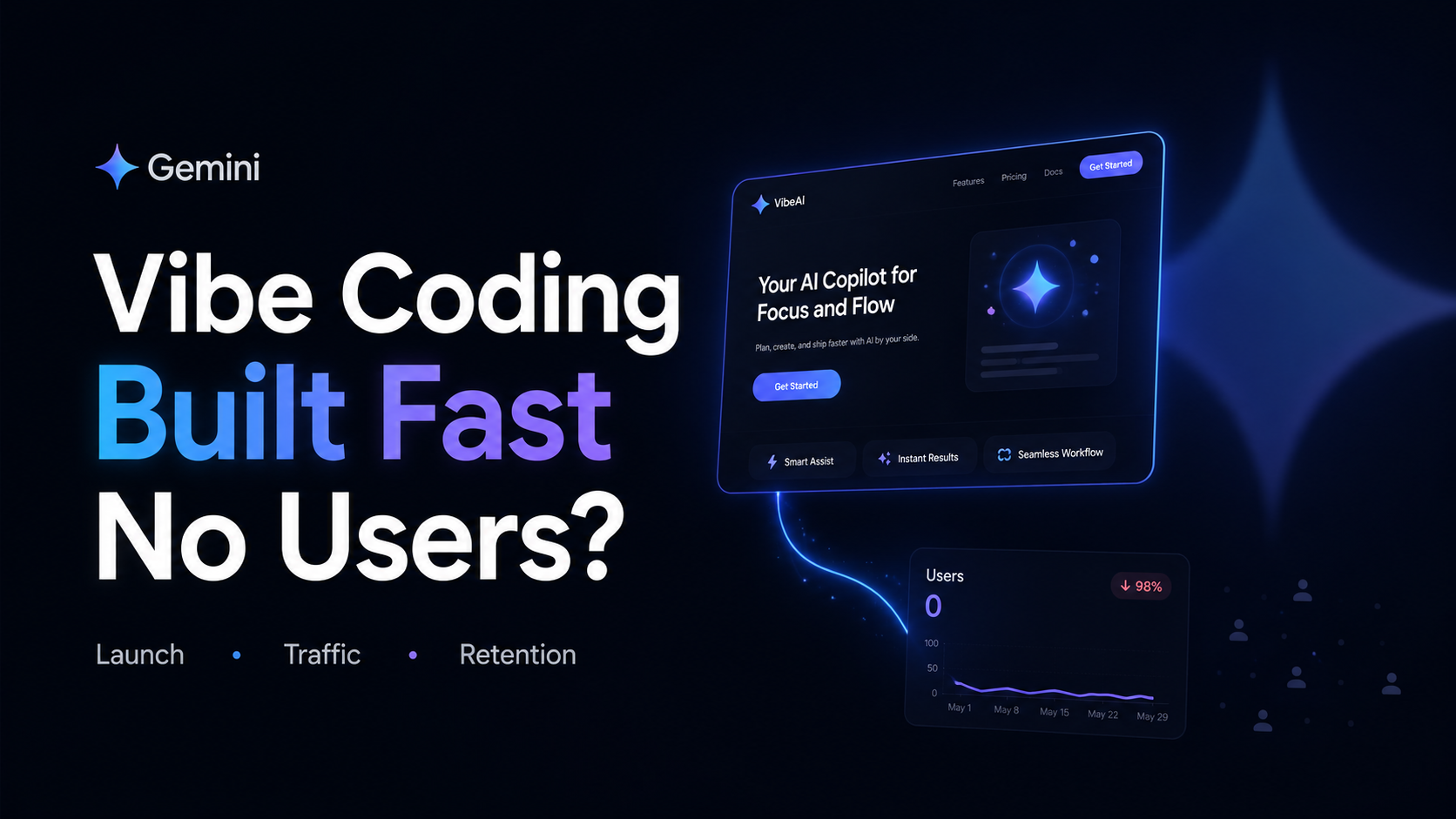
Gemini Makes Vibe Coding Products Fast — So Why Do So Many AI Products Still Launch Without Users?
The Bottom Line First
The problem today is no longer "can you build it or not."
The real question is: Why would anyone use what you've built?
Gemini and other AI coding tools have genuinely pushed "development speed" to a whole new level. One person, a few hours, or even less, can put together a Vibe Coding product that looks decent.
But after launch, many products still get no users.
No sign-ups, no return visits, no shares, no retention.
It's like there was a brief buzz, and then nothing.
This isn't actually a contradiction.
AI solves "production efficiency," not "user demand."
1. Why "Building Fast" Doesn't Equal "People Using It"
| What You Think Happens | What Actually Happens |
|---|---|
| You build a product quickly | You quickly build a product nobody needs |
| The UI looks good | The value isn't clearly communicated |
| There are lots of features | Users don't know what to do first |
| The demo is impressive | It's unstable in real-world scenarios |
| You launched | But there's no traffic, no distribution, no conversion |
This is the most common illusion today:
You think you're building a product, but you're really just turning an idea into a webpage.
Vibe Coding is great for prototypes, validation, demos, and internal tools.
But if you want to turn it into an AI product that people keep using, you can't stop at just "it runs."
You also have to answer these questions:
- Who will proactively come to use it?
- Why are they coming?
- After they use it, what's the next step?
- Where does the usage frequency lie for this product?
- What drives repeat visits and referrals?
If you can't answer these clearly, having no users after launch is perfectly normal.
2. Why AI Products Launch to No Users — It's Usually Not One Reason but a Chain of Problems
1) The demand is imagined, not discovered
Many products are built on "I think this is useful," not "users are actively searching for this."
That's a big difference.
If your product has no clear search intent, no clear use case, and no clear thing it replaces, users won't naturally show up.
2) The positioning is too broad — users can't tell what problem you actually solve
"I help you work smarter with AI" sounds like it covers everything, but actually says nothing.
Users aren't here to admire concepts.
Users come to solve one very specific problem.
3) Launch is the starting line, not the finish line
Many people treat launch as the final destination.
But the hardest part comes after launch:
Distribution, content, SEO, social media, email, conversion, retention.
4) No demonstrable scenario
AI products are especially prone to dying right here.
You have capability, but users can't see it.
You have features, but users can't feel them.
You have models, but users just see "another tool."
This is also why many AI products eventually need a "presentation layer" —
Not piling on more features, but making the value clear, showing it, and making it instantly understandable.
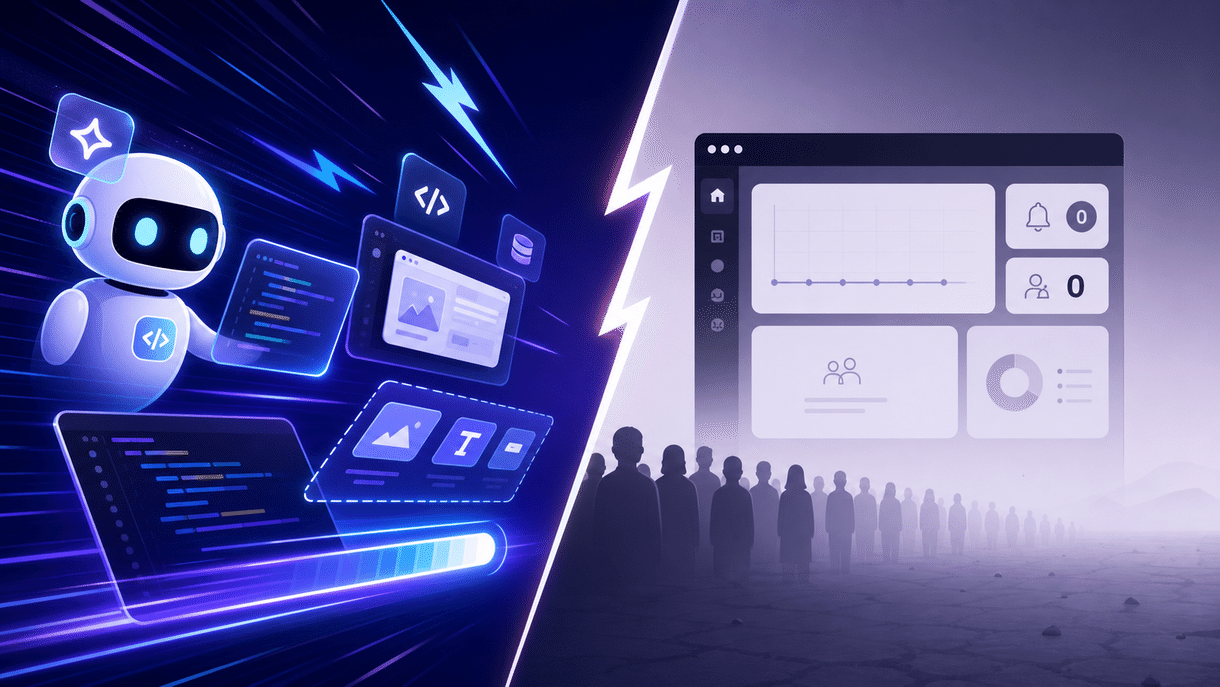
3. Why Products Are Even More Likely to Die Fast in the Vibe Coding Era
Vibe Coding has lowered the barrier to "building a product," but it has also raised the level of homogenization.
Before, nobody could build it.
Now, everyone can build it.
So the core of competition has shifted:
It's no longer about who finishes writing the code first, but who can turn a product into something that can be understood, searched, shared, and trusted.
At this point, just "knowing how to develop" isn't enough.
You also need to know:
- Topic selection
- Positioning
- Page structure
- Copywriting
- Conversion design
- SEO / GEO
- Data observation
- Continuous optimization
Plainly put, a product isn't finished when it's built — it's built through operation.
4. What Many AI Products Are Missing Isn't Features — It's a "Post-Launch Path"
If a product launches with no users, the most common issue isn't too few features — it's a path that's too weak.
You can think of the path this way:
Where users come from → Why they click in → What they see → Why they stay → Why they come back → Why they pay.
If just one link breaks in this chain, the traffic leaks out completely.
So what you really need to do isn't to build another "faster page generator" tool, but to turn your website or product into an asset that consistently delivers results.
This is also what We0 AI focuses on:
Not just helping you build it, but helping you make it something that can showcase, grow, and acquire users.
5. A More Realistic Framework: AI Products Should First Have "Showcase Value," Then "Tool Value"
Many AI products define themselves as tools from day one.
But when users first encounter you, they usually aren't there to "use a tool" — they're there to "get something done."
So a better sequence is usually:
- First, have a clear showcase page
- Then, have a clear use case
Another content entry point that can be continuously updated
4. A clear conversion action
The more complete this chain is, the less likely the product will go silent immediately after launch.
| Tool-only mindset | Showcase + growth mindset |
|---|---|
| Build a feature | Build a product that can be understood |
| Wait for users to discover | Proactively capture search and content traffic |
| Rely on sporadic sharing | Rely on long-term SEO / content / distribution |
| Launch is the finish line | Continuous optimization after launch |
| Look at whether the feature runs | Look at whether it generates leads and customers |
That's the difference.
6. If you're building an AI product, don't rush to add features. Ask these 3 questions first.
1) Who is the user, specifically down to what identity?
Don't say "everyone."
The broader the audience, the fewer people actually show up.
2) Why does the user need it right now?
Without an immediate motivation, the product will easily get bookmarked, get likes, and then fade into nothing.
3) Where does the user go next after using it?
Is it sign-up, booking, inquiry, joining a waitlist, or continuing to read content?
Without a next step, the product is just a one-time experience.
7. Give your AI product a more reliable landing point: showcase website + growth assets
If you're building an AI product, SaaS, independent project, consulting service, or portfolio, what you often need is not "another page" but a showcase website that works continuously.
It should at least:
- Make people understand who you are
- Make people understand what you solve
- Make people willing to stay
- Make people able to find you through search
- Make people willing to reach out
That's what We0 AI is about.
It's not just "generating websites" — it treats the website as a long-term growth entry point:
Build → Showcase → Grow → Leads.
Build first, then showcase, then grow, and finally capture leads.
That path is what many AI products are truly missing.
Ready to get started?
If you're building an AI product, showcase page, landing page, or waitlist page — or you've already built the product but no one is coming — don't rush to keep stacking features.
First, figure out the "why would anyone come" part.
A product that gets no users after launch is often not because it's not advanced enough, but because it wasn't seen, wasn't understood, and wasn't captured.
FAQ
Q1: Aren't tools like Gemini already fast enough to build products?
Yes, building is faster now. But "building it" is only the first step. After that comes positioning, distribution, conversion, and retention.
Q2: What's the most common reason AI products get no users?
Usually unclear demand, too broad positioning, insufficient showcase, and no growth path.
Q3: What is Vibe Coding good for?
Good for prototypes, internal tools, demo pages, validating ideas, and quick experimentation.
Q4: Why do many AI products look good but still have no users?
Because users aren't there to appreciate the technology — they want clear outcomes.
Q5: How do you keep a product from going silent after launch?
At minimum, you need a clear showcase page, search entry points, content distribution, and a conversion path.
References
- Google Cloud: real-world generative AI use cases
- Menlo Ventures: 2025 The State of Consumer AI
- Microsoft: Global AI Adoption in 2025
- Hostinger: Vibe coding statistics 2026
Summary
Gemini makes building products faster.
But what truly determines whether an AI product gets users has never been speed itself.
It's positioning, it's showcase, it's path, it's growth.
Being able to build is just the starting point.
Being used is the real outcome.