Gemini 3 Flash Production-Grade Application Development Guide: Streaming Architecture, Cost Optimization, Monitoring, and Migration in Practice
This is a production-grade application development guide for Gemini 3 Flash, designed for developers and AI product teams. It systematically covers core topics such as streaming output, batch processing, hybrid routing, caching strategies, error retries, circuit breaking, migration, monitoring, security, and cost optimization. The article also adds a growth perspective from We0 AI, covering product websites, documentation pages, SEO/GEO content pages, and lead conversion funnels to help teams turn model capabilities into products that can be launched, scaled, and sustainably acquire customers.
What’s most noteworthy about Gemini 3 Flash is not just that it is faster, but that, for the first time, it brings “fast” and “production-ready” into the same model.
If your product involves scenarios such as high-frequency Q&A, writing assistance, real-time translation, or batch extraction, it is very likely more cost-effective than the previous default option.
What truly determines production performance is not the model name, but whether you have fully implemented streaming, caching, retries, circuit breaking, monitoring, and fallback together.
For teams like We0 AI that need to build product capabilities while also creating a showcase-style official website and acquiring users through search, model performance is only the first half of the journey; the second half is Build -> Showcase -> Grow -> Leads.
Production-Grade Application Development Guide for Gemini 3 Flash: Architecture, Performance, and Cost Optimization in Practice
Compiled Edition, May 2026
The most discussed aspect of Gemini 3 Flash right now is that it places speed, quality, and cost in a position that is easier to balance. For many teams, this means capabilities that previously could only run in demos finally have a chance to move into real production environments.
But there is a very practical issue here: a cheaper model does not mean the production environment automatically becomes simpler. Once it truly goes live, user experience, error handling, cache hit rate, rate limiting, monitoring, and fallback chains all matter. If any one of them is missing, both your bill and your reputation can suffer.
This article slightly reorganizes the original structure and focuses on: architecture patterns, performance tuning, error handling, migration strategies, real business scenarios, cost control, and how to ultimately connect technical capabilities to the growth funnel.
Why Gemini 3 Flash Deserves Dedicated Study
In the past, a “fast model” often meant sacrificing some quality, while a “powerful model” usually meant higher cost and longer latency. What makes Gemini 3 Flash genuinely worth evaluating is that it feels more like a default layer that can be placed directly into a production stack.
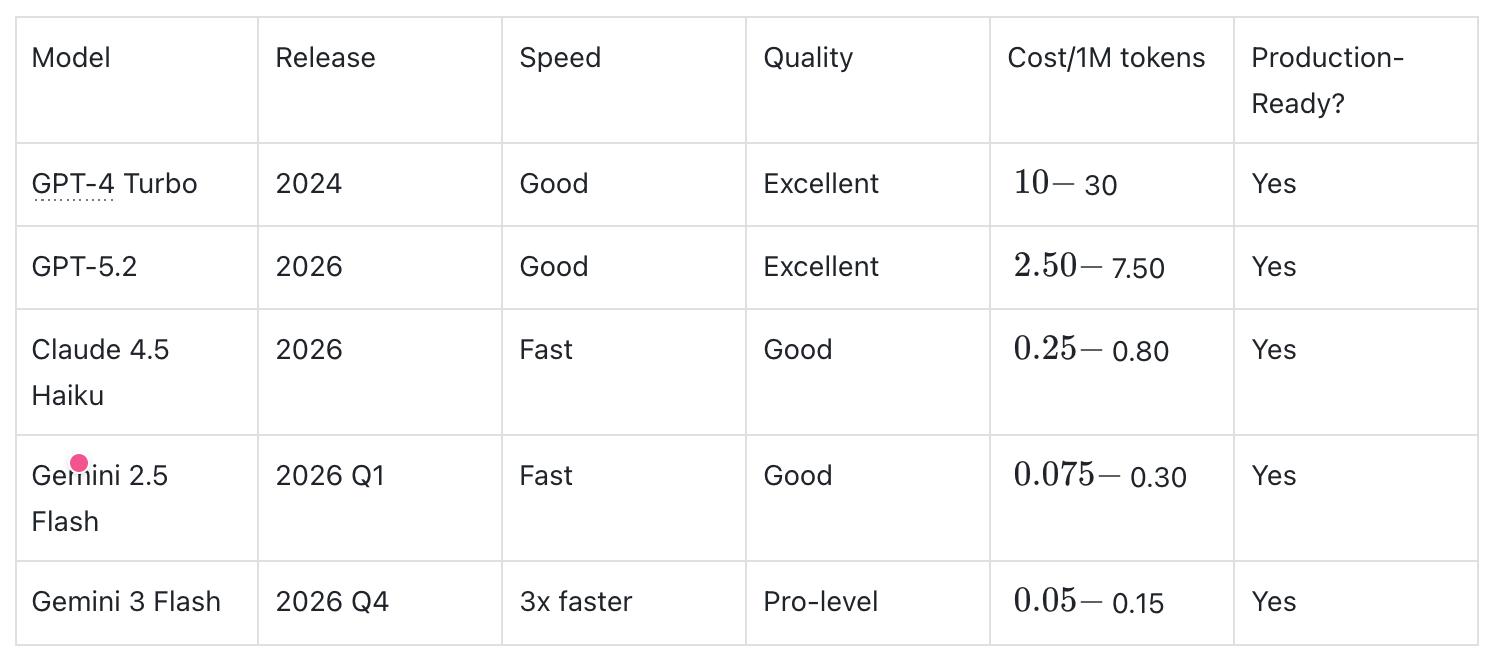
The real breakthrough is this: Gemini 3 Flash is beginning to approach a state of being “fast without degradation.” This will lead many products that previously had to adopt a two-model tiering strategy to reassess their default routing.
Impact in Real Business Scenarios
If your product involves:
User-facing chat, Q&A, and real-time writing
High-frequency batch generation, classification, and extraction
API services that require constant fine-tuning between speed and cost
Then 3x speed + lower unit pricing often means more than just better-looking cost numbers; it can directly reshape the interaction feel, per-session cost, and concurrency capacity of your product.
The Three Most Practical Architecture Patterns for Production Environments
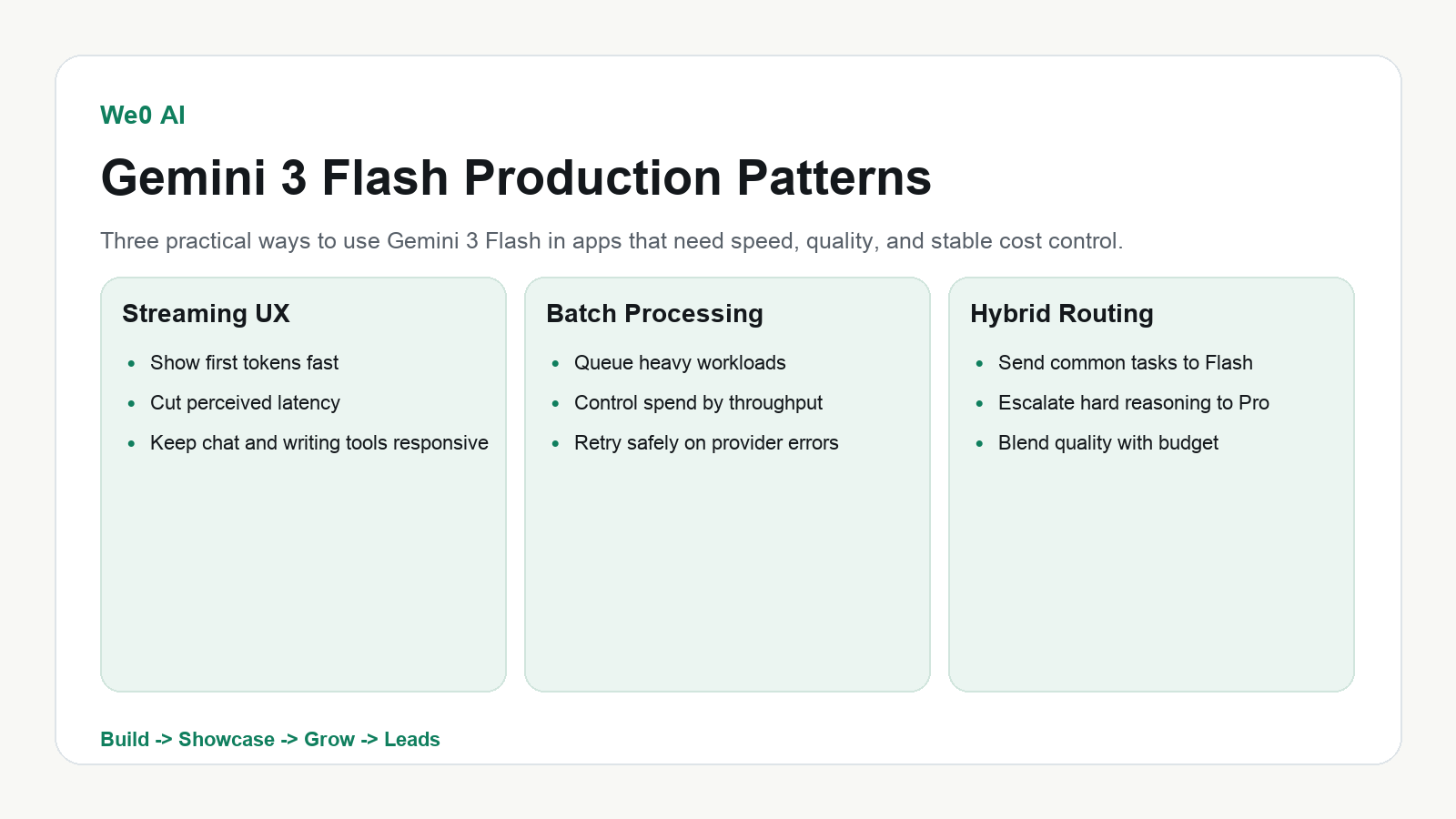
Pattern 1: Streaming for Real-Time UX
What users are most sensitive to is not “how many seconds the model ran in total,” but “whether I immediately saw something start to appear.” So in chat, writing assistants, and Copilot-like products, streaming should basically be the default, not a nice-to-have.
import { GoogleGenerativeAI } from '@google/generative-ai';

const genAI = new GoogleGenerativeAI(process.env.GEMINI_API_KEY!);
const model = genAI.getGenerativeModel({ model: 'gemini-3-flash' });

export async function POST(req: Request) {
  const { prompt } = await req.json();
  const result = await model.generateContentStream(prompt);

  const encoder = new TextEncoder();
  const stream = new ReadableStream({
    async start(controller) {
      for await (const chunk of result.stream) {
        const text = chunk.text();
        controller.enqueue(encoder.encode(text));
      }
      controller.close();
    },
  });

  return new Response(stream, {
    headers: { 'Content-Type': 'text/plain; charset=utf-8' },
  });
}
If the frontend renders synchronously at the token level, users will clearly feel that “the system is alive.” In these scenarios, perceived latency usually affects retention more than total time spent.
const response = await fetch('/api/chat', {
  method: 'POST',
  body: JSON.stringify({ prompt }),
});

const reader = response.body?.getReader();
const decoder = new TextDecoder();
let content = '';

while (reader) {
  const { done, value } = await reader.read();
  if (done) break;
  content += decoder.decode(value);
  setMessage(content);
}
Pattern 2: Batch Processing for Cost Optimization
As long as the workload is not strictly real-time, batch processing is one of the first cost-reduction approaches you should consider. For example:
Bulk content summarization
Product tag extraction
FAQ cleanup
Support ticket classification
import PQueue from 'p-queue';

const queue = new PQueue({ concurrency: 10 });

async function processBatch(items) {
  return Promise.all(
    items.map((item) =>
      queue.add(async () => {
        const result = await model.generateContent(item.prompt);
        return { id: item.id, output: result.response.text() };
      })
    )
  );
}
The key to this kind of pattern is not just “getting concurrency running,” but rather: you need to manage queue depth, failure retries, rate-limit responses, and per-batch cost all at the same time.
Pattern 3: Hybrid Routing (Flash + Pro)
Not every request is worth sending to a high-cost model. A more stable approach is:
Use Flash for general Q&A, completion, and structured extraction
Use Pro for high-complexity analysis and critical business decisions
class ModelRouter {
  async generate(prompt, taskType) {
    if (taskType === 'simple_chat' || taskType === 'autocomplete') {
      return geminiFlash.generateContent(prompt);
    }

    if (taskType === 'complex_reasoning' || taskType === 'code_review') {
      return geminiPro.generateContent(prompt);
    }

    return geminiFlash.generateContent(prompt);
  }
}
The value of this routing approach is that you don’t have to pay the “most powerful model tax” for every ordinary request.
Performance Tuning: Don’t Just Focus on the Model; Focus on the System First
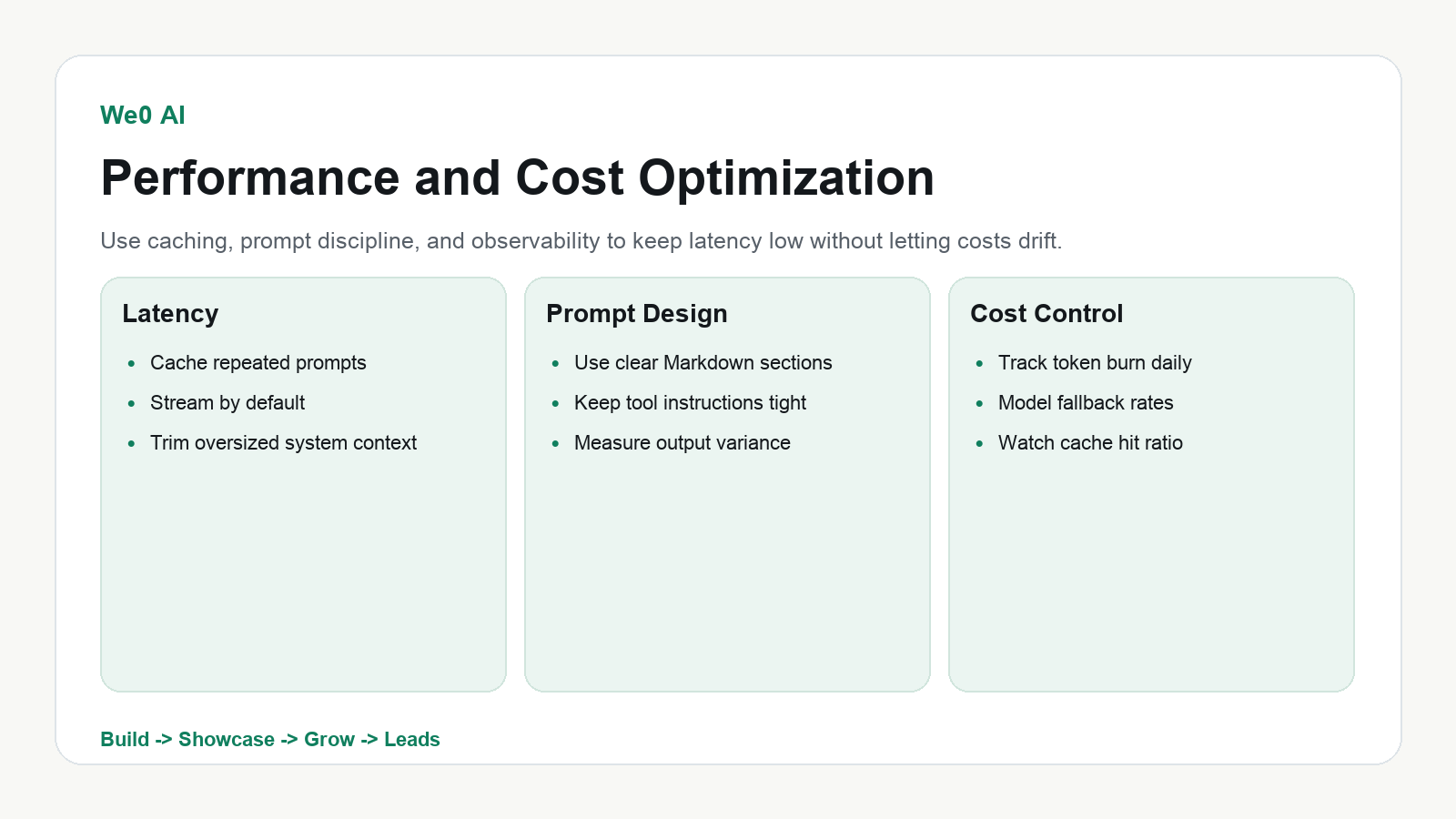
1. Latency Optimization
In most scenarios, what really slows down the experience is not just model inference itself, but also:
Overly Long Prompts
Repeated context
Unnecessary serial calls
Lack of caching
In practice, you can start with three things:
Stream first when streaming is possible
Cache first when caching is possible
Shorten the context first when it can be shortened
2. Caching Strategy
Caching is usually the most direct cost-saving lever. Many teams only discover after launch that there are actually many repeated questions, repeated templates, and repeated system instructions.
import Redis from 'ioredis';
const redis = new Redis(process.env.REDIS_URL!);

async function cachedGeneration(prompt) {
  const cacheKey = `gemini:${hash(prompt)}`;
  const cached = await redis.get(cacheKey);

  if (cached) {
    return JSON.parse(cached);
  }

  const result = await model.generateContent(prompt);
  const text = result.response.text();

  await redis.setex(cacheKey, 3600, JSON.stringify(text));
  return text;
}
In many businesses, a 30% to 50% reduction in costs often comes not from switching models, but from the cache hit rate.
3. Prompt Optimization
Gemini 3 Flash is often more stable with prompts that have a clear structure and well-defined task boundaries. Rather than continuously lengthening the system prompt, it is better to:
Clearly state the objective
Clearly specify the output format
Clearly define the boundaries for tool calls
Use Markdown structure instead of lengthy natural language
Error Handling and Reliability
Exponential Backoff Retry
async function generateWithRetry(prompt, maxRetries = 3) {
  let lastError;

  for (let i = 0; i < maxRetries; i++) {
    try {
      return await model.generateContent(prompt);
    } catch (error) {
      lastError = error;
      const delay = Math.pow(2, i) * 1000 + Math.random() * 1000;
      await new Promise((resolve) => setTimeout(resolve, delay));
    }
  }

  throw lastError;
}
Once it is truly deployed in production, having retries is not optional; it is the bare minimum of self-protection.
Circuit Breaker Pattern
class CircuitBreaker {
  constructor(threshold = 5, timeout = 60000) {
    this.failures = 0;
    this.threshold = threshold;
    this.timeout = timeout;
    this.lastFailureTime = 0;
    this.state = 'CLOSED';
  }

  async call(fn) {
    if (this.state === 'OPEN') {
      if (Date.now() - this.lastFailureTime > this.timeout) {
        this.state = 'HALF_OPEN';
      } else {
        throw new Error('Circuit breaker is OPEN');
      }
    }

    try {
      const result = await fn();
      this.onSuccess();
      return result;
    } catch (error) {
      this.onFailure();
      throw error;
    }
  }
}
If you don't have circuit breaking, a localized failure can easily bring down the entire chain.
Migration Strategy
Migrating from the GPT-4 / GPT-5 Path
A more stable migration approach is not to switch all at once, but to:
First identify high-traffic, latency-sensitive, and cost-sensitive endpoints
Run A/B tests
Compare quality, latency, cost, and error rates
Gradually roll out in phases
async function abTestGeneration(prompt, userId) {
  const useGemini = hashUserId(userId) % 100 < 10;

  if (useGemini) {
    const result = await geminiFlash.generateContent(prompt);
    logMetric('gemini_flash', result);
    return result.response.text();
  } else {
    const result = await openai.chat.completions.create({
      model: 'gpt-4',
      messages: [{ role: 'user', content: prompt }],
    });
    logMetric('gpt4', result);
    return result.choices[0].message.content;
  }
}
Migrating from Claude to Gemini 3 Flash
The easiest pitfalls here are the prompt structure and the tool schema. Many Claude-style prompts tend to be XML-oriented, while Gemini is often better suited to a clear Markdown structure.
## Instructions
Analyze this code for bugs.

## Code
```javascript
function foo() { ... }
```
You also need to check for differences in the field structure of function calls:
const claudeTools = [{
  name: 'get_weather',
  description: 'Get weather for a location',
  input_schema: {
    type: 'object',
    properties: { location: { type: 'string' } }
  }
}];

const geminiTools = [{
  functionDeclarations: [{
    name: 'get_weather',
    description: 'Get weather for a location',
    parameters: {
      type: 'object',
      properties: { location: { type: 'string' } }
    }
  }]
}];
Real-World Business Scenarios
1. Customer Service Chatbots
A typical configuration suitable for Gemini 3 Flash is:
High concurrency
Sensitive to time to first byte
Requires multi-turn conversations
Costs must be controllable
2. Content Generation Pipelines
Tasks such as title generation, summaries, tags, FAQ expansion, and landing page copy are usually better suited to batch processing + caching. For teams like We0 AI that need to continuously produce showcase websites, case study pages, and SEO content pages, this type of pipeline can be easily integrated directly into the growth system.
3. Real-Time Translation API
For any scenario involving low latency, multiple languages, and intensive short-text calls, Gemini 3 Flash will make it easier to achieve healthy unit costs than “using a large model by default.”
Cost Optimization Checklist
Enable streaming by default to reduce perceived waiting time
Cache highly repetitive requests to capture the easiest cost benefits first
Route by task complexity to avoid using Pro at every step
Tighten prompts to reduce meaningless context
Track the fallback ratio; don’t look only at the main model’s unit price
Use batch processing for throughput; don’t disguise offline tasks as real-time tasks
Monitoring and Observability
Key Metrics to Watch
p50 / p95 / p99 latency
input / output token usage
cache hit rate
retry rate
fallback rate
cost per request
error rate by endpoint
Recommended Alert Items
Abnormal increase in latency
Sudden rise in error rate
Daily token consumption deviating from budget
Increase in fallback call ratio
Significant drop in cache hit rate
Security Best Practices
1. API Key Management
export GEMINI_API_KEY=your_key_here2. Input Sanitization
function sanitizeInput(input) {
  return input
    .replace(/<script[^>]*>.*?<\/script>/gi, '')
    .replace(/javascript:/gi, '')
    .trim();
}
3. Output Filtering
function filterOutput(text) {
  const blockedPatterns = [/api[_-]?key/i, /password/i, /secret/i];
  for (const pattern of blockedPatterns) {
    if (pattern.test(text)) {
      throw new Error('Sensitive content detected');
    }
  }
  return text;
}
Common Pitfalls and Solutions
Pitfall 1: Not Handling Rate Limiting
async function rateLimitedCall(fn, maxRetries = 5) {
  for (let i = 0; i < maxRetries; i++) {
    try {
      return await fn();
    } catch (error) {
      if (error.status === 429) {
        const retryAfter = error.headers?.['retry-after'] || Math.pow(2, i);
        await new Promise((resolve) => setTimeout(resolve, retryAfter * 1000));
        continue;
      }
      throw error;
    }
  }
}
Pitfall 2: Ignoring Token Limits
function chunkText(text, maxTokens = 30000) {
  const estimatedTokens = text.length / 4;

  if (estimatedTokens <= maxTokens) {
    return [text];
  }

  const chunkSize = Math.floor(text.length / Math.ceil(estimatedTokens / maxTokens));
  const chunks = [];

  for (let i = 0; i < text.length; i += chunkSize) {
    chunks.push(text.slice(i, i + chunkSize));
  }

  return chunks;
}
Pitfall 3: No Fallback
async function generateWithFallback(prompt) {
  try {
    return await geminiFlash.generateContent(prompt);
  } catch (error) {
    console.error('Gemini Flash failed, trying fallback');

    try {
      return await openai.chat.completions.create({
        model: 'gpt-3.5-turbo',
        messages: [{ role: 'user', content: prompt }],
      });
    } catch (fallbackError) {
      return { text: 'Service temporarily unavailable. Please try again.' };
    }
  }
}
Conclusion: From POC to Production, What Matters Is Engineering Completeness
What Gemini 3 Flash changes is not just the model pricing table, but the launch boundary for many AI applications. Capabilities that once seemed “functional but not economically viable” now have a chance to enter real business scenarios.
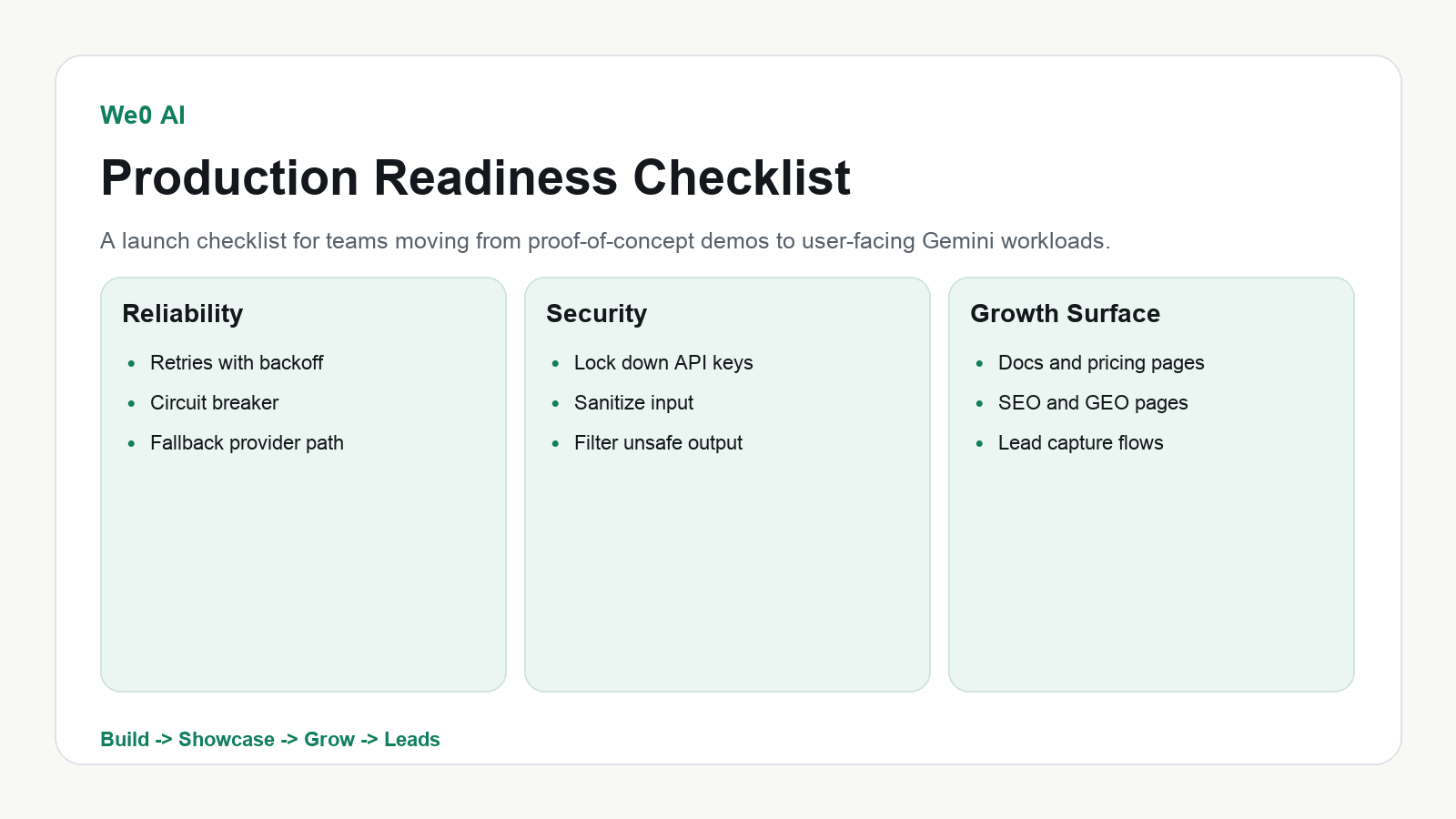
But don’t misunderstand: cheap and fast never mean simple. Truly turning it into a production capability depends on whether the following pieces are fully in place:
Retry and rate-limit handling
Caching and cost modeling
Monitoring, alerting, and fallback
Security filtering and permission isolation
Growth-layer showcase pages, documentation pages, FAQ pages, and conversion paths
If you’ve only connected the API, that’s just the beginning of the build. What truly enables a product to continuously gain search traffic, AI recommendation traffic, and sales leads is whether you have also built the other half of the chain: Showcase, Grow, and Leads.
Related Tools and Resources
We0 AI Showcase Website Planner: Plan the structure of product websites, capability pages, case study pages, documentation pages, and comparison pages.
We0 AI SEO / GEO Content Map: Break down technical capabilities into a matrix of searchable, recommendable, and conversion-focused articles and landing pages.
API Cost Model Worksheet: Estimate prompt volume, cache hit rate, fallback rate, and blended cost in advance.
Rollout Checklist: Turn streaming, retries, circuit breakers, monitoring, fallback, and rate limits into a unified launch checklist.
Provider Comparison Board: Compare Gemini, Claude, OpenAI, and open-source approaches side by side in terms of speed, quality, and budget.
FAQ
Why is Gemini 3 Flash suitable for production environments?
The key point is that speed and quality are no longer an either-or choice. For high-frequency request scenarios, this means lower per-request costs, faster responses, and less layering complexity.
What products is Gemini 3 Flash best suited for?
Chat, writing assistants, content pipelines, translation APIs, knowledge Q&A, and structured extraction are all good fits. You can start by using it as the default layer, then decide whether to upgrade to a more powerful model based on complexity.
What are the three most important things to do before launch?
Streaming, caching, and fallback. These three often deliver real benefits sooner than continuing to dwell on prompt details.
Why should technical teams still care about showcase websites and SEO / GEO?
Because model capabilities do not automatically turn into customers. What truly explains product capabilities clearly, gets discovered in search, gets recommended by AI, and ultimately converts into leads is the website structure, case study pages, FAQ, comparison pages, and content matrix.