Gemini 3.6 Flash Prioritizes Efficiency, but Independent Tests Show Flat Intelligence Gains
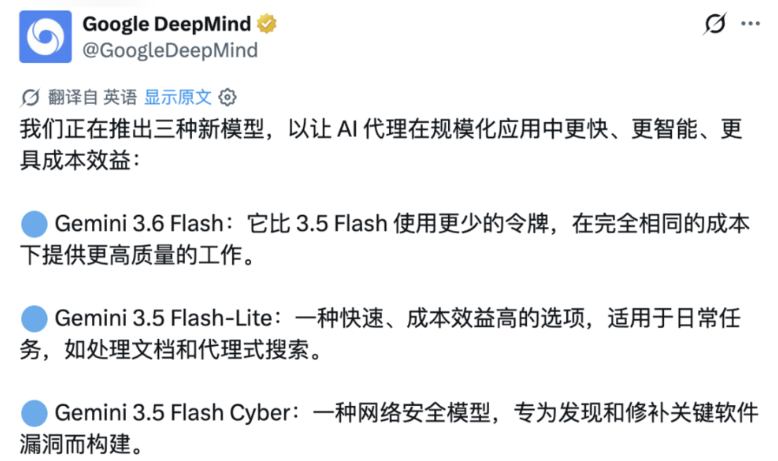
Google has introduced three new Gemini models aimed at different parts of the agent market:
Gemini 3.6 Flash Prioritizes Efficiency, but Independent Tests Show Flat Intelligence Gains
Introduction
Google has introduced three new Gemini models aimed at different parts of the agent market:
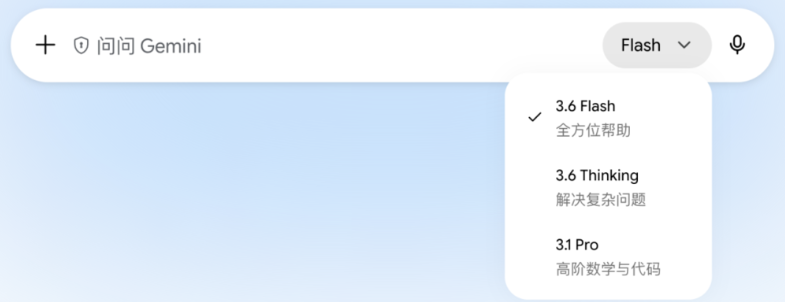
- Gemini 3.6 Flash, positioned as the main workhorse for coding, multimodal work, and multi-step agents
- Gemini 3.5 Flash-Lite, optimized for high-throughput and latency-sensitive workloads
- Gemini 3.5 Flash Cyber, a restricted cybersecurity model designed to find, validate, and patch software vulnerabilities
Google’s launch message centers on efficiency. The company says the new Flash models complete tasks with fewer output tokens, fewer tool calls, and less execution-loop overhead. Prices are also lower than those of Gemini 3.5 Flash.
That part of the story is supported by both Google’s internal benchmarks and early independent testing.
The more complicated question is whether Gemini 3.6 Flash is meaningfully more intelligent than the model it replaces.
Artificial Analysis measured the new model at the same score as Gemini 3.5 Flash on its composite Intelligence Index. Early users also reported mixed experiences, especially in visual design, Chinese-language generation, tool selection, and instruction following.
The result is not a simple failure. Gemini 3.6 Flash appears faster, less verbose, and cheaper per completed task in many workloads. It also improves several coding, computer-use, machine-learning, and knowledge-work benchmarks.
But the release illustrates an important distinction:
A model can become more efficient without making an equally large improvement in general intelligence or subjective output quality.
The Three New Gemini Models at a Glance
| Model | Primary Role | API Price per 1M Tokens | Default Thinking Level | Availability |
|---|---|---|---|---|
| Gemini 3.6 Flash | Coding, multimodal work, and complex agent workflows | $1.50 input / $7.50 output | Medium | Generally available |
| Gemini 3.5 Flash-Lite | High-volume extraction, search, translation, routing, and subagents | $0.30 input / $2.50 output | Minimal | Generally available |
| Gemini 3.5 Flash Cyber | Vulnerability discovery, validation, and patching | Not publicly listed | Specialized | Limited pilot for governments and trusted partners |
Gemini 3.6 Flash and Gemini 3.5 Flash-Lite both support:
- Up to 1 million tokens of context
- Up to 64,000 output tokens
- Text, image, audio, and video input
- Text output
- Configurable thinking levels
- Built-in tools, including Computer Use
- Access through the Gemini API and Google AI Studio
Google’s model cards list a March 2026 knowledge cutoff for both generally available models.
Gemini 3.6 Flash: Fewer Tokens and Lower Task Costs
Gemini 3.6 Flash is based on Gemini 3.5 Flash and is intended to replace it for many coding, knowledge-work, multimodal, and agentic workloads.
The most consistent improvement is efficiency.
Google reports that Gemini 3.6 Flash uses 17% fewer output tokens than Gemini 3.5 Flash on the Artificial Analysis Index. On some agentic coding evaluations, including DeepSWE, Google observed reductions of up to 65%.
The model also tends to use:
- Fewer reasoning steps
- Fewer tool calls
- Shorter execution loops
- Fewer unnecessary code changes
- Less verbose final output
These changes matter because agent cost is not determined only by the advertised price per token.
A long-running agent may call the model repeatedly, send large tool definitions, inspect files, execute code, recover from failures, and generate extensive reasoning output. Reducing the number of turns and tokens can lower the total cost even when the per-token price changes only modestly.
Gemini 3.6 Flash Pricing
Google lists the following API prices:
| Token Type | Gemini 3.6 Flash | Gemini 3.5 Flash |
|---|---|---|
| Input | $1.50 per 1M tokens | $1.50 per 1M tokens |
| Output | $7.50 per 1M tokens | $9.00 per 1M tokens |
Input pricing remains unchanged, while output pricing falls by approximately 16.7%.
Artificial Analysis measured an average cost per task of roughly $0.50** for Gemini 3.6 Flash, compared with **$0.59 for Gemini 3.5 Flash in its evaluation setup. That represents an approximate 18% reduction, driven by lower output pricing and fewer generated tokens.
Those figures should be treated as workload-specific rather than universal. Actual costs depend on:
- Prompt size
- Thinking level
- Output length
- Number of turns
- Tool usage
- Context caching
- Retry behavior
- The type of agent harness
- Whether the application sends the full conversation on every turn
Faster Completion, Not Just Faster Token Generation
Artificial Analysis reported an average task time of approximately 1.3 minutes for Gemini 3.6 Flash, down from around 2.7 minutes for Gemini 3.5 Flash.
The improvement comes from both faster output and a more economical reasoning process.
A model that generates tokens quickly can still take a long time if it enters repeated tool loops. Conversely, a slightly slower model may finish earlier if it reaches the right plan with fewer calls.
For agent developers, time per completed task is often more useful than raw tokens per second.
Coding, Machine Learning, Computer Use, and Knowledge Work
Google reports improvements across several benchmark categories.
Coding and Software Engineering
On DeepSWE, Gemini 3.6 Flash improved from 37% to 49% compared with Gemini 3.5 Flash.
Google says the model:
- Produces fewer unwanted edits
- Uses shorter debugging loops
- Follows the requested scope more closely
- Generates more production-ready code
- Is more likely to inspect a project programmatically before changing it
The final point has a trade-off.
Google’s developer guide notes that Gemini 3.6 Flash may run diagnostic scripts before editing, which can improve accuracy on complex tasks. On simple front-end work, those extra exploratory steps can add latency without always improving the result.
Google also states that human evaluators sometimes preferred earlier models for visual layout and styling, even when Gemini 3.6 Flash produced more functional code. Developers building interfaces may therefore need to provide clearer visual-design constraints.
Machine-Learning Research
On MLE-Bench, Google reports an increase from 49.7% to 63.9%.
This evaluation focuses on practical machine-learning engineering and research tasks rather than isolated coding questions. The increase suggests stronger performance in workflows that require experimentation, data handling, implementation, and iterative improvement.
Computer Use
On OSWorld-Verified, Gemini 3.6 Flash improved from 78.4% to 83.0% in Google’s published comparison.
Computer Use is now available as a built-in client-side tool through the Gemini API and Gemini Enterprise. It allows agent systems to interact with graphical interfaces instead of relying only on direct APIs.
Computer-use benchmarks remain sensitive to the agent harness, screen environment, task design, and failure-recovery strategy. A higher score is useful, but production systems still need strict permissions and confirmation steps for consequential actions.
Knowledge Work
On GDPval-AA v2, Gemini 3.6 Flash increased from 1349 to 1421.
Google highlights use cases such as:
- Document parsing
- Chart interpretation
- Financial-data analysis
- Report drafting
- Transcript analysis
- Code migration
- Multimodal research workflows
Customers including Figma, Harvey, Hebbia, and JetBrains supplied positive comments for Google’s launch announcement. These testimonials reflect customer experiences and should not be treated as independent benchmarks.
The Knowledge Cutoff and Context Window
Gemini 3.6 Flash supports a context window of up to 1 million tokens and a maximum output of 64,000 tokens.
Its model card lists a knowledge cutoff of March 2026, an improvement over earlier Gemini releases whose cutoffs were substantially older.
A newer cutoff reduces the amount of basic recent context that developers must supply manually. It does not make the model reliable for current news, live prices, changing laws, software releases, or other time-sensitive facts.
Applications handling fresh information should still use retrieval, search, verified databases, or tool calls.
A large context window also does not guarantee that the model will use every part of a long document equally well. Developers should test:
- Retrieval accuracy across distant sections
- Consistency over long conversations
- Whether key rules remain active
- Performance when irrelevant material is included
- Cost and latency at realistic context lengths
Safety Upgrades in Gemini 3.6 Flash
Google says Gemini 3.6 Flash includes stronger Frontier Safety safeguards for:
- Chemical, biological, radiological, and nuclear misuse
- Cyber-offense misuse
- Jailbreak resistance
The model card reports improved automated multilingual and content-safety results compared with Gemini 3.5 Flash while keeping unjustified refusals relatively low.
Google also notes several limitations:
- The model can hallucinate.
- Occasional slowness or timeouts may occur.
- Tone showed a slight regression in some internal testing.
- Jailbreak resistance remains an area of continued work.
Google’s Frontier Safety assessment concluded that Gemini 3.6 Flash remained below the company’s defined Critical Capability Levels, including the cyber threshold.
That conclusion is based on Google’s evaluation framework and should be read alongside independent security testing as it becomes available.
Gemini 3.5 Flash-Lite: The High-Throughput Option
Gemini 3.5 Flash-Lite is designed for workloads where speed, throughput, and cost matter more than maximum reasoning depth.
Typical use cases include:
- Document extraction
- Classification
- Search
- Translation
- Data routing
- Structured JSON generation
- Receipt processing
- E-commerce data analysis
- High-volume subagent execution
Google describes it as the fastest and least expensive model in the Gemini 3.5 family.
Gemini 3.5 Flash-Lite Pricing
| Token Type | Price per 1M Tokens |
|---|---|
| Input | $0.30 |
| Output | $2.50 |
Its default thinking level is minimal, which favors throughput and low latency.
For autonomous subagents, code execution, tool calls, or multi-step planning, Google recommends increasing the thinking level to medium or high when needed. A higher setting can improve task completion but will typically increase token use and latency.
Speed
Google’s launch announcement cites an Artificial Analysis measurement of approximately 350 output tokens per second from pre-release testing.
Artificial Analysis later recorded provider-specific speeds that can vary over time. Throughput depends on:
- Provider capacity
- Request size
- Reasoning setting
- Output length
- Regional routing
- Current demand
- Whether the test measures visible output or hidden reasoning
The stable conclusion is that Flash-Lite is designed to be substantially faster than the larger Flash model.
Benchmark Improvements
Google reports the following gains over Gemini 3.1 Flash-Lite:
| Benchmark | Gemini 3.1 Flash-Lite | Gemini 3.5 Flash-Lite |
|---|---|---|
| Terminal-Bench 2.1 | 31% | 54% |
| GDM-MRCR v2 | 60.1% | 72.2% |
| GDPval-AA v2 | 642 | 1140 |
Google also reports that Gemini 3.5 Flash-Lite outperforms Gemini 3 Flash on several agentic and coding benchmarks:
- SWE-Bench Pro: 54.2% vs. 49.6%
- OSWorld-Verified: 74.0% vs. 65.1%
This makes Flash-Lite more than a simple low-quality budget model. For some narrow, high-throughput agent tasks, it may provide a better balance than the older Gemini 3 Flash.
Independent Intelligence Improvement
Artificial Analysis scored Gemini 3.5 Flash-Lite at 36 on its Intelligence Index, up from 25 for Gemini 3.1 Flash-Lite.
That 11-point increase is one of the clearest intelligence gains in the launch.
Flash-Lite remains below the most capable frontier models, but it is not intended to compete with them on every complex reasoning task. Its role is to process a large volume of work quickly and economically.
Gemini 3.5 Flash Cyber: A Restricted Security Model
The third release, Gemini 3.5 Flash Cyber, has a different purpose.
It is a specialized model based on Gemini 3.5 Flash and fine-tuned to:
- Find software vulnerabilities
- Validate whether a vulnerability is real
- Trace relevant code paths
- Propose patches
- Support repeated scans
- Analyze large repositories at lower cost than larger cyber models
The model works with CodeMender, Google DeepMind’s code-security agent.
Within CodeMender, multiple Flash Cyber agents can search different parts of a codebase and combine their findings into one report.
Google argues that a smaller and less expensive model is useful in cybersecurity because vulnerability research often requires exploring a very large number of possible execution paths. Repeated calls to a large, expensive model can become a bottleneck.
CyberGym Performance
Google says Gemini 3.5 Flash Cyber reaches competitive frontier performance on CyberGym when used through the CodeMender system.
The result depends on the full agent infrastructure, not only the underlying model. Orchestration, tools, validation, and report aggregation all contribute to the final score.
Limited Availability
Gemini 3.5 Flash Cyber is not generally available through the public Gemini API.
Google plans to offer it through a limited CodeMender pilot for:
- Governments
- Trusted partners
- Frontline defensive-security teams
The restricted rollout reflects the model’s dual-use nature. A system that can find and validate vulnerabilities can help defenders patch software, but similar capabilities could also support offensive activity.
Where Is Gemini 3.5 Pro?
Google says Gemini 3.5 Pro is being tested with partners and will be released more broadly when it is ready.
The AIBase source article linked that delay to outside reports and online rumors about coding performance and possible retraining.
Google has not publicly confirmed claims that the model’s original training plan was discarded or that the system was restarted from zero.
The verified information is narrower:
- Gemini 3.5 Pro is still in partner testing.
- Google has not announced a general-release date.
- The company has begun what it calls its most ambitious pretraining run for Gemini 4.
- Google says it is encouraged by the progress of the next-generation model.
The absence of a flagship Pro release makes the Flash launch more strategically important. Gemini 3.6 Flash and Flash-Lite must cover a larger share of production demand while the higher-end model remains unavailable.
It does not necessarily mean that Google has abandoned Gemini 3.5 Pro or that Gemini 4 will arrive soon.
Model development timelines can change, and pretraining is only one stage. Post-training, safety testing, tool integration, latency optimization, and deployment readiness can take substantial additional time.
Independent Tests: Efficiency Improved More Than Intelligence
Artificial Analysis reached a more restrained conclusion than Google’s product announcement.
Intelligence Index
Gemini 3.6 Flash scored 50 on the Artificial Analysis Intelligence Index.
Gemini 3.5 Flash also scored 50.
The new model therefore did not improve the composite intelligence score in that test, even though the evaluation showed gains in some categories.
Artificial Analysis reported:
- A higher GDPval-AA v2 result
- A slight regression on Humanity’s Last Exam
- Similar overall intelligence
- Lower output-token use
- Faster task completion
- Lower cost per task
This is a credible efficiency upgrade, but not a broad intelligence jump.
Time per Task
Artificial Analysis measured:
- Gemini 3.5 Flash: approximately 2.7 minutes
- Gemini 3.6 Flash: approximately 1.3 minutes
The model completed the evaluation workload in less than half the time.
Cost per Task
Artificial Analysis estimated:
- Gemini 3.5 Flash: approximately $0.59 per task
- Gemini 3.6 Flash: approximately $0.50 per task
The reduction is meaningful for large-scale agents, especially when the system performs thousands or millions of tasks.
The Benchmark Should Not Be Treated as a Universal Ranking
Artificial Analysis combines multiple evaluations into one index. A composite score can be useful for broad comparison, but it may hide major differences between workloads.
A model with the same overall score may still be better at:
- Coding
- Multimodal document work
- Computer use
- Speed-sensitive agents
- Long-context extraction
It may also be worse at:
- Difficult abstract reasoning
- Visual styling
- A particular language
- Creative generation
- Tasks that require deep planning
The correct model choice depends on the application.
Why Early User Feedback Was More Negative
The source article collected several critical reactions from social media.
Users complained about problems including:
- Unnatural Chinese word choice
- Memory inconsistency
- Incorrect tool selection
- Weak visual styling
- Poorer generated game textures
- Mismatches between instructions and visual output
- Usage limits
- No obvious increase in general intelligence
These reports matter because benchmarks do not capture every aspect of product quality.
A model can perform well on repository tasks while producing weaker layouts. It can use fewer tokens while becoming too terse. It can be more accurate on one coding benchmark and less dependable in a specific language.
At the same time, social-media tests have serious limitations:
- Prompts are not always disclosed.
- Model settings may differ.
- Users may compare different product surfaces.
- A preview route and the API may not use identical configurations.
- Tool availability can change the outcome.
- One failed example does not establish a general regression.
- Viral criticism tends to amplify the most dramatic failures.
Early user feedback should therefore be treated as a signal for targeted testing, not as a definitive verdict.
A Practical Evaluation Framework
Teams considering Gemini 3.6 Flash should not choose it solely because Google reports higher benchmarks, nor reject it solely because several online demos were disappointing.
A useful migration test should compare the new and old models on the same application.
1. Use Representative Tasks
Build an evaluation set from real work:
- Actual repositories
- Real documents
- Typical tool calls
- Common user requests
- Known failure cases
- Multilingual prompts
- Long-context examples
2. Measure Completion, Not Just Output Quality
Track:
- Task success
- Number of tool calls
- Number of retries
- Unwanted file changes
- Human correction time
- Latency
- Output tokens
- Total cost
- Failure severity
3. Test Different Thinking Levels
Gemini 3.6 Flash defaults to medium thinking.
Gemini 3.5 Flash-Lite defaults to minimal thinking.
A model may look weak simply because the reasoning setting is too low for the task. Conversely, using high thinking for simple extraction can waste time and money.
4. Evaluate Visual and Language Quality Separately
Coding benchmarks do not measure whether a website looks polished or whether Chinese phrasing feels natural.
Use dedicated human review for:
- Visual hierarchy
- Brand consistency
- Tone
- Translation quality
- Cultural appropriateness
- Instruction adherence
5. Test the Full Agent Stack
An agent’s result depends on more than the model.
Compare:
- Tool definitions
- Prompt structure
- Memory strategy
- Context caching
- Retry rules
- Approval boundaries
- Browser or computer-use environment
- The orchestration framework
A model migration may require changes to the surrounding system.
Which Model Should Developers Choose?
Choose Gemini 3.6 Flash When:
- The task requires multi-step reasoning.
- Coding quality matters.
- The agent uses several tools.
- The workload includes images, charts, video, or large documents.
- Computer Use is required.
- Fewer turns and lower task latency are valuable.
- Gemini 3.5 Flash currently works but is too verbose or expensive.
Choose Gemini 3.5 Flash-Lite When:
- Throughput is the priority.
- The work involves extraction, classification, translation, or routing.
- Many subagents run in parallel.
- The application must process large document volumes.
- A low per-token price is important.
- Complex tasks can be escalated to a stronger parent model.
Use Gemini 3.5 Flash Cyber Only Through Approved Access When:
- The organization is part of Google’s limited pilot.
- The workload is defensive cybersecurity.
- Vulnerability findings are validated before action.
- Sensitive repositories are handled under strict permissions.
- The organization can manage dual-use risks.
The Larger Lesson from the Flash Release
Gemini 3.6 Flash is easier to understand when viewed as an operational upgrade rather than a dramatic intelligence breakthrough.
It is designed to reduce the waste that makes agents expensive:
- Excessive reasoning
- Repeated tool calls
- Long outputs
- Debugging loops
- Unnecessary code edits
- Slow task completion
Those improvements can be more valuable in production than a small increase on an abstract reasoning benchmark.
However, efficiency cannot replace quality in every application.
A model that completes a task cheaply is not useful if the result requires extensive human repair. A model that scores well on coding can still disappoint in design. A model that is strong in English may require additional validation in Chinese or other languages.
Google’s new Flash lineup creates more specialized choices:
- 3.6 Flash for stronger agent work
- 3.5 Flash-Lite for scale
- Flash Cyber for controlled security use
The launch is therefore less about one model replacing every other model and more about assigning the right level of intelligence and cost to each part of an agent system.
Frequently Asked Questions
What is Gemini 3.6 Flash?
Gemini 3.6 Flash is Google’s general-purpose workhorse model for coding, multimodal tasks, knowledge work, and agentic workflows. It is based on Gemini 3.5 Flash but is designed to use fewer tokens, fewer turns, and fewer tool calls.
Is Gemini 3.6 Flash smarter than Gemini 3.5 Flash?
Google reports improvements on several coding, computer-use, machine-learning, and knowledge-work benchmarks. Artificial Analysis gave both models the same overall Intelligence Index score of 50, so the clearest gains appear to be efficiency and task completion speed rather than a broad intelligence increase.
How much does Gemini 3.6 Flash cost?
Google lists the model at $1.50 per million input tokens and $7.50 per million output tokens. Prices can change, and total agent cost also depends on reasoning, context size, tool calls, retries, and output length.
What is Gemini 3.5 Flash-Lite used for?
Flash-Lite is intended for high-volume, latency-sensitive workloads such as extraction, classification, search, translation, routing, structured data processing, and subagent execution. It is cheaper and faster than Gemini 3.6 Flash but is not intended to replace stronger models for every difficult task.
Does Gemini 3.6 Flash support images and video?
Yes. Its model card lists support for text, image, audio, and video input, with text output. The model has a context window of up to 1 million tokens.
What is Gemini 3.5 Flash Cyber?
It is a specialized version of Gemini 3.5 Flash trained for vulnerability discovery, validation, and patching. Google plans to offer it through a restricted CodeMender pilot for governments and trusted defensive partners.
Is Gemini 3.5 Pro canceled?
Google has not said that it is canceled. The company says Gemini 3.5 Pro is being tested with partners and will be made broadly available when ready.
Should I migrate from Gemini 3.5 Flash immediately?
Not automatically. Run both models on representative production tasks and compare success rate, human correction time, tool reliability, latency, token use, and total cost before switching.
Related Tools
- Google AI Studio: Google’s browser-based environment for testing Gemini models, prompts, tools, and API configurations.
- Gemini API: The official API for integrating Gemini models into applications and agent workflows.
- Gemini App: Google’s consumer interface for using Gemini models directly.
- Google Antigravity: Google’s agentic development environment, with Gemini 3.6 Flash available for coding workflows.
- CodeMender: Google DeepMind’s agent for finding and repairing software vulnerabilities.
- Artificial Analysis: An independent model-comparison platform covering intelligence, speed, latency, token use, and pricing.
Related Links
- Official Gemini Flash Launch Announcement: Google’s specifications, benchmark results, pricing, customer examples, and availability information.
- Gemini 3.6 Flash Model Card: Official details on inputs, context length, limitations, safety testing, and knowledge cutoff.
- Gemini 3.5 Flash-Lite Model Card: Official information on intended use, model limitations, safety evaluations, and distribution.
- Gemini 3.5 Flash Cyber: Google DeepMind’s explanation of the specialized cybersecurity model and restricted pilot.
- Gemini API Latest-Model Guide: Official model IDs, migration guidance, API changes, pricing, and recommended use cases.
- Gemini API Pricing: The current official pricing page for Gemini API models and services.
- Artificial Analysis Evaluation: Independent analysis of intelligence, cost per task, output speed, token efficiency, and task duration.
Summary
Google’s latest Flash release contains three distinct products. Gemini 3.6 Flash targets complex agents and coding, Gemini 3.5 Flash-Lite targets high-throughput execution, and Gemini 3.5 Flash Cyber targets defensive vulnerability research under restricted access.
Gemini 3.6 Flash improves several task-specific benchmarks, reduces output-token use, completes agent tasks faster, and lowers output pricing. Independent testing, however, found no increase in its composite intelligence score over Gemini 3.5 Flash.
The mixed response is therefore understandable. The release makes a stronger case for efficiency than for a dramatic leap in general capability.
Gemini 3.6 Flash is best evaluated as a faster, leaner production model—not as proof that every form of intelligence or output quality has moved forward at the same pace.