Figma Make Can Generate Websites Using Prompts—How Is It Different from We0 AI, and Which Is Better for Enterprise Customer Acquisition?
Figma Make can quickly generate websites through prompts, but if an enterprise truly seeks long-term SEO, content growth, and lead generation, We0 AI is positioned entirely differently. This article breaks down the differences in terms of generation capabilities, deployment capabilities, growth capabilities, and customer acquisition capabilities.
First, the Conclusion
Figma Make is more like a tool for "quickly creating web pages/prototypes/interactive pages using prompts."
We0 AI is more like a platform + service capability for "turning showcase websites into growth assets."
If you simply want to:
- Quickly turn an idea into a page
- Create a landing page first
- Validate a product concept
- Use AI to assist with design and web page generation
Then Figma Make is very appealing. It's fast, intuitive, and convenient for teams already in the Figma ecosystem.
But if what you really want to solve is something else:
After the website goes live, how to continuously get search traffic, update content, handle inquiries, and turn the official website into a long-term customer acquisition asset.
Then what you need to consider is not just "whether it can generate a website," but:
Whether this website can continue to grow.
This is the most fundamental difference between We0 AI and Figma Make.
Why Do Many People Compare These Two Products?
Because on the surface, they both have a very memorable feature:
You give it a prompt, and it creates a web page for you.
But that's precisely where the problem lies.
Many people, upon hearing "AI website builder," automatically categorize all products as the same type of tool. That's not the case.
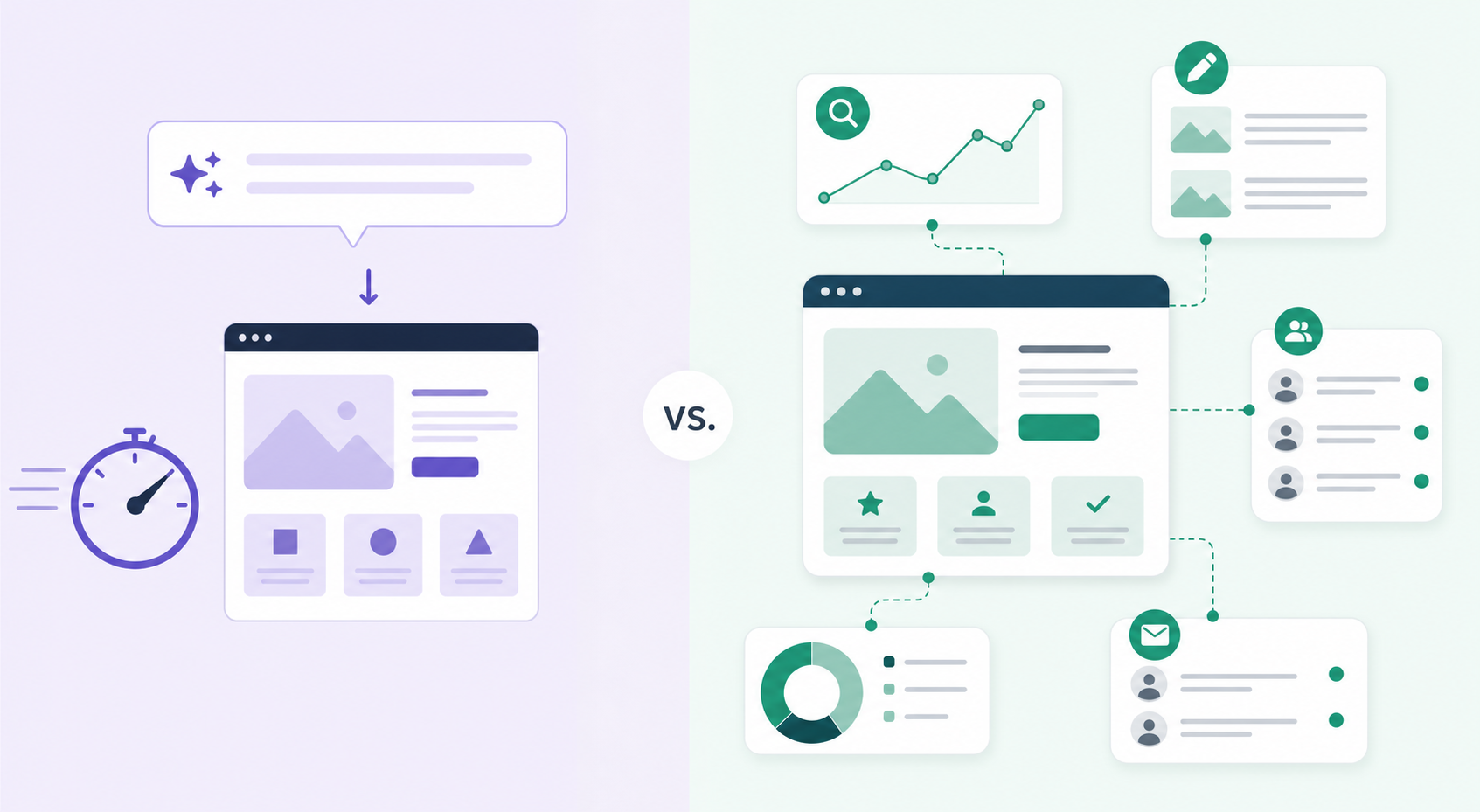
Some products sell: the speed of page generation.
Other products sell: the long-term value of the website as a business asset.
These two things sound the same but are vastly different.
What is Figma Make? What are its Strengths?
According to the official Figma page, Figma Make emphasizes these capabilities:
- Generate website layouts, structure, and interactions using natural language
- Design, generate, and edit simultaneously within Figma
- Supports responsive pages and interactive effects
- Can connect to real data or backends for testing
- Supports publishing, sharing links, and custom domains in some scenarios
Simply put, Figma Make solves the problem of:
Quickly turning "the web page idea in my head" into something visible, clickable, and editable.
This is particularly appealing to:
- Designers
- Product managers
- Teams building prototypes
- Entrepreneurs wanting to quickly test a page concept
- Teams already deeply using Figma
Its advantages are clear.
1. Fast to learn
You don't need to fully structure everything first.
Write a prompt, see a version, then iterate.
This process fits the workflow of many teams today.
2. Smooth design workflow
If a team already works within Figma, the Make experience is seamless.
It doesn't pull you into another unfamiliar tool but lets you continue working within your existing design environment.
3. Better for "Let's create it first"
Many early-stage projects aren't afraid of being rough; they're afraid of never having a first version.
A product like Figma Make is great for quickly overcoming "blank page anxiety."
4. More focused on "generation" and "iteration"
From the official Figma information, it repeatedly emphasizes:
- prompt generation
- prototyping
- visual editing
- interactions
- design context
- handoff / publish
So you'll notice that Figma Make's core value proposition is very clear:
It leans more toward web page generation, interactive prototyping, design collaboration, and rapid experimentation.
This positioning is valid and powerful.
But it does not equate to a "business customer acquisition website growth system."
This is the key point we'll discuss next.
What is We0 AI?
We0 AI is not simply a "one-prompt website generator."
Its more accurate positioning is an AI-powered website building and customer acquisition growth platform for showcase websites.
It doesn't just help you create a single page.
It cares more about this entire chain:
Build -> Showcase -> Grow -> Leads
Which means:
- Build the website
- Showcase products / services / case studies / portfolio
- Gain traffic from SEO / GEO / AI recommendations / content
- Generate leads and customers
This sentence is very important.
It means that We0 AI views a website not as a "whether the page is done" problem, but as:
Whether this website can become an entry point for business growth.

The Real Difference Isn't in the Generation Step
Many comparison articles focus on:
- Which generates faster
- Which has a cooler interface
- Which can "make a website with one prompt"
- Which has more templates
Honestly, these are not the core issues that businesses should care about most.
The real question a business should ask is:
After the website is built, can it continuously bring in traffic, inquiries, and customers?
If it can't, then that website is likely just a "completed" project, not a "running" asset.
This is the biggest dividing line between Figma Make and We0 AI.
A Quick Comparison: Figma Make vs We0 AI
| Dimension | Figma Make | We0 AI |
|---|---|---|
| Core Positioning | Prompt to generate web pages / interactive prototypes / design collaboration | Showcase website building + growth + customer acquisition |
| Strength | Fast page generation, interaction, prototyping, visual editing | Website launch, SEO/GEO, content growth, lead handling |
| Best Suited For | Designers, product teams, prototyping teams | Business owners, independent developers, consultants, agencies, foreign trade & service teams |
| Target Outcome | Quickly create a website or prototype version | Create a website that can be continuously operated and attract customers |
| Focus on SEO | Not a core focus | Is a core focus |
| Support for Content Growth | Not a primary selling point | A key component of long-term value |
| Focus on Lead Generation | Relatively weak | Very strong, designed around inquiries and customer acquisition |
| Suitable Scenarios | Landing pages, concept validation, quick interactive web pages | Official websites, service pages, case study pages, product pages, content sites, multilingual customer acquisition sites |
Why is Figma Make more about "Building Pages," while We0 AI is more about "Delivering Results"?
This judgment might be a bit sharp, but I believe it's very accurate.
Figma Make prioritizes solving the birth of a web page.
We0 AI prioritizes solving the operation of a website.
Both are important.
But if you are a business, you need customers, not just pages.
Of course, you need a website that looks good.
But what you really need is:
- This website can be found
- This website's content can be continuously expanded
- This website can capture user intent
This website can generate an inquiry entry point
- After the website goes live, someone continuously optimizes it
And these are precisely the areas that most prompt-generated website tools are not truly good at.
Why can’t companies just settle for “generating a website”?
Because a corporate website has never been a static operation.
It’s more like a sales front desk, a brand showcase, a search entry point, a content container, and a conversion landing page rolled into one.
Creating the website today is just the beginning.
What really sets businesses apart afterward is:
1. Whether content is continuously updated
Without content, long-tail keywords struggle to rank.
Without content, traffic beyond brand searches is basically nonexistent.
2. Whether there is a basic SEO structure
Titles, descriptions, internal links, page structure, semantic hierarchy, and page relationship logic all impact long-term organic traffic.
3. Whether there are inquiry and conversion paths
A corporate website isn’t meant for visitors to just glance at and leave.
Users need to know what to do next.
Booking, consulting, submitting a form, adding contact information, requesting a demo—these all need to be designed.
4. Whether there is data monitoring and continuous optimization
Which pages get the most visitors?
Which pages have a high bounce rate?
Which keywords generate leads?
Which CTAs have poor conversion rates?
Without tracking these, a website will struggle to become a true customer acquisition asset.
So, which one is better for corporate customer acquisition?
If I had to answer in one sentence:
Most companies that truly want to leverage their website for customer acquisition would be better off with We0 AI.
The reason isn’t that it’s better at “generating pages” than Figma Make.
It’s that the two tools have completely different end goals.
Figma Make’s end goal, in many cases, is:
To get the page built.
We0 AI’s end goal is:
To turn the website into a showcaseable, operable, growable, revenue-generating asset.
But that doesn’t mean Figma Make is bad
Let me be clear here.
Figma Make isn’t weak; it just solves a different set of problems.
If you fall into these categories, Figma Make is still a great choice:
- You are a design-driven team looking to quickly produce web layouts
- You’re working on an MVP and need to validate product pages first
- You frequently need to create interactive prototypes
- You already rely heavily on Figma
- You want a seamless flow from design → prototype → demo → web generation
But if you fall into these categories, We0 AI is a better fit:
- You want a corporate website that actually brings in customers
- You need service showcase pages, case study pages, product pages, and inquiry pages
- You value SEO and content accumulation
- You want multi-language display and overseas customer acquisition
- You don’t want the website to be neglected after launch

A more practical way to decide
Don’t ask “which tool is more advanced.”
Ask yourself:
Right now, are you missing a page, or are you missing a customer acquisition system?
If you’re missing a page, Figma Make is excellent.
If you’re missing customer acquisition, We0 AI is closer to what you need.
That’s the most practical judgment criterion.
Key conclusions
Figma Make is better at getting a webpage built quickly.
We0 AI is better at turning a showcase website into an asset for sustained growth and customer acquisition.
The former leans toward generation and prototyping; the latter leans toward launch, operations, SEO, content, and leads.
Ready to get started?
If you just want to experiment with prompt-based web page creation, Figma Make is worth trying.
But if you’re already seriously thinking about:
- How a corporate website supports business operations
- How to generate organic traffic
- How to keep publishing content consistently
- How to gradually optimize pages
- How to consistently generate inquiries through the website
Then what you need is often more than just an AI page builder.
You need a more complete website growth solution.
That’s why We0 AI deserves a place in discussions about enterprise customer acquisition.
Frequently Asked Questions
Can Figma Make generate a website directly?
Yes. According to Figma’s official page, Figma Make supports generating website layouts, structures, and interactions using natural language, and also supports responsive pages and publishing capabilities.
Is Figma Make suitable for long-term corporate website operations?
It can be used to create a website, but its core strengths lie more in generation, prototyping, interaction, and design collaboration. For long-term SEO, content growth, and lead generation, it wasn’t designed around those goals.
What is the biggest difference between We0 AI and ordinary AI website builders?
The biggest difference isn’t “generation speed” but the end goal. We0 AI places more emphasis on Build → Showcase → Grow → Leads, meaning the website’s ability to sustain growth and generate customer acquisition after launch.
What should an enterprise customer acquisition website focus on most?
Not which tool generates pages faster, but rather: Is it launch-ready? Is it SEO-friendly? Is it easy to add content? Does it have a clear conversion path? Does it support ongoing optimization?
Which teams building showcase websites are best suited for We0 AI?
SaaS / AI product teams, service-based enterprises, consultants, agencies, independent developers, foreign trade teams, creators, and expert-driven brands are all good fits.
Related Tools
References
- 《Figma Make: Create with AI-Powered Design Tools》
- 《AI Website Builder - Prompt to Website in Seconds | Figma》
- 《We0 SEO 文章生产 AI 工作流文档.md》
Related Reading / Internal Link Suggestions
- What is the difference between AI website builders and AI website acquisition platforms?
- Why can’t a corporate website stop at just being created?
- How should showcase websites approach SEO and content growth?
- How can a SaaS website evolve from a showcase page to an inquiry entry point?
Summary
To wrap it up with the same point:
Figma Make and We0 AI are not the same product philosophy.
One is better at quickly generating a “webpage.”
The other is better at turning a “website” into a business growth asset.
If you ask me which one is better for enterprise customer acquisition?
My answer is straightforward:
If a company genuinely cares about long-term SEO, content accumulation, inquiry conversion, and website growth, then We0 AI is the better fit.