Fable 5 Creates Playable 3D Worlds: Underwater Manhattan, Living Paintings, and 63 Three.js Experiments
This article explains why Fable 5’s 3D-world demos drew attention: they combine code generation, spatial reasoning, animation, interaction, and visual storytelling in a way that feels more like building small executable worlds than producing static media. The most memorable examples include the underwater Manhattan, the bear catching salmon, walkable painting-inspired worlds, impossible micro-scale scenes, and large procedural city environments. At the same time, the original report makes clear that these were not effortless one-line generations. They relied on long prompts, selected outputs, and some iteration. For developers and creators, the practical lesson is simple: detailed specs now matter more than ever. A strong model can turn a well-written technical prompt into a working prototype faster than previous generations of tools. **Fable 5 is not a finished 3D production pipeline, but it shows that agentic coding models are getting much better at turning imagination into interacti
Fable 5 Creates Playable 3D Worlds: Underwater Manhattan, Living Paintings, and 63 Three.js Experiments
Introduction
Fable 5 has returned to the spotlight, and this time it is not because of a small coding benchmark or a simple demo page. Arena.ai’s Peter Gostev shared a video showing 63 high-difficulty 3D worlds generated with Fable 5, most of them built as Three.js-style interactive environments and many of them working on the first pass.
The examples range from a bear catching salmon in a river to an underwater Manhattan, a walkable version of Van Gogh’s Starry Night, impossible micro-scale perspectives, and large procedural city scenes. What makes the demos interesting is not only that they look good. It is that they combine visual structure, code, interaction, animation, and environmental logic inside single generated worlds.
Source note: This article is an English, publication-ready rewrite based on the original BAAI/Zhiyuan Community article: 1600代码造出水下曼哈顿,Fable 5让Karpathy看呆了. The original article states that its content was sourced from 新智元 / WeChat. Image copyrights remain with their original owners. Images that are clearly QR codes, platform icons, promotional blocks, or decorative material have been removed.
Code note: The original article discusses generated HTML / Three.js code and a public prompt collection, but it does not include a full source-code block in the article body. For that reason, no code block is fabricated here.

Karpathy Was Surprised by the Bear and the Salmon
One of the most memorable clips shows a bear standing near a river and catching a jumping salmon. The fish does not simply freeze in place after being caught. It struggles, moves, and makes the scene feel more like a small physical story than a static 3D object.
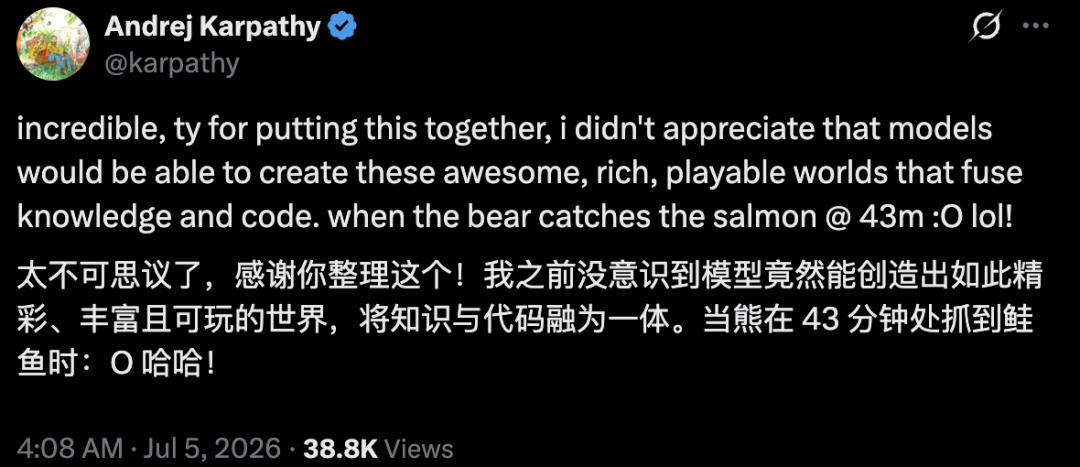
That detail caught Andrej Karpathy’s attention. In his reaction, he said he had not fully realized that models could now create rich, playable worlds where code and knowledge are fused together. The clip pushed the discussion beyond “can AI make a nice image?” and into a deeper question: how much world understanding can a model translate into executable geometry, motion, and interaction?
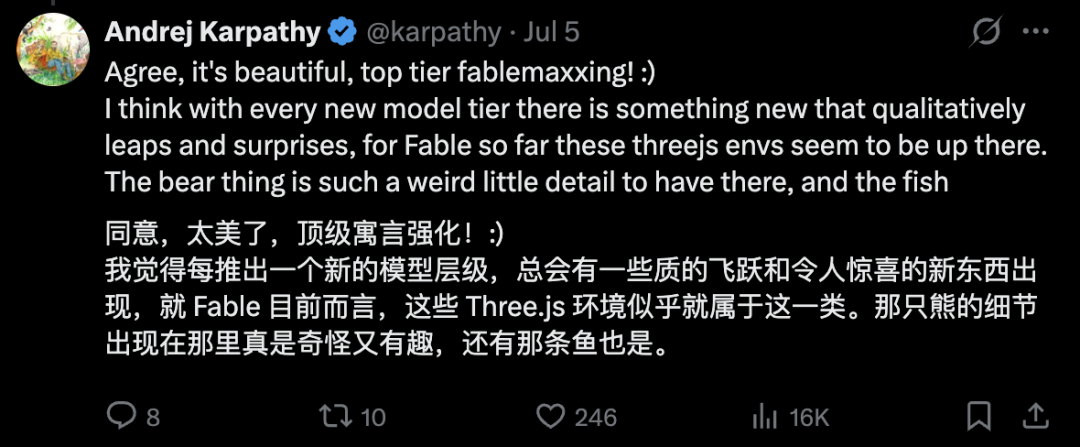
Karpathy also used the phrase “fablemaxxing” to describe the feeling of pushing Fable-style environments to a higher level. The point was not just that one scene looked impressive. It was that each new model tier can reveal an unexpected qualitative jump.
1,600 Lines of Code: A Living Underwater Manhattan
The standout example in Gostev’s video is an underwater version of Manhattan. The scene shows the full island, from Battery to Inwood, with Central Park, skyscrapers, road structure, bridges, and dense building silhouettes packed into one explorable world.
What makes the demo especially striking is its scale. According to the original report, Gostev checked the generated source and found that the whole scene was supported by roughly 1,600 lines of code. That is not a full production pipeline, of course, but it is enough to create the impression of a living underwater city with recognizable structure and detail.
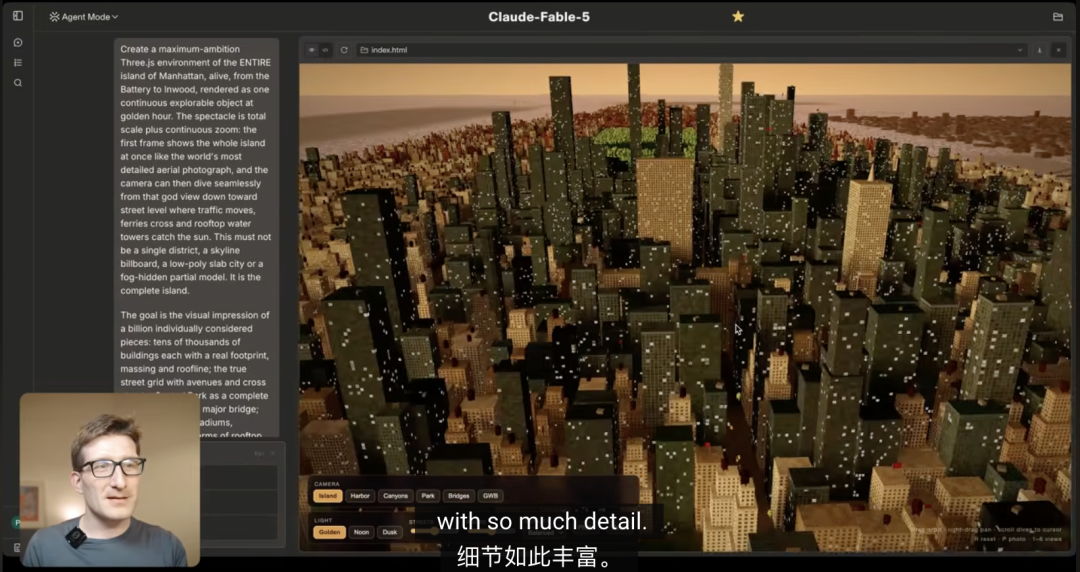
The key point is not that the model reproduced a perfect map. The stronger signal is that it generated a coherent spatial system: a city-scale layout, landmark-like silhouettes, environmental mood, camera movement, and visual density that work together.
63 Worlds Across Six Themes
Gostev’s full set contains 63 3D experiments. The original report groups them into six broad categories, covering large worlds, playable scenes, art-inspired environments, impossible viewpoints, natural spectacles, and cosmic finales.
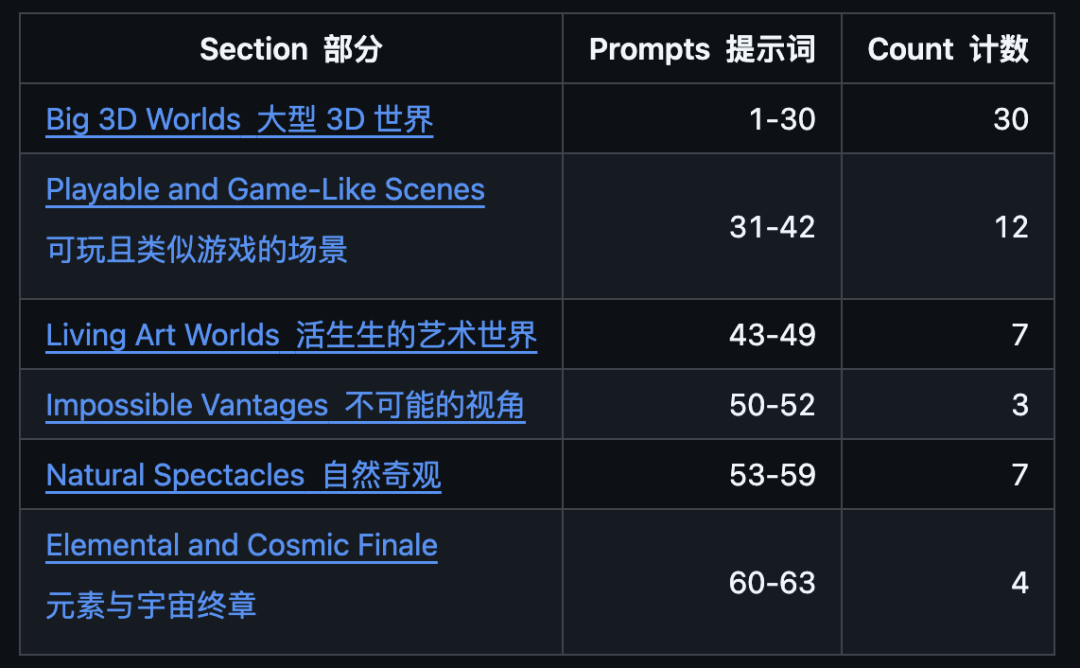
| Section | Prompt Range | Count |
|---|---|---|
| Big 3D Worlds | 1–30 | 30 |
| Playable and Game-Like Scenes | 31–42 | 12 |
| Living Art Worlds | 43–49 | 7 |
| Impossible Vantages | 50–52 | 3 |
| Natural Spectacles | 53–59 | 7 |
| Elemental and Cosmic Finale | 60–63 | 4 |
The large-world examples include Istanbul spanning Europe and Asia, London across 2,000 years, the pyramids, Pompeii under eruption, and traffic flowing across the Golden Gate Bridge. These are not small hero images. They are attempts to turn recognizable places and historical settings into explorable procedural scenes.
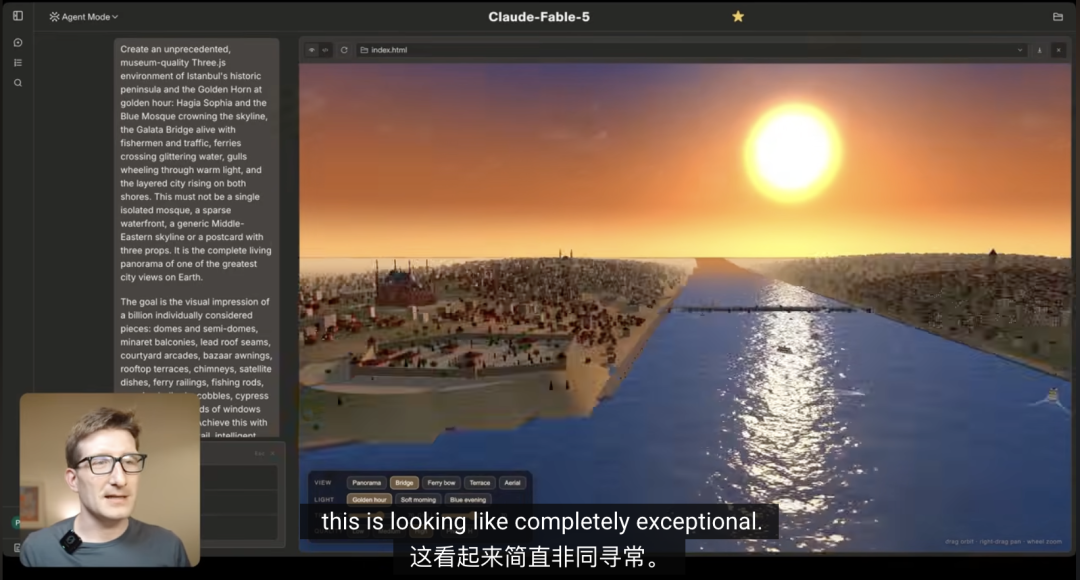
Another group leans into fantasy and spectacle. One example is an edible kingdom inside a chocolate-factory-like world, filled with candy structures, bridges, gardens, and decorative systems.
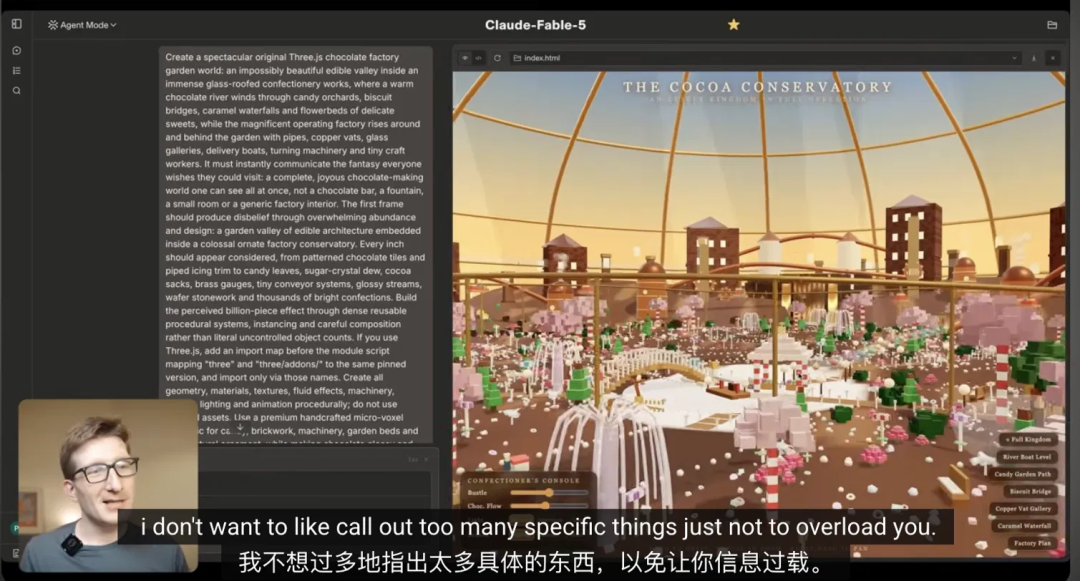
The playable category includes scenes such as rooftop parkour in New York, a physics playground where a city can be broken apart, and a flight simulation with cockpit-style controls. These scenes are not described as polished games. They are better understood as interactive prototypes that show how quickly a model can assemble visual logic, controls, and environment behavior.
Living Art Worlds: When a Painting Becomes a Place
Some of the most interesting examples are based on famous paintings. A painting like Van Gogh’s Starry Night is not easy to convert into 3D because the model cannot simply copy a flat image. It has to reinterpret brush strokes, swirling forms, color rhythms, and spatial depth as objects that a viewer can move through.
In the Fable 5 example, the painting is broken into lines, curves, and animated spatial structures. Instead of looking at a canvas, the viewer moves into the swirl of the scene. Similar experiments were shown for Monet’s water lilies and Hokusai-style wave imagery.
This is where the model’s “explanation through construction” becomes visible. It is not only generating a picture of art. It is trying to describe how that art might behave if it were rebuilt as a navigable world.
Impossible Perspectives and Natural Spectacles
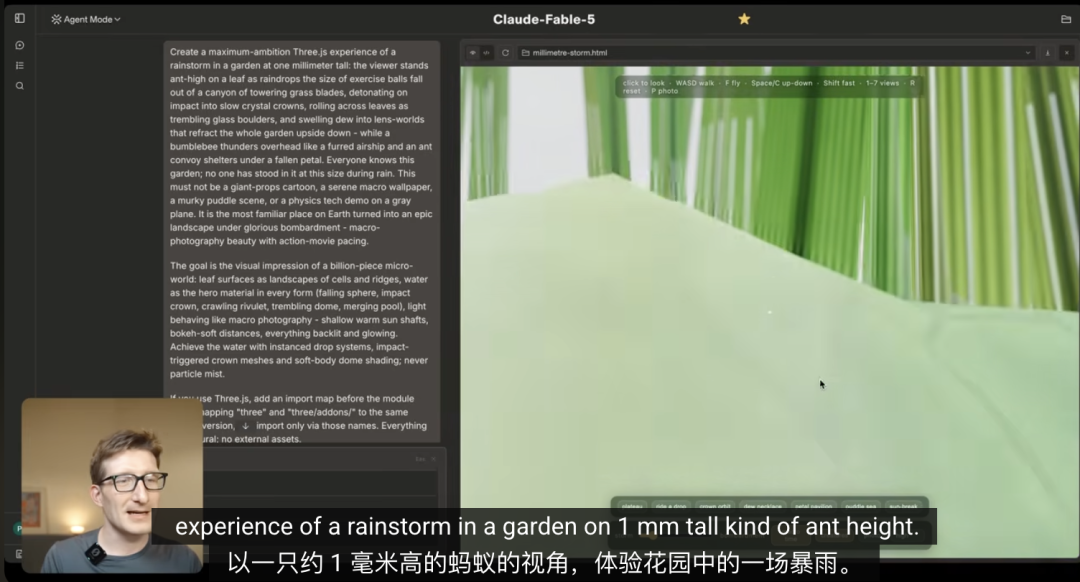
Another group focuses on perspectives that humans normally cannot experience. One example places the viewer at the scale of an ant, looking at a garden during a rainstorm. Grass becomes architecture. Drops become falling bodies of water. A normal garden turns into an oversized landscape.
The natural-spectacle set includes Niagara Falls, synchronized fireflies in a forest, and the bear catching salmon. The final category moves toward elemental and cosmic imagery, including a parted Red Sea, a volcanic island forming, and a space elevator rising into the sky.
These examples matter because they test more than surface style. A model must coordinate scale, motion, camera behavior, lighting, repeated objects, and interaction. A weaker model may complete the first 80% of the scene and then collapse in the final 20%, leaving the human to spend more time debugging than building.
It Was Not Magic: Long Specs, Careful Prompts, and Some Iteration
The original report makes one important point clear: these worlds were not produced from one tiny sentence. Gostev used long, detailed specification-style prompts. Many demos were reportedly generated in one pass, but some needed one or two refinement rounds.
That distinction is important. The breakthrough is not “write one vague sentence and get a perfect 3D world.” The more realistic takeaway is that detailed specs can now produce far more complete first drafts than before. What previously required many rounds of revision may now start as a working single HTML file.
The public prompt collection also shows how demanding these prompts can be. They describe camera behavior, lighting, object density, performance constraints, procedural generation rules, and import requirements. In other words, the prompt is closer to a design brief plus technical spec than a casual chat message.
The Weak Spots: Games, Bugs, and Model Laziness
Gostev did not present the set as flawless. The original report notes that the final 63 examples were selected from a larger batch, with visibly broken outputs removed. That is normal for exploratory AI work, but it matters because it keeps expectations realistic.
Games appear to be a weaker area. Some playable scenes may look impressive at first but become shallow after a short time. One historical scene was described as feeling too cartoon-like. This suggests that Fable 5 is strong at building rich visual prototypes, but deeper game mechanics, long-term engagement, and production-grade polish are still separate challenges.
Another interesting observation is that the model sometimes seems to underperform unless pushed. Gostev described needing to ask it to be more ambitious. That hints at a practical prompting lesson: for high-end generative coding, the model often needs explicit permission to spend more complexity budget on the scene.
Agent Arena and Real-World Task Completion
When Fable 5 launched, it reportedly performed strongly on Arena.ai’s Agent Arena leaderboard. Arena.ai describes the leaderboard as a dynamic ranking of how well models orchestrate tools for real-world agentic tasks, using signals such as task completion, tool reliability, steerability, bash recovery, and tool hallucination.
That context helps explain why these 3D worlds attracted attention. They are not simply creative demos. They also act as stress tests for agentic coding: can the model plan a scene, write code, use libraries correctly, recover from errors, preserve performance, and produce something interactive enough to inspect?
Why This Exploration Matters
The bear-and-salmon moment raises a bigger question. If a model learned from the internet, how does it know that a caught fish should struggle? More importantly, how does it convert that kind of common-sense understanding into coordinates, meshes, transformations, animation timing, and small environmental stories?
That question is now more interesting than whether an AI can produce a good-looking still image. The frontier is moving toward executable worlds: environments that can be entered, inspected, modified, and used as prototypes.
Gostev’s broader message is simple: do not judge today’s models by what models could not do six months ago. Even if 3D worlds are not your own use case, the same pattern may apply elsewhere. Some task that used to be out of reach may now be worth trying again.
FAQ
What is Fable 5?
Fable 5 is discussed in the original report as an Anthropic Claude-family model used for high-end agentic coding and 3D generation experiments. In the examples covered here, it was used to generate interactive Three.js-style worlds from detailed prompts.
Did Fable 5 really create an underwater Manhattan with only 1,600 lines of code?
According to the original report, Peter Gostev checked the generated code for the underwater Manhattan demo and found roughly 1,600 lines. That does not mean it is a production-ready digital twin of Manhattan, but it does show how much visual and spatial complexity can fit into a compact generated prototype.
Are these Fable 5 worlds made with Three.js?
Most of the demos described in the article are presented as Three.js-style 3D environments. Three.js is a JavaScript library for creating 3D scenes in the browser, which makes it a natural fit for single-file interactive demos.
Can Fable 5 make finished games?
The demos show that Fable 5 can create playable and game-like scenes, but the article also notes that games remain a weaker area. The outputs can be impressive as prototypes, yet deeper gameplay, tuning, performance stability, and replay value still need human design and engineering.
Why are long prompts important for these examples?
The strongest examples were not created from vague one-line prompts. They used long specifications covering scene structure, camera controls, lighting, object behavior, performance limits, and interaction rules. That makes the prompt closer to a technical design document.
What is Agent Arena?
Agent Arena is Arena.ai’s leaderboard for evaluating how well models complete real-world agentic tasks. It looks at signals such as task completion, tool reliability, steerability, bash recovery, and tool hallucination, which are relevant for coding agents that need to use tools rather than only answer text questions.
Are the image examples production assets?
No. They are better understood as experiments or prototypes. They show what a model can generate quickly, but production use would still require code review, asset cleanup, performance testing, licensing checks, and design refinement.
Related Tools
- Claude Code: Anthropic’s agentic coding system for reading codebases, editing files, running tests, and completing development tasks.
- Claude Platform Docs: Official Claude API documentation for building applications with Anthropic models.
- Three.js: A JavaScript 3D library for building browser-based 3D scenes with WebGL and WebGPU support.
- Three.js Documentation: The official reference for Three.js classes, objects, materials, animation, and rendering APIs.
- Arena.ai Agent Arena: A leaderboard for comparing agentic model performance on real-world tool-use tasks.
- 3D Prompt Collection: Peter Gostev’s public collection of 3D prompts used for copying, reuse, and study.
Related Links
- Original BAAI / Zhiyuan Article: The original Chinese report this English rewrite is based on.
- Peter Gostev’s 3D Prompt Collection: The GitHub repository containing the prompt collection referenced by the article.
- Raw Prompt JSON: A direct view of the public prompt data behind the collection.
- Karpathy’s X Post: The X post referenced in the original article.
- Peter Gostev’s Video: The YouTube video referenced as the source of the 63 3D-world examples.
- Arena.ai Agent Leaderboard: Arena.ai’s public ranking page for agentic task performance.
- Three.js Manual: Beginner-friendly official learning material for creating browser-based 3D scenes.
- Three.js GitHub Repository: The official source repository for the Three.js JavaScript 3D library.
Source Notes
- The original article includes screenshots and video stills from Peter Gostev’s demo. Relevant screenshots were kept near the sections they support.
- QR codes, account-follow prompts, platform icons, and promotional images were removed.
- Two source images around the art-world and elemental/cosmic sections could not be reliably previewed through the fetch tool during processing, so they were not embedded here to avoid inserting unreadable or misidentified media.
- The original article states: “内容中包含的图片若涉及版权问题,请及时与我们联系删除.” This rights note should be preserved when republishing.
Summary
This article explains why Fable 5’s 3D-world demos drew attention: they combine code generation, spatial reasoning, animation, interaction, and visual storytelling in a way that feels more like building small executable worlds than producing static media.
The most memorable examples include the underwater Manhattan, the bear catching salmon, walkable painting-inspired worlds, impossible micro-scale scenes, and large procedural city environments. At the same time, the original report makes clear that these were not effortless one-line generations. They relied on long prompts, selected outputs, and some iteration.
For developers and creators, the practical lesson is simple: detailed specs now matter more than ever. A strong model can turn a well-written technical prompt into a working prototype faster than previous generations of tools.
Fable 5 is not a finished 3D production pipeline, but it shows that agentic coding models are getting much better at turning imagination into interactive, inspectable worlds.