Enterprise AI Gateway Guide: How to Control LLM Cost, API Keys, Routing, and Audit Trails
A practical guide to enterprise AI gateways, model governance, token cost control, API key lifecycle management, multi-model routing, quota enforcement, audit trails, and MAI Gateway-style AI infrastructure. This article explains why companies need a unified LLM gateway before large-scale AI Agent adoption, and how gateway governance connects AI usage, security, finance, and business value.
In the AI Agent era, the most dangerous enterprise problem is often not “not using AI.” It is using AI without governance.
Once support, engineering, operations, sales, and content teams all start calling large models, API usage grows quickly. What starts as a small experiment can become recurring token spend, scattered API keys, invisible model calls, and security incidents with no clear owner.
That is why enterprise AI gateways matter. They are not just API forwarding tools. They are the control plane for enterprise AI usage: permissions, budgets, routing, audit trails, security, and cost allocation in one entry point.
Original article image: fragmented compute, cost black holes, and missing AI governance
Why enterprises need an AI gateway instead of direct model API access
Direct model API access is convenient during PoC. In production, the questions become harder: who called the model, which model was used, how much did it cost, did the prompt contain sensitive data, did an API key leak, and were expensive models used for simple tasks? Without one gateway, these questions are hard to answer.
Issue | Direct model API access | Enterprise AI gateway |
Model access | Each team connects separately | One API entry point for multiple models |
Cost control | Bills are fragmented and hard to attribute | Cost allocation by department, project, user, and key |
Security | Keys are easy to hard-code, leak, and forget | Key lifecycle, rotation, permissions, and audit control |
Availability | A single model outage can break the workflow | Routing, fallback, backup providers, and graceful degradation |
Compliance | Logs are incomplete and responsibility is unclear | Trace-ID, content audit, alerting, and accountability |
MAI Gateway: treating tokens as a managed enterprise asset
The original article uses MAI Gateway to explain a broader point: companies should not treat token usage as an invisible background expense. Tokens should be budgeted, allocated, audited, and optimized like a real enterprise digital asset.
The goal of this kind of AI gateway is not to stop employees from using AI. It is to make AI usage controllable. The company should use stronger models when needed, block waste when it is unnecessary, trace responsibility when incidents happen, and connect AI spend with business value.
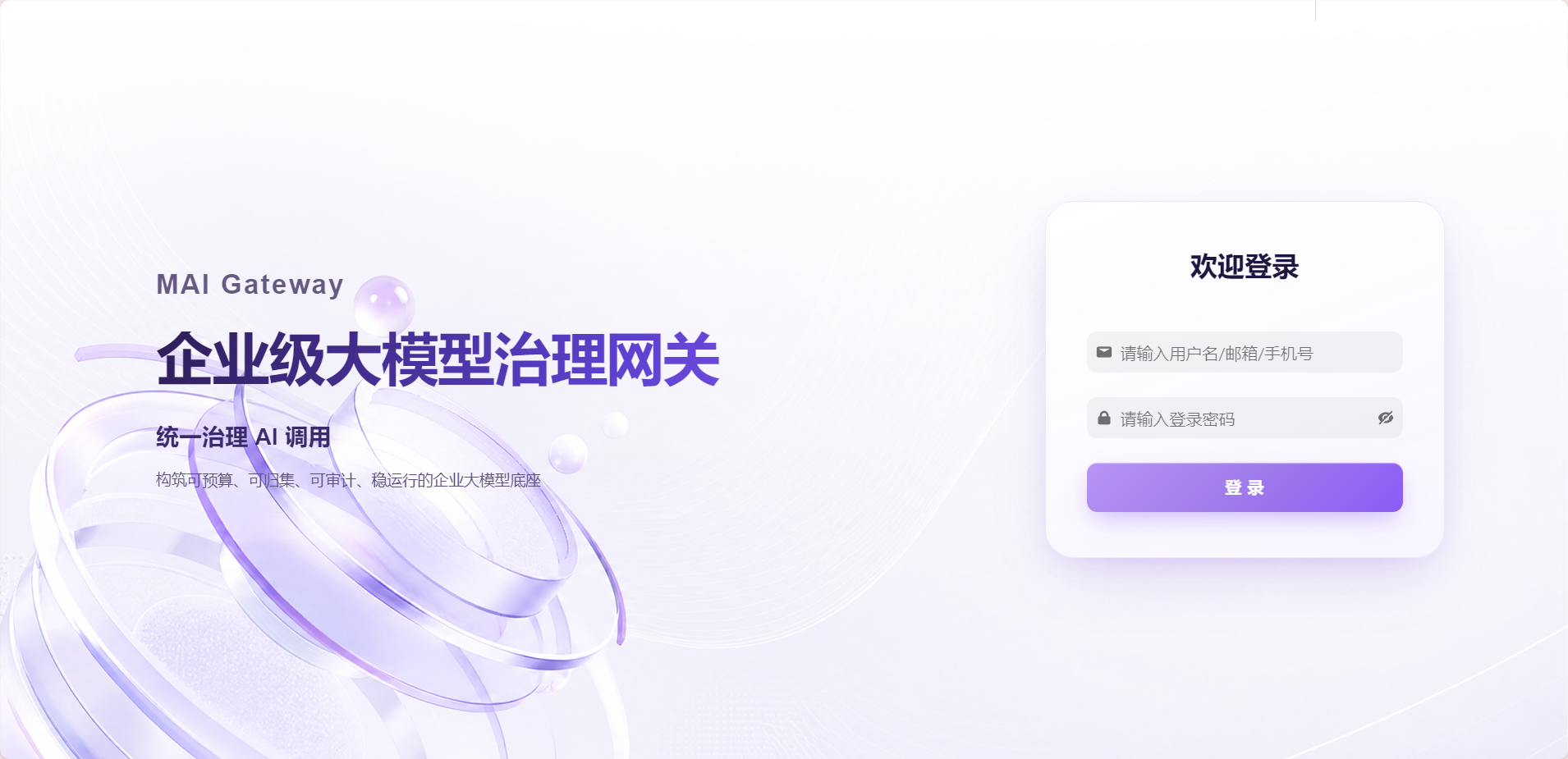
Original article image: MAI Gateway enterprise model governance login interface
Five governance principles: cost, permission, routing, audit, and ROI
Principle | Meaning | Implementation |
Unified gateway + smart routing | All AI traffic enters one managed entry point | Route simple tasks to cheaper models and complex tasks to stronger models |
Caching + prompt compression | Reduce repeated answers and unnecessary context | Semantic cache, context trimming, prompt templates |
Quota + circuit breaker | Control cost before the month-end bill arrives | User, project, and department budgets with threshold alerts |
Scenario fit + ROI | AI spend must connect to business outcomes | Usage and conversion reports by business line |
Cost allocation + audit | Every AI call should have an owner and purpose | Trace-ID, logs, dashboards, anomaly detection |
Architecture: application layer, governance layer, model access layer
A mature enterprise AI gateway usually has three layers. The top layer is the business application layer: agents, customer support, coding assistants, content tools, and office endpoints. The middle layer is the governance layer: authentication, quota, budget, routing, audit, masking, caching, and monitoring. The bottom layer connects public model providers, overseas models, private models, and internal GPU clusters.
The key idea is a unified outbound path. Business systems should not expose keys or couple themselves to every model provider. They call the gateway, and the gateway handles governance. This reduces migration cost and lowers the risk of key leakage and vendor lock-in.
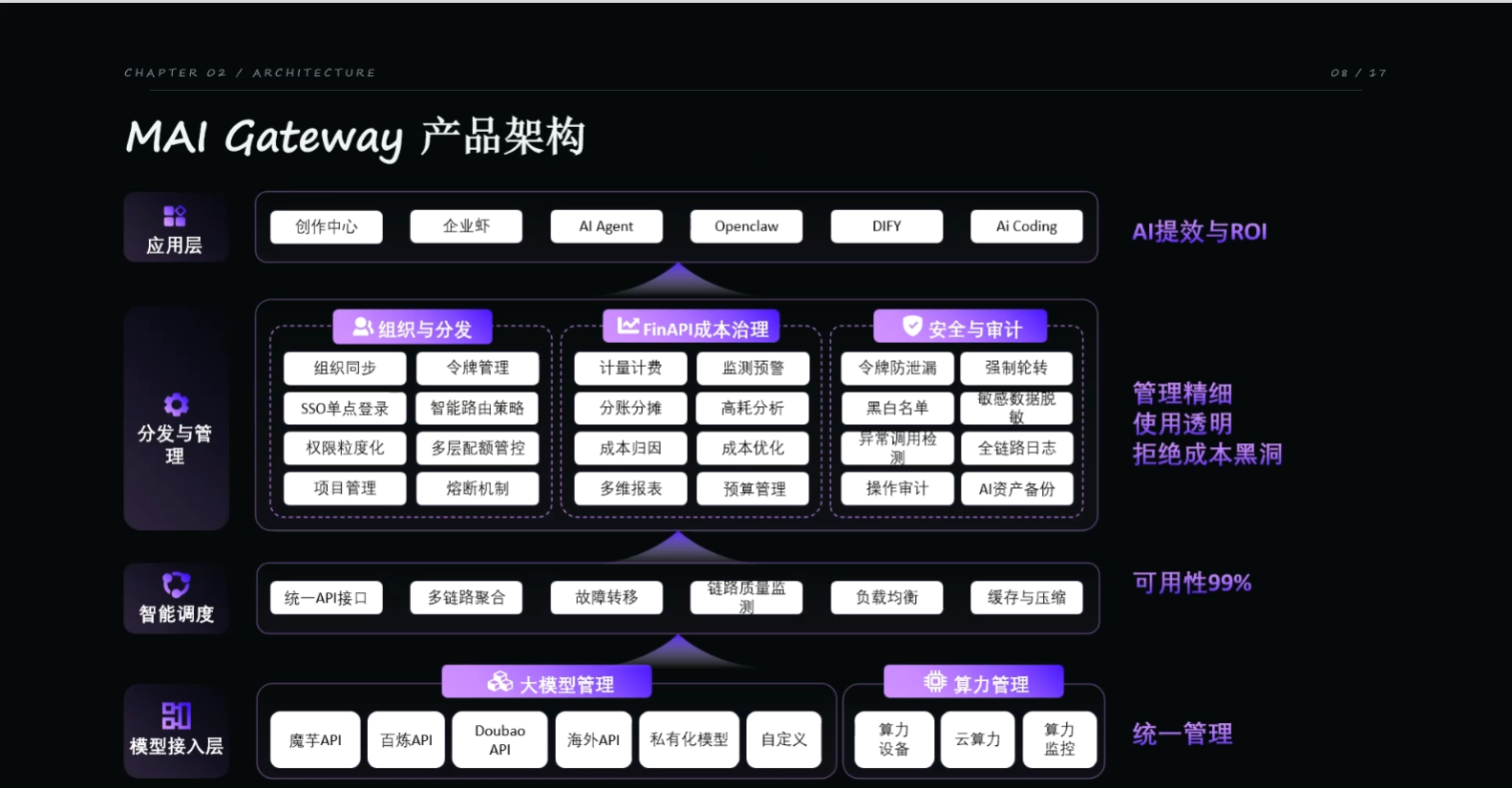
Original article image: MAI Gateway product architecture and layered capabilities
Six capabilities: from multi-model access to audit trails
• Multi-model unified access: Connect OpenAI, Anthropic, Gemini, domestic models, and private models through one managed interface.
• Unified GPU resource governance: Monitor internal GPU clusters, cloud GPUs, and private model services in one control plane.
• Smart routing and failover: Route dynamically by cost, latency, availability, model capability, and business priority.
• API key lifecycle management: Create, bind, rate-limit, rotate, disable, and revoke keys through process control.
• FinAPI-style cost governance: Allocate token cost by organization, department, project, user, and business scenario.
• Monitoring, audit, and data safety: Use Trace-ID, logs, alerts, masking, and content retention to make AI usage reviewable.
Product forms: software subscription and gateway appliance
The original article describes two product forms: software subscription and hardware appliance. A lightweight team may only need API aggregation, routing, and cost governance. A highly regulated organization or a high-frequency AI team may need an appliance that combines local compute and gateway governance.
Original article image: MAI AI gateway appliance and G/S series positioning
Form | Best fit | Core value |
Software subscription | Teams using multiple model APIs without necessarily self-hosting compute | Fast deployment of one entry point, budget control, and audit |
G series gateway appliance | Small and mid-sized teams with lightweight governance needs | Govern external model calls without local GPUs |
S series compute + gateway appliance | Government, finance, R&D, or high-security teams | Local GPU, private model, and gateway governance in one box |
A model marketplace is only useful when it can be governed
Many companies are attracted by the number of supported models. But the real challenge comes later. The more models a company adopts, the more it needs unified permissions, cost reporting, routing rules, and reliability monitoring. Otherwise, multi-model access creates more chaos instead of reducing risk.
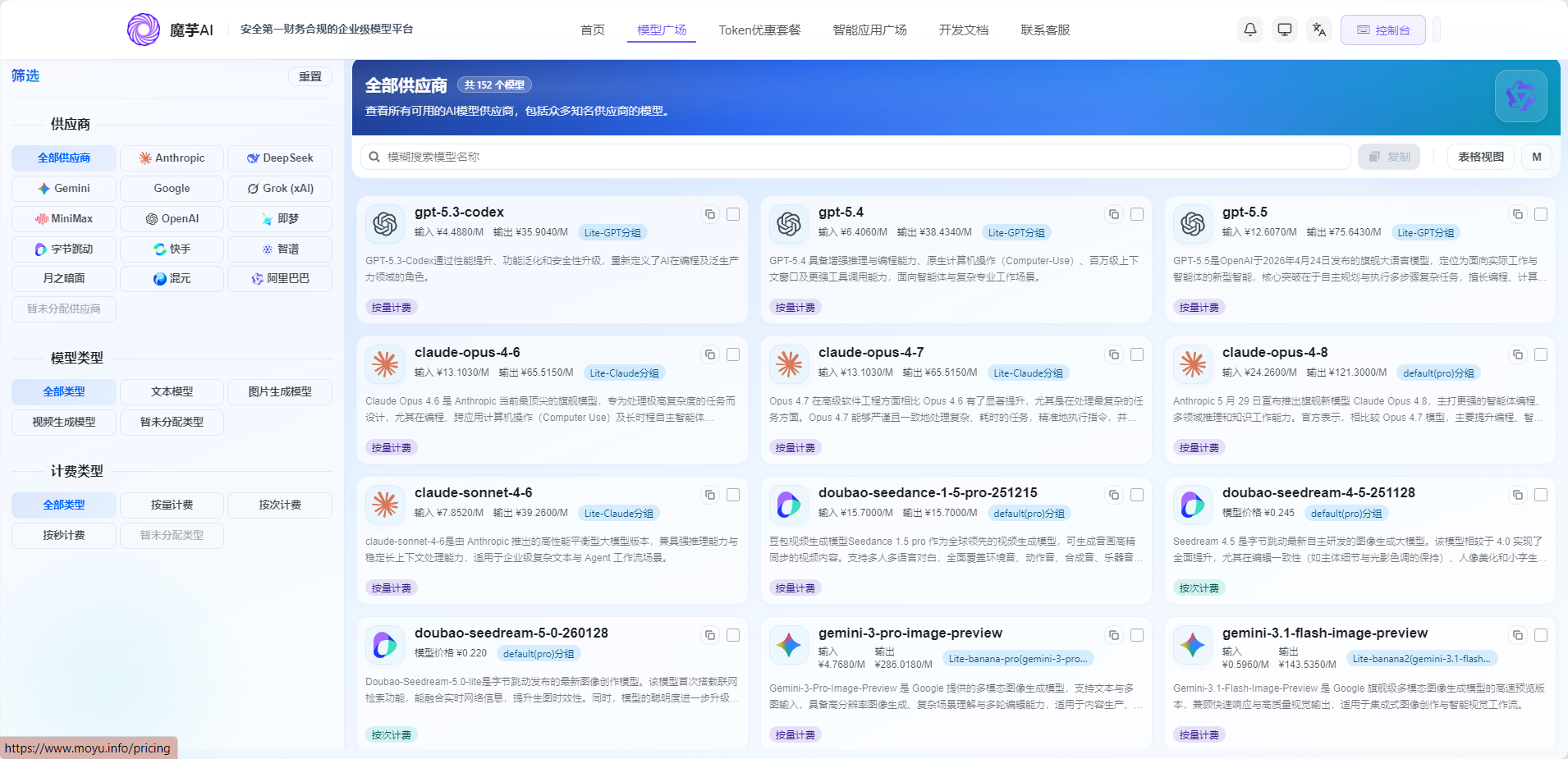
Original article image: model marketplace and multi-provider model access
AI gateway buying checklist: 8 questions to ask first
Question | Why it matters |
Can it manage multiple model providers? | Avoids locking business code to one vendor |
Can it allocate cost by department, project, and user? | Makes AI ROI measurable |
Does it support hard quotas and circuit breakers? | Email warnings alone do not control spend |
Does it manage API key lifecycle? | Prevents code leaks, stale keys, and unauthorized access |
Does it support fallback routing? | Production apps should not fail because one provider is down |
Does it support sensitive data masking? | AI prompts often include customer, contract, order, or internal data |
Does it keep complete audit logs? | Incidents require user, key, request, response, and timeline visibility |
Can it integrate with existing systems? | SSO, finance, alerting, and DevOps workflows matter |
What this means for We0.ai: stronger AI products need clearer trust pages
For We0.ai as an AI Showcase Website Growth Platform, the rise of AI gateways also has a marketing lesson. Enterprise AI products should not only show what they can generate. They must also show how they handle governance, auditability, cost control, security, integration, and compliance.
A strong enterprise AI website should explain the architecture, permission system, cost controls, use cases, FAQs, integration path, and contact flow. That is the Build → Showcase → Grow → Leads path: build the site, showcase trust, gain search and AI visibility, and convert enterprise buyers into leads.
An AI gateway governs internal AI usage. We0.ai helps turn the external product story, case studies, SEO/GEO content, and lead capture flow into a visible growth asset. Both point to the same trend: AI must become a sustainable business system, not a disconnected experiment.
Final takeaway
Once enterprise AI adoption reaches production scale, simply connecting to models is no longer a competitive advantage. The real advantage is managing models, compute, keys, budgets, audits, and business outcomes in one governable system.
An AI gateway does not ask companies to use less AI. It lets them use AI at greater scale with more confidence. Without a gateway, AI calls become a cost black hole. With a gateway, tokens can become managed production assets.
FAQ
What is an enterprise AI gateway?
It is a unified control layer between business applications and model providers, handling authentication, routing, quota, cost reporting, security, logging, and audit trails.
Why not let every team call model APIs directly?
Direct access is convenient in testing, but in production it creates key leakage, runaway cost, fragmented providers, unclear ownership, and missing audit records.
How is an AI gateway different from a normal API gateway?
A normal API gateway focuses on traffic and access control. An AI gateway also needs to handle tokens, prompts, model routing, cost allocation, content audit, and multi-provider governance.
Who needs MAI Gateway-style governance?
Organizations with multiple teams, models, projects, or AI scenarios that already care about budget, security, auditability, and private deployment.
Can an AI gateway reduce cost directly?
It does not make models free, but it can reduce waste through routing, caching, compression, quota control, and cost attribution.
How does this relate to We0.ai?
AI gateways govern internal AI calls. We0.ai helps enterprise AI products turn architecture, trust, use cases, SEO/GEO content, and lead capture into a showcase website growth workflow.
Related Tools
• We0.ai
Sources
• ChinaDaily: MAI Gateway and FinAPI