OpenAI Says Enterprise AI Is Moving from 'Asking' to 'Doing' — Should We0.ai's Website Also Shift from 'Giving Answers' to 'Helping Customers Complete the Next Step'?
OpenAI says enterprise AI is moving from Q&A to execution. So shouldn't We0.ai's website also evolve from 'giving answers' to 'helping customers take the next step'? This article explores how a showcase website can transform from an information page into an asset for growth and customer acquisition.
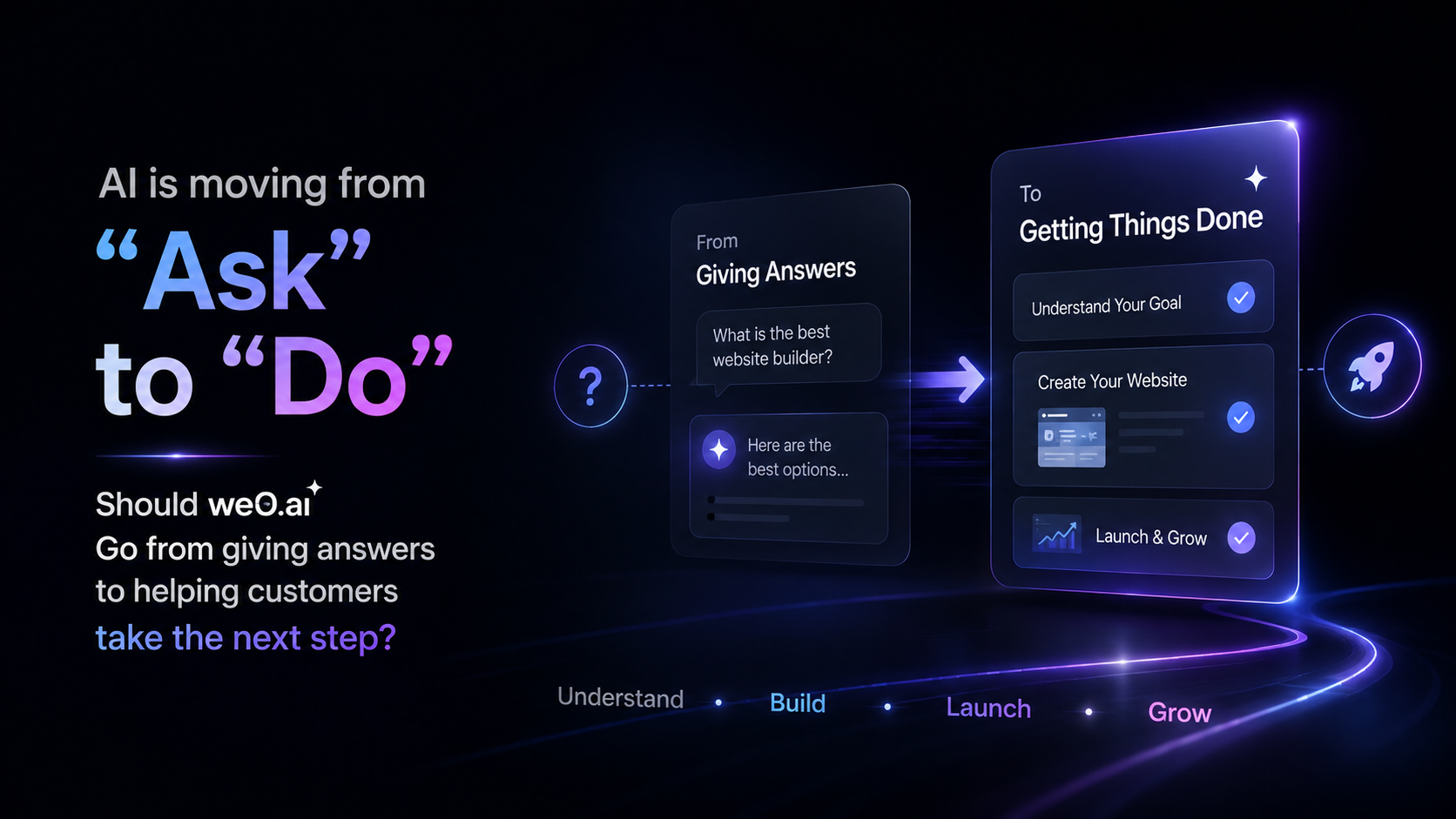
OpenAI says enterprise AI is moving from "asking" to "doing" — shouldn't the We0.ai website also shift from "giving answers" to "helping customers take the next step"?
Judgments like OpenAI's are actually quite straightforward: the value of enterprise AI is shifting from "answering questions" to "moving things forward for you."
That statement doesn't sound new, but it really will change how many websites are built.
Because most websites today are still stuck in an old logic:
- You come, I introduce myself
- You ask, I give answers
- You understand, then you reach out on your own
The problem is, users are more pressed for time now.
They don't just want to "learn more."
They want to know right away: Where do I click next? What do I fill in? How do I get started?
So the real question today isn't "does the website have AI?" — it's:
Can the website actually help the customer move one step forward?
This matters especially for a product like We0.ai.
Because We0.ai shouldn't be understood as just an ordinary AI website builder. It's better seen as a showcase website growth platform:
- First, get the site built
- Then, present the brand, products, and services clearly
- Then, connect SEO / GEO / content / traffic
- Finally, capture leads, inquiries, and customers
In other words, We0.ai's value shouldn't just be "generating pages" — it should be helping users turn their website into an asset that continuously advances their business.
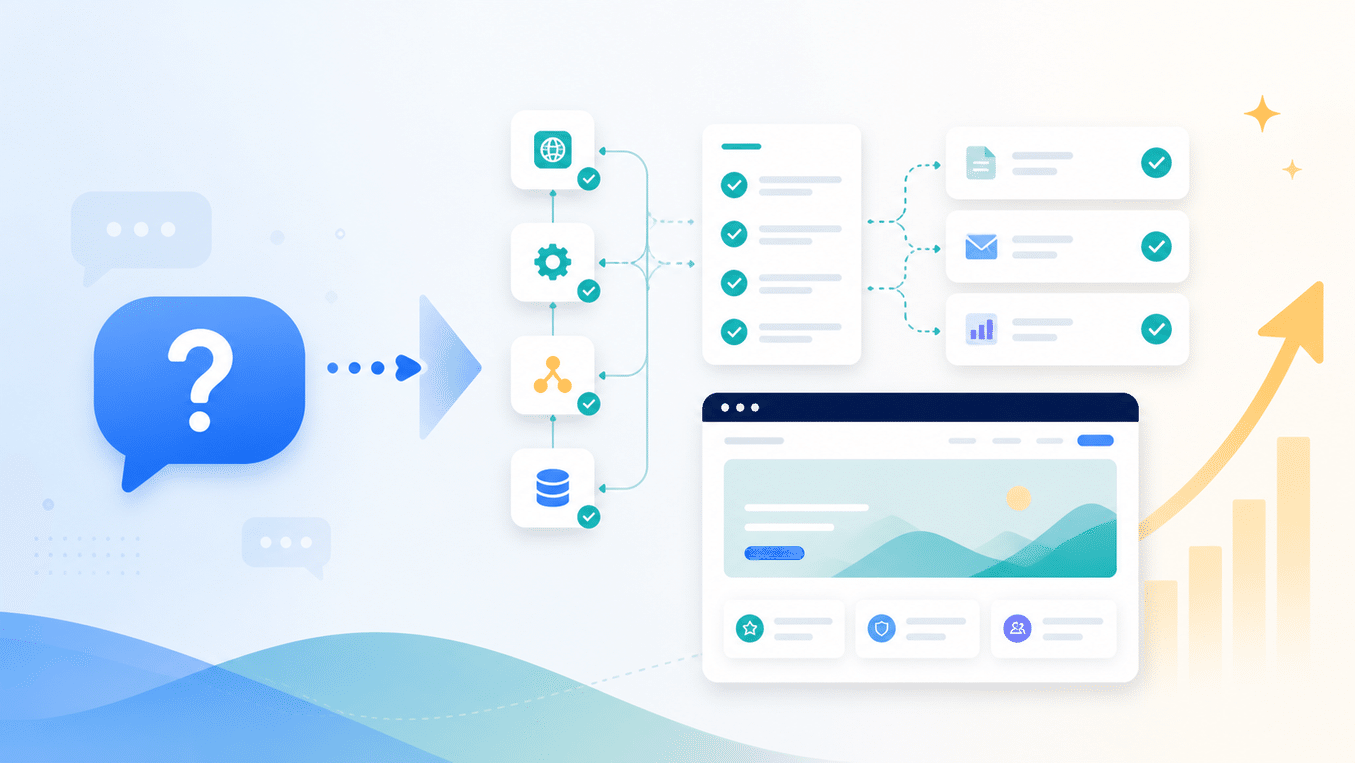
1. "Answer-giving" websites are no longer enough
Many websites used to be built on a simple logic:
| Old website logic | User experience |
|---|---|
| Who I am | Fine, but not enough |
| What I do | Got it, so what? |
| Why choose me | Sounds good, but still far from action |
| Contact us | The last step — by then, most people have already dropped off |
This logic isn't wrong — it's just too slow.
Because many of today's visitors aren't there to "research the company's history."
They're there to get a result.
They might be:
- Trying to build a product website
- Trying to create a service page
- Trying to make an inquiry page
- Trying to make a waitlist page
- Trying to build a content site to start getting search traffic
If you just lay out information, users will browse and leave.
But if you can help them complete the next step, they'll stay.
That's the difference.
"Giving answers" is static.
"Helping customers take the next step" is dynamic.
2. What a website should really do isn't explain — it's move things forward
I increasingly believe websites need to advance through at least three levels:
| Level | What the website does | Result |
|---|---|---|
| Level 1 | Explains who I am | Users only understand |
| Level 2 | Helps you judge whether I fit you | Starts building trust |
| Level 3 | Directly tells you what to do next | Starts generating conversions |
Many websites are stuck at Level 1.
They look content-rich, but nothing actually moves forward.
A truly useful website should aim to do these things:
- Let users quickly confirm whether they're the right fit
- Let users immediately see the next-step entry point
- Make users think less, click less, hesitate less
- Let users complete an action right on the page
That action could be:
- Booking a demo
- Leaving contact information
- Downloading materials
- Starting a trial
- Viewing case studies
- Generating a page directly
- Entering a consultation flow directly
You'll find that the strongest websites aren't the ones with the most information — they're the ones with the clearest path.
3. We0.ai is better suited for "growth websites," not just a one-page generator
If you understand We0.ai as just "type a sentence, generate a webpage," that's way too shallow.
Because what it should really be seen as is:
Build -> Showcase -> Grow -> Leads
That is:
- Build first
- Showcase next
- Then grow
- Then capture leads
This order matters a lot.
It says one thing:
The website isn't the end point of delivery — it's the starting point of growth.
That's also why We0.ai's own website can't just answer "what we are."
It should answer:
- Now that you're here, how do you get started next?
- After your site is built, how do you keep getting traffic?
- Once your page is live, how do you keep optimizing?
- How does your content become a search asset?
- How does your showcase page become a lead-generation page?
That's what We0.ai should be communicating most.
4. A better website should be like a "front desk + operations desk" combined
I really like thinking of this change as:
The old website was like a front desk.
The new website should be a front desk and operations desk combined.
The front desk handles people seeing you.
The operations desk handles getting things done.
In the We0.ai context, it might look something like this:
| Traditional website | We0.ai-style website |
|---|---|
| Introduces the product | Helps you start quickly |
| Lists features | Gives you your next action |
| Shows case studies | Helps you match your scenario |
| Leaves a form | Takes you into an execution flow |
| Relies on people to understand | Relies on process to move forward |
That's the difference.
It's not that the page is flashier — it's that the path is smoother.
5. Why is this also related to SEO / GEO?
Because search traffic is changing too.
Previously, users searched for "what is."
Now users more often search for:
- How to do it
- How to get started
- Is there an existing solution
- Which tool fits me better
- How to get the result done
This means if a website can only "explain," it will struggle to capture search intent.
And if We0.ai can turn its website into a "next-step executor," it won't just capture brand keywords — it can also capture more long-tail and scenario-based keywords.
For example:
- How to build an AI website
- How to build a showcase website
- How to improve conversion on a product website
- How to turn a website from showcasing to lead generation
- How to do SEO after building with AI
Behind these keywords, users aren't looking for concepts — they're looking for paths.
So, SEO isn't just about stuffing keywords into a page. SEO is also about writing the next step clearly.
6. How could the We0.ai website be changed?
If we really follow the logic of "from giving answers to helping customers take the next step," I'd suggest the website at least do these things:
6.1 The first screen on the homepage shouldn't just say "who we are"
Say it directly:
- Who you help
- What you help them accomplish
- How to get started next
Don't make users guess.
6.2 Every page should have a clear action
Don't let users finish reading and only find a "contact us."
Make it more specific:
- View case studies
- View the process
- Book a consultation
- Get a solution
- Start generating
- Get optimization suggestions
6.3 Put "ongoing growth" into the website
This is critical.
Because many websites treat delivery as the end point.
But what's truly valuable is:
- How to run things after launch
- How to update content
- How to expand keywords
- How to read the data
- How to follow up on leads
This is what We0.ai should really emphasize.
6.4 Less filler on the page, more momentum
Cut down on "we are committed to," "we empower," "we continuously explore."
Add more of:
- What you can do right now
- What happens when you click here
- How you save time on your next step
- How you get results faster
7. A simple test: Is your website explaining, or is it moving forward?
This question works well.
If after opening your website, users only know who you are, then it's still explaining.
If after opening your website, users already know where to click, what to fill in, and how to start, then it's moving forward.
Explanatory websites solve awareness.
Action-driven website, completing actions.
Now, action is worth more than cognition.
Because what enterprises lack most is often not "more information," but a "shorter path."
8. Conclusion: We0.ai's website should truly move toward "helping customers take the next step"
OpenAI says enterprise AI is shifting from "asking" to "doing"—this isn't just a slogan.
It's really reminding all product websites: Pages shouldn't just explain; they should drive progress.
For We0.ai, this shift is especially natural.
Because it was never just about building websites.
It should help users turn their website into an asset that continuously showcases, grows, and acquires customers.
So I'll give a direct verdict:
We0.ai's website should evolve from "providing answers" to "helping customers take the next step."
This isn't just tweaking copy.
This is the website's positioning, moving one step forward.
Ready to Build?
If you also believe a website shouldn't just display information but should genuinely push the business forward, then what We0.ai should do isn't just build websites—it's connecting showcase, growth, and customer acquisition into one flow.
Conclusion
The future website isn't the endpoint for answering questions—it's the starting point for completing actions.
FAQ
Q1: Why is enterprise AI shifting from "asking" to "doing"?
Because enterprises care more about efficiency, execution, and results. Merely answering questions isn't enough—AI that advances tasks, reduces friction, and completes actions is far more valuable.
Q2: What does it mean for a website to go from "providing answers" to "helping customers take the next step"?
It means not just adding more buttons, but making the page guide users more clearly toward the next action—like booking, leaving contact info, viewing case studies, or starting a trial.
Q3: Why is We0.ai suited for growth-driven websites?
Because it shouldn't just generate pages—it should connect website building, showcasing, SEO/GEO, content, and lead capture into one seamless chain.
Q4: What's the difference between a showcase website and a regular corporate website?
A showcase website prioritizes scenarios, conversions, and search traffic; a regular corporate website often just presents introductory information.
Q5: How can a website tell if it's too "explainer-style"?
See whether users still have to guess the next step after opening the page. If they do, the website isn't proactive enough.