Earned Media as the Primary Lever for GEO: Why Third-Party Mentions Matter More in AI Search
In the AI search era, GEO is not only about optimizing owned content. Earned media, third-party mentions, expert citations, and credible external signals are becoming the primary lever for AI visibility, brand trust, and lead generation.

When people talk about GEO, they usually jump straight to owned content.
Optimize the website.
Write FAQ.
Add schema.
Publish long-tail articles.
Make the page easier for AI systems to understand.
All of that is valid.
But it is not enough.
Because AI search does not only look at what your own website says.
It also looks at what others say about you.
That is where earned media starts to matter much more.
Media coverage, industry articles, third-party reviews, expert quotes, podcast interviews, customer stories, community discussions, listicles, partner pages, analyst opinions — these used to be treated mainly as PR or brand awareness.
Now they are becoming a core lever for GEO.
More bluntly:
In the AI search era, saying you are credible on your own website is owned content. Being repeatedly mentioned in credible third-party contexts becomes an authority signal.
This article is not just saying “PR matters.”
The sharper point is this:
Earned media may become the hardest-to-copy and most important growth lever in GEO.
The short version: GEO is not only about optimizing pages. It is about optimizing how the outside world understands you.
Traditional SEO often starts with your own website.
Keywords. Titles. Content structure. Internal links. Speed. Indexing. Backlinks.
When teams move into GEO — Generative Engine Optimization — they often carry the same mindset forward:
How do we make AI read our website better?
That is step one.
But it is not the end.
AI search, AI Overviews, ChatGPT, Perplexity, and Gemini often synthesize answers from multiple sources. They do not only read brand websites. They also look at news media, industry publications, forums, encyclopedic sources, reviews, social content, third-party lists, and data reports.
So the thing you need to optimize is bigger than a page.
You need to optimize:
The trusted context around your brand on the web.
A simple comparison:
Old SEO question | New GEO question |
|---|---|
Can my website rank? | Will AI answers mention my brand? |
Does my page have keywords? | Does the outside world describe me with consistent language? |
Do I have backlinks? | Do I have credible third-party mentions? |
Will users click? | Even without a click, will users remember me? |
Do I have enough content? | Do my content and external proof support each other? |
This is where earned media fits.
It does not replace your website.
It makes your website more credible. It helps AI systems connect your brand with a problem, category, or solution.
Owned media explains who you are. Earned media proves you are not the only one saying it.
Why earned media matters more for GEO
The reason is simple: AI needs to judge trust.
There is too much content now.
Every brand can say it is leading, professional, innovative, and trustworthy.
Every product can claim to save time, reduce cost, and drive growth.
Every article can look like a complete guide.
The question is:
Is any of it believable?
Google’s people-first content and E-E-A-T guidance repeatedly emphasizes helpfulness, reliability, and trust. Worldcom Group’s article on AI visibility and PR also points out that visibility in AI search is not just about keyword rankings. It is about whether a brand appears in AI-generated answers and trusted citation chains.
The logic is simple:
What you say about yourself is a claim. What credible others say about you becomes a signal.
Earned media provides that signal.
It may include:
media coverage
industry interviews
expert quotes
third-party reviews
customers mentioning you publicly
partner website mentions
product listicles, directories, or industry reports
real discussions on Reddit, LinkedIn, YouTube, or podcasts
founder or team thought leadership
These signals may not always bring direct clicks.
But they influence how AI systems, search systems, and users understand your brand.
GEO is not about making AI see you once. It is about making AI repeatedly see a consistent version of you across credible sources.
Owned media and earned media are not either-or
This is easy to misunderstand.
Some people hear “earned media matters” and conclude that the website matters less.
No.
The opposite is true.
Without a clear, credible, updated website, earned media is hard to convert into lasting value.
External mentions bring people near your brand.
But your own website still needs to explain the product, show proof, provide CTA, and turn attention into leads.
A better model is:
Owned media is your brand home base. Earned media is third-party proof. GEO is the connection layer between them.
Type | Role | GEO value |
|---|---|---|
Owned media | Website, blog, case studies, FAQ, product pages | Helps AI and users understand who you are |
Earned media | Media, reviews, coverage, expert quotes | Helps AI and users trust that you are not self-claiming |
Shared media | Social, community, podcasts, video discussions | Adds real context and user language |
Paid media | Ads, sponsorships, paid placements | Can amplify reach, but trust needs careful handling |
The strongest GEO strategy does not pick one.
It makes them reinforce each other.
For example:
your website clearly states your positioning
case pages show real projects
industry media cites your perspective
customers mention you publicly
the founder shares frameworks on LinkedIn
podcast interviews explain the real experience behind the product
third-party lists place you in the right category
AI search sees these signals and connects your brand with relevant questions
This is not single-article optimization. This is brand semantic asset building.
Why earned media is harder to copy than content
Content can be mass-produced.
Opinions can be imitated.
Page structures can be copied.
Earned media is different.
It requires real relationships, real value, real stories, and real participation in the industry.
You cannot just ask AI to generate “10 media mentions” and call it done.
Journalists do not cover you just because you want coverage.
Experts do not quote you just because you want to be quoted.
Customers do not publicly praise you just because you need social proof.
That is the barrier.
Earned media is slow.
It is not fully controllable.
It compounds.
And because of that, it behaves more like a moat.
In GEO, that moat becomes even clearer.
When AI models and search systems repeatedly see a brand associated with a topic across different sources, that association becomes stronger.
For example:
“AI website builder for showcase websites”
“GEO-ready SaaS website”
“website growth platform for leads”
“build showcase grow leads”
If those phrases only appear on your own website, the signal is thin.
If they also appear in third-party articles, partner pages, customer stories, podcast notes, and tool directories, the signal gets much stronger.
GEO is not a one-time optimization. It is the long-term process of teaching the outside world how to describe you.
What this means for showcase websites
If you are a SaaS team, AI product, indie maker, agency, consultant, export business, creator, or local service provider, this is very practical.
You cannot rely on a single landing page and wait for customers.
You also cannot expect a few SEO articles to solve every trust problem.
You need a showcase website that can receive and convert earned media.
When the outside world mentions you, users may search your brand, visit your website, read your case studies, and compare your service.
Your website cannot fail at that moment.
It needs to answer:
Who are you?
What problem do you solve?
Who do you serve?
What have you done?
Why are others mentioning you?
How is your method different?
If I am interested, what should I do next?
This is exactly where We0 AI fits.
We0 AI is not just a page generator.
It is closer to a combination of a showcase website growth team and an AI website platform, helping you build a site that can go live, operate, grow, and capture leads.
The core loop is:
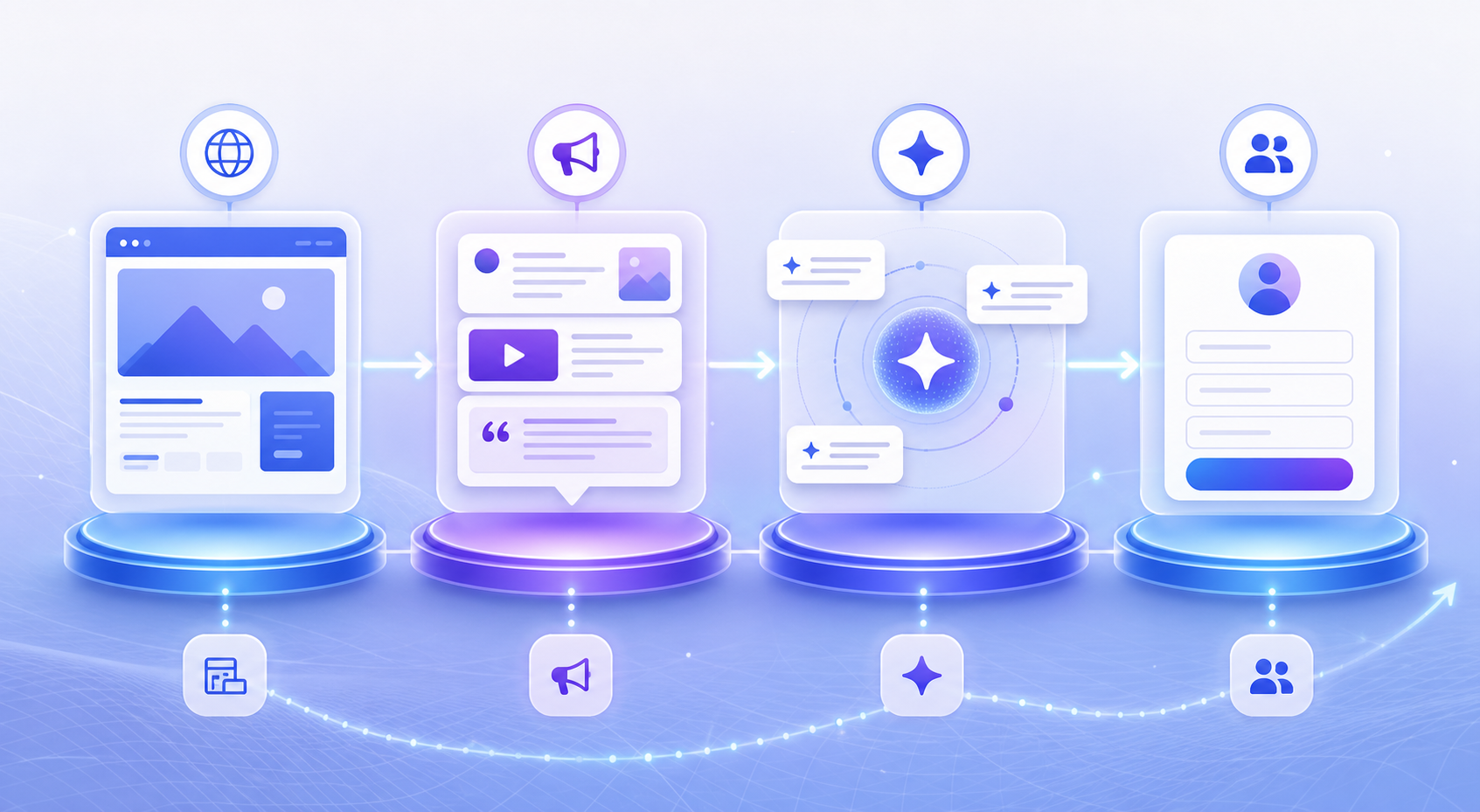
Build -> Showcase -> Grow -> Leads
In the context of earned media + GEO, it means:
We0 loop | GEO meaning |
|---|---|
Build | Build a credible website with unified brand and category positioning |
Showcase | Present products, cases, customers, work, methodology, and proof |
Grow | Grow through SEO/GEO, content, external mentions, and data monitoring |
Leads | Convert external visibility and AI visibility into real inquiries and customers |
Without a website, earned media is hard to capture. Without earned media, a website can become self-claiming.
How to turn earned media into a GEO lever
Not every external mention is useful.
Low-quality directories, random syndication, and contextless paid posts rarely build durable value.
Earned media that helps GEO usually has a few qualities.
1. It appears in credible sources
Industry media, professional blogs, known communities, respected directories, partner websites, customer websites, and research reports tend to send stronger signals.
Not all links are equal.
Not all mentions are equal.
A natural mention in a trusted source matters more than a pile of low-quality links.
2. The mention has context, not just the brand name
A brand name alone says very little.
A better mention explains:
what category you belong to
what problem you solve
who you are for
how you differ from alternatives
why you are worth mentioning
For example, not just: We0 AI.
But: We0 AI helps SaaS teams and independent builders create showcase websites that support SEO/GEO, content growth, and lead generation.
That kind of description is much more useful for AI.
It helps build a relationship between the brand and the problem.
3. External messaging should match the website
If your website says you are an AI website builder, an external article says you are a landing page generator, a customer says you are a design tool, and a directory says you are a no-code builder, the signal gets messy.
You can be multi-dimensional.
But your core positioning needs to stay stable.
GEO suffers when brand semantics drift.
4. You need citation-worthy content, not just press releases
Why would media or industry writers cite you?
Usually not because you published “we are excited to announce.”
They cite you because you have:
original data
a distinct perspective
practical case studies
a useful framework
industry observations
comparison analysis
clear, repeatable conclusions
So if you want earned media, you first need owned content worth referencing.
That is why the website and content center still matter.
5. It needs consistency, not one spike
One media placement is good.
But GEO benefits from repeated, stable, consistent signals.
You need to appear across credible sources over time.
It does not have to be a major publication every month.
It can be:
founder insights quoted in industry articles
customer stories republished with partners
product listed in relevant tool directories
team members joining podcasts
high-quality answers in communities
industry reports that others cite
Repeated presence creates brand memory.
A practical Earned Media + GEO workflow
If you do not know where to start, follow this order.
Step 1: Clarify website positioning first
Do not rush to media outreach.
Answer these questions first:
Who do we serve?
What problem do we solve?
What category do we belong to?
How are we different from alternatives?
How do we want AI and users to describe us?
If your own website is unclear, the outside world will be even more confused.
Step 2: Build a set of citation-worthy core pages
At minimum, prepare:
homepage
product/service pages
case studies
About page
FAQ
methodology articles
comparison pages
industry point-of-view articles
These pages become the reference base for earned media.
When someone covers, interviews, or mentions you, they need places to link, verify, and understand your brand.
Step 3: Extract 3-5 ideas worth spreading
Do not only talk about features.
Talk about points of view.
For example:
A showcase website is not a digital business card. It is a lead generation asset.
GEO does not replace SEO. It helps AI understand and cite you.
The value of AI website building is not only page generation, but post-launch growth.
For SaaS teams and indie builders, a website must serve users, search engines, and AI systems at the same time.
The clearer the idea, the easier it is for media, podcasts, communities, and AI systems to remember.
Step 4: Find the most relevant third-party contexts
Do not chase huge publications first.
Start where your actual audience pays attention:
industry newsletters
vertical media
SaaS / AI / Indie Hacker communities
tool lists and directories
partner blogs
co-published customer stories
podcasts and online events
Reddit / LinkedIn / YouTube discussion spaces
Relevance matters more than fame.
Step 5: Bring external mentions back to the website
When you earn coverage or mentions, do not let them scatter.
You can:
add a Press / Media / Mentions section
include coverage in case pages
show third-party quotes on the About page
reference media coverage inside content pages
use mentions to strengthen FAQ and comparison pages
monitor branded search and direct traffic changes
Earned media does not end when it is published.
It should flow back into your showcase website and become a reusable trust asset.
What should you measure?
Traditional PR likes impressions.
Traditional SEO likes traffic.
In the GEO era, measurement needs to expand.
Metric | Why it matters |
|---|---|
Brand mentions in AI answers | Shows whether you enter AI recommendation contexts |
Source citations in AI answers | Shows whether your content or third-party coverage is cited |
Branded search volume | Shows whether external visibility drives search demand |
Direct visits | Shows whether people remember and visit you主动ly |
High-quality external mentions | Shows whether authority signals are increasing |
Mention context consistency | Shows whether the outside world describes you correctly |
Conversion page visits | Shows whether visibility creates high-intent visits |
Lead quality | Shows whether visibility becomes real customer opportunity |
Do not only ask, “How many clicks did this coverage bring?”
Ask a better question:
Did this external mention make the brand easier to search, easier for AI to understand, and easier for users to trust?
What We0 AI can do in this chain
Earned media matters, but it is not an isolated action.
You need a website that can receive and compound it.
We0 AI helps build that chain:
Need | How We0 AI supports it |
|---|---|
Brand positioning is unclear | Clarifies brand information, website structure, and core messaging |
Website cannot capture media-driven attention | Plans homepage, product pages, case pages, FAQ, and CTA |
Content is not citation-worthy | Plans methodology articles, comparison pages, and industry POV content |
External mentions are not captured | Adds Press, Mentions, cases, and trust proof modules |
GEO impact is unclear | Reviews data, branded search, page visits, and lead quality |
No one operates the site after launch | Supports ongoing content publishing, page optimization, and SEO/GEO growth recommendations |
So this is not about “publishing a few PR articles.”
It is about:
Building a credible website first, letting the outside world validate it, and making it easier for both AI and users to choose you.
That is what earned media as the primary lever for GEO really means.
FAQ
1. What is earned media?
Earned media refers to third-party exposure a brand gains through value, ideas, products, cases, or influence. Examples include media coverage, industry articles, expert quotes, customer mentions, community discussions, directory listings, and podcast interviews.
2. How is earned media related to GEO?
GEO focuses on whether a brand and its content can be understood, cited, and recommended by AI search systems. Earned media provides third-party trust signals that help AI systems understand a brand’s authority and relevance in a category.
3. Is owned website content still important?
Yes. Your website is the home base for brand information and conversion. Earned media adds external trust, but users still need a clear website to understand your product, cases, pricing, process, and next steps.
4. Can small teams use earned media for GEO?
Yes. Small teams do not need to start with major media. They can begin with niche communities, co-published customer stories, partner blogs, tool directories, podcasts, LinkedIn thought leadership, and industry newsletters.
5. How does We0 AI help with GEO?
We0 AI helps build showcase websites, clarify brand positioning, plan product pages, case pages, FAQ, content hubs, and trust proof modules, then continuously support SEO/GEO, content publishing, data monitoring, and growth optimization.