Do We0.ai homepages still need a long brand story when AI browsers can already summarize webpages?
It's true that AI browsers can help users quickly 'understand' a webpage. But it cannot replace the three most important things a homepage does: building trust, conveying who you are, and prompting the next step. So the question isn't 'do we still need a brand story.'
Bottom line first: Tell a story, but it doesn't have to be long.
AI browsers can help users quickly "understand" a webpage — that's true.
But they can't replace the three most important things a homepage must do: make people trust you, make people understand you, and make people want to take the next step.
So the question isn't "do we still need a brand story?"
The real question is: Is the story on your homepage still a long, self-indulgent introduction?
If the answer is yes, it's time to cut it.
If the answer is "short, clear, and conversion-driven," keep it.
1. What AI browsers summarize is information, not trust
Many people now use AI browsers, sidebar summarizers, and webpage summary tools to compress an entire page into a few lines.
This makes long brand stories look risky:
- Users will skip them anyway
- AI will summarize them anyway
- No one reads word by word anyway
But that's only half the picture.
AI can summarize content, but it can't do the persuading for you.
It can extract facts, but it can't build brand presence for you;
It can pull keywords, but it can't convey "why you";
It can tell users what you do, but it can't make them instantly think "I want to try this."
That's why a homepage still needs to exist.
2. A homepage isn't an encyclopedia page — it's "the first impression before the deal"
Many brand websites make the mistake of turning their homepage into a company profile page.
Right at the top:
- What year we were founded
- How many years of experience we have
- How many clients we've served
- What our philosophy is
- What our vision is
These aren't things you can never write.
The problem is, they're usually not what users want to know first.
What users want to know first is:
- Who exactly do you help?
- What problem do you solve?
- What makes you different from others?
- Why should I keep reading right now?
If the homepage can't answer these four questions in the first 5 seconds, no amount of brand story will help.
So a better homepage structure isn't a "long story" — it's:
- A one-line positioning statement
- One core value
- A few credible proofs
- One clear next step
You should have a story, but it should serve conversion, not self-expression.
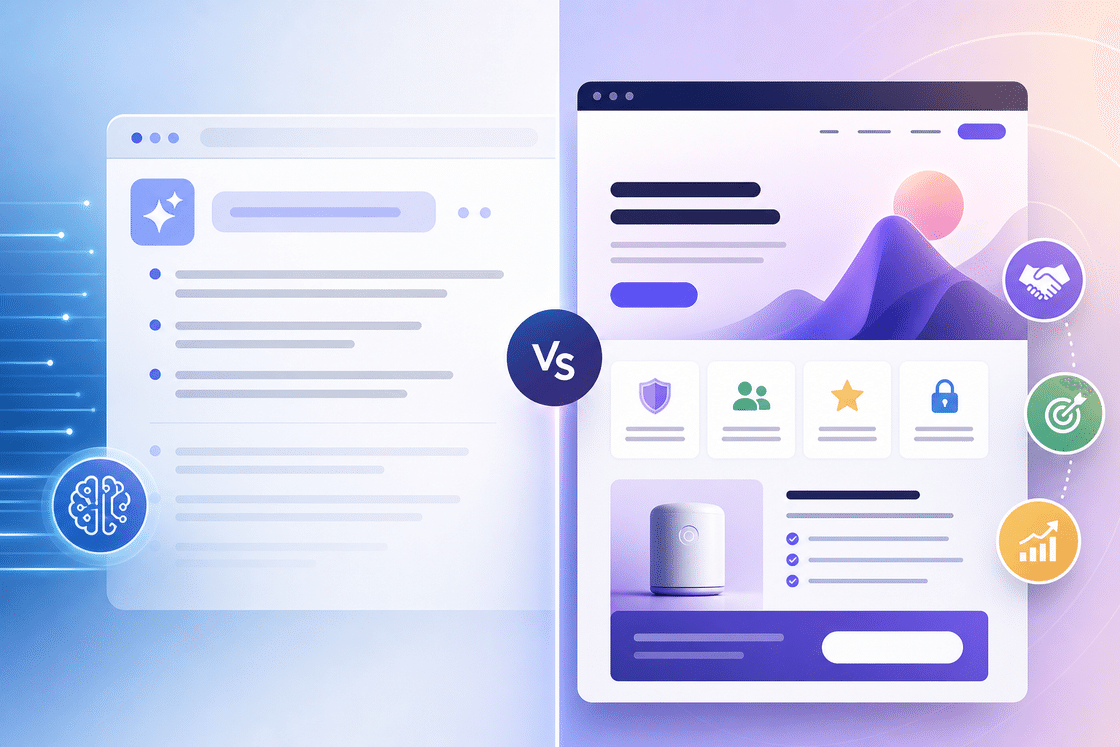
3. What deserves to stay isn't "length" — it's "flow"
Some people think the longer the homepage story, the more warmth it conveys.
That's not really true.
What actually matters is the order:
| Order | What users want to see | How the homepage should be written |
|---|---|---|
| 1 | Who you are | State your positioning in one sentence |
| 2 | What you do | Directly present your product/service |
| 3 | Why trust you | Cases, data, results, endorsements |
| 4 | Why I should keep reading | Scenarios, pain points, differentiators |
| 5 | What I do next | CTA, consultation, trial, booking |
When the order is right, the story won't drag.
It will feel like guidance, not an autobiography.
4. For We0.ai, the homepage is better suited for a "growth story," not a "brand autobiography"
We0.ai isn't just a simple AI website builder.
It's more like an all-in-one platform for showcase websites: website building + presentation + SEO/GEO + content + growth + lead generation.
That means the homepage shouldn't just answer "what pages can you generate" — it also needs to answer:
- What happens after the website goes live?
- Where does traffic come from?
- Who creates the content?
- How does SEO/GEO fit in?
- How do you turn visits into leads?
That's the story We0.ai should really be telling.
Not "we're great."
It's: We help you turn your website into a lead-generation asset that keeps growing.
That one sentence is worth more than any long brand history.
5. Which homepage stories should be cut? Which should stay?
Cut these
- Big chunks of empty talk: mission, vision, values all piled together
- Excessive self-introduction: reads like an annual report, not a website
- Only talks about history, not results
- Only says "we're very dedicated," not "what users get"
- Leaves users still unsure what you're selling after reading
Keep these
- Why you do what you do
- What problem you're best at solving
- How you relate to real user scenarios
- The results you can deliver
- Your methodology or service process
Keep the story, cut the fluff.
That's the judgment homepage copy should always have.
6. How to write homepage copy correctly in the AI era: short, but not shallow
The stronger AI browsers become, the less a homepage can win on word count.
It has to win on structure.
A better homepage story typically looks like this:
- First screen: One sentence on who you are
- Second screen: What problem you solve
- Third screen: Why you do it better
- Fourth screen: Cases / data / results
- Fifth screen: Guide the next step
This isn't "less content."
It's more precise content.
Short doesn't mean empty.
Short means every sentence is doing its job.
7. How could the We0.ai homepage be written better?
You don't have to write a long brand story.
You can write a clearer "growth narrative" instead:
We help showcase websites launch faster, get discovered faster, and capture leads faster.
Not just building pages — turning your website into a sustainable lead-generation asset.
Then build it out in three layers:
1) Why we exist
Why users need you, rather than just picking any AI tool and piecing things together themselves.
2) How you do it
Manually organizing information, building the official site, configuring SEO/GEO, and continuously optimizing after launch.
3) What the result is
Faster launch, better presentation, easier organic search traffic and inquiries.
Written this way, the homepage won't feel empty.
And it won't be so long that people want to close the tab.
8. A simple test: Is your homepage telling a story, or making things clear?
This is the most critical question.
If after reading your website homepage, users say:
- "I get it — you guys do this"
- "I know this is for me"
- "I want to keep exploring"
That's enough.
If after reading, users only feel:
- "Hmm, looks professional"
- "There's a lot of content"
- "But I still don't know if this can help me"
Then the story is too long, but not clear enough.
Clarity matters more than length.
This is especially obvious in the AI era.
Conclusion: AI can summarize webpages, but a homepage still has to "persuade"
AI browsers will only get smarter.
But they can't change one fact: the homepage is still a brand's first face.
So the We0.ai homepage doesn't need a long brand story.
What it needs is:
- More concise expression
- Clearer positioning
- Stronger trust signals
- A more natural conversion path
Don't delete the story — write it in a way that closes the deal.
That's what We0.ai
What I really want to do:
Not just build you a page,
But turn your showcase site into a website that truly grows and converts.
FAQ
1. Will AI browsers make homepage copy meaningless?
No. They just make "fluff" meaningless.
2. Do I still need a brand story on the homepage?
Yes, but it needs to be short, clear, and built to drive conversions.
3. What types of websites is We0.ai best suited for?
Showcase sites, brand official sites, product pages, service pages, case study pages, inquiry pages, and portfolios.
4. What matters most in homepage copy?
Positioning, trust, and the next step.
5. When is a long brand story valuable?
When your users genuinely need to understand your background, methodology, differentiators, and credibility.
Ready to Get Started?
If you're also wondering: Should my homepage tell a long story, or clearly state the positioning?
Maybe the answer isn't an either/or.
It's about writing the story short, making the value clear, and smoothing out the conversion path.
We0.ai can help you pull this off properly.
Summary
AI will continue to summarize web pages for users.
But it won't speak, build trust, or convert on behalf of your brand.
So yes, you still need to write your homepage.
Just stop writing it as a long autobiography no one wants to read.