Does GPT-5.6 Require U.S. Government Approval? OpenAI’s Controversy Explained
Does OpenAI need U.S. government approval to release GPT-5.6? This article reviews Sam Altman’s limited preview remarks, the White House’s clarification, the voluntary review framework, Anthropic’s export restrictions, and the distinction between formal licensing and actual regulatory pressure.
Did GPT-5.6 Need U.S. Government Approval? The OpenAI Rollout Dispute Explained
Introduction
A little more than two weeks after OpenAI said GPT-5.6 would launch only as a limited preview at the request of the U.S. government, the public story changed.
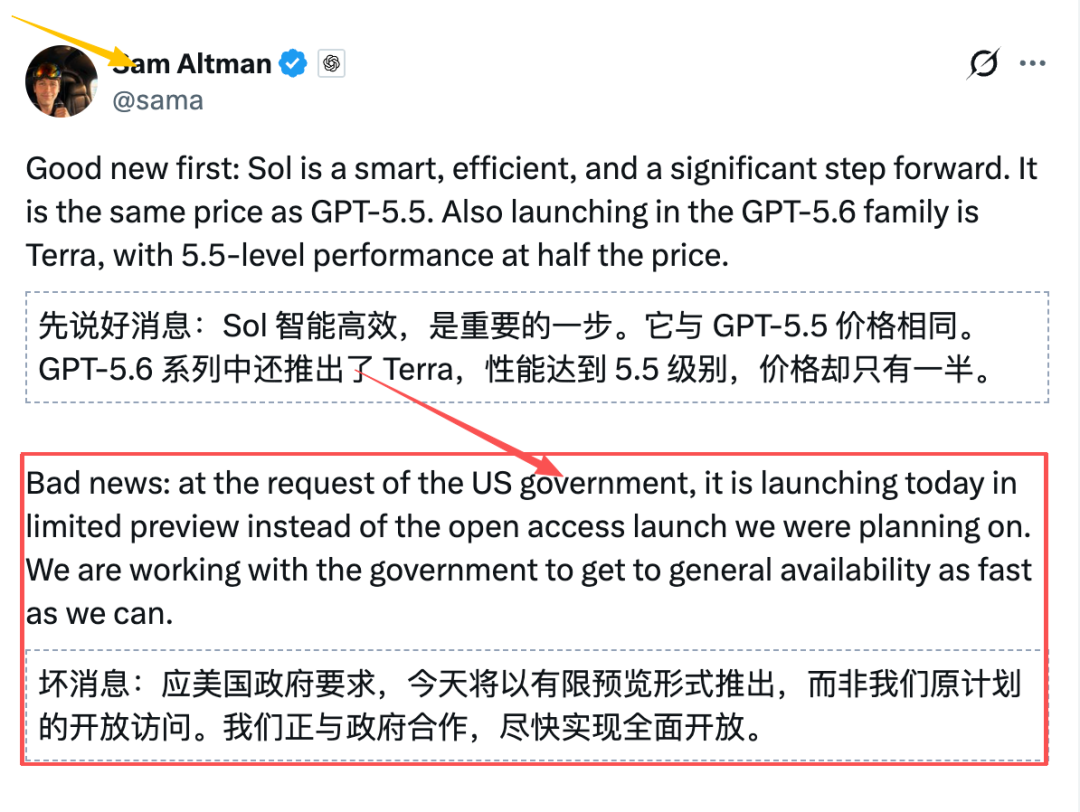
On June 26, 2026, Sam Altman said the company had originally planned an open-access release but was limiting the initial rollout because of a government request. OpenAI said it was working with federal officials to reach general availability as quickly as possible.
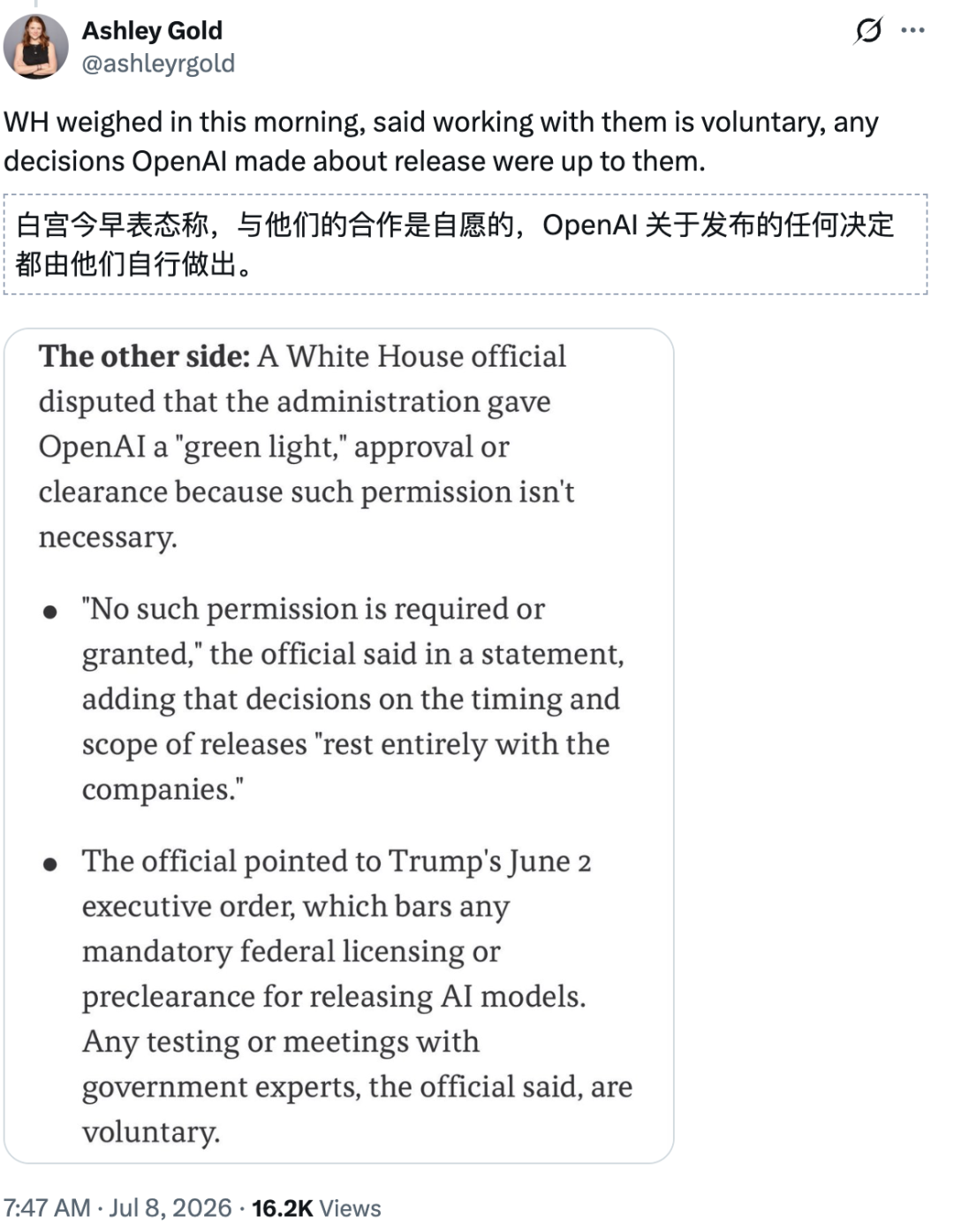
Then, as GPT-5.6 prepared for a broad public launch in early July, a White House official disputed the idea that the administration had granted OpenAI a formal "green light," approval, or clearance. The official said no such legal permission was required, and that decisions about the timing and scope of releases rested with the companies.
Both statements can be true in a narrow sense.
The executive order governing the new frontier-model review framework explicitly says it does not create a mandatory licensing or preclearance requirement. At the same time, reporting from Axios and Reuters says OpenAI delayed the wider rollout after a government request, shared access information about vetted partners, participated in additional testing, and held meetings with federal officials before the broad release.
The real question is therefore not simply, "Who lied?" It is whether a process can be formally voluntary while still creating strong practical pressure on companies that depend on export permissions, government contracts, infrastructure access, and continued political cooperation.
The Reversal After GPT-5.6's Limited Preview
OpenAI's first public message was unusually direct.
Altman described GPT-5.6 Sol as a major step forward and said the company was also launching Terra, a lower-cost tier intended to deliver performance around the level of GPT-5.5. But he paired that announcement with what he called the bad news: at the request of the U.S. government, GPT-5.6 would begin with a limited preview instead of the open-access launch OpenAI had planned.
That wording naturally suggested that the government had blocked or delayed the wider release.
Less than two weeks later, Axios reported that the Trump administration had given OpenAI a "green light" for a broad launch after additional testing and discussions. Reuters repeated the core sequence: OpenAI had restricted access to vetted partners after a government-requested delay, and the public launch followed further engagement with officials.
The White House then objected to the language of formal approval.

According to the official quoted by Axios:
- No formal permission was required or granted.
- Release timing and scope remained the companies’ responsibility.
- Meetings and testing with government experts were voluntary.
- The June 2 executive order prohibited a mandatory federal licensing or preclearance system for releasing AI models.
This clarification did not erase the reported government request or the additional testing. It clarified the legal framing.
The distinction is important:
| Question | Best-supported answer |
|---|---|
| Did federal law require OpenAI to obtain a formal release license? | The June 2 executive order says no mandatory licensing or preclearance system was created. |
| Did the U.S. government ask OpenAI to limit the initial rollout? | OpenAI publicly said the limited preview was launched at the government’s request. |
| Did OpenAI engage in additional testing and meetings before broad release? | Axios and Reuters reported that it did. |
| Did the White House formally “approve” GPT-5.6 in a legal licensing sense? | The White House said no such permission was required or granted. |
| Could government pressure still affect a formally voluntary decision? | That is a reasonable policy question, but the strength and mechanism of that pressure require interpretation. |
The contradiction is therefore partly about language. “Approval” can mean a legal permit, an informal political signal, the removal of restrictions, or the end of an unresolved review process. Different participants may use the same word for different things.
The Letter That Exposed the Meaning of “Voluntary”
The original article turns next to a letter from U.S. Commerce Secretary Howard Lutnick to Anthropic.
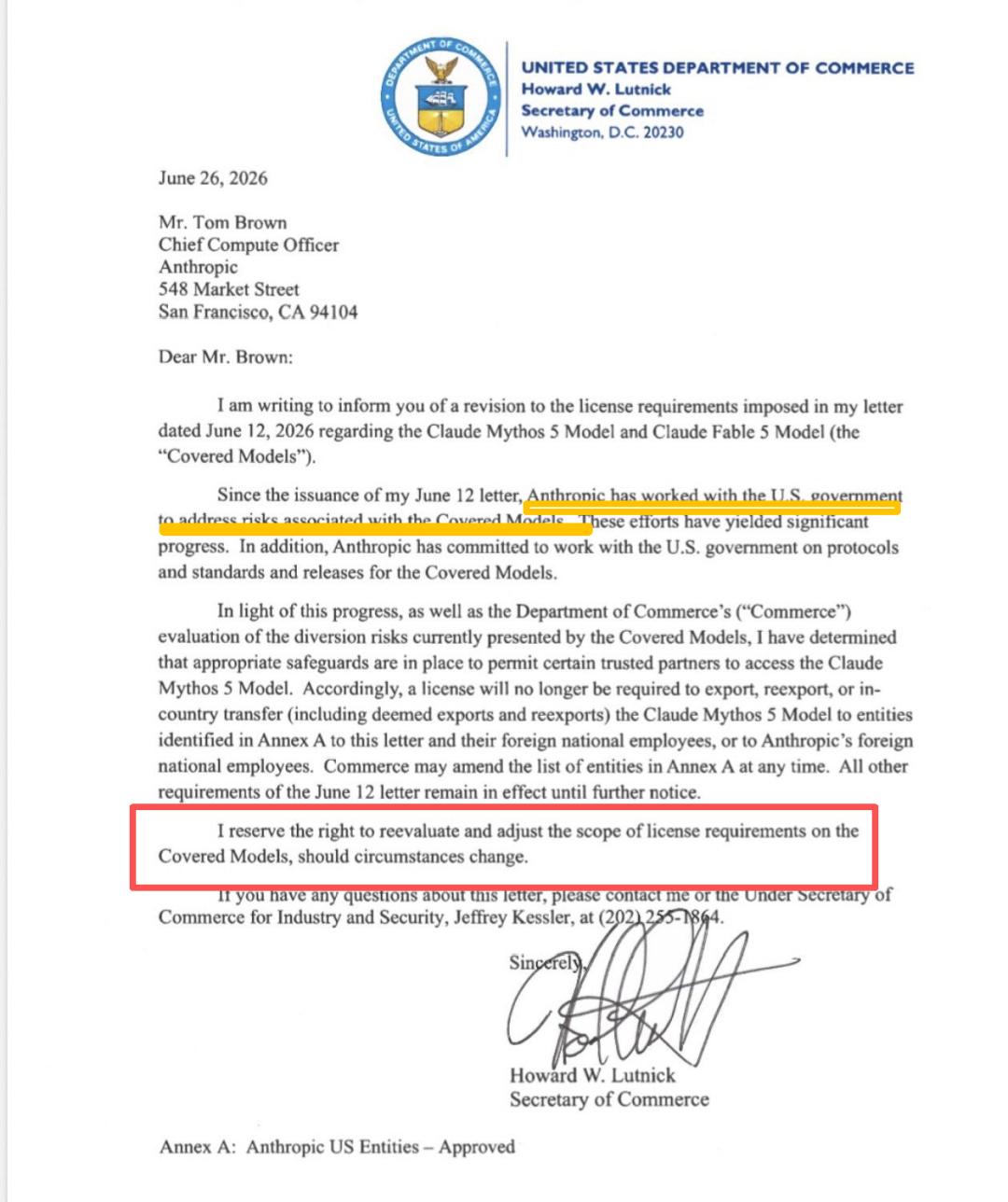
The June 26 letter revised export-license requirements that had been imposed on Anthropic’s Claude Mythos 5 and Claude Fable 5 models. It said Anthropic had worked with the U.S. government to address risks and had committed to cooperate on protocols, standards, and releases for the covered models.
The letter also said the Commerce Department reserved the right to reevaluate and adjust the scope of the license requirements if circumstances changed.
Formally, this is not the same as a universal model-release license.
The restrictions in the letter concerned export, re-export, and in-country transfer rules for covered models and specific entities. The White House executive order separately states that it does not establish mandatory federal preclearance for model publication or release.
Even so, the letter shows why the word “voluntary” may feel incomplete to companies.
A company may voluntarily cooperate with government testing, but the government
may still hold other lawful powers that matter to the business, including:
- Export-control authority
- Access restrictions for foreign users
- Government procurement decisions
- National-security investigations
- Contract eligibility
- Enforcement of existing computer crime and trade rules
When non-cooperation could expose a company to restrictions elsewhere, voluntary participation may carry substantial practical incentives.
The original article compares this dynamic with the 1981 U.S.–Japan voluntary export restraint on automobiles. The arrangement was called voluntary, but it emerged under heavy political and trade pressure.
The comparison is not exact. Automobile import quotas and frontier-model safety reviews operate under different statutes, markets, and national-security concerns. Still, the analogy highlights a useful policy principle:
The meaning of “voluntary” depends partly on the consequences of refusing.
Formal Voluntariness and Practical Leverage
The U.S. framework currently contains two ideas at once.
First, the June 2 executive order rejects mandatory licensing or preclearance for the development, publication, release, or distribution of new AI models. This is an explicit legal limit on the framework.
Second, the same order invites frontier-model developers to collaborate with the federal government, provide models for security evaluation, and help select trusted partners for early access.
This creates a cooperative system rather than a conventional licensing agency.
That structure may be attractive to both sides:
- The government gains early visibility into advanced cyber and national-security capabilities.
- Companies avoid a permanent statutory licensing system.
- Regulators can react quickly while formal technical standards are still developing.
- Companies can demonstrate responsibility and reduce political risk.
But it also creates ambiguity.
If companies believe refusal could damage export treatment, procurement opportunities, political relationships, or future regulatory outcomes, cooperation may become functionally difficult to decline even when it remains legally voluntary.
That does not prove misconduct by OpenAI or the government. It does show why the debate cannot be resolved by quoting the word “voluntary” alone.
Altman’s Public Position and OpenAI’s Private Incentives
The original article argues that Altman’s public complaint served OpenAI strategically.
This is an interpretation, not an established fact. Still, the incentives are worth examining.
By saying the launch was limited at the government’s request, OpenAI could:
- Explain why the release did not match the company’s original plan.
- Shift some user and investor frustration away from the product team.
- Emphasize the model’s national-security significance.
- Present OpenAI as a company cooperating reluctantly but responsibly.
- Signal that GPT-5.6 was powerful enough to require special attention.
At the same time, Axios reported that OpenAI sent technical experts to Washington and participated in additional testing through the Commerce Department’s Center for AI Standards and Innovation.
That behavior is not
not necessarily inconsistent with Altman’s public message.
A company may disagree with a government request while still deciding that cooperation is the fastest and safest route to a broad launch. OpenAI may also have viewed participation as useful for improving safeguards, maintaining political trust, and reducing the chance of more restrictive action later.
The original article describes this as a coordinated performance or a political “martyr” narrative. Publicly available evidence does not prove that characterization. A more defensible conclusion is that OpenAI faced multiple incentives at once:
- Release the model quickly.
- Avoid a confrontation with the federal government.
- Reassure users and investors.
- Demonstrate serious safety work.
- Preserve access to future government and infrastructure partnerships.
Corporate messaging often reflects all of these goals simultaneously.
Was GPT-5.6 “Allowed” to Launch?
The word “allowed” needs careful treatment.
The official OpenAI release says GPT-5.6 became available across ChatGPT, Codex, and the API, with Sol, Terra, and Luna offered as distinct capability tiers. OpenAI also described extensive safeguards, continuous monitoring, rapid remediation, and government collaboration.
Axios described the broad rollout as following a government “green light.” Reuters reported a delayed rollout prompted by U.S. government requests and additional national-security scrutiny. The White House denied that it had issued a formal approval because no such legal authorization was required.
A precise description is therefore:
OpenAI broadened the GPT-5.6 release after a government-requested limited rollout, additional testing, and discussions with officials, while the White House maintained that the process was voluntary and did not constitute formal legal approval.
That sentence is less dramatic than accusing one side of lying, but it better matches the available evidence.
The Reported 5% Equity Proposal
The article then moves from model-release policy to a separate but related story: OpenAI’s reported proposal to contribute 5% of its equity to a U.S. sovereign or public wealth fund.
TechCrunch, citing Financial Times reporting based on people familiar with the discussions, said Altman had proposed giving 5% of OpenAI’s equity to a U.S. sovereign wealth fund. Other AI companies could be encouraged to make similar contributions.
The reported discussions remained preliminary. No finalized transfer agreement had been announced, and a formal arrangement would likely require congressional action.
OpenAI had already discussed the broader concept publicly. Its policy paper on industrial policy for the intelligence age proposed a public wealth fund that could invest in AI companies and distribute some returns to citizens.
The original article values the 5% stake at roughly $42.6 billion using an $852 billion valuation reported in connection with recent financing discussions.
That calculation is mathematically straightforward:
Reported company valuation: $852 billion
Proposed equity share: 5%
Implied value: $42.6 billion
But both inputs need qualification.
- The $852 billion
figure is a reported private-company valuation, not a continuously traded public market capitalization.
- The 5% proposal was reported as preliminary, not completed.
- The value of a private stake can change materially before any transaction.
- The terms, voting rights, liquidity, and governance of the proposed stake were not publicly settled.
The proposal should therefore be described as a reported policy concept, not a completed donation.
Public Wealth Fund or Political Insurance?
Supporters of a public AI wealth fund argue that the public should participate in the economic upside of technology built on public research, infrastructure, data, and social investment.
A fund could potentially:
- Invest in AI companies or infrastructure.
- Distribute returns to citizens.
- Support education and workforce transitions.
- Finance public-interest research.
- Share the gains of AI growth more broadly.
Critics see different risks:
- Government ownership may create conflicts of interest.
- Regulators could become financially dependent on company valuations.
- Large incumbent firms may gain stronger political protection.
- Public downside risk could increase if valuations fall.
- Governance and distribution rules could become politicized.
The original article interprets the proposal as a “Trojan horse” that would turn the government from referee into shareholder.
That concern has a foundation in regulatory-capture theory, but it is not the only possible outcome.
Economist George Stigler’s classic work on economic regulation argued that industries often seek regulation and may shape it for their own benefit. A government equity stake could create incentives to protect the value of a company it regulates. On the other hand, a carefully designed, independently governed fund could separate asset ownership from day-to-day regulatory decisions.
The details would determine the result:
- Who controls voting rights?
- Can the government sell the shares?
- Who receives the returns?
- Are regulators legally insulated from the fund?
- Are competing companies treated equally?
- Does participation remain voluntary?
- What happens if the company’s value falls?
Without answers to those questions, the political meaning of the proposal remains uncertain.
OpenAI’s Financial Pressure
The original article connects the wealth-fund proposal with OpenAI’s financial position.
Leaked financial documents reported by independent outlets showed substantial growth and substantial losses in 2025. The reported figures include:
| 2025 Financial Item | Reported Amount |
|---|---|
| Revenue | $13.07 billion |
| Cost of revenue | $7.50 billion |
| Research and development | $19.18 billion |
| Sales and marketing | $5.73 billion |
| General and administrative expenses | $1.57 billion |
| Total costs and expenses | $34.00 billion |
| Operating loss | $20.92 billion |
The source article describes the company’s future compute commitments as $1.4 trillion. Other reporting has cited different totals depending on the date, contracts included, and whether figures refer to signed obligations, projected capacity, or longer-term infrastructure plans.
Because OpenAI is
Privately held and the cited financial statements were leaked rather than published through a normal public-company filing, readers should treat exact totals carefully.
What is clear is the scale of the business model:
- Revenue is growing rapidly.
- Training and serving frontier models require enormous capital.
- OpenAI relies on major cloud and infrastructure partners.
- Long-term compute commitments increase financing risk.
- Product launches and political relationships can affect investor confidence.
These pressures may make government relationships strategically important. They do not, by themselves, prove that the equity proposal was designed to obtain favorable regulatory treatment.
Oracle, Infrastructure Risk, and the Search for Stable Capital
The original article also points to market concerns around Oracle, one of OpenAI's core infrastructure partners.
Oracle shares experienced major volatility as investors evaluated the company's rapidly rising capital expenditure, debt needs, and exposure to enormous AI infrastructure commitments. Reuters reported a sharp decline linked to concerns about AI spending and financing, while later reporting showed the shares reacting positively to GPT-5.6's broader release.
This illustrates the circular dependency in the frontier-AI economy:
- AI labs require massive data-center capacity.
- Cloud companies borrow and spend to build that capacity.
- Investors expect model demand and revenue to justify the spending.
- Delays, regulatory restrictions, or weaker-than-expected growth affect both sides.
- Governments become increasingly interested because the infrastructure has national-security and economic significance.
A public wealth fund would insert the government more directly into that system. Whether that improves stability or creates dangerous entanglement depends on its legal design.
Who Was Actually Misleading Whom?
The evidence does not support a simple answer.
OpenAI's statement
OpenAI said the limited preview occurred at the U.S. government's request. Reporting from Axios, Reuters, and TechCrunch supports the claim that the government requested a staged or restricted initial rollout.
The White House statement
The White House said no legal permission was required or granted, and that the June 2 order prohibited mandatory licensing or preclearance. The text of the executive order supports that position.
The apparent contradiction
The contradiction comes from treating a government request and formal legal approval as the same thing.
They are not necessarily the same:
- A company can comply with a request without being legally required to do so.
- A government can influence a launch without issuing a formal license.
- A company can wait for political comfort without receiving statutory authorization.
- Officials can describe cooperation as voluntary while companies experience strong practical pressure.
The original headline asks whether Altman lied. A more careful conclusion is that public statements emphasized different layers of the same process.
OpenAI emphasized the government's role in delaying the launch. The White House emphasized that the final
法律权限仍由OpenAI保留。
这两段描述单独呈现时,都只反映了部分事实。
GPT-5.6争议揭示了AI治理的哪些问题
这场争议表明,前沿模型的治理速度正在超越正式立法。
当前体系主要依赖:
- 行政命令
- 自愿合作
- 出口管制权
- 国家安全审查
- 私人测试安排
- 可信伙伴访问
- 企业与政府间的非正式协商
这种方法有其优势。它比建立完整的许可审批机构更快,也能适应新的技术风险。
但同时也存在弱点:
- 规则可能对公众不明确。
- 类似的公司可能受到不同待遇。
- 非正式压力难以衡量。
- 问责机制分散在多个机构和私营公司之间。
- 公司可以利用策略性描述框架。
- 官员可以在否认正式批准的同时施加影响。
一个可持续的框架需要更高的透明度。
至少,前沿模型开发者与政府应披露以下信息:
- 参与是自愿还是法律强制。
- 由哪个机构进行评估。
- 审查了哪些风险类别。
- 限制是否涉及国内发布、出口或可信伙伴。
- 在更广泛开放前,哪些条件发生了变化。
- 政府是否有权撤销决定。
- 存在哪些申诉或审查程序。
- 商业与国家安全冲突如何管理。
缺乏这些信息,公众只能看到相互矛盾的叙述,而无法了解清晰的治理过程。
常见问题
OpenAI发布GPT-5.6在程序上必须获得美国政府批准吗?
2026年6月2日的行政命令明确表示,该命令并未建立发布AI模型的强制性联邦许可、预审或批准制度。白宫因此表示,未要求也未给予任何正式许可。
为什么OpenAI表示GPT-5.6是应政府要求限制发布的?
OpenAI表示,政府要求进行有限的初始预览。据Axios和路透社报道,OpenAI在更广泛发布前,使用了经过审查的合作伙伴,参与了额外测试,并与联邦官员进行了讨论。
GPT-5.6的审查是自愿的吗?
行政命令描述的是一个自愿合作框架。然而,由于联邦机构控制着出口规则、采购、国家安全流程以及其他可能影响AI企业的政策,公司可能仍面临参与的实际激励。
政府是否给GPT-5.6开了"绿灯"?
Axios在报道全面发布时使用了这个表述。白宫拒绝将其描述为正式的合法批准,表示发布决定权仍在OpenAI手中。更准确的描述是:更为广泛的发布是在额外测试和政府讨论之后进行的。
商务部致Anthropic的信函内容是什么?
6月26日的信函修订了对受覆盖Anthropic模型的出口许可限制,此前该公司与政府合作制定了保障措施。信函同时指出,商务部保留在Anthropic未来模型未能达到合理安全预期时重新评估相关限制的权利。
and adjust the scope of the license requirements.
Did OpenAI donate 5% of its equity to the U.S. government?
No completed donation has been announced. Financial Times reporting, summarized by TechCrunch, said Altman proposed a 5% contribution to a U.S. sovereign wealth fund, but discussions were preliminary and would likely require further legal and political action.
Is the reported $42.6 billion value confirmed?
The figure is an implied calculation based on a reported $852 billion private valuation and a hypothetical 5% stake. It is not the value of a completed, liquid transaction and could change substantially depending on valuation and deal terms.
Why are OpenAI’s financial losses relevant to this debate?
Building and operating frontier models requires extraordinary infrastructure spending. OpenAI’s reported losses and long-term compute commitments make access to capital, cloud partners, and stable government relationships strategically important, although they do not prove any improper political bargain.
Related Tools
- ChatGPT: OpenAI’s product interface for accessing GPT models, including GPT-5.6 availability by plan.
- OpenAI API Platform: The official developer platform for building applications with OpenAI models.
- OpenAI Safety Evaluations Hub: OpenAI’s public resource for model system cards, evaluations, and deployment-safety information.
- NIST AI Risk Management Framework: A voluntary framework for identifying and managing AI risks.
- BIS Export Administration Regulations: Official U.S. Commerce Department rules governing exports, re-exports, and controlled technology transfers.
- Federal Register: The official source for U.S. executive orders, agency rules, and public notices.
Related Links
- OpenAI GPT-5.6 Announcement: OpenAI’s official release page for GPT-5.6 Sol, Terra, and Luna.
- White House Executive Order on Advanced AI: The June 2 order establishing a voluntary frontier-model cooperation framework while rejecting mandatory preclearance.
- Axios Report on the GPT-5.6 Rollout: Reporting on the additional testing, broad launch, and White House clarification.
- Reuters Report on the Delayed GPT-5.6 Launch: Independent reporting on the rollout timeline and national-security context.
- Commerce Secretary’s Letter to Anthropic: The June 26 letter revising export-license requirements for covered Anthropic models.
- TechCrunch Report on the 5% Equity Proposal: Coverage of the Financial Times report on the equity proposal.
(com/2026/07/02/openai-proposed-donating-5-of-its-equity-to-a-us-sovereign-wealth-fund/): A summary of the reported preliminary public wealth fund proposal.
- OpenAI Financials Report: Reporting based on leaked financial documents describing 2025 revenue, spending, and losses.
Summary
The GPT-5.6 rollout dispute is not best understood as a simple choice between “government approval was required” and “the government had nothing to do with it.”
The available evidence indicates that OpenAI limited the initial release at the government’s request, participated in additional testing, and broadened access after further discussions. At the same time, the governing executive order explicitly rejected mandatory licensing and the White House denied granting formal legal approval.
The separate reports about a possible 5% OpenAI equity contribution to a public wealth fund raise legitimate questions about regulatory capture, shared public benefit, and conflicts of interest, but no completed agreement has been announced.
The central issue is not whether the process was formally voluntary; it is whether frontier-model governance can remain transparent, consistent, and accountable when informal government leverage and corporate incentives are so closely intertwined.