Cursor May Disappear from New Products After SpaceX’s \$60 Billion Acquisition
Cursor May Be Phased Out as SpaceX’s \$60 Billion Acquisition Nears
Cursor May Be Phased Out as SpaceX’s $60 Billion Acquisition Nears
Introduction
The Cursor name may not survive the next phase of the company it helped create.
SpaceX has already signed a $60 billion all-stock agreement to acquire Anysphere, the company behind Cursor. The transaction is not yet complete, but SpaceX says it expects the deal to close during the third quarter of 2026.
Now the discussion has shifted from whether the acquisition will happen to what Cursor will look like after it does.
The Information reported that Cursor employees were told at an all-hands meeting that the Cursor brand would likely be phased out from new products over the coming months. The existing coding assistant is expected to keep its name for now, but an unreleased general-purpose agent—internally called Sand—could launch as Grok Bot or under another new brand.
That is a very different outcome from simply putting a SpaceX logo next to Cursor.
It suggests that SpaceX may treat Cursor less as a permanently independent software brand and more as a major part of its broader AI stack.
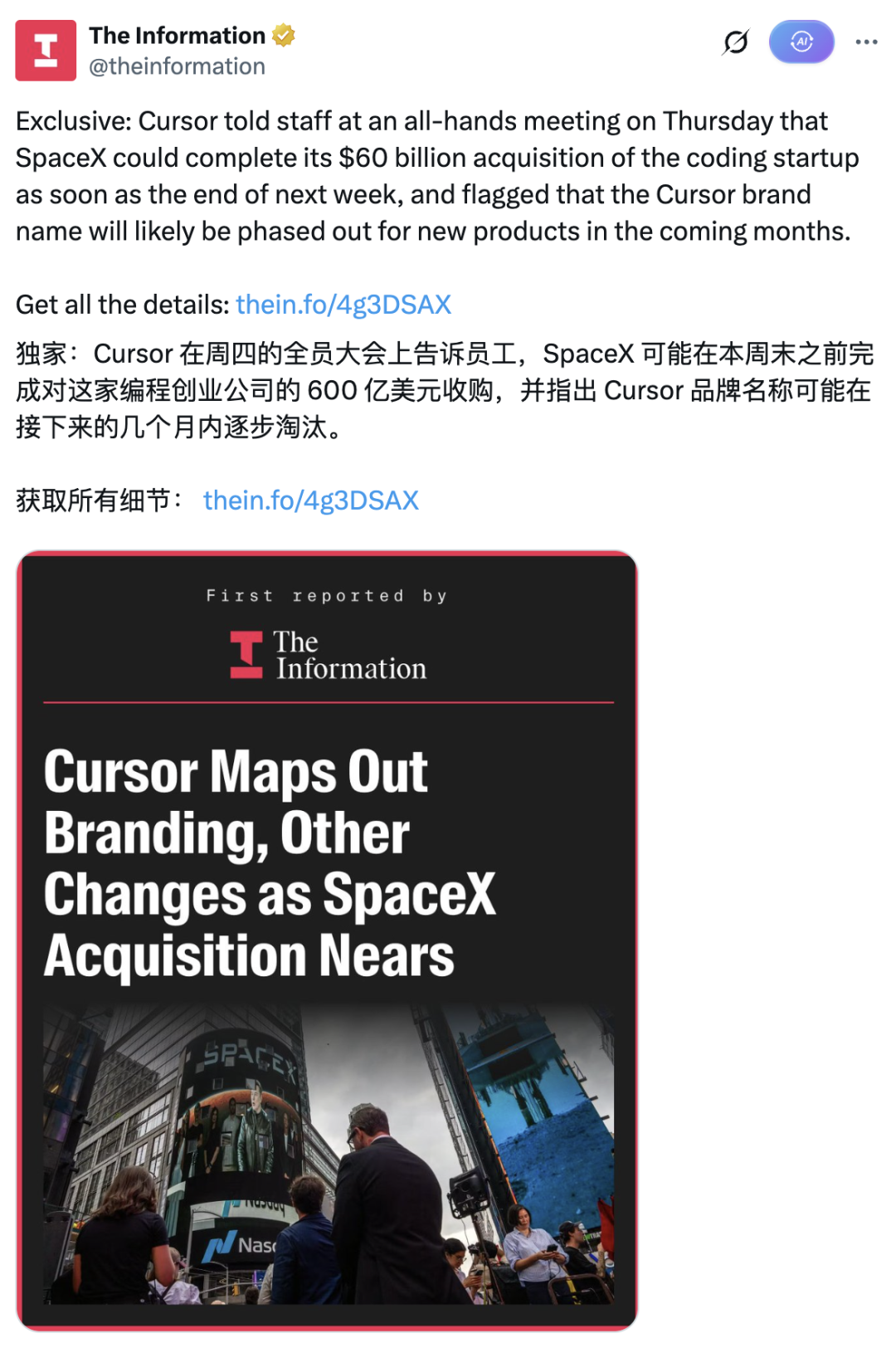
The important caveat is that the branding decision is not final.
The same report says plans can still change. As of August 10, 2026, Cursor’s website, product, enterprise offering, models, CLI, desktop app, and developer ecosystem continue to operate under the Cursor name.
So Cursor is not “gone.”
The more accurate question is whether the Cursor brand remains central after the acquisition closes.
$60 Billion Buys More Than a Coding App
The acquisition is already unusually large by software-startup standards.
SpaceX’s official Q2 2026 earnings release lists the agreement among its major business developments:
| Item | Current status |
|---|---|
| Buyer | SpaceX |
| Target | Anysphere, maker of Cursor |
| Transaction value | $60 billion |
| Structure | All-stock acquisition |
| Expected close | Q3 2026 |
| Strategic goal | Expand SpaceX’s AI enterprise offerings |
Reuters reported that SpaceX had first secured an option in April to acquire Cursor later in the year, before locking in the full acquisition agreement in June.
The deal gives SpaceX something it had not built on its own at the same scale: a mature developer product with a large enterprise footprint.
Cursor’s current enterprise page says:
- 64% of Fortune 500 companies use Cursor.
- 50,000+ enterprises build with Cursor.
- More than 100 million lines of enterprise code are written per day with the product.
The company’s revenue has also expanded at unusual speed.
Cursor officially reported more than $500 million in annual recurring revenue in June 2025. Reuters later reported roughly $2.6 billion in annualized B2B revenue in June 2026, while Forbes reported that total annualized revenue had crossed $4 billion around the same period.
The numbers use different revenue definitions, so they should not be treated as identical metrics.
The broad point is simpler: Cursor entered the acquisition with a substantial installed base, fast-growing revenue, and unusually deep exposure to real developer workflows.
The Brand Itself May Be Part of the Integration
The Information’s report goes beyond a financial acquisition.
According to people familiar with the internal meeting, Cursor staff were told that the company name would likely be phased out on new products.
The clearest example is Sand.
Sand is reportedly a general-purpose AI agent that Cursor has been developing beyond its traditional coding-assistant role.
The current branding discussion could turn that product into:
Cursor internal project: Sand
            ↓
Possible public name: Grok Bot
A completely new brand is also reportedly under consideration.
What appears much less likely is that the new agent will simply launch as another product called Cursor.
The existing Cursor coding tool is different.
According to the same report, there is no immediate plan to rename it.
That distinction matters.
A company can phase out a brand gradually without switching off the product that made the brand valuable in the first place.
The likely transition, if the internal plan is carried through, would look more like this:
Existing Cursor coding product
→ keeps the Cursor name in the near term

New general-purpose products
→ increasingly use Grok, SpaceXAI, or another umbrella brand

Internal teams and infrastructure
→ become more deeply integrated with SpaceX
That is a brand migration, not a sudden shutdown.
Cursor’s Identity Was Supposed to Be an Asset
The reported change is notable because Cursor’s identity had previously been described as valuable in the transaction.
The Information says CEO Michael Truell had earlier told staff that SpaceXAI regarded both Cursor’s brand identity and its enterprise customer relationships as important assets.
That made sense.
Cursor became one of the defining brands of the AI coding boom because it did not present itself as the front end for one foundation-model company.
Developers could use different model families inside the same product.
Cursor’s current enterprise positioning still emphasizes model access and central controls over which models organizations allow.
That flexibility helped distinguish it from vertically integrated competitors.
The acquisition creates an obvious tension:
Can a product remain credibly model-neutral when its owner also develops one of the models competing for developer usage?
There is no evidence that Cursor has already stopped supporting competing models.
In fact, Cursor continues to provide separate usage pools for first-party and third-party models, and its enterprise tooling still supports model-level configuration.
The question is about the direction of travel after the deal closes.
Cursor and SpaceX Were Already Building Models Together
The acquisition did not appear out of nowhere.
In April, Cursor announced a partnership with SpaceX to scale its model-training efforts using SpaceXAI’s Colossus infrastructure.
Cursor said its own model development had become compute-constrained after successive generations of Composer.
The partnership gave the company access to substantially more training capacity.
That relationship then deepened into model co-development.
In July, Cursor and SpaceXAI released Grok 4.5 together.
Cursor’s own announcement says Grok 4.5 was jointly trained by the two organizations and used trillions of tokens of Cursor data capturing interactions with codebases, software tools, and developer-agent workflows.
That is one of the strongest explanations for why Cursor is strategically valuable beyond subscription revenue.
The company possesses data showing not only finished code, but also the process of software engineering:
- What developers ask an agent to do.
- How agents inspect repositories.
- Which edits succeed or fail.
- How developers correct model outputs.
- Which tools are called.
- How long-running tasks unfold.
- Which code changes are accepted.
Training data of this kind can be more useful for an agentic coding model than static source code alone.
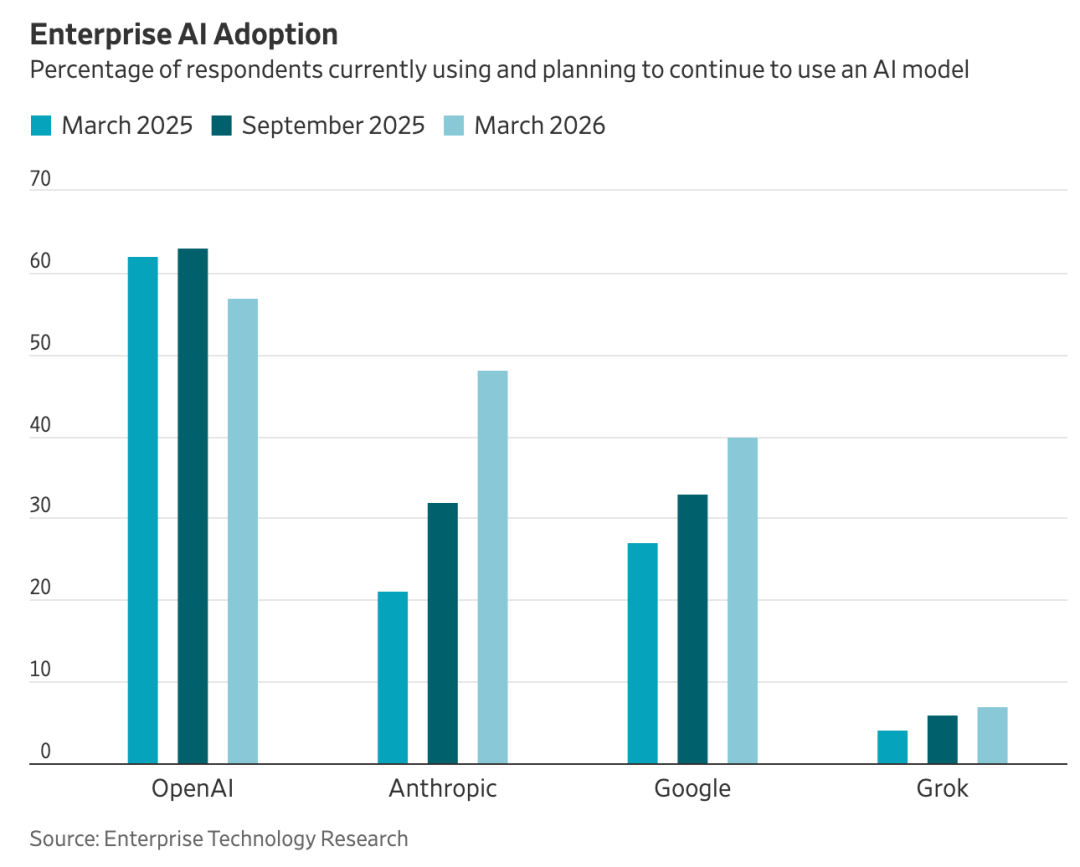
Why SpaceX Wants Cursor So Badly
The source article frames the acquisition around a simple competitive problem: SpaceX’s AI business needed a stronger position in coding and enterprise software.
That conclusion is directionally supported by the deal itself.
Reuters described AI coding as one of the first areas where enterprises have turned generative AI into meaningful recurring revenue, and said the acquisition would strengthen SpaceX/xAI against Anthropic and OpenAI.
Cursor brings three things at once:
- A developer product with strong adoption.
- Enterprise distribution and customer relationships.
- Large volumes of real-world coding and agent interaction data.
SpaceX brings something Cursor struggled to obtain independently:
- Massive compute infrastructure.
- Capital.
- Its own frontier-model program.
- Distribution across a broader technology group.
The April partnership already exposed this complementarity.
Cursor wanted more compute.
SpaceX wanted a stronger software and developer channel.
The acquisition turns the partnership into vertical integration.
The Competition in Coding Is Already Intense
The source article compares Cursor and Grok with the rapid rise of Claude Code and other coding agents.
One figure in the source needs correction.
Anthropic’s February 2026 funding announcement said Anthropic as a company had reached a $14 billion run-rate revenue level.
The same announcement said Claude Code itself had exceeded $2.5 billion in run-rate revenue and had more than doubled since the beginning of the year.
Those are both large numbers, but they describe different things.
The wider competitive point remains valid.
AI coding has become one of the clearest enterprise markets for frontier models.
A successful coding product can influence:
- Which model developers use every day.
- Which provider receives enterprise spend.
- Which company collects high-quality agent interaction data.
- Which platform becomes the default interface for engineering work.
- Which model receives feedback from millions of real tasks.
This creates a flywheel:
Better coding product
→ more developer usage
→ more interaction data
→ better model training
→ stronger coding model
→ more developer usage
Cursor already owned a powerful position inside that loop.
SpaceX appears to want the entire loop rather than just a partnership with one part of it.
SpaceX’s Financials Explain the Urgency
SpaceX’s first public quarterly earnings release after its IPO shows how aggressively the company is expanding its AI business.
For the second quarter of 2026, SpaceX reported:
| Metric | Q2 2026 |
|---|---|
| Total revenue | $7.814 billion |
| AI revenue | $2.561 billion |
| Net loss | $541 million |
| Adjusted EBITDA | $3.538 billion |
| Total capex | $18.369 billion |
| AI capex | $15.828 billion |
| Cash, cash equivalents, and marketable securities | $100 billion |
AI revenue increased 247% year over year, according to SpaceX.
At the same time, AI capital expenditure reached $15.828 billion in a single quarter.
The company also reported $14.1 billion in contracted cloud-service sales.
That combination explains why enterprise AI software matters so much.
Infrastructure investment is enormous.
SpaceX needs software, model, and cloud revenue that can absorb the capacity it is building.
Cursor gives it a direct route into enterprise engineering budgets.
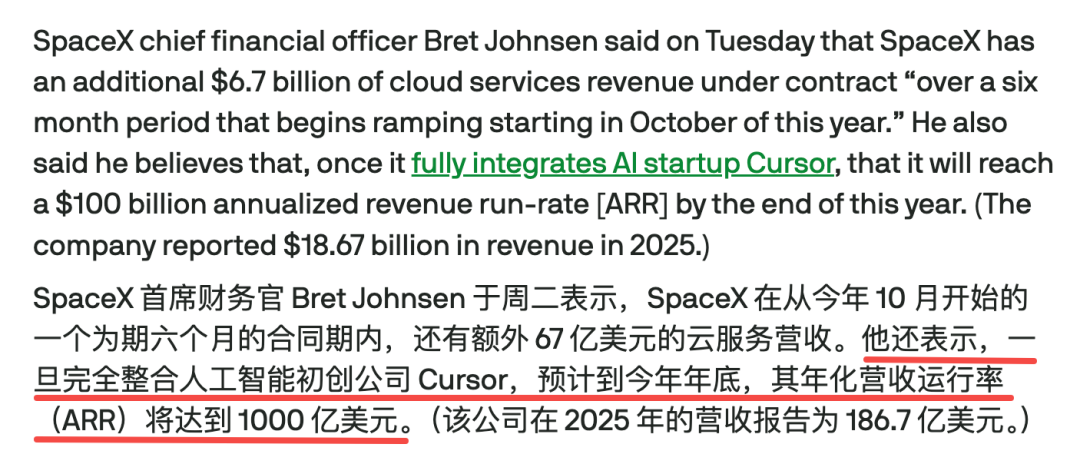
The source screenshot quotes CFO Bret Johnsen connecting future revenue growth with cloud-service contracts and Cursor integration.
That does not mean Cursor alone can transform SpaceX’s economics.
It does show that management sees the acquisition as part of the company’s broader AI revenue strategy rather than a side project.
Grok 4.5 Already Shows What the Combined Stack Looks Like
Grok 4.5 is useful because it provides an early example of the technical relationship before the acquisition has even closed.
Cursor’s July announcement says:
- The model was trained jointly with SpaceXAI.
- Training included trillions of tokens of Cursor data.
- The model targets coding as well as research, finance, legal work, data science, and other computer-based tasks.
- Grok 4.5 is available inside Cursor across desktop, web, iOS, CLI, and the Cursor SDK.
- Composer 2.5 remains available as a separate model family.
This makes the reported Sand/Grok Bot branding idea easier to understand.
Cursor is no longer just a code editor using somebody else’s models.
It is already participating in the training of broader general-purpose models and agents.
The acquisition could accelerate that shift from:
AI coding product
into:
general-purpose agent platform
+
model-training data engine
+
enterprise AI distribution layer
At that point, the Cursor name may be less important to SpaceX than the technology and user base behind it.
Developers See a Different Trade-Off
For developers, the concern is less about corporate structure and more about product behavior.
A post highlighted in the source article summarizes the tension well.
The combination offers obvious advantages:
- SpaceX has compute.
- Cursor has product momentum.
- Both sides now share model-training infrastructure.
- SpaceX has a reason to push hard against Anthropic and OpenAI in coding.
But Cursor’s appeal has also been tied to its relative independence.
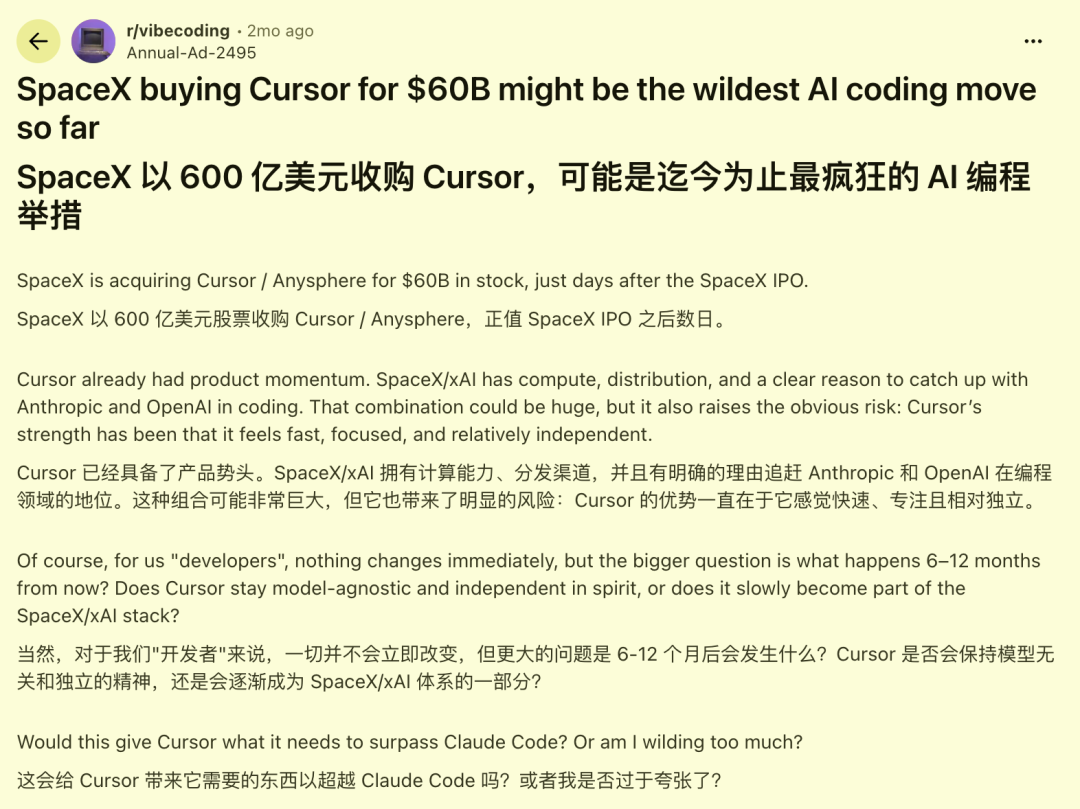
For many teams, the important feature was not simply that Cursor had an agent.
It was that Cursor could serve as a common interface across models.
That creates practical benefits:
- Use one model for fast edits.
- Use another for difficult architecture work.
- Switch when pricing changes.
- Block certain models at the organization level.
- Compare results without changing tools.
The ownership change raises a reasonable question:
Will SpaceX continue optimizing Cursor equally for models that compete directly with Grok?
No public evidence currently proves that it will stop doing so.
Cursor’s existing product still exposes model choice, and the company has publicly said Composer 2.5 will remain offered alongside Grok 4.5.
Still, incentives matter.
When the owner of the interface also owns a frontier-model family, decisions about:
- Default routing.
- Included usage.
- Pricing.
- New features.
- Benchmark optimization.
- Enterprise sales.
- Training-data collection.
can gradually favor the vertically integrated model without requiring competitors to disappear overnight.
This is why developers are watching the post-acquisition roadmap so closely.
Model Neutrality Is the Strategic Question
Cursor’s acquisition is part of a larger shift in AI software.
At the beginning of the generative-AI boom, many application companies built on models from several providers.
Their advantage was the product layer.
The value proposition was:
We do not need to own the model.
We make the model useful.
Cursor became one of the strongest examples of that thesis.
It started as an application company built by four MIT students and became a major enterprise software platform without first building a frontier foundation model of its own.
Then the economics changed.
Model providers moved into applications.
Application companies began training their own models.
Compute became a competitive bottleneck.
Interaction data became a training asset.
The distinction between “model company” and “application company” started to collapse.
Cursor’s path from editor → model trainer → SpaceX acquisition captures that transition unusually clearly.
The Cursor Brand Is Not Gone Yet
The most important correction to the original headline is timing.
As of August 10, 2026:
- The acquisition agreement is signed.
- SpaceX officially expects the transaction to close in Q3 2026.
- The Information says it could close as soon as the coming days or weeks, subject to remaining approvals.
- Cursor still operates under the Cursor brand.
- The current coding assistant is not reported to be facing an immediate renaming.
- New products may gradually use Grok or another brand.
- Sand may become Grok Bot, but the branding decision can still change.
So “Cursor is disappearing” is best understood as a possible brand transition, not a completed disappearance of the product.
The company’s technology, developers, enterprise relationships, models, and coding workflows are not being erased.
They are being absorbed into a much larger AI strategy.
The End of an Independent Application-Layer Story?
The source article closes on a more symbolic point.
Cursor represented an important idea during the first phase of the AI application boom:
A startup could become essential without owning the frontier model beneath it.
That idea is not dead.
Many successful AI products still rely on multiple external model providers.
But Cursor’s acquisition shows why independence becomes difficult at extreme scale.
Training better models requires enormous compute.
Running agents generates valuable proprietary data.
Enterprise customers want increasingly integrated platforms.
Model companies want the distribution owned by applications.
Application companies want the economics and control owned by model companies.
Eventually, both sides start moving toward each other.
The $60 billion deal is therefore about more than the future of one editor.
It is a test of whether a widely used AI application can join a vertically integrated model company without losing the neutrality that helped make it successful.
The answer will not be visible the day the acquisition closes.
It will appear gradually in defaults, pricing, routing, product names, enterprise contracts, and which models receive the deepest integration.
That is the part developers should watch over the next six to twelve months.
常见问题
Is SpaceX really buying Cursor for $60 billion?
Yes. SpaceX has officially announced an agreement to acquire Anysphere, the company behind Cursor, for $60 billion. Its Q2 2026 earnings release says the company expects the transaction to close in the third quarter of 2026.
Is the Cursor brand definitely being discontinued?
No. The Information reports that Cursor employees were told the brand is likely to be phased out for new products over the coming months, but the same reporting says final branding decisions can still change. Cursor’s existing coding assistant is not expected to be renamed immediately.
What is Cursor’s Sand agent?
Sand is the internal code name reported for an unreleased general-purpose AI agent being developed by Cursor. The Information says the product could launch as Grok Bot, although a different new brand is also possible.
Will the current Cursor coding editor disappear after the acquisition?
There is no public evidence that SpaceX plans to shut down the existing coding product when the deal closes. Current reporting says the Cursor coding assistant will retain its name in the near term while branding changes are considered for newer products.
Why does SpaceX want Cursor?
Cursor brings a large enterprise developer customer base, an established coding-agent product, proprietary model-training work, and large volumes of developer-agent interaction data. SpaceX brings the compute infrastructure and capital needed to scale model training, making the combination strategically complementary.
Did Cursor data help train Grok 4.5?
Yes. Cursor’s official Grok 4.5 announcement says the model was jointly trained with SpaceXAI and that training included trillions of tokens of Cursor data representing interactions with codebases and software tools.
Will Cursor remain model-neutral?
That is not yet known. Cursor still supports model choice and separate first-party and third-party usage, but after the acquisition its owner will also have a strong incentive to promote Grok models. The practical answer will depend on future defaults, pricing, enterprise controls, and third-party model integrations.
How large is Cursor’s enterprise business?
Cursor’s official enterprise page currently says 64% of Fortune 500 companies use the product and more than 50,000 enterprises build with it. Reuters reported roughly $2.6 billion in annualized B2B revenue in June 2026, while Forbes reported more than $4 billion in total annualized revenue around the same period.
相关工具
- Cursor: The AI coding agent and development environment at the center of the SpaceX acquisition.
- Grok 4.5 in Cursor: Cursor’s jointly trained SpaceXAI model for coding, agentic tasks, and broader knowledge work.
- Composer 2.5: Cursor’s first-party coding model, which the company says will continue to be offered alongside Grok 4.5.
- Claude Code: Anthropic’s agentic coding product and one of Cursor’s major competitors in professional software development.
- GitHub Copilot: GitHub’s AI development platform with code completion, chat, model choice, and coding agents.
Related Links
- SpaceX Q2 2026 Earnings Release: Official confirmation of the $60 billion Cursor agreement, Q3 closing expectation, and SpaceX’s AI financial results.
- Reuters: SpaceX Locks In $60 Billion Cursor Deal: Independent reporting on the signed all-stock transaction and its strategic rationale.
- The Information: Cursor Maps Out Branding Changes: The report behind the claims that the Cursor brand may be phased out from new products and Sand could become Grok Bot.
- Cursor and SpaceX Model-Training Partnership: Cursor’s April announcement explaining why it turned to SpaceXAI’s Colossus infrastructure for more training compute.
- Cursor: Introducing Grok 4.5: Official description of the jointly trained model and the use of trillions of tokens of Cursor interaction data.
- Cursor Enterprise: Current official figures for Fortune 500 adoption, enterprise customers, and model controls.
- Anthropic February 2026 Funding Announcement: Official source showing the difference between Anthropic’s company-wide revenue run rate and Claude Code’s own run-rate revenue.
Summary
SpaceX has officially agreed to acquire Cursor for $60 billion and expects the transaction to close in the third quarter of 2026. The acquisition combines SpaceX’s massive AI compute investment with Cursor’s developer product, enterprise distribution, models, and proprietary interaction data.
The more dramatic branding story is real but still provisional. The Information reports that Cursor’s name may be phased out from new products, while the existing coding assistant keeps its name for now. Sand, Cursor’s unreleased general-purpose agent, could become Grok Bot, but the final branding plan can still change.
The deeper issue is not the logo. Cursor became valuable partly because developers could treat it as an independent interface across models. After the acquisition, SpaceX will own both the interface and an increasingly important model family.
Cursor is not disappearing today. The real question is whether the independent, model-neutral identity behind Cursor survives vertical integration with SpaceX.