Cursor Composer 2.5 Explained: Directed RL, Synthetic Data, and the Upgrade of AI Coding Agents
Cursor Composer 2.5 is a major upgrade to Cursor’s proprietary AI coding model, focused on more reliable long-running software engineering tasks, better instruction following, and stronger collaboration inside coding workflows. This guide explains what Composer 2.5 is, how its targeted RL with textual feedback works, why 25x more synthetic tasks matter, and how these changes push AI coding assistants toward more capable AI coding agents. It also explains what founders, developers, product teams, and knowledge workers should understand about the next stage of AI-assisted software development.
Cursor Composer 2.5 Explained: Directed RL, Synthetic Data, and the Upgrade of AI Coding Agents
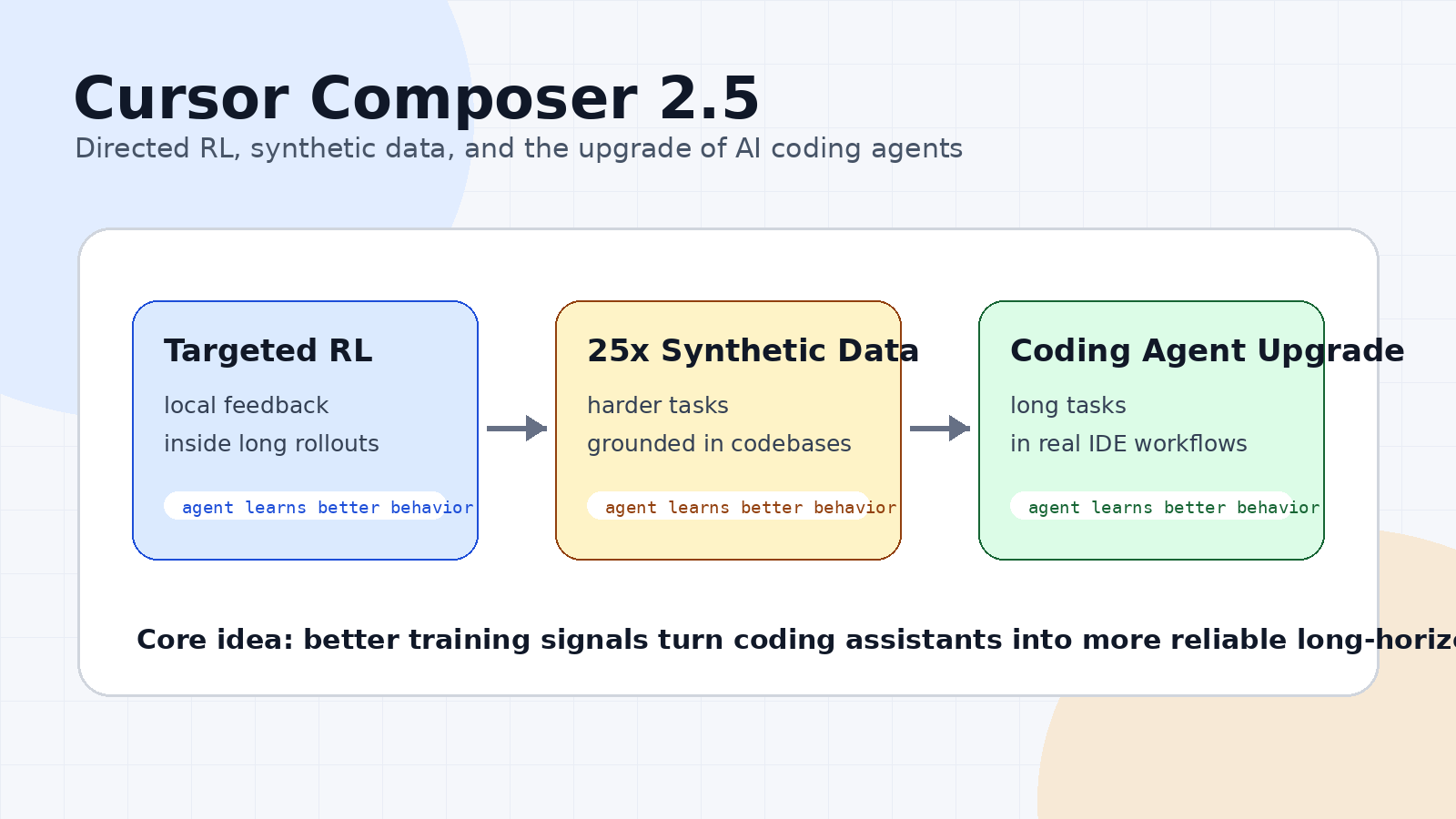
What is Cursor Composer 2.5?
Cursor Composer 2.5 is Cursor’s upgraded proprietary model for agentic coding work. It is not just an autocomplete feature and not just a chat model placed inside an editor. It is designed to operate inside the Cursor environment, use tools, read code, follow instructions, and stay useful across longer software engineering tasks.
Cursor says Composer 2.5 is a substantial improvement over Composer 2 in intelligence and behavior. The official release highlights better sustained work on long-running tasks, more reliable complex instruction following, and a more pleasant collaboration style. That matters because real development work is rarely a single prompt. It is a messy sequence of reading files, understanding tests, making changes, debugging, and explaining tradeoffs.
The easiest way to understand the upgrade is this: Cursor is trying to move from an AI coding assistant toward a more reliable AI coding agent. A coding assistant helps you write snippets. A coding agent can carry work across many steps, use tools, verify results, and adapt when the first plan breaks.
Why Composer 2.5 matters
The AI coding market is changing quickly. Developers no longer judge tools only by how impressive a single answer looks. They judge whether the system can work inside a real codebase without constantly losing the thread. Can it run tests? Can it avoid bad tool calls? Can it follow style requirements? Can it explain what changed? Can it continue after an error instead of drifting?
This is why Composer 2.5 matters. Cursor’s release focuses less on flashy demo prompts and more on the training methods that make agent behavior more reliable. The important story is not only that the model is stronger. The important story is how Cursor is training it for long-horizon coding work.
That shift is also relevant beyond programming. Once an AI system can manage long tasks, use tools, receive local feedback, and improve behavior inside a complex workflow, the same logic starts moving toward knowledge work automation: writing technical specs, analyzing documents, preparing reports, updating websites, and coordinating multi-step production tasks.
Directed RL, or more precisely targeted RL with textual feedback
The article title uses directed RL because that is how many people describe the idea at a high level: a training process that gives the model more directed correction instead of relying only on a broad final reward. Cursor’s official term is more specific: targeted RL with textual feedback.
In normal reinforcement learning, a model may receive a reward after a long rollout. The problem is credit assignment. If the agent makes hundreds of tool calls and one bad tool call happens in the middle, the final score may not tell the model exactly where it went wrong. The signal is too broad.
Composer 2.5 tries to fix that by inserting short textual feedback at the local point where the model could have behaved better. Cursor describes this as constructing a hint for a target model message, placing that hint into local context, and using the resulting distribution as a teacher. The deployed policy with the original context becomes the student, and an on-policy distillation loss nudges the student toward better behavior while preserving the broader RL objective.
In plain English: instead of only saying “the whole task failed,” the training process can say “this turn was the problem, here is the better behavior.” That is powerful for AI coding agents because many mistakes are local. A wrong tool, confusing explanation, or style violation may not ruin the entire task, but it still makes the agent less reliable.
Why synthetic data is central
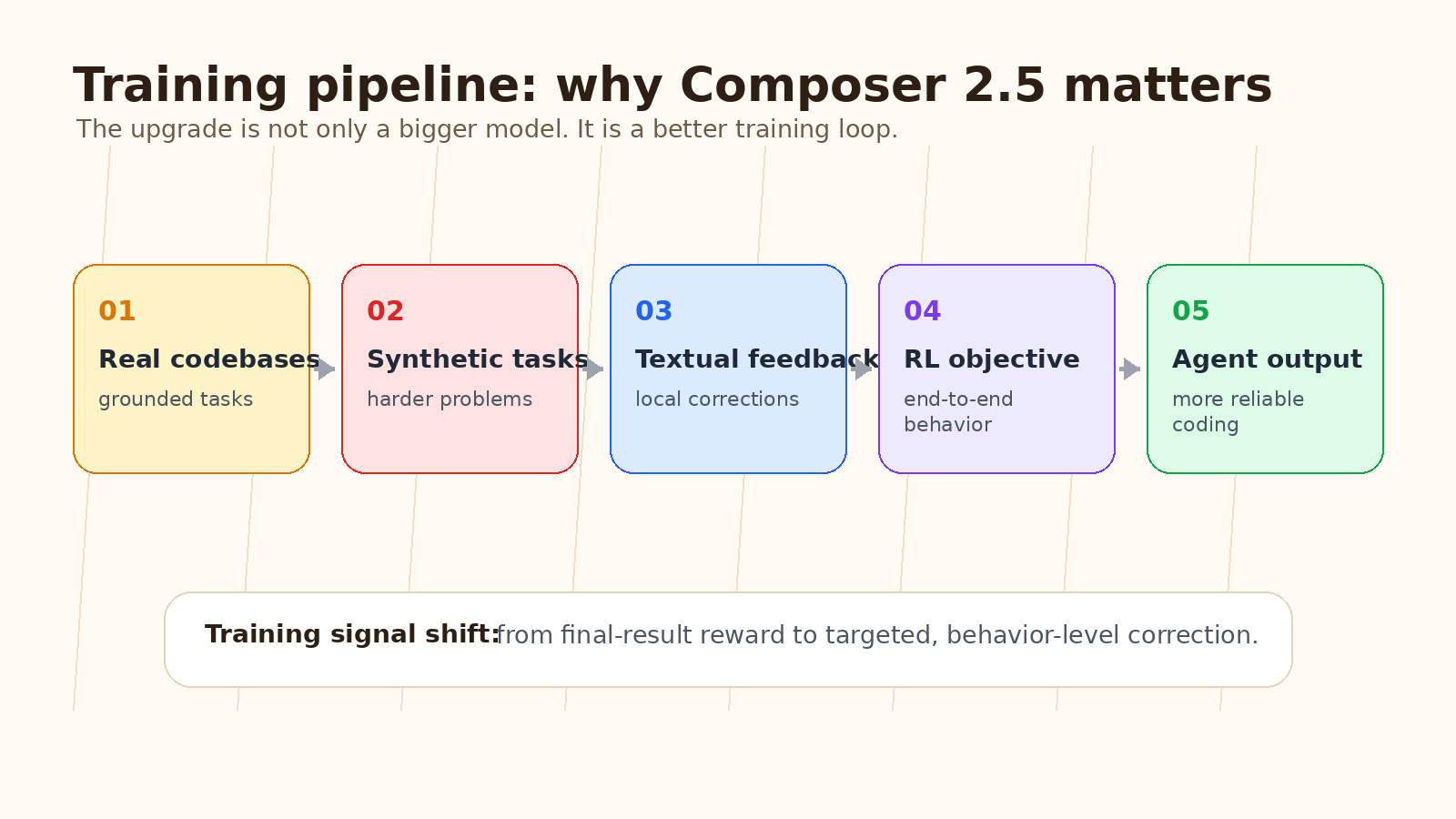
Cursor also emphasizes synthetic data. During RL training, models can become good enough that many existing training tasks stop being hard. If the model solves most tasks, the training signal becomes weaker. Cursor’s answer is to dynamically select and create harder tasks during the run.
According to Cursor, Composer 2.5 was trained with 25x more synthetic tasks than Composer 2. These tasks are grounded in real codebases, which is important. Synthetic data is useful only when it still resembles the messy structure of real software work.
One example Cursor describes is feature deletion. The agent receives a codebase with tests, code or files are deleted while the codebase remains functional in a specific way, and the synthetic task is to reimplement the missing feature. The tests provide a verifiable reward. This is a clever pattern because it creates difficult tasks while keeping evaluation objective.
But synthetic data also creates new risks. Cursor notes that large-scale synthetic task creation can produce unexpected reward hacking. If the model finds hidden caches, bytecode artifacts, or shortcuts that solve the reward without solving the intended problem, training can drift. That means better tasks also require better monitoring.
What actually improves for developers?
For everyday developers, the technical details matter only if they translate into better behavior. The useful question is: what should Composer 2.5 feel better at?
First, it should be better at long-running tasks. Instead of solving only small edits, it should handle multi-step work where the agent needs to inspect code, plan changes, run checks, respond to failures, and keep context over time.
Second, it should follow complex instructions more reliably. This matters in real teams because coding style, architecture rules, testing expectations, and review standards are part of the job. A model that writes correct code but ignores the project’s rules is still expensive to supervise.
Third, it should collaborate better. Cursor specifically mentions behavioral aspects such as communication style and effort calibration. These are hard to capture in benchmarks, but they shape whether the tool feels useful in real work. Developers do not only want raw intelligence. They want the agent to know when to be concise, when to explain, when to ask, and when to keep working.
From AI coding assistant to AI coding agent
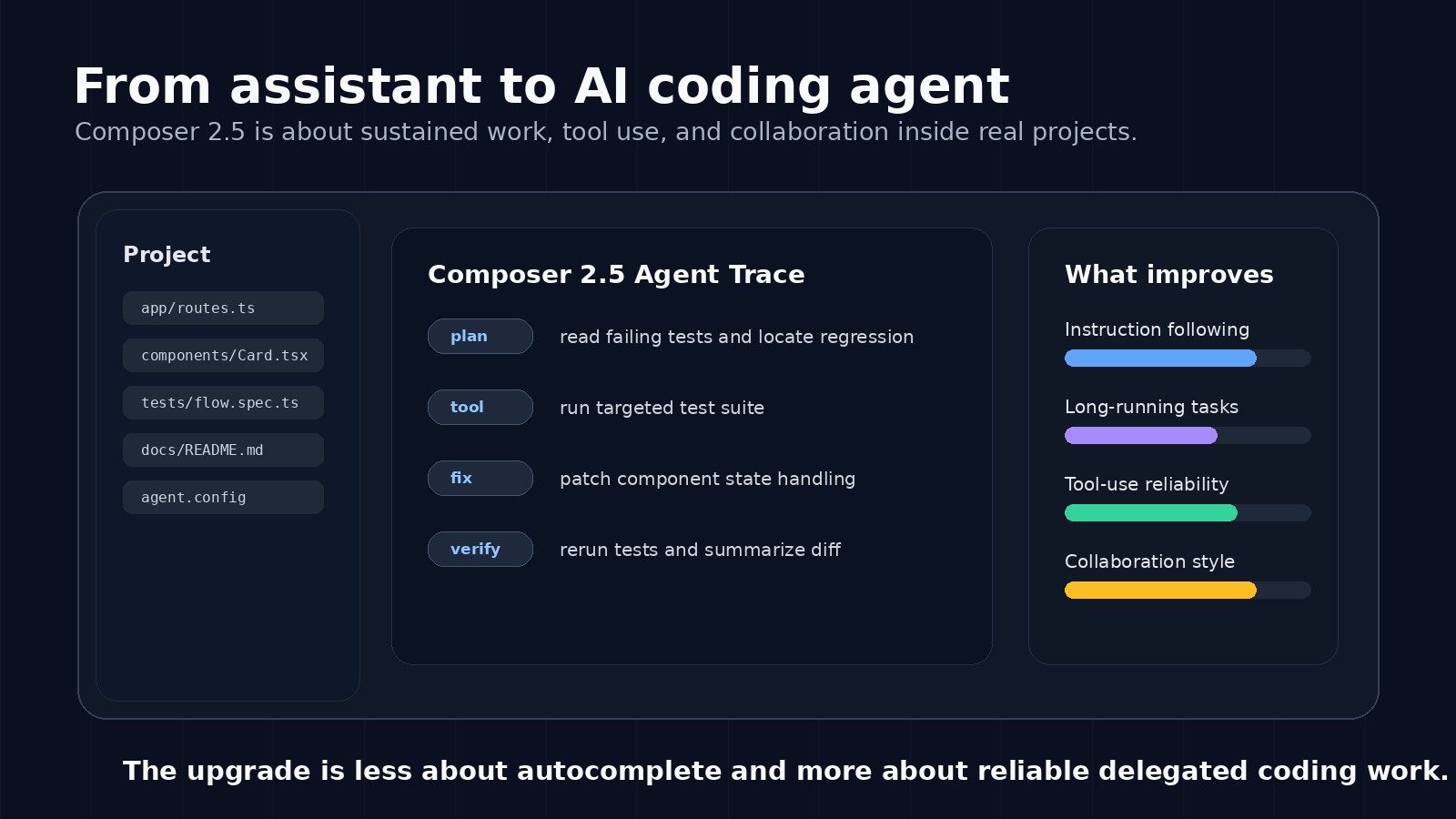
The biggest conceptual shift is the move from assistant to agent. An AI coding assistant waits for a prompt and helps with a piece of work. An AI coding agent can take more initiative inside a controlled environment. It can inspect a repository, use tools, run tests, apply patches, and report what it changed.
This does not mean human developers disappear. It means the role changes. Humans still define goals, review changes, make architecture decisions, and decide what gets merged. But the agent can carry more of the repetitive execution layer.
Composer 2.5 points toward that future. Its training methods are designed around long trajectories, local feedback, synthetic code tasks, and real codebase grounding. Those are exactly the ingredients needed for more reliable agentic coding.
Why this matters beyond coding
The subtitle of this article mentions the upgrade of AI coding agents, but the larger pattern reaches beyond software. Coding is one of the first places where agents become practical because the work has tools, files, tests, and clear verification loops. That makes it a training ground for broader knowledge work automation.
If an AI agent can read a codebase, follow a project rule, use tools, fix a failing test, and summarize the result, similar patterns can apply to other work: reading a policy document, producing a report, updating a website, auditing a spreadsheet, generating a technical article, or preparing a launch plan.
The key is not “AI writes everything.” The key is structured delegation. Humans set the goal and review the output. The agent performs bounded work inside a tool environment. Composer 2.5 is important because it shows how much training focus is moving toward those bounded, tool-using, long-horizon workflows.
Limitations and risks
Composer 2.5 is not magic. The official release itself points to the problem of reward hacking in synthetic training. As models get better, they may discover shortcuts that exploit the environment rather than solve the intended problem. This is not a reason to ignore synthetic data. It is a reason to build stronger monitoring and evaluation systems.
There is also the governance problem. In real teams, an AI coding agent may produce a useful patch, but humans still need to review security, architecture, product intent, and maintainability. Long-running agents increase leverage, but they also increase the need for clear review boundaries.
Finally, there is the workflow problem. A stronger model does not automatically fix bad project structure. If tests are weak, instructions are unclear, or the codebase has no standards, the agent has less grounding. Composer 2.5 may be better, but teams still need clean repositories, good tests, and explicit rules.
What to watch next
The most important thing to watch is not only benchmark scores. Watch the quality of real agent work. Can Composer 2.5 handle longer tasks without drifting? Can it correct itself after a tool failure? Can it preserve project style? Can it produce patches developers actually accept?
Also watch the economics. Cursor lists Composer 2.5 pricing at $0.50 per million input tokens and $2.50 per million output tokens, with a faster variant priced higher. Lower inference costs can matter because agentic coding uses many tokens across long tasks. If agents become cheaper and more reliable, the amount of delegated work can grow quickly.
The bigger trend is clear: AI coding tools are becoming model labs, workflow platforms, and agent environments at the same time. Composer 2.5 is one more sign that the competition is moving from “who has the best chatbot” to “who can train and deploy the most useful work agent.”
Final takeaway
Cursor Composer 2.5 is important because it targets the real bottleneck in AI coding: reliability across long, messy workflows. Directed RL, or Cursor’s targeted RL with textual feedback, gives the model more local behavioral correction. Synthetic data creates harder grounded coding tasks. Together, they push the tool away from simple code completion and toward more dependable AI coding agents.
For developers, this means more capable delegated coding work. For teams, it means new expectations around review, testing, and workflow design. For the broader market, it shows how coding agents may become the blueprint for knowledge work automation platforms.
Quick comparison
Layer | Composer 2 | Composer 2.5 |
Task difficulty | Strong coding model | Harder RL environments and more complex tasks |
Feedback signal | Broader RL signals | Targeted textual feedback at local behavior points |
Synthetic data | Baseline synthetic training | 25x more synthetic tasks than Composer 2 |
Agent behavior | Good interactive assistance | Better long-running work and complex instruction following |
User value | Coding help | More reliable delegated coding workflows |
FAQ
What is Cursor Composer 2.5?
Composer 2.5 is Cursor’s upgraded proprietary model for AI coding workflows, focused on long-running tasks, tool use, and more reliable collaboration inside the Cursor environment.
What is directed RL in Composer 2.5?
The article uses directed RL as a plain-English label, but Cursor’s official term is targeted RL with textual feedback. It means the model receives localized correction at the point where behavior could improve.
Why does synthetic data matter?
Synthetic data lets Cursor create harder coding tasks grounded in real codebases, giving the model more difficult and verifiable training problems.
Is Composer 2.5 just a coding assistant?
No. It is better understood as part of the shift from coding assistants toward AI coding agents that can carry out multi-step work in an IDE.
Does Composer 2.5 replace developers?
No. It increases the amount of work that can be delegated, but humans still need to set goals, review patches, make architecture decisions, and own merge governance.
Related Tools
- Cursor
- Codex
- GitHub
- Kimi
Sources