Could AI Compute Become 10× More Expensive? Dwarkesh Patel’s Anthropic Scenario Explained
For most of the computing era, the direction of travel seemed obvious: chips became more capable, cloud infrastructure expanded, and the effective price of computation fell. AI may

Could AI Compute Become 10× More Expensive? Dwarkesh Patel’s Anthropic Scenario Explained
Introduction
For most of the computing era, the direction of travel seemed obvious: chips became more capable, cloud infrastructure expanded, and the effective price of computation fell.
AI may complicate that pattern.
In a July 29, 2026 essay, technology interviewer and writer Dwarkesh Patel proposed a deliberately aggressive scenario in which frontier AI becomes much better at turning compute into economically valuable work while the physical supply of advanced compute expands much more slowly.
Under that scenario, the market price of high-end AI compute could rise by 10× or more before eventually returning to a long-run path of declining costs.

The argument begins with a provocative comparison.
If an AI agent running on the equivalent of one NVIDIA H100 could perform the work of a highly paid software engineer, why should that GPU continue to rent at a price determined mainly by hardware depreciation and cloud competition?
Why would its price not move closer to the economic value of the labor it can replace or augment?
The source article expands this thought experiment into a broader prediction about AI laboratories, data centers, advanced semiconductor capacity, and the possibility that the world is entering a temporary period of severe compute inflation.
Several boundaries are important from the outset:
- A human-level software engineer running on one H100 equivalent is a hypothetical future capability, not a current benchmark result.
- Anthropic’s official run-rate revenue crossed $47 billion in May 2026, but Patel’s figures of $100–150 billion by year-end and $1 trillion the following year are scenario assumptions, not Anthropic guidance.
- The 10× compute-price outcome is an economic argument, not a confirmed market forecast.
- Cloud GPU prices vary by chip, contract length, utilization, networking, security, and service level; there is no single universal H100 price.
With those caveats in place, the thought experiment is useful because it asks a question the industry often avoids:
What happens when the economic value produced by AI improves faster than the world can manufacture the infrastructure that runs it?
Silicon Labor: When an H100 Starts Looking Like a $250,000 Engineer
The argument begins by changing the unit of comparison.
Today, compute is normally priced as infrastructure:
- Dollars per GPU-hour
- Dollars per token
- Dollars per server month
- Dollars per reserved cluster
- Dollars per watt or megawatt
Patel asks what happens when the same hardware becomes a container for autonomous labor.
Imagine that an AI software engineer can:
- Read a large codebase
- Implement features
- Debug failures
- Run tests
- Review pull requests
- Investigate incidents
- Work continuously
- Produce output comparable with an experienced human engineer
If that agent requires approximately one H100-equivalent unit of compute while operating, the GPU is no longer only a server component. It is part of a digital production system.
The $250,000 Thought Experiment
Patel uses a round figure of $250,000 per year for the market value of a strong Silicon Valley software engineer.
He then compares it with an annualized H100 spot-rental estimate of roughly $16,000.
The implied gap is:
$250,000 / $16,000 ≈ 15.6×
In the simplified thought experiment, a GPU capable of hosting an equivalent digital worker appears dramatically underpriced relative to the labor value it can generate.
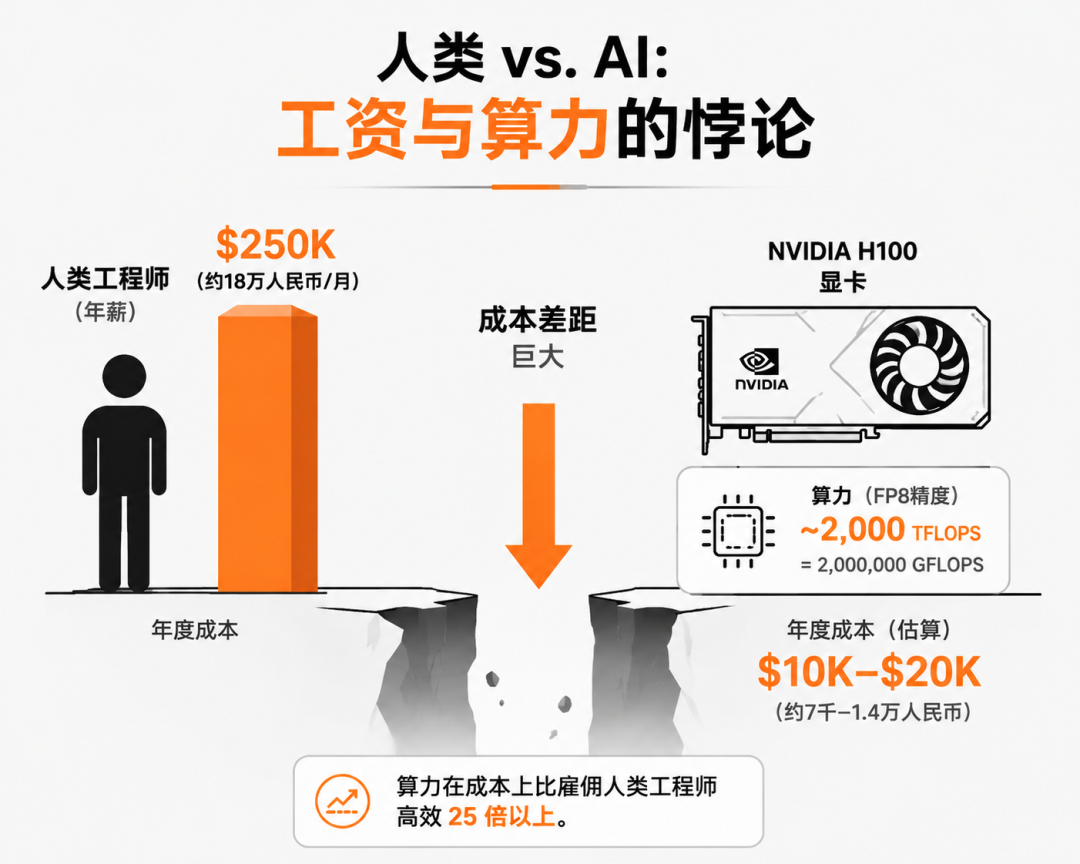
The calculation is not a direct prediction that every H100 will rent for $250,000.
It leaves out several important factors:
- The agent may require more than one H100 equivalent.
- A GPU cannot run at perfect utilization all year.
- Serving infrastructure includes CPUs, memory, networking, storage, electricity, cooling, and operations.
- Human engineers do more than generate code.
- Wages may change if digital labor expands rapidly.
- Model providers may capture much of the economic value through API pricing rather than GPU rent.
- Competition and efficiency improvements may reduce the compute required per task.
Patel’s narrower point is that the willingness to pay for compute can rise sharply when compute becomes capable of producing more valuable outcomes.
Why the Value of Labor May Not Collapse Immediately
A natural objection is that adding millions of AI software engineers would reduce the market value of software-engineering labor.
If software becomes abundant, perhaps one digital engineer would no longer be worth $250,000.
Patel acknowledges that possibility but argues that it is not automatic.
Standard economic reasoning often rejects the idea that there is a fixed quantity of useful work. Additional skilled workers can create new products, new firms, new specializations, and new demand.
In that view, a large increase in capable workers does not merely divide the existing work among more participants. It expands what becomes economically possible.
AI could produce an unusually fast labor-supply shock, so historical comparisons may not hold. Even so, Patel argues that it is plausible for the marginal value of AI-enabled compute to remain high as new software and services become viable.
The Argument Is Strongest in Fully Digital Work
A useful counterargument from the discussion below Patel’s essay is that the labor-value comparison is strongest when the entire task can be completed inside a digital environment.
Software engineering is close to that ideal:
- Inputs are digital.
- Outputs are digital.
- Tests can often be automated.
- Distribution is fast.
- Many feedback loops run at machine speed.
The comparison becomes weaker when physical bottlenecks dominate.
An AI system might design a drug quickly, but clinical trials still require patients, regulation, manufacturing, and time. It might optimize a factory, but construction, permits, supply chains, and equipment remain physical constraints.
In those domains, intelligence may stop being the primary bottleneck before compute can capture the full value of the displaced human labor.
AI Revenue May Be Growing Faster Than AI Compute Supply
The second part of the argument shifts from one GPU to the finances of frontier AI laboratories.
Anthropic provides the main example because its recent revenue growth has been unusually fast.
Anthropic officially reported:
- About $9 billion in run-rate revenue at the end of 2025
- More than $30 billion in run-rate revenue by April 2026
- More than $47 billion in run-rate revenue earlier in May 2026
These are annualized run-rate figures, not full-year audited revenue.
They describe the pace implied by revenue at a point in time.
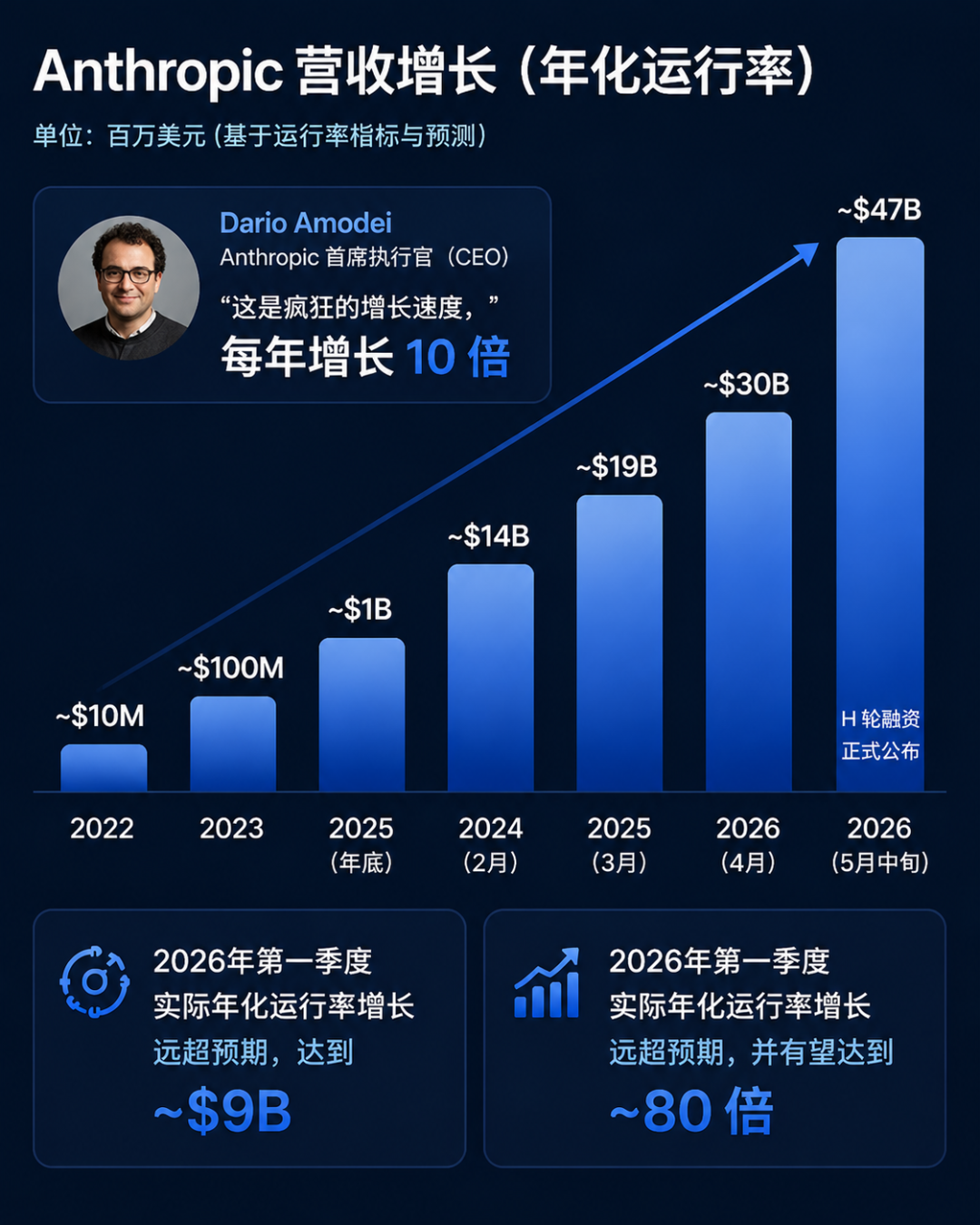
Patel begins from the observation that Anthropic’s revenue had grown by approximately an order of magnitude year over year.
He then constructs a deliberately extreme continuation scenario:
- Anthropic ends 2026 at approximately $100–150 billion in annualized revenue.
- The same broad trend continues.
- By the end of the following year, revenue approaches $1 trillion.
Patel explicitly says there is no deep reason this trajectory must continue. It depends on future AI capabilities, product adoption, pricing, and competition.
The purpose of the scenario is not to claim that Anthropic has forecast $1 trillion in revenue. It is to ask what else would need to be true if an AI company did grow that quickly.
Revenue Growth and Compute Growth Do Not Match
Patel contrasts a hypothetical 10× revenue increase with an estimated 3× annual expansion in AI compute supply.
Epoch AI estimates that the global stock of AI compute roughly tripled in H100-equivalent terms during 2025, although it emphasizes that company-level and future estimates remain uncertain.
The resulting mismatch is approximately:
AI business demand growth: 10×
Physical compute growth:     3×
Gap:                         about 3.3×
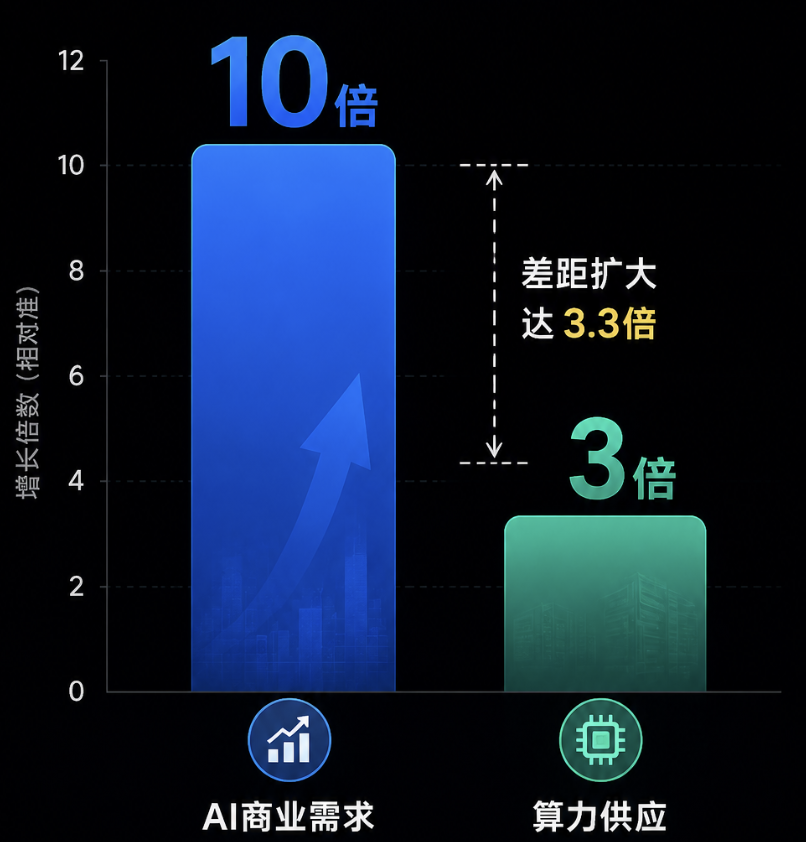
If a frontier laboratory grows revenue much faster than the compute available to it, some combination of three things must change:
- The laboratory earns much higher margins.
- The market price of compute rises.
- A larger share of the laboratory’s compute goes to revenue-producing inference instead of research and training.
Patel argues that all three have already been moving to some degree.
Option 1: Frontier-Lab Margins Rise
A model provider pays a large fixed cost to train a model, then serves the learned capabilities across many customers.
This creates potential economies of scale.
The same trained capability can be sold through:
- Consumer subscriptions
- Enterprise seats
- APIs
- Coding products
- Agent platforms
- Cloud partnerships
The marginal cost of one additional request may be much lower than the value that request creates.
Patel suggests that inference margins have already improved substantially for leading laboratories. However, one of his specific margin figures for Anthropic’s Fable inference is explicitly presented as a rough estimate rather than a verified company disclosure.
High margins can absorb some of the gap between revenue growth and compute growth.
The difficulty is scale.
In Patel’s $1 trillion scenario, margins would need to move toward the mid-90% range if price and compute allocation did not adjust enough. He considers that unusually high, even for a leading technology platform.
The exact required margin depends on many variables, but the broader point remains: margins alone may not be able to reconcile explosive demand with constrained infrastructure.
Option 2: More Compute Moves From Training to Inference
The second option is to allocate a larger share of compute to serving customers.
Epoch AI estimated that OpenAI spent about $1.8 billion on inference compute in 2024, compared with roughly $5 billion on research and development compute. Inference therefore represented around one-quarter of the reported compute expenditure in that estimate.
As commercial usage expands, the inference share can rise.
This helps support revenue, but frontier laboratories face a strategic tension.
Inference pays the current bills.
Training and experimentation produce the models that may define the next generation.
A laboratory that directs most of its compute to serving the current model may generate more immediate revenue but have less infrastructure available for:
- Training larger models
- Running experiments
- Reinforcement learning
- Evaluation
- Data generation
- Architectural research
- Long-horizon model development
Patel describes a Silicon Valley flywheel in which current inference revenue helps justify financing, which purchases more compute, which trains stronger models, which produces more revenue.

The laboratories do not generally behave as though today’s models are the endpoint. They expect current frontier systems to be surpassed quickly.
That makes them reluctant to turn entirely into high-margin cloud providers serving a static model generation.
Option 3: The Price of Frontier Compute Rises
The remaining adjustment is price.
If AI laboratories and their customers can generate much more economic value from each unit of compute, they can afford to bid more aggressively for scarce infrastructure.
That does not mean every GPU-hour rises equally.
Frontier laboratories need a specialized class of compute:
- Large, contiguous clusters
- High-speed interconnects
- Predictable availability
- Strong security
- High utilization
- Stable power
- Fast deployment
- Long-term access
- Protection for model weights and customer data
Spot instances from an open marketplace are not a complete substitute for a secure, multi-year, multi-gigawatt infrastructure contract.
Anthropic and Google’s SpaceX Compute Deals
Recent contracts illustrate the premium placed on immediate capacity.
Anthropic officially confirmed an agreement with SpaceXAI for access to Colossus 1 and later said it had expanded capacity across Colossus 1 and Colossus 2.
SpaceXAI describes Colossus 1 as containing more than 220,000 NVIDIA GPUs across H100, H200, and GB200 systems.
Axios reported that Anthropic agreed to pay approximately $1.25 billion per month through 2029 for the arrangement.
A later regulatory filing reported by TechCrunch said Google would pay SpaceX approximately $920 million per month from October 2026 through June 2029 for access to roughly 110,000 GPUs and related components.
These are not ordinary on-demand cloud purchases.
They reflect the value of quickly obtaining large blocks of functioning infrastructure when new data-center construction, grid interconnection, and chip delivery may take years.
Patel estimates that the implied price per GPU-hour in the Google deal is roughly twice the contemporary spot rate for the relevant blended hardware.
That comparison is approximate because the contract includes more than bare GPUs and the hardware mix includes different accelerator generations.
GPUs Are Becoming Factories, Not Just Servers
The source article uses an industrial analogy.
During the internet era, companies competed for:
- Users
- Traffic
- Distribution
- Search position
- App-store access
Frontier AI competition adds a more physical layer:
- Electricity
- Advanced chips
- Memory
- Data-center land
- Cooling
- Grid connections
- Networking
- Large synchronized clusters
A frontier GPU cluster is closer to an industrial production line than a normal collection of rented servers.
Its output is not a physical product, but economically useful intelligence:
- Code
- Research
- Support
- Design
- Analysis
- Media
- Decisions
- Agent actions
The companies controlling the most capable models and the most reliable compute can potentially produce more of this digital work.
Why Large Laboratories Cannot Rely Only on Spot Markets
Spot capacity has several disadvantages for frontier workloads:
- Instances may be interrupted.
- Hardware may be distributed across locations.
- Network performance can vary.
- Capacity may disappear during demand spikes.
- Security and data-handling requirements may be difficult to satisfy.
- Long training runs require stable, coordinated infrastructure.
A laboratory training or serving a frontier model therefore values guaranteed capacity more than a buyer running a short batch job.
This helps explain why contractual compute can command a premium even when public cloud listings appear cheaper.
The Supply Side Is Constrained by Physical Multipliers
Patel’s argument depends on the claim that compute supply cannot respond quickly enough to a major demand shock.
He summarizes annual compute growth as the product of three broad multipliers:
Annual AI compute growth ≈
1.4× hardware improvement
× 1.2× new fabrication capacity
× 1.8× reallocation of leading-edge wafers toward AI
≈ 3.0×
These figures are estimates rather than immutable physical constants.
They are intended to show where growth has recently come from.
Multiplier 1: Better Chips
Semiconductor improvements increase the useful computation delivered by each watt, chip, and dollar.
Potential gains come from:
- Smaller process nodes
- Better architectures
- Lower-precision arithmetic
- More memory bandwidth
- Advanced packaging
- Faster interconnects
- Better software and kernels
The pace is not unlimited.
Each new process generation becomes harder and more expensive. Power density, leakage, yield, memory movement, and packaging increasingly determine real performance.
AI systems can also become more efficient through model and software improvements, which may offset hardware scarcity. Any compute-price forecast therefore depends on how quickly efficiency improves relative to demand.
Multiplier 2: More Fabs and Equipment
New semiconductor capacity takes years to plan, finance, construct, equip, qualify, and ramp.
The supply chain depends on highly specialized systems, including extreme-ultraviolet lithography equipment.
Advanced fabs also require:
- Skilled labor
- Reliable utilities
- Chemical supply
- Water
- Packaging capacity
- Testing capacity
- Long lead-time equipment
Patel argues that EUV-tool availability constrains rapid expansion through at least the end of the decade.
Higher prices can stimulate investment, but they cannot instantly produce a fully qualified leading-edge factory.
Multiplier 3: Reallocating Existing Advanced Capacity to AI
A large share of recent AI-chip growth has come from shifting advanced manufacturing capacity away from other products.
Smartphones, personal computers, networking chips, and other devices compete for the same leading-edge processes and packaging resources.
Patel cites an estimate that AI’s share of TSMC N3 capacity could rise from around 60% to 86% by the end of 2027.
This is a supply-model estimate, not public capacity guidance from TSMC.
The implication is straightforward: reallocation works only while non-AI demand still occupies capacity that can be displaced.
Once AI already consumes most of the relevant node, that growth lever becomes much weaker.
Other Bottlenecks Can Appear First
Even if wafer supply expands, the system can still be constrained by:
- High-bandwidth memory
- Advanced packaging
- Optical networking
- Transformers and grid equipment
- Data-center construction
- Power generation
- Cooling
- Permitting
- Financing
Compute supply is therefore a chain, not one factory output.
The effective capacity is limited by the slowest critical component.
Why Expensive Compute Could Favor the Best Models
The source then makes a counterintuitive claim: if compute becomes more expensive, buyers may not migrate toward weaker models.
They may prefer the strongest model even more.
Patel connects this to the Alchian–Allen effect.
When a fixed cost is added to goods of different quality, the premium version can become relatively more attractive because the quality surcharge becomes a smaller share of the total price.
A Simplified Example
Assume the underlying compute costs $20 per hour.
A strong model completes the task in one hour and carries a $5 model premium:
Strong model:
$20 compute + $5 premium = $25
A weaker model has no premium but needs two hours because of retries and inefficient reasoning:
Weaker model:
2 × $20 compute = $40
The nominally free model is more expensive per completed task.
The relevant metric is not price per token or model license fee. It is cost per successful outcome.
Efficiency Becomes a Pricing Advantage
A stronger model may reduce cost by using:
- Fewer tokens
- Fewer attempts
- Fewer tool calls
- Less human correction
- Shorter task duration
- Better plans
- More reliable execution
If compute is cheap, the cost of inefficient attempts may be tolerable.
If compute is expensive, wasting it becomes more painful.
The laboratory with the model that extracts the most useful work from each scarce GPU-hour may be able to charge a substantial premium.
This Does Not Mean Small Models Disappear
The strongest version of the source article says mediocre models may have no future.
That conclusion is too broad.
Smaller and specialized models can remain attractive when they offer:
- Lower latency
- Lower memory requirements
- On-device deployment
- Privacy
- Predictable structured output
- Adequate quality for a narrow task
- Much lower compute use
- Open-weight customization
A lightweight classifier does not need to be a frontier coding agent.
The Alchian–Allen argument applies when two models consume similar expensive infrastructure and the weaker model requires significantly more work to reach the same result.
It is weaker when the smaller model is genuinely more efficient for the task.
Some Current AI Applications Could Be Priced Out
Patel argues that rising compute prices could redirect capacity away from low-value uses.
If a GPU can run an agent producing high-value software or business output, the opportunity cost of using the same hardware for disposable media becomes much higher.
This could affect applications such as:
- Low-value short-form content
- Bulk synthetic engagement
- Repetitive image or video generation
- Extremely cheap consumer inference
- Products with weak willingness to pay
The market would not necessarily eliminate the content itself.
It could instead shift it toward:
- Smaller models
- Older hardware
- On-device inference
- Cached output
- More efficient architectures
- Lower-resolution generation
- Off-peak capacity
The key is allocation.
Scarce frontier compute will tend to move toward workloads with the highest willingness to pay.
Why the Prediction Could Be Wrong
The source article also presents several objections.
These are important because predictions of permanent resource scarcity have often failed.
Counterargument 1: Human Labor Is the Wrong Price Anchor
The $250,000 engineer comparison assumes the GPU can capture something close to the engineer’s current economic value.
That may fail for several reasons:
- Software-engineering wages could fall.
- AI may create output that is abundant but difficult to monetize.
- Human trust, responsibility, relationships, and judgment may remain valuable.
- The agent may need supervision.
- Physical-world bottlenecks may dominate.
- Competition may push model prices toward cost.
One commenter suggested that the initial value of the digital worker could be high but might settle closer to $50,000 once AI labor becomes abundant.
Under that assumption, compute could still become more valuable without rising 15×.
Counterargument 2: Efficiency Gains Could Outrun Demand
Token prices are not identical to compute prices.
Models and serving systems continue to improve through:
- Quantization
- Distillation
- Sparsity
- Better kernels
- Speculative decoding
- Caching
- Routing
- Improved architectures
- Better hardware utilization
A future low-value video or chat response may require a much smaller fraction of the compute it uses today.
Even if frontier-agent compute becomes expensive, commodity AI services may continue to get cheaper because they migrate to more efficient models and hardware.
Counterargument 3: Open Models Increase Competition
Open-weight models can place pressure on frontier API pricing.
If several models provide similar capability, users can switch among:
- Hosted commercial APIs
- Open-weight cloud deployments
- Private clusters
- Domestic providers
- Specialized models
This limits the ability of one laboratory to capture extremely high margins.
Compute scarcity can still raise the underlying infrastructure cost, but model competition determines how much of that value the laboratory retains.
Counterargument 4: Supply Responds to High Prices
The classic response to scarcity is investment.
Higher compute prices encourage:
- More fabs
- More packaging capacity
- More memory production
- More power generation
- Better cooling
- Alternative accelerators
- New cloud providers
- More efficient software
Patel agrees that compute should eventually become cheap again.
His claim is about the current transition period, when demand may move faster than long-lead physical infrastructure can respond.
The Simon–Ehrlich Wager
The source compares the compute prediction with the famous wager between biologist Paul Ehrlich and economist Julian Simon.
In 1980, Ehrlich selected a basket of five metals and bet that their real price would rise over the following decade.
By 1990, the inflation-adjusted price of the basket had fallen, and Ehrlich paid Simon.
The wager is often used to argue that scarcity predictions underestimate innovation, substitution, and supply response.
Historical interpretation is more complicated. Analyses have noted that a different starting decade could have produced a different winner.
Patel concedes that his compute thesis resembles scarcity forecasts that have frequently been wrong.
He argues that compute may differ from metal extraction because its short-run supply is less elastic:
- There are few substitutes for leading-edge AI accelerators.
- Advanced fabs cannot appear quickly.
- EUV tools are produced by a highly concentrated supply chain.
- Data-center power and networking take time.
- Frontier laboratories require large coordinated clusters, not arbitrary commodity chips.
The disagreement is therefore largely about timing.
Will price signals and innovation expand effective compute supply before AI demand overwhelms the current buildout?
A More Balanced Compute-Price Framework
Rather than treating “10×” as a fixed forecast, the argument can be converted into a set of measurable variables.
Demand-Side Variables
- Frontier-model capability growth
- Revenue per GPU-hour
- Agent adoption
- Enterprise willingness to pay
- Degree of labor substitution
- New applications created
- Inference share of compute
- Model-provider margins
Supply-Side Variables
- Accelerator shipments
- Hardware performance per watt
- Advanced-node wafer supply
- Packaging capacity
- High-bandwidth-memory supply
- Data-center power
- Grid connection speed
- Cluster utilization
- Serving efficiency
- Alternative chips
Market-Structure Variables
- Number of competitive frontier models
- Open-weight model quality
- Cloud-provider concentration
- Long-term infrastructure contracts
- Geographic and regulatory constraints
- Capital availability
- Ability to route workloads to cheaper models
A 10× price increase becomes more plausible if:
- Capability and monetization improve rapidly.
- Frontier laboratories bid against one another for limited clusters.
- Supply expands only around 3× annually.
- Efficiency gains do not offset demand.
- One or two laboratories maintain a meaningful quality lead.
It becomes less plausible if:
- Capability growth slows.
- Revenue growth normalizes.
- Open models become close substitutes.
- Efficient smaller models absorb most workloads.
- New hardware and power arrive faster than expected.
- Software substantially reduces compute per completed task.
What the Scenario Means for AI Companies
Even if compute does not rise 10×, the argument has practical implications.
Measure Cost per Completed Task
Track:
- Total input and output tokens
- Reasoning tokens
- Tool calls
- Retry count
- Human correction time
- End-to-end latency
- Success rate
- Infrastructure cost
A cheaper model is not cheaper if it fails repeatedly.
Use Model Routing
Reserve expensive frontier models for tasks that genuinely benefit from them.
Use smaller models for:
- Classification
- Extraction
- Routing
- Formatting
- Repetitive structured operations
Escalate only difficult cases.
Design for Compute Portability
Avoid binding the entire product to one model or one GPU provider.
Useful abstractions include:
- Model gateways
- Evaluation suites
- Portable prompts
- Provider-independent memory
- Multiple hardware backends
- Batch and asynchronous execution
Optimize Context and Tool Use
Long agent loops can waste compute through repeated context and oversized tool output.
Improve:
- Prompt caching
- Context retrieval
- Tool-output filtering
- Retry policies
- Termination conditions
- Parallel execution
- Result validation
Secure Capacity Before It Is Needed
Companies with predictable demand may benefit from:
- Reserved instances
- Multi-year cloud contracts
- Committed-use discounts
- Multiple infrastructure partners
- On-premises capacity for stable workloads
The correct strategy depends on utilization. Reserved hardware is expensive when idle.
What the Scenario Means for Investors and Policymakers
The thesis also shifts attention from model benchmarks toward infrastructure.
Important areas include:
- Advanced semiconductor manufacturing
- Lithography
- High-bandwidth memory
- Packaging
- Data-center power
- Transformers
- Optical networking
- Cooling
- Grid infrastructure
- Cloud financing
If intelligence becomes a major economic input, control over these layers becomes strategically important.
The result could be concentration.
A laboratory with the best model and the strongest revenue may outbid new entrants for scarce compute. That compute helps it improve the model, which strengthens revenue and makes the next bid easier.
This is a reinforcing loop:
Better model
    ↓
More valuable products
    ↓
More revenue
    ↓
More compute access
    ↓
More training and inference
    ↓
Better model
The risk is that intelligence production becomes concentrated among a small number of firms able to finance enormous infrastructure commitments.
常见问题
Why does Dwarkesh Patel think AI compute could become 10× more expensive?
Patel argues that smarter AI models may generate far more revenue from each unit of compute while the physical supply of advanced compute grows much more slowly. If demand and willingness to pay rise faster than chip, power, and data-center supply, market prices can increase sharply.
Is Anthropic forecasting $1 trillion in annual revenue?
No. Anthropic officially reported that its annualized run-rate revenue crossed $47 billion in May 2026. The $100–150 billion year-end figure and $1 trillion following-year figure are assumptions in Patel’s thought experiment, not company guidance.
Why compare an H100 with a $250,000 software engineer?
The comparison asks how compute might be priced if one H100-equivalent system could host an AI agent performing work comparable with a highly paid engineer. It is a hypothetical value benchmark, not evidence that current agents replace one engineer per H100.
How fast is global AI compute growing?
Epoch AI estimates that the global stock of AI compute roughly tripled in H100-equivalent terms during 2025. Future growth is uncertain and depends on chip performance, manufacturing, packaging, power, construction, and capital spending.
Why can frontier-lab compute cost more than public spot GPU prices?
Frontier laboratories need secure, reliable, large-scale clusters with high-speed networking and predictable long-term availability. A public spot instance is not equivalent to a dedicated multi-year deployment containing hundreds of thousands of coordinated accelerators.
Does expensive compute always favor the strongest model?
No. It can favor a stronger model when that model reaches the same outcome with fewer tokens, retries, or hours. Smaller specialized models can still be more economical for narrow, low-latency, private, or on-device workloads.
Will AI compute stay expensive forever?
Patel does not argue that compute remains expensive permanently. His thesis concerns a transition period in which AI demand may outpace the ability of the semiconductor and data-center supply chain to expand; in the longer term, hardware and automation could make compute cheaper again.
What evidence would disprove the 10× compute-price scenario?
The thesis weakens if AI revenue growth slows, model capability plateaus, open models become close substitutes, serving efficiency improves faster than demand, or semiconductor and power supply expand more rapidly than expected.
相关工具
- Epoch AI: Research and data on AI compute, model scaling, infrastructure, and frontier-lab economics.
- NVIDIA H100 Tensor Core GPU: NVIDIA’s official specifications for the accelerator used as the central unit in Patel’s thought experiment.
- AWS EC2 P5 Instances: Amazon’s official cloud instances built around NVIDIA H100 GPUs for large AI workloads.
- Google Cloud A3 Virtual Machines: Google Cloud documentation for GPU-backed compute, including accelerator availability and configuration.
- CoreWeave Cloud GPU: A specialist cloud platform offering large-scale GPU infrastructure for AI workloads.
- NVIDIA Triton Inference Server: An inference-serving system for improving utilization, batching, and deployment efficiency across AI models.
Related Links
- Dwarkesh Patel: Why Compute Might Get 10× More Expensive: The original essay presenting the H100 labor-value scenario and compute-scarcity argument.
- Anthropic Series H Announcement: Anthropic’s official May 2026 announcement confirming more than $47 billion in run-rate revenue and major compute partnerships.
- Anthropic–Google–Broadcom Compute Partnership: Anthropic’s official description of its multi-gigawatt TPU expansion and $30 billion run-rate milestone.
- SpaceXAI Compute Partnership With Anthropic: The official announcement granting Anthropic access to the Colossus 1 GPU cluster.
- Epoch AI: Frontier Labs Don’t Use Most AI Compute Yet: Estimates of global AI compute, frontier-lab shares, growth rates, and infrastructure constraints.
- Epoch AI: OpenAI’s 2024 Compute Spending: An estimate of the split between OpenAI research, training, and inference compute in 2024.
- AI Supercomputer Trends: Research on the growth of AI supercomputer performance, hardware cost, chip counts, and power demand.
Summary
Dwarkesh Patel’s 10× compute-price thesis begins with a simple idea: if a GPU can host an AI agent that performs highly valuable knowledge work, the willingness to pay for that GPU may move toward the value of the work rather than the historical cost of a server.
The argument becomes more forceful when paired with Anthropic’s rapid revenue growth and estimates that global AI compute has been expanding at roughly 3× per year. If AI business demand grows much faster, the adjustment must appear through margins, the allocation of compute, higher infrastructure prices, or some combination of the three.
The prediction is far from certain. Efficiency, open models, smaller specialized systems, additional fabs, new accelerators, and slower capability growth could prevent a 10× increase. Historical resource-scarcity forecasts have also often underestimated adaptation.
The durable insight is not that compute must rise exactly 10×; it is that smarter AI can increase the economic value of each GPU faster than the physical world can manufacture and power new ones.