Copilot Can Now Read Meeting Images: How We0.ai's Customer Case Pages Let AI Understand Screenshots, Charts, and Project Results?
Copilot can now see screenshots, charts, and meeting images. This article breaks down how We0.ai's customer case pages turn project results, screenshots, and evidence into display pages that AI can understand, cite, and recommend.
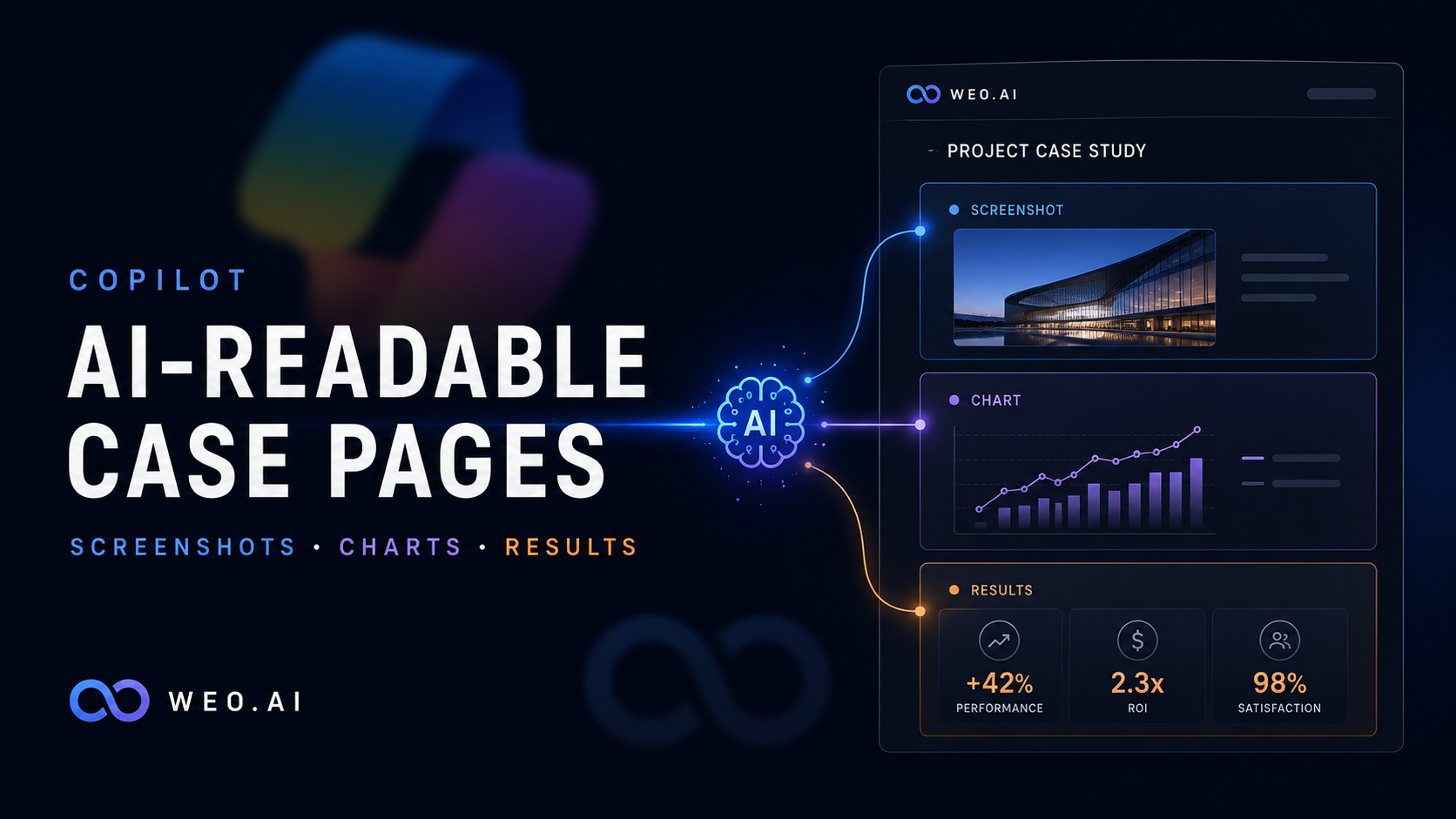
Copilot Can Now Read Meeting Images: How We0.ai's Customer Case Pages Let AI Understand Screenshots, Charts, and Project Results?
In the past, when people created customer case pages, they basically focused on three things:
Brand name, a few screenshots, and a few lines describing results.
It looked like a case study.
But in many cases, it was really just for human eyes.
That's changed now.
Products like Copilot have begun to understand images, screenshots, charts, dashboards, and even operation interfaces inside pages. In other words, AI isn't just "seeing" anymore—it's starting to "comprehend."
Once this holds true, the logic of customer case pages shifts.
Before, you were writing for people to read.
Now you also have to consider: Can AI quickly grasp what this case actually did, what the results were, and where the evidence is?
This is where a We0.ai customer case page truly earns its keep.
It's not about piling up assets.
It's about organizing those assets into a growth narrative that AI can understand too.
Why Screenshots, Charts, and Results Pages Suddenly Matter
Because AI is increasingly acting like a "second reader."
It scans images first, then headlines, then structure, and only then decides whether your case is worth citing, summarizing, or recommending.
If your page looks like this:
| Page State | What AI Might Read |
|---|---|
| Only large images, no captions | This is an image, but the key point is unclear |
| Only results, no evidence | Conclusion exists, but credibility is insufficient |
| Only screenshots, no structure | Lots of information, but no clear thread |
| Screenshots + charts + conclusions + methodology | AI can easily restate it and cite it |
That's the difference.
It's not about "having content" but about "whether content can be understood by machines."
And customer case pages are exactly the kind of page best suited for this.
They naturally should carry:
- Project background
- Solution
- Process screenshots
- Chart evidence
- Before-and-after comparison
- Results summary
In other words, a case page was always meant to be a structured evidence page.
With Copilot Able to Read Images, How Should Pages Be Designed?
If you're still making case pages as "a few images + a paragraph," that's a wasted opportunity.
A better approach is to break the page into modules that are easy for AI to understand.
1) Turn Screenshots into "Explainable Evidence"
Don't just paste screenshots.
Give them a conclusion.
For example:
- What process this image shows was shortened
- What feature this image proves actually went live
- Which customer pain point this image addresses
A screenshot without explanation is just an asset.
A screenshot with explanation is evidence.
2) Turn Charts into "Results Language"
Charts have one big problem: they can look highly professional while nobody knows what they're saying.
So on case pages, charts are best paired with this structure:
- What the metric is
- Why it matters
- When the change happened
- How the change relates to the solution
When AI reads content like this, it can more easily translate "images" into "conclusions."
3) Write Project Results as Short Statements, Not Long Paragraphs
Don't be too scattered.
This approach works better:
- Conversion rate up 27%
- Sales follow-up time reduced by 40%
- Customer decision cycle cut from 14 days to 7 days
These kinds of sentences are easy for both AI and people to grasp.
They're also ideal for page summaries, search snippets, and even repurposing in future content.
How Should the We0.ai Customer Case Page Ride This Shift?
We0.ai doesn't just build the page.
More importantly, it turns the page into an asset that can showcase, grow, and acquire customers.
So customer case pages can't just stop at "presenting results."
They also need to do three things:
- Let people instantly understand what you did
- Let AI quickly understand your results too
- Make search engines and recommendation systems want to cite you
That's where We0.ai fits in well.
It's not just building a webpage; it's putting the official site, case pages, content pages, and inquiry pages all into one growth pipeline.
A More Practical Case Page Structure
| Module | Purpose |
|---|---|
| Hero Section | State the case clearly in one sentence |
| Problem Definition | Tell readers where the bottleneck originally was |
| Solution Breakdown | Explain how We0.ai or the project plan worked |
| Screenshots / Charts | Provide evidence, not empty claims |
| Results Summary | Present outcomes in short statements |
| FAQ | Answer search intent |
| CTA | Encourage further inquiries or viewing the solution |
The core of this structure isn't good looks. It's readability.
You Can Think of a Case Page as a "Resume for AI"
This point matters a lot.
A case page isn't just for potential customers.
It's also for AI.
If the page contains:
- Clear headlines
- Clear problems
- Process evidence
- Results data
- Reusable conclusions
Then it becomes easy to understand, summarize, and recommend.
Conversely, if the page only has lines like "We're very professional," "We deeply understand growth," and "Our clients are very satisfied," AI will read it too, but it will struggle to distill meaningful information.
AI isn't afraid of too little information. It's afraid of messy information.
The Conclusion Is Simple: Case Pages Are No Longer Display Boards—They're Comprehension Layers
Copilot reading images might seem like a feature upgrade on the surface.
But in reality, it's forcing every website to reorganize its information.
So the most important thing for We0.ai's customer case pages isn't "more images," but:
- Clearer structure
- More explicit evidence
- Shorter conclusions
- Stronger readability
- Page hierarchy better suited for AI understanding
A page that humans can understand merely passes the bar.
A page that AI can understand is where real growth value begins.
FAQ
Q1: Can Copilot really understand screenshots and charts?
Yes. Microsoft has publicly stated that Copilot can process text, images, charts, tables, dashboards, screen interfaces, and more.
Q2: Why should customer case pages consider AI readability?
Because search, summarization, recommendation, and content citation increasingly depend on structured understanding. If AI can understand the page, it's more likely to be summarized and referenced.
Q3: Isn't visuals the most important thing on a case page?
No. What matters most is the combination of "images + captions + results + structure."
Q4: What can We0.ai do in this regard?
We0.ai can turn case pages into pages better suited for presentation, search, and growth, rather than just a static display page.
Related Tools
Reference Sources
- Microsoft Support — How vision in Microsoft 365 Copilot works
- Microsoft Support — Data, Privacy, and Security for Microsoft 365 Copilot
- Microsoft Support — Supported languages for Microsoft 365 Copilot
com/en-us/microsoft-365-copilot/supported-languages-for-microsoft-365-copilot)
Related Reading / Internal Link Suggestions
- How should case study pages be written to serve both SEO and conversions?
- Why do showcase websites build assets more effectively than single-page landing pages?
- After AI generates a website, the real value lies in the growth stage that follows.
Ready to Get Started?
If you already have screenshots, charts, and project results but haven't turned them into a page that people can understand and AI can process, it's time to redesign your case study pages.
We0.ai can help you turn a showcase page into a growth page.
Not just going live.
But continuing to capture leads after launch.
Summary
Copilot reading images isn't just an AI capability upgrade.
It's also a reminder for everyone building corporate websites, case study pages, and content pages:
Pages are no longer just "displaying content" — they are "organizing understanding."
Whoever organizes screenshots, charts, and project results more clearly will be more likely to be seen, understood, and converted.