Comparison of AI-powered lead generation website tools for 2026: How to choose between We0 AI, Unbounce, Framer, and Webflow?
A clear breakdown of the core differences between We0 AI, Unbounce, Framer, and Webflow for building AI-driven lead generation websites in 2026: which is best for fast conversions, which for brand design, which for long-term SEO growth, and which truly turns your website into a lead asset.
2026 AI-Driven Lead Generation Website Tool Comparison: We0 AI, Unbounce, Framer, Webflow — Which One Should You Choose?
As we head into 2026, many people are still asking an old question: Which AI website builder is faster?
But honestly, that question is already outdated.
What you should really be asking now isn't "which one generates pages faster," but rather: Which one can turn your website into a long-term asset that continuously generates leads?
Because the reality is harsh.
Some tools can indeed get you a page live in 30 minutes.
But going live doesn't mean people will see it.
People seeing it doesn't mean they'll leave their contact info.
And leaving contact info doesn't guarantee it'll keep bringing in inquiries over time.
That's why these four tools — We0 AI, Unbounce, Framer, and Webflow — are often compared side by side, yet they fundamentally solve very different problems.
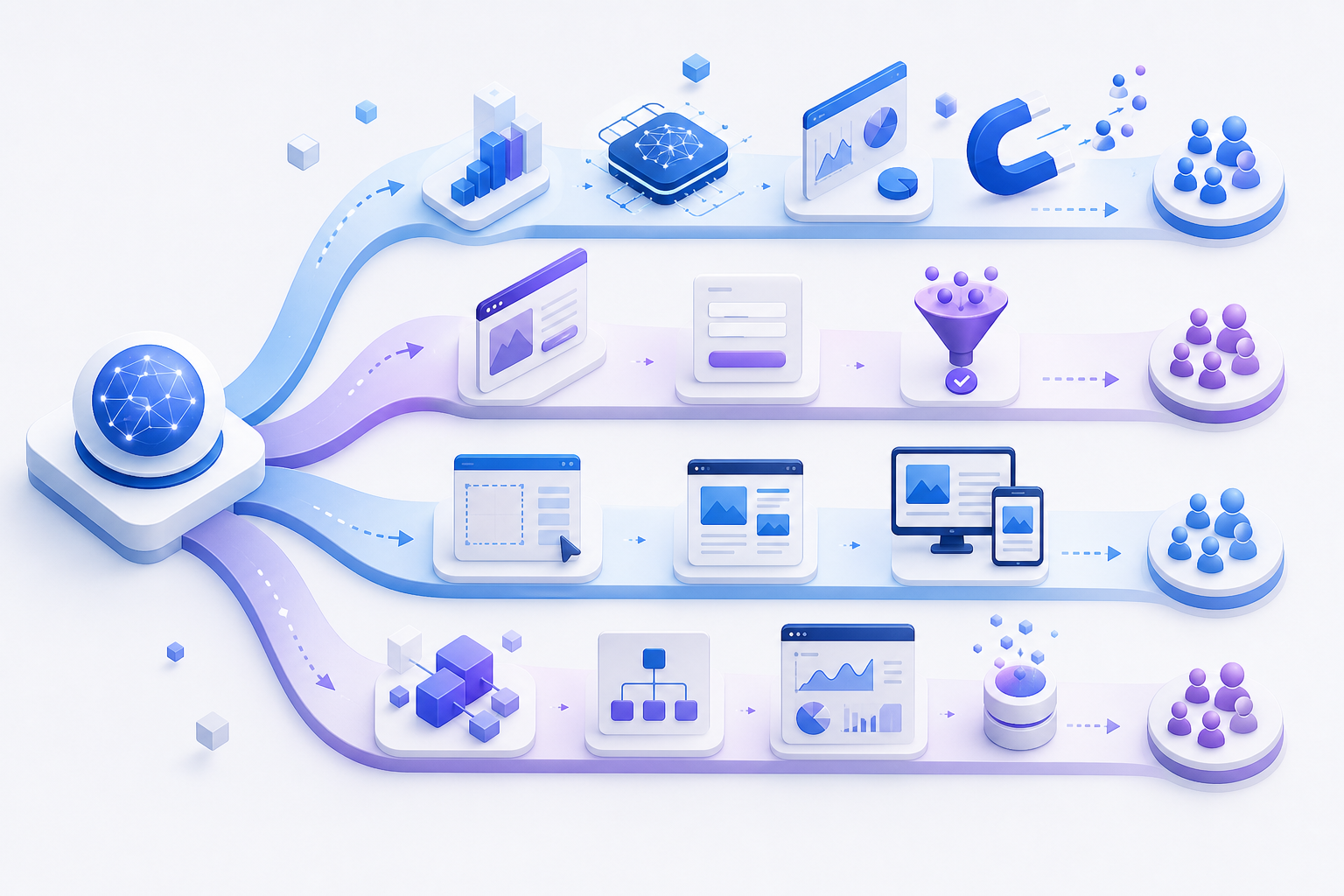
The Bottom Line First: These 4 Tools Suit 4 Completely Different Types of People
If you're short on time, start here:
| Tool | Best Suited For | Core Strengths | Biggest Weakness |
|---|---|---|---|
| We0 AI | Teams, independent developers, consultants, and foreign trade/service businesses that want their website to be a long-term lead generation asset | Integrated website building + SEO/GEO + content + growth + lead management all in one | Not ideal for those wanting a very lightweight, one-time landing page |
| Unbounce | Ad campaign teams, growth teams, and those needing fast conversion testing | Landing pages, A/B testing, Smart Traffic, mature conversion optimization | More campaign-first, not a complete website growth system |
| Framer | Teams that prioritize page aesthetics, design expression, and visual control | High design freedom, fast AI-assisted page building, great for making campaigns look stunning | Lead generation growth pipeline needs to be built separately; long-term SEO capabilities are less comprehensive |
| Webflow | Teams needing strong visual building + CMS + structured content + high scalability | Robust design, CMS, code extensibility, AI workflows, strong team collaboration | Higher learning curve and maintenance cost; not all teams want that level of complexity |
A One-Liner to Help You Decide
- If you just want to maximize landing page conversion rates, go with Unbounce.
- If you just want your website to look cooler and more design-forward, go with Framer.
- If you want a flexible, scalable, professional-grade website system, go with Webflow.
- If you don't just want "a website," but "a website that continuously grows and captures leads," go with We0 AI.
This difference is critical.
Because you're not just choosing a tool name.
What you're really choosing is how you'll run your website for the next 12 months.
Why, in 2026, Choosing a Website Builder Can No Longer Be Just About "Building Fast"
A few years ago, AI website builders were all about one thing:
Type a prompt, get a website.
Sounded great.
But today, people are slowly realizing that's just the first 5% of the work.
The real headache is the remaining 95%:
- Is the page structure search-friendly and conversion-friendly?
- Can the content be updated continuously?
- Can the website capture both branded and long-tail search traffic?
- Is there a system for ongoing optimization after the page is live?
- Is there a way to move from "display" to "inquiry" and "lead generation"?
In short, the dividing line in 2026 is no longer build, but grow.
Being able to create a site is no longer a barrier.
Being able to continuously generate leads is the real barrier.

We0 AI: It's Not Just an AI Website Builder — It's a Lead Generation Growth Platform for Showcase Sites
Let's start with We0 AI.
Because it's the most easily misunderstood.
Many people, at first glance, think it's just another AI website builder.
But understanding it that way means underestimating it.
The core of We0 AI isn't "helping you generate a webpage." It's helping you build a website that's truly ready to launch, operate, grow, and continuously generate leads — faster.
It's more like this chain:
Build -> Showcase -> Grow -> Leads
Meaning:
Build your site -> Showcase products/services/case studies -> Gain SEO/GEO/AI-recommended traffic -> Generate leads and customers
This is a massive difference from ordinary page builders.
What Scenarios Does We0 AI Fit Best?
It's especially great for:
- SaaS / AI product teams building product websites, feature pages, pricing pages, and case study pages
- Independent developers creating project showcase pages, launch pages, and waitlist pages
- Consultants, agencies, and service providers making service introduction and lead capture pages
- Foreign trade companies creating multilingual showcase sites, product pages, and inquiry pages
- Creators, experts, and personal brands making portfolios, consultation pages, and content sites
What Is We0 AI Really Good At?
It's not about having tons of templates.
It's not just about one-off AI page generation either.
What it really emphasizes is:
- Site structure planning
- Page content organization
- SEO / GEO foundational setup
- Continuous content creation and publishing
- Traffic data monitoring
- Growth suggestions and reviews
- Ensuring the website actually captures inquiries and customers
In other words, We0 AI isn't selling the "act of building a website."
It's selling: how to make your website asset work for you over the long term.
That's why, if your goal is lead generation — not just a pretty homepage — We0 AI provides a more complete solution.
Unbounce: If Conversion Testing Is What You Need, It's Still a Contender
Unbounce has always been very clear about its positioning.
It's not going after the "complete website system" market.
It's more like: making landing pages mature enough, easy enough to use, and conversion-focused enough.
Based on its official messaging, it heavily emphasizes a few things:
- Quickly create personalized landing pages
- Drag-and-drop page building
- Create page variants and run no-code A/B testing
- Smart Traffic uses AI for traffic allocation and optimization
- Supports dynamic text replacement to better match search intent
So you'll notice Unbounce's focus has never been "websites," but campaigns.
Who Is Unbounce Best For?
- People running ads
- People running growth experiments
- People who need to quickly validate offers, copy, and page structures
- People with high-volume campaign page needs
Its Advantages Are Very Clear
First, strong conversion perspective.
It was designed from the start to make pages easier to convert, not to serve as a full-site content system.
Second, mature testing loop.
Creating variants, running experiments, and reviewing data is much more intuitive for marketing teams.
Third, AI optimization is more performance-focused.
Capabilities like Smart Traffic are clearly aimed at improving traffic allocation efficiency, not solving whole-site content growth.
But It Also Has Boundaries
The boundaries are equally clear.
Unbounce excels, but it excels at "single-point conversions."
It is not strong as a "long-term website growth system."
If your goal today is:
- Running ads
- Validating landing pages
- Quickly improving landing page conversion rates
Then it is a perfect fit.
But if your goal shifts to:
- Building a brand website
- Creating a content site
- Implementing long-tail SEO strategies
- Maintaining a continuously updated system of case studies, blogs, and feature pages
You will gradually feel its limitations.
So you can think of it this way:
Unbounce is more like a "conversion engine."
But it is not a complete operating system for website growth.
Framer: More of a Design-Driven Modern Website Tool, Not a Pure Lead Gen Tool
Framer has become very popular in the last two years, and for good reason.
It truly combines "design aesthetics" with "speed of publishing."
Looking at its official comparison page with Unbounce, Framer emphasizes these points:
- AI-assisted page creation
- Visual design capabilities
- Reusable sections / components
- CMS
- SEO
- Hosting and publishing
- Integration of campaign pages with the main site
What does this mean?
It means Framer's message is:
I am not just letting you create a landing page; I am enabling you to incorporate campaign pages into your overall website system.
This is fundamentally different from Unbounce's logic.
Who is Framer Best For?
- Teams with high standards for visual quality
- People who want their marketing team to publish pages more independently
- Those who need both campaign pages and consistency with the main site
- Individuals seeking design control without complete reliance on engineering
Framer's Strengths
First, strong page expressiveness.
If you care deeply about whether a website "looks premium," Framer's appeal is significant.
Second, it transitions more smoothly from single pages to full sites compared to Unbounce.
The official narrative consistently emphasizes: landing pages should not be isolated from the main site.
Third, CMS + SEO + hosting make it more complete than a pure landing page tool.
But There's a Catch
Framer is excellent for making a site beautiful, unified, and modern.
However, if your goal isn't just "to build a good site," but "to have the site consistently generate leads," you still need to ask a few questions:
- Who will handle your content strategy?
- Who will continuously implement long-tail SEO?
- Who will review data after monitoring?
- Who will make ongoing adjustments after pages go live?
- How will the site transition from presentation to generating inquiries?
Framer isn't incapable of doing these things.
But its core strength remains primarily in design + publishing workflow.
So, it is an excellent modern website platform.
But it is not inherently a "lead generation growth platform."
This point is crucial.
Framer is great for making a website a work of art.
But it does not naturally help you turn a website into a long-term lead generation asset.
Webflow: Very Capable, But Be Prepared for Its Complexity
Webflow has always positioned itself more as a "platform" than many other tools.
Looking at its AI page, Webflow now emphasizes:
- AI site builder
- Copy generation
- Code component generation
- CMS item generation
- Page section modification
- SEO / AEO optimization suggestions
- Personalization / experimentation
- Localization
- MCP server and more AI workflow connections
Simply put, Webflow aims to provide everything:
From site building, to management, to optimization, to internationalization, to expansion.
This is also where its strength lies.
Who is Webflow Best For?
- Professional marketing / design / content teams
- Sites requiring CMS and structured content
- People needing greater extensibility and control
- Larger teams with long-term site system planning
Webflow's Strengths
First, it is truly comprehensive.
Site building, CMS, SEO, AEO, code extensions, AI workflows, experimentation, and personalization are all essentially within one platform.
Second, it is suitable for complex site structures.
The value of Webflow becomes particularly evident when your site isn't just a few pages but includes a content center, industry pages, a case study library, and a resource page.
Third, it offers more long-term flexibility than many "lightweight AI site builders."
But Don't Overlook the Cost
Webflow is powerful because it is a platform.
But the other side of being a platform is:
It is not the lightest option.
It is also not the least demanding on your brain.
You often have to face these realities:
- Higher learning curve
- More complex operations and maintenance
- Need for clear team collaboration and permission management
- Not every business requires such a heavy system
So, Webflow is great for teams with a clear website operation capability.
But if you already lack content, structure, and growth rhythm, Webflow won't automatically fill those gaps.
It gives you a powerful toolbox.
It does not directly hand you a "growth result."
The Real Dividing Line Between the Four Tools Is Not AI, But Website Operation Logic
Many articles like to compare based on "AI generation quality," "number of templates," or "drag-and-drop experience."
These comparisons are possible.
But honestly, they are no longer sufficient.
The truly useful dividing line is actually the following four types of operational logic:
| Dimension | We0 AI | Unbounce | Framer | Webflow |
|---|---|---|---|---|
| Core Positioning | Showcase site growth & lead gen platform | Conversion-focused landing page tool | Design-driven website platform | Platform-based site building & operation system |
| Main Focus | Long-term traffic, content, SEO/GEO, leads | Experimentation, ad campaigns, page conversion | Design experience, publishing efficiency, brand unity | CMS, scalability, structured operations |
| Relationship Between Pages & Main Site | Builds in a complete site & growth asset mindset from the start | Often favors independent campaign pages | Tendency to integrate campaigns into the main site | Can handle complete full-site structure |
| AI Value | Helps you build a site that is operational and growth-oriented faster | Helps optimize conversion efficiency | Helps you generate and adjust pages faster | Helps accelerate site building, content, optimization, and expansion |
| SEO / Content Continuity | Strongly relevant, a core part of the chain | Relatively weak | Exists, but not the strongest focus | Strong, but requires team effort to operate |
| Ultimate Goal | Website becomes a lead generation asset | Improve page conversion | Make the site look better and more unified | Make the site system stronger and more controllable |
The Most Important Thing in This Table is Not "Who Has More Features"
It is:
Whose default approach aligns with your business goals.
Because choosing the wrong tool isn't just a matter of adding feature patches later.
It's about the entire website trajectory becoming increasingly awkward.
If you fundamentally want SEO growth but choose a campaign-first tool.
If you basically just want to run ad pages but choose a platform geared towards heavy site management.
In both cases, it will become exhausting.
How to Choose? Here Are 4 Practical Decision Points
1) If You Care Most About Ad Conversion
Choose Unbounce.
The reason is simple.
What you need most right now is not a complex site system, but:
- Quick page building
- Fast testing capabilities
- Rapid conversion optimization
Quickly validate traffic quality.
For that, Unbounce has the smoothest logic.
2) If your top priority is a premium look and design control
Choose Framer.
Especially when brand identity matters, page presentation is key, and your marketing team wants to ship sites quickly, Framer will feel great.
3) If your top priority is complex site capabilities and scalability
Choose Webflow.
Especially when you have complex content systems, intricate structures, need a CMS, and need to connect with various AI/code workflows, Webflow's platform capabilities offer more value.
4) If your top priority is long-term customer acquisition, not a one-time launch
Choose We0 AI.
Because it's more like answering a real business question:
After the website goes live, how do you keep getting traffic, inquiries, and clients?
This is something many people realize later.
Building a website isn't hard.
Turning a website into a lead asset is very hard.
We0 AI doesn't just stop at "building a website."
It cares more about:
- Structuring things correctly
- Allowing content to grow continuously
- Embedding SEO / GEO from the start
- Making the website a long-term showcase and lead generation hub

A More Realistic Judgment: Do You Need a Tool, or a Result?
At this point, the answer is actually quite clear.
When many teams choose a website builder, they appear to be comparing features.
In reality, they are comparing:
- How we will publish pages in the future
- Who will maintain the website
- Whether the website relies mainly on ads or search
- Whether we want "faster launches" or "long-term customer acquisition"
This is why We0 AI, Unbounce, Framer, and Webflow are not simple substitutes for one another.
Each is valid in its own right.
But they are valid only if you first clarify what you want.
A Straightforward Final Suggestion
If you just want to make a page quickly, there are plenty of tools on the market.
But if what you truly want is:
A website that can showcase your business, update content continuously, capture search and AI recommendation traffic, and gradually become a customer acquisition asset,
then what you need is usually more than just a page builder.
And that's precisely why We0 AI deserves a separate look.
It doesn't just help you "build the site."
It helps you turn the website into a complete growth pipeline.
FAQ
What is the biggest difference between We0 AI and Unbounce?
The biggest difference lies in the goal. We0 AI focuses more on long-term website growth and lead generation, while Unbounce focuses more on ad landing page conversion and testing optimization.
Which is better for a brand website, Framer or Webflow?
If you care more about visual expression and design freedom, Framer is often more appealing; if you care more about CMS, scalability, team collaboration, and managing complex sites, Webflow is more suitable.
In 2026, is SEO still important for a lead generation website?
Yes, and more important than ever. Because it's not just about Google search anymore; there's also AEO, GEO, and AI-recommended traffic. A website's ability for continuous content creation and structured expression is increasingly critical.
Is We0 AI suitable for creating just a single landing page?
It can be used that way, but it's designed for those who want to link landing pages, official websites, content pages, case study pages, and inquiry pages into a complete growth pipeline.
Can Unbounce replace a full official website system?
For pure campaign scenarios, it can work temporarily, but if you need a full website, content hub, and continuous SEO operations, it's generally not recommended to use Unbounce as a complete official website system.
Related Tools
Sources
- 《We0 SEO Article Production AI Workflow Documentation》
- Framer vs Unbounce: AI Website Builder for Landing Pages
- Webflow AI
- Unbounce Landing Pages
- Best AI Website Builders for GEO in 2026 Compared: We0 AI, Webflow, Framer, and Wix
Friendly Links / Related Reading / Internal Link Suggestions
- Consider writing next: Best AI Website Builders for SEO in 2026
- Consider writing next: Framer vs Webflow for SaaS Marketing Teams
- Consider writing next: Why "Fast Website Generation" Is Not Enough for B2B Lead Gen
- Consider writing next: How to Turn a Product Website into a Lead Generation Asset
Ready to Build?
If you are no longer satisfied with just "launching a website first" and want to more seriously turn your official site into a growth and lead generation hub, We0 AI is a direction worth exploring more deeply.
Because its focus isn't just on generating pages.
It's on whether the website can continue working after the pages go live.
Conclusion
In 2026, the difference between AI website builders is no longer about "who generates pages better."
The real difference lies in:
Who just helps you build a site, and who helps you manage a continuously growing website asset.
- Unbounce suits conversion experiments.
- Framer suits high-quality design expression.
- Webflow suits complex website systems.
- We0 AI is better suited for those who want to make their website a long-term customer acquisition asset.
This isn't about who is absolutely stronger.
It's about who best matches what you truly want to do next.
choose between We0 AI, Unbounce, Framer, and Webflow?
If you're still choosing an AI website tool based on who can generate a site fastest, you're asking the wrong question.
In 2026, the real question is this:
Which tool helps you turn a website into a lead-generating asset?
That is exactly where these four tools split:
- We0 AI is better for teams that want a showcase website that keeps growing, ranking, and generating leads over time.
- Unbounce is better for campaign teams that care most about landing page conversion and testing.
- Framer is better for teams that want beautiful, modern, design-led websites with faster publishing workflows.
- Webflow is better for teams that need a more powerful, extensible, CMS-driven website system.
Quick comparison
| Tool | Best for | Core strength | Main limitation |
|---|---|---|---|
| We0 AI | Businesses that want long-term SEO, GEO, content, and lead generation | Build + showcase + grow + leads in one workflow | Less ideal if you only want a one-off campaign page |
| Unbounce | Paid traffic teams and conversion marketers | Landing page creation, testing, Smart Traffic, optimization | More campaign-first than full-site growth-first |
| Framer | Design-conscious teams | Great visual control, AI-assisted page creation, polished publishing | Growth operations still need to be built around it |
| Webflow | Teams needing CMS, flexibility, and operational depth | Strong platform, AI workflows, structured content, extensibility | More complexity, more maintenance, more team discipline required |
The real difference is not AI. It is operating model.
This is the part people miss.
These tools are not just different interfaces.
They represent different website strategies:
- Unbounce = conversion testing engine
- Framer = design-first website system
- Webflow = full platform for web operations
- We0 AI = showcase website growth platform built around ongoing visibility and lead generation
That is why We0 AI stands out in a very specific way.
It is not just about generating a page from a prompt.
It is about helping you build a site that can actually keep working after launch:
- structured pages
- SEO and GEO readiness
- ongoing content production
- monitoring and improvement
- lead capture and business growth
Final takeaway
If you only need a fast landing page, many tools can do that.
But if you need a website that can:
- clearly showcase your business
- keep publishing useful content
- support SEO, AEO, and GEO visibility
- capture leads over time
- become a long-term growth asset
then you probably do not just need another page builder.
You need a system that thinks beyond launch.
And that is exactly why We0 AI deserves serious consideration in 2026.