Claude Opus 4.8 Learns to Say “I’m Not Sure”: The Next Step in AI Reliability
A key change in Claude Opus 4.8 is its greater willingness to mark uncertainty instead of forcing a confident-looking answer. This article explains why “I’m not sure” can be more valuable than “I know everything,” through the lenses of model calibration, hallucination control, professional use cases, and content workflows.
Why a Late “I’m Not Sure” Deserves Attention
Claude Opus 4.8 is not just another routine upgrade about stronger parameters, longer context, or better coding ability. What makes it worth discussing is that the model appears more willing to expose uncertainty when the available information is insufficient, instead of packaging a guess as a definite answer.
That may not sound like a flashy new feature, but it could be a key step from “AI that can answer” toward “AI that can be trusted.”
In everyday use of large language models, what many people really fear is not that AI cannot answer, but that it does not know while sounding as if it does. For coding, research, reporting, product pages, and customer case studies, whether a model can honestly mark its boundaries often matters more than whether it can produce a few more polished paragraphs.
Why Is “I Don’t Know” So Hard for Large Language Models?
The basic working pattern of a large language model is to predict the next most likely token from context. This mechanism makes it very good at continuing language patterns, but it does not automatically mean the model knows what it knows.
So when a user asks a question with insufficient evidence, an ambiguous time reference, or a level of detail that may be impossible to verify, the model may still continue generating a smooth answer. It is not necessarily trying to deceive; it is following the objective of continuing the sequence.
This is also one of the most common sources of AI hallucination:
The model may not have a stable built-in confidence meter.
The model may not reliably distinguish between “grounded in reliable training evidence” and “linguistically plausible.”
When a question lacks a factual basis, the model may still complete a seemingly credible story.
Therefore, “I’m not sure” is not just a polite phrase. It reflects model calibration: whether the model’s estimate of its answer correctness can approach the true probability of being correct.
The Point of Opus 4.8 Is Boundaries, Not Just Refusal
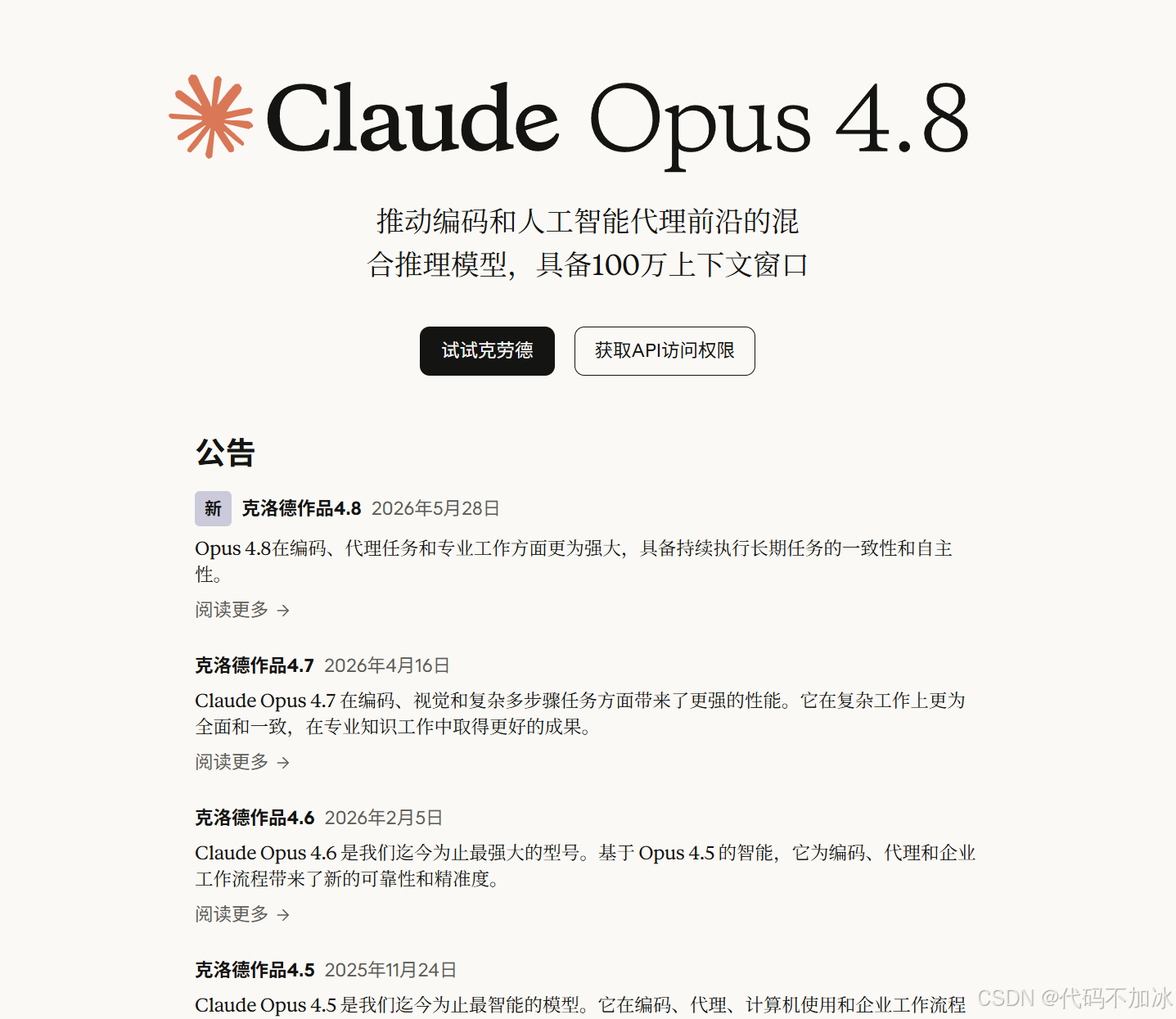
In its official release, Anthropic describes Claude Opus 4.8 as a “modest but tangible improvement” over Opus 4.7, with gains in coding, agentic tasks, reasoning, and practical knowledge work. More notably, early reviews and media coverage also highlight a greater willingness to mark uncertainty and make fewer unsupported assertions.
This means the value of Opus 4.8 is not simply that it answers more questions, but that in some situations it may know how to answer a little less.
For users, this change creates a subtle experience: you may more often see the model say “I’m not sure,” “more context is needed,” or “this conclusion should be verified.” In the short term, it may feel less instantly satisfying; in the long term, it reduces the risk of spreading a wrong answer as fact.
This is especially important for professional content production. For example, when using We0 AI to build showcase websites, case pages, or SEO/GEO content pages, teams need more than fast copy generation. They need to separate facts, assumptions, recommendations, and information that still requires verification. An AI that marks boundaries better can help content teams reduce overpromising and avoid publishing unverified product claims.
How Should We Understand the “Multi-Path Reasoning” Mentioned in the Source Article?
The source article explains the changes in Opus 4.8 through “multi-path reasoning sampling,” “consistency evaluation,” and “uncertainty expression generation.” Since those mechanism details could not be verified one by one in official materials, this article treats them as an explanatory framework rather than an architecture description publicly confirmed by Anthropic.
Still, the framework itself is easy to understand:
The model first tries to reason about the question from multiple angles.
If multiple reasoning directions agree with each other, it is more likely to provide a clear answer.
If the reasoning directions conflict strongly, it needs to tell the user that this part is uncertain.
A better answer does not merely say “I don’t know”; it explains where the uncertainty lies, what information is missing, and how to verify the next step.
This is more useful than traditional refusal. A truly mature AI should not only stop at the boundary; it should mark the boundary so users know what to supplement, what to verify, and what tools to use next.
A “Smaller Capability Boundary” May Actually Be More Reliable
On the surface, a model willing to say “I’m not sure” may seem to have a smaller capability boundary. It no longer gives a seemingly complete answer to every question, nor does it force every ambiguous question into a conclusion.
But in high-reliability scenarios, that is exactly the progress.
Legal consultation, medical assistance, financial analysis, scientific literature review, and enterprise content publishing are not suitable for “make something up first.” In these scenarios, a model that pauses when uncertain is far more trustworthy than one that is always confident but often wrong.
The ECE, accuracy, and refusal-rate table in the source article can be used as an example for understanding “calibration”: lower calibration error and higher accuracy on high-confidence answers suggest that a model better knows when to answer and when to warn about risk. However, because those specific numbers were not verified in official release materials, they should not be cited as official benchmarks when publishing.
Dimension | Common issue in overconfident models | Goal of a better-calibrated model |
Uncertain questions | Continue generating a fluent answer | Mark uncertainty |
Professional scenarios | May present speculation as fact | Separate facts, assumptions, and items to verify |
Content production | Easy to overpromise | Better suited for pre-publication risk control |
User trust | Impressive at first, damaging when wrong | Restrained at first, more reliable over time |
Technical Cost: Honesty Is Not Free
Better uncertainty expression is not cost-free.
First, the model needs more judgment steps. Whether through diverse reasoning, internal consistency checks, or additional tool use and verification workflows, it will require more computation. Even if the official materials do not confirm the exact multiplier in the source article, it is safe to say that more reliable answers are usually not completely free.
Second, uncertainty detection is not the same as factual verification. Internal reasoning consistency does not guarantee external factual correctness. If all reasoning paths are based on the same false premise, the model may still produce a consistent but wrong conclusion.
Third, in creative writing, brainstorming, and marketing concept exploration, excessive caution may weaken the output. What users really need is not permanent conservatism, but the ability to switch by context: be cautious with serious factual questions, be bold in creative exploration, and return to verifiable wording for public content.
Industry Impact: AI Competition Is Not Only About Being Stronger, but Also More Stable
In recent years, large-model competition has often revolved around larger parameters, longer context, faster inference, and stronger coding ability. Claude Opus 4.8 makes another dimension more visible: calibration quality.
If “knowing what it does not know” becomes an evaluable capability, several industry changes may follow:
Benchmarks may expand from accuracy alone to confidence, refusal quality, and evidence awareness.
Enterprise customers may value auditable, traceable, and explainable model outputs more.
Content tools may evolve from “automatic generation” into “generation + risk labeling + verification suggestions.”
AI tools for lead-generation pages, website content, and case showcases may place more emphasis on truth boundaries before publication.
This is also a direction that showcase website growth platforms such as We0 AI should pay attention to. For companies, the goal of launching pages is not to generate the most content, but to produce content that is credible, presentable, conversion-ready, and free from unnecessary compliance risk. If AI can slow down at factual boundaries, it can make website pages, case pages, and SEO content more stable.
How Should Everyday Users Work With This More Cautious AI?
If you use Claude Opus 4.8 or a similar model that pays more attention to calibration, you can treat it as a knowledge-work collaborator rather than an always-confident answer machine.
A better way to use it is:
Ask the model to distinguish between confirmed information, reasonable inference, and items requiring verification.
For fact-sensitive content, ask the model to list evidence and gaps.
For time-sensitive facts, prices, policies, model versions, and product capabilities, proactively require web lookup or source verification.
Treat “I’m not sure” as an entry point for better follow-up questions, not as a failure.
When an AI says “I’m not sure,” it is not being lazy. In many cases, it is preventing you from being led into a more troublesome mistake.
From Forced Output to Active Verification
Learning to say “I’m not sure” is only the first step.
The truly more valuable next step is for the model, after admitting uncertainty, to proactively propose verification paths: checking official documentation, reading databases, searching for the latest sources, asking the user for key conditions, or calling tools to fill evidence gaps.
This moves AI from a “language completer” toward a “reliable workflow participant.”
For enterprise content and website growth, this shift is practical: AI should not only help write page copy, but also help judge which content can be published directly, which content needs sources, where wording should be softened, and which claims may mislead users.
This is also where the meaning of Claude Opus 4.8 lies. It is not the endpoint, but it reminds us that the next round of AI progress is not only about who answers more, but who better knows when to pause.
English FAQs
What Is the Core Change in Claude Opus 4.8?
Official materials emphasize its improvements over Opus 4.7 in coding, agentic tasks, reasoning, and practical knowledge work. This article focuses on the more noteworthy side: a greater willingness to mark uncertainty and reduce unsupported confident statements.
Does “I’m Not Sure” Mean the Model Has Become Weaker?
Not necessarily. For entertainment and creative tasks, excessive caution may feel conservative. But for legal, medical, financial, research, and public content publishing scenarios, the ability to mark boundaries usually means greater reliability.
Can the ECE Table in the Source Article Be Quoted Directly?
It is not recommended to cite it directly as an official benchmark. When checking the official release page and model documentation, this article did not find public sources for those specific numbers, so they are better used as a conceptual example for understanding model calibration.
How Should Enterprise Content Teams Use This Capability?
They can ask AI to mark layers such as confirmed facts, reasonable inferences, items requiring verification, and claims that should not be published. For showcase website growth platforms like We0 AI, this can help reduce factual risk in website pages, case pages, and SEO content before publication.
Related Tools / 相关工具
Related Articles / 相关文章
Anthropic releases Opus 4.8 with new Dynamic Workflow tool
Sources / 来源