Claude Code vs OpenAI Codex: Which Is the Best AI Coding Agent in 2026?
Claude Code vs OpenAI Codex is one of the most important comparisons in AI coding in 2026. Claude Code is a terminal-native coding assistant from Anthropic that can understand a codebase, run commands, edit files, and support agentic development workflows. OpenAI Codex is a broader coding agent platform with local, IDE, app, and cloud workflows, including delegated tasks, code review, and parallel work across repositories. This guide compares Claude Code and OpenAI Codex across workflow, automation, codebase understanding, cloud tasks, security, developer experience, team adoption, and real-world use cases so founders, developers, agencies, and engineering teams can choose the best AI coding agent for their needs.
Claude Code vs OpenAI Codex: Which Is the Best AI Coding Agent in 2026?
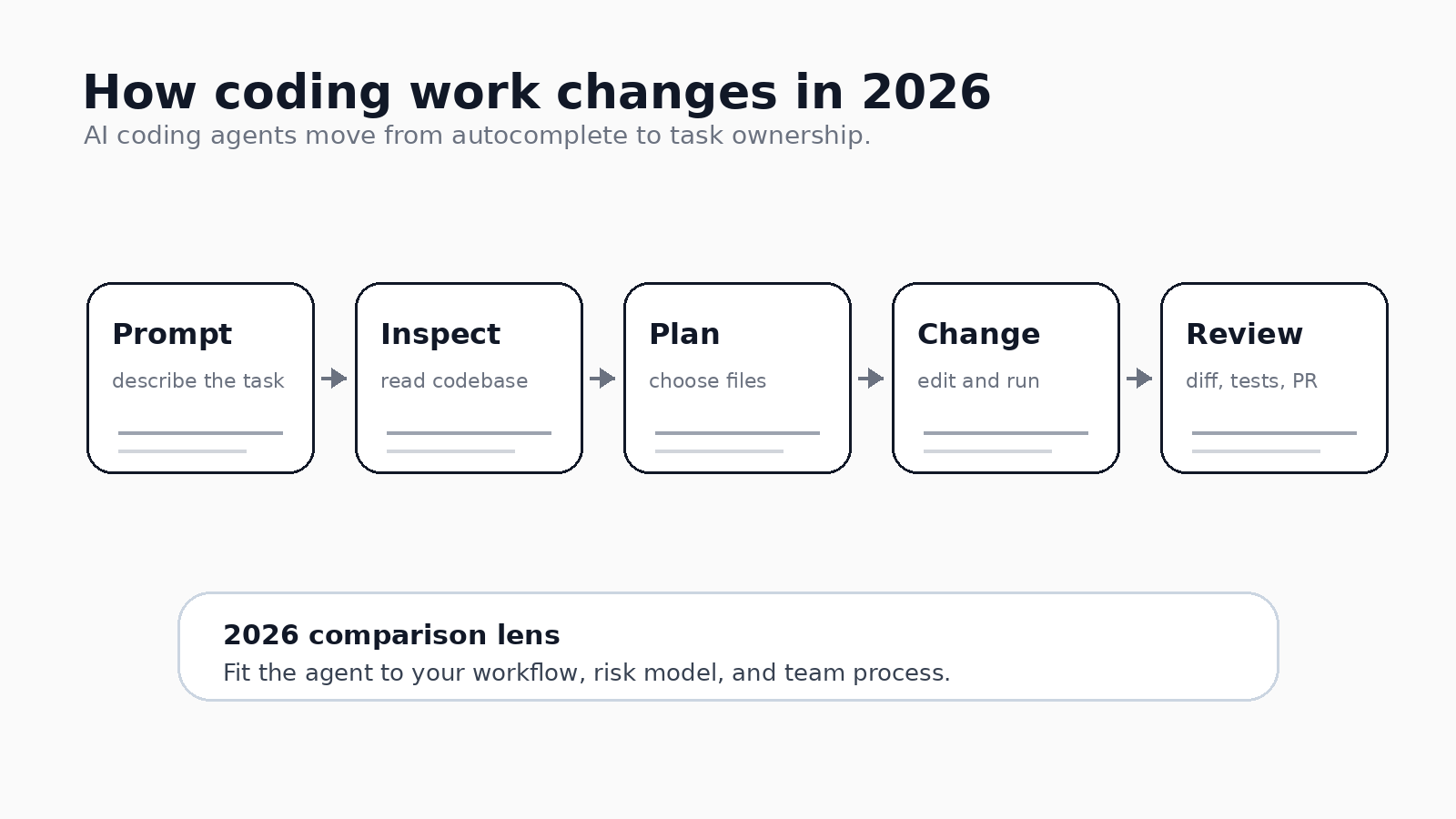
In 2026, the question is no longer whether an AI coding agent can write code. The better question is whether it can take responsibility for a real engineering workflow without creating chaos.
That is why Claude Code vs OpenAI Codex is such an important comparison. Both tools sit beyond simple autocomplete. Both can help with real codebases. Both are designed for agentic coding, where the model can inspect files, reason through a task, edit code, run commands, and help move work forward.
But they are not the same product, and they are not built around the same rhythm of work.
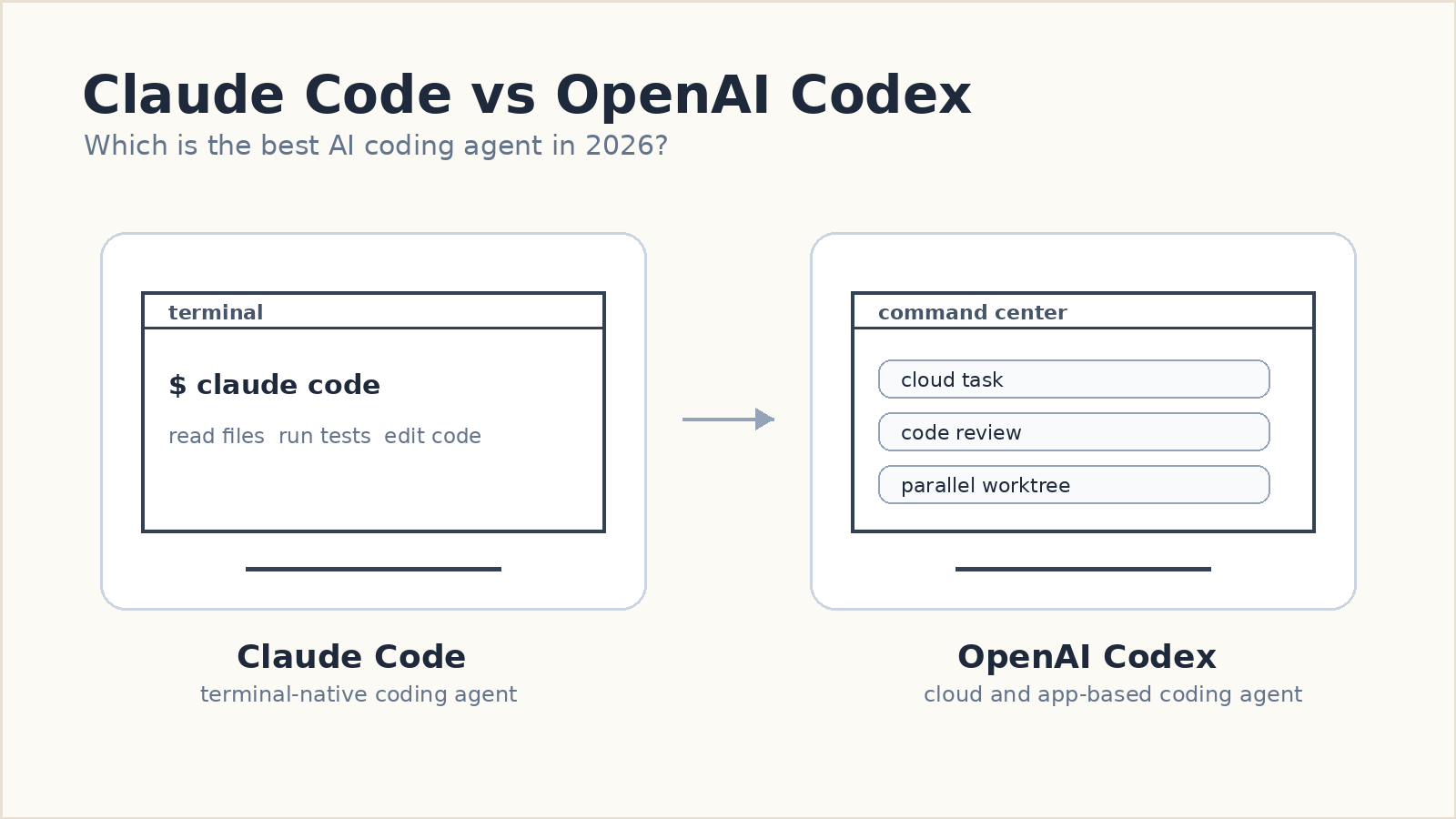
Claude Code feels closer to a terminal-native coding partner. It lives where many developers already work: inside the terminal, close to the repository, close to commands, close to local control. OpenAI Codex feels more like a coding command center. It spans CLI, IDE, app, and cloud workflows, with a stronger emphasis on delegated cloud tasks, worktrees, code review, and parallel execution.
The short answer is simple: Claude Code is often the better fit for developers who want hands-on codebase control in the terminal. OpenAI Codex is often the better fit for teams that want parallel workflows, delegated software engineering tasks, and a broader automation platform. The best AI coding agent depends on how you work.
What Claude Code is best at
Claude Code is an AI-powered coding assistant from Anthropic that helps developers build features, fix bugs, and automate development tasks. Its core strength is that it understands the codebase and operates in a workflow that feels close to everyday development.
The big appeal is the terminal. Many engineers do not want their coding agent to live only in a chat box or a separate web dashboard. They want it to read files, run commands, inspect tests, and work through problems where the repository already lives. Claude Code is designed around that kind of interaction.
This makes it strong for iterative development. You can ask it to explore a bug, explain a module, propose a plan, edit a file, run tests, and refine the change. It works well when the developer wants to stay close to the loop and approve important steps. That matters because serious code work is not only about generating code. It is about understanding constraints, respecting project conventions, and avoiding damage to critical files.
Claude Code also has features that support more advanced agentic coding workflows. Anthropic documents subagents, skills, and security practices, which suggests a direction beyond simple pair programming. The product is moving toward configurable coding workflows where different kinds of tasks can be delegated, constrained, and reused.
What OpenAI Codex is best at
OpenAI Codex is OpenAI’s coding agent platform for reading, editing, running, reviewing, and delegating software work. OpenAI describes Codex as a cloud-based software engineering agent that can work on many tasks in parallel. More recently, Codex has expanded across cloud, CLI, app, IDE, code review, and GitHub-connected workflows.
The central advantage of OpenAI Codex is not just code generation. It is task delegation. Codex is useful when you want to hand off a defined piece of software engineering work and let the agent operate inside a controlled environment. That can include building a feature, fixing a bug, explaining unfamiliar code, preparing a pull request, or reviewing a change.
The Codex app and Codex Cloud matter because they change the shape of developer productivity. Instead of one developer asking one model for one answer, teams can run multiple tasks in parallel. Built-in worktrees and cloud environments make it easier to keep work isolated. The result is closer to a software engineering operations layer than a normal chat assistant.
This is why OpenAI Codex feels broader than a single CLI tool. Codex CLI is useful locally, but the full Codex story is larger: local workflows, cloud tasks, code review, app-based task management, GitHub integration, and agent-first engineering practices.
The main difference: local control vs delegated parallel work
The cleanest way to compare Claude Code and OpenAI Codex is not model quality. It is workflow shape.
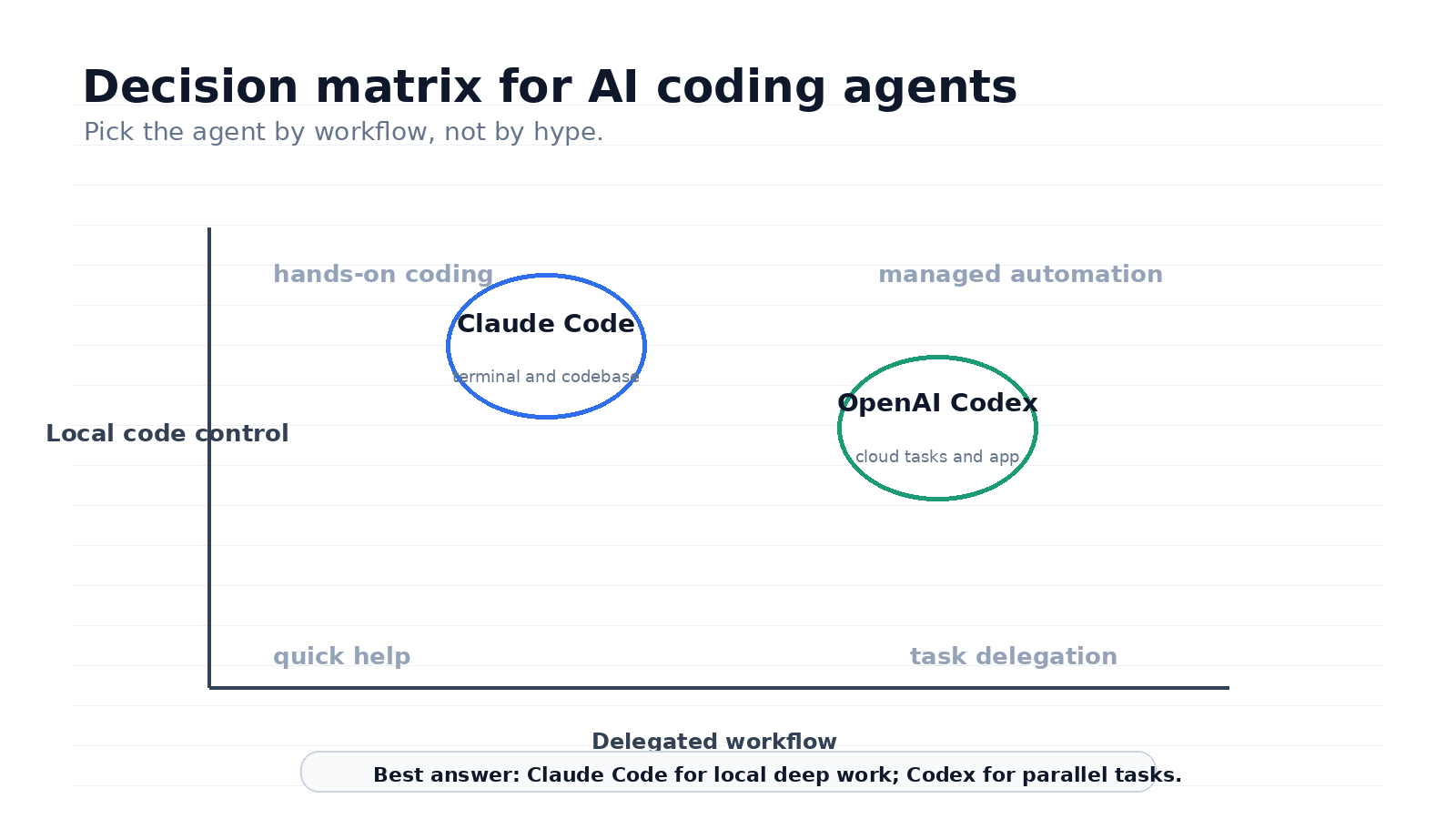
Claude Code is strongest when a developer wants to stay close to the repository and use the AI coding agent as a terminal-native partner. It fits the loop of inspect, ask, edit, run, verify, repeat. The developer remains highly involved. The agent helps accelerate thinking and execution, but the workflow still feels local and hands-on.
OpenAI Codex is strongest when the task can be delegated. It fits the loop of describe the task, assign it to the agent, let it work in a cloud environment or worktree, then review the output. The developer or team becomes more like a reviewer, orchestrator, and product owner for coding work.
Both approaches are useful. But they solve different bottlenecks. Claude Code reduces friction inside the developer’s immediate coding loop. OpenAI Codex reduces coordination cost across multiple tasks and repositories.
Comparison table
Area | Claude Code | OpenAI Codex | Best fit |
Primary feel | Terminal-native partner | Agent command center | Workflow preference |
Work style | Interactive local loop | Delegated parallel tasks | Task type |
Strength | Deep codebase collaboration | Cloud tasks and code review | Team size |
Automation | Subagents and skills | Cloud, worktrees, app, IDE | Environment |
Review model | Developer stays close | Agent prepares work for review | Risk tolerance |
Best user | Hands-on developer | Team or builder with backlog | Adoption model |
Codebase understanding and task quality
Both Claude Code and OpenAI Codex are designed to work with real codebases, but their experience differs because of how they are used.
Claude Code is useful when you want the agent to explore the codebase interactively. It can help explain a confusing module, trace logic, plan a refactor, or work through a bug with command-by-command feedback. This makes it strong for developers who want reasoning support while they stay in control.
OpenAI Codex is useful when the task can be specified clearly enough to run as a delegated unit. For example, you might ask it to implement a small feature, write tests, fix a known issue, or prepare a code review. It can work in parallel with other tasks, which matters for teams that have more engineering requests than available human attention.
The difference is subtle but important. Claude Code often feels like a senior pair programmer inside your terminal. OpenAI Codex often feels like assigning work to an agentic teammate and coming back to review the output.
Security and governance
Security is not a side topic for AI coding agents. It is central. A coding agent can read files, suggest commands, modify code, and interact with sensitive repositories. That creates real risk if permissions, review, and execution boundaries are weak.
Claude Code security guidance emphasizes reviewing suggested commands before approval, avoiding unsafe handling of untrusted content, verifying proposed changes to critical files, and using safer environments such as virtual machines or containers when needed. That aligns with the terminal-native nature of the tool: developers should remain alert to what the agent is doing.
OpenAI Codex approaches governance through workspace controls, local versus cloud permissions, supported surfaces, and delegated cloud tasks. For organizations, this matters because administrators need to decide who can run local workflows, who can launch Codex Cloud tasks, and how agents connect to repositories and environments.
The practical takeaway is that neither tool should be treated like magic. The best teams will create rules for what the agent can touch, how changes are reviewed, when tests must pass, and which repositories require human approval.
Which is better for individuals?
For an individual developer, Claude Code may feel better if you like working in the terminal, want direct control, and need help understanding or changing a codebase step by step. It is especially useful when the project is complex and you want the agent to reason with you rather than disappear into a cloud task.
OpenAI Codex may feel better if you want a broader agent system that can handle both local and cloud workflows. If you often have a backlog of small tasks, bug fixes, tests, documentation changes, or code review work, Codex can feel more like leverage. You can define tasks, let the agent work, and review results.
The choice depends on personality as much as capability. Some developers want a companion. Others want delegation. Claude Code leans toward companion. OpenAI Codex leans toward delegation and orchestration.
Which is better for teams?
For teams, OpenAI Codex has a strong argument because parallel workflows matter more at scale. A team does not just need help writing one function. It needs a way to move many small tasks forward, review code, connect to GitHub, manage worktrees, and standardize how AI agents participate in engineering work.
Claude Code can still be excellent inside teams, especially when developers use it as a powerful local assistant. It can help engineers move faster in their own repositories and may be especially valuable for debugging, refactoring, and exploring unfamiliar code.
But if the question is team-level automation, OpenAI Codex has the broader platform story. It is designed to sit across local, cloud, IDE, app, and code review workflows. That gives it more room to become part of an engineering operating system.
In short, Claude Code can make individual engineers faster. OpenAI Codex can make engineering workflows more parallel.
Final verdict
There is no single winner for every team. The best AI coding agent in 2026 depends on the work pattern.
Choose Claude Code if you want a terminal-native AI coding agent that stays close to your codebase, supports interactive development, and helps you reason through code with local control.
Choose OpenAI Codex if you want a broader agentic coding platform that supports delegated cloud tasks, code review, worktrees, app-based task management, and parallel software engineering workflows.
The deeper trend is bigger than either product. AI coding agents are moving from suggestion tools to workflow tools. They are no longer just writing snippets. They are reading repositories, running commands, reviewing diffs, creating pull requests, and automating parts of software engineering.
That shift changes how teams think about developer productivity. The question is no longer how many lines of code an AI can write. The question is how much reliable work an AI coding agent can move through the system without lowering quality or increasing risk.
For hands-on terminal work, Claude Code is hard to ignore. For delegated parallel engineering work, OpenAI Codex is the stronger bet. For many teams, the future may not be choosing only one. It may be using Claude Code for deep local development and OpenAI Codex for cloud-scale task delegation.
CTA
If your team is comparing AI coding agents, start by mapping the workflow: terminal help, code review, cloud tasks, parallel workflows, or full software engineering automation. The best tool is the one that fits the job your developers actually need to hand off.
FAQ
What is the main difference between Claude Code and OpenAI Codex?
Claude Code is more terminal-native and interactive, while OpenAI Codex is broader across CLI, IDE, app, cloud tasks, code review, and parallel workflows.
Is Claude Code better for individual developers?
Claude Code can be better for developers who want direct codebase control inside the terminal and an interactive coding partner.
Is OpenAI Codex better for teams?
OpenAI Codex can be better for teams that need delegated tasks, cloud environments, worktrees, code review, and parallel engineering workflows.
Can both tools edit code and run commands?
Yes. Both tools are designed for agentic coding workflows that can involve reading files, editing code, running commands, and helping with software engineering tasks.
Which AI coding agent should I choose in 2026?
Choose based on workflow. Pick Claude Code for terminal-first local control. Pick OpenAI Codex for delegated cloud work and parallel team workflows.
Related Tools
- Codex
- GitHub
- VS Code
- Cursor
Sources