ChatGPT Is Helping Small Businesses Get More Done—Do They Still Need Separate Design, Development, and SEO Teams?
ChatGPT is taking on more and more work for small businesses. So here's the question: do small companies still need to hire separate design, development, and SEO teams? This article explains how to staff smartly, save money, and use AI to turn your website into a customer-generating asset.
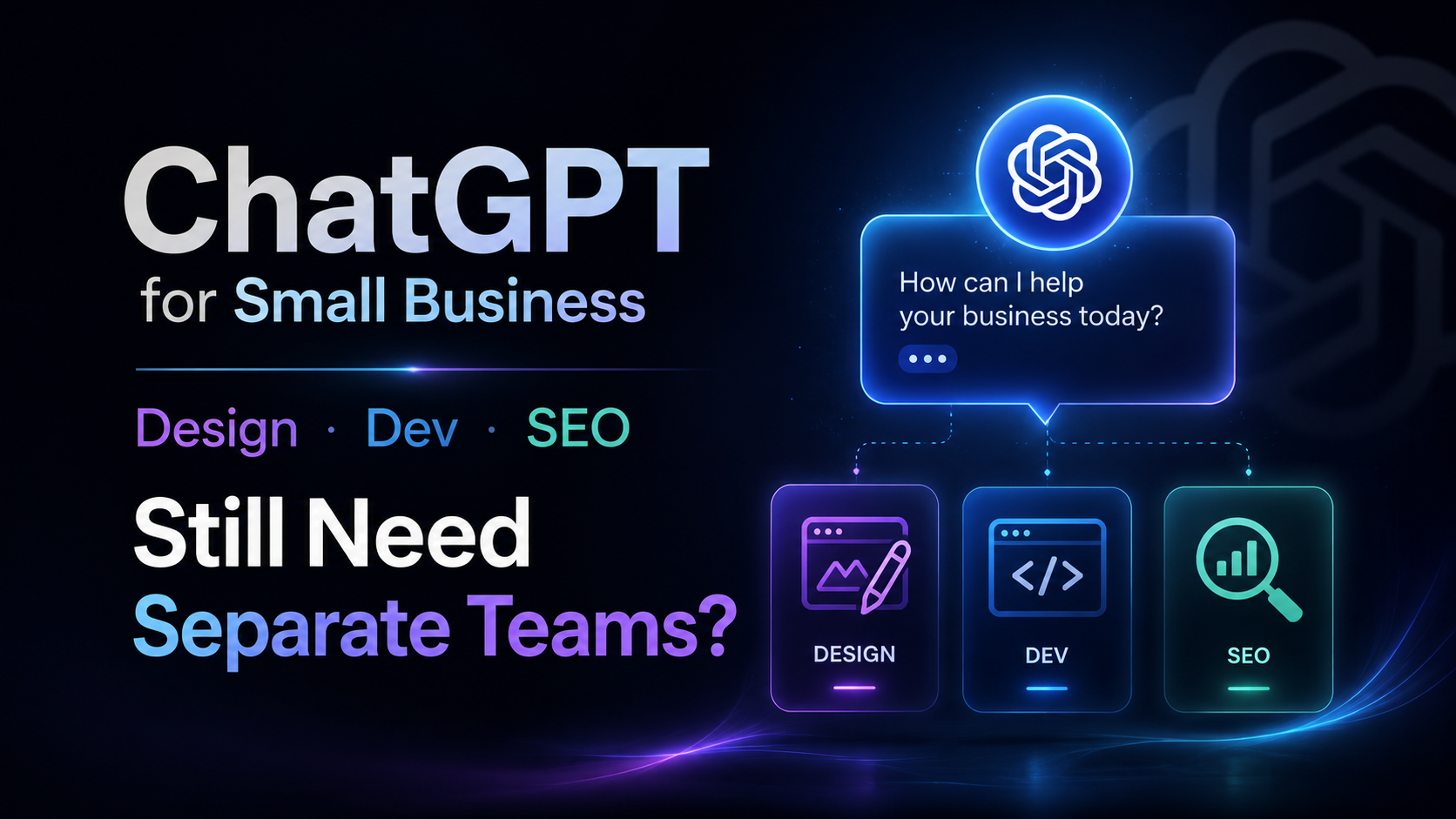
ChatGPT Is Helping Small Businesses Get More Done—Do They Still Need Separate Design, Development, and SEO Teams?
The Bottom Line First
If you're a small business, the question probably isn't "should we still hire three teams," but rather "can you combine them into one leaner growth pipeline?"
Tools like ChatGPT can already handle much of the work that previously required manual division of labor across roles:
- Copy organization before design
- Requirements gathering before development
- Keyword drafting before SEO
- Initial page drafts
- FAQ, titles, descriptions, and structural outlines
- Even some basic operational content
But keep in mind: AI can do a lot of the work for you, but that doesn't mean it can take on the responsibility for results.
So the answer isn't "don't hire anyone at all," nor is it "keep all three teams as before." The more realistic answer is:
Small companies don't have to staff up separate design, development, and SEO teams the traditional way, but someone still needs to tie those three things together.
That's the key.
What Small Companies Really Lack Isn't Tools—It's a Closed Loop
Many small companies find themselves stuck in a painfully familiar situation from day one:
- The owner wants a company website
- Design says visuals come first
- Development says requirements are unclear
- SEO says there isn't enough content
- The page finally goes live—but no one visits, no one asks, no one converts
This is the classic "everyone did their part, but there's no result."
Since ChatGPT appeared, the first thing that changed isn't any particular role—it's the boundaries between tasks.
Before, you had to break work into three sequential stages:
- Design defines the visuals first
- Development builds the page next
- SEO pads in the content last
Now, much of the foundational work can be quickly drafted by AI first:
| Stage | Traditional Approach | What's Changed Now |
|---|---|---|
| Requirements gathering | Endless back-and-forth communication | AI produces structure, question lists, and page drafts first |
| Visual copy | Design and copy go back and forth | AI provides titles, selling points, and section text first |
| Page development | Built from scratch | Start with templates or AI-assisted generation, then have humans refine |
| SEO content | Added at the end | Keywords and structure are built in from the start |
| Post-launch optimization | Relies on experience | Data + AI + human review |
So what small companies need isn't more people—it's less friction.
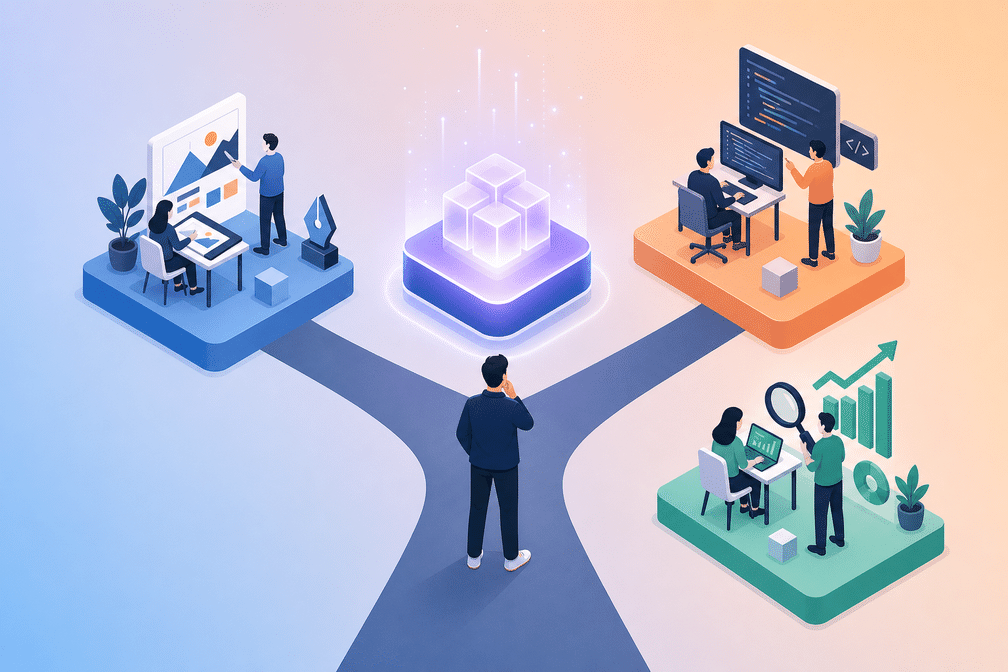
Do You Still Need to Hire Design, Development, and SEO Separately?
1) Design: You Need the Capability, Not Necessarily a Full-Time Designer
If you're building a brand website, product pages, service pages, or case study pages, design absolutely matters. But what many small companies actually need isn't a design team cranking out dozens of drafts a day—it's:
- The ability to communicate brand messaging clearly
- The ability to produce page structures that can actually go live
- The ability to maintain basic visual consistency
- The ability to make conversion paths smoother
In other words, design isn't about "making it look pretty"—it's about "making it easier for users to understand and take action."
For this kind of work, AI can lay the groundwork first, with humans reviewing and finalizing.
2) Development: You Need Delivery Capability, Not Necessarily a Large Dev Team
Small companies often mistakenly believe a website requires a full development team. In reality, many display sites, campaign pages, inquiry pages, and content pages don't need complex engineering.
What you actually need is:
- Fast time-to-launch
- Stability and easy edits
- Clear structure
- The ability to iterate continuously afterward
If even changing a headline requires scheduling a sprint, your system is too heavy.
For small companies, the most important thing about development isn't "how sophisticated it is"—it's "don't slow down growth."
3) SEO: You Need a Growth Mindset, Not Necessarily a Standalone SEO Team
SEO isn't an afterthought once the site goes live—it's something you should be thinking about when building the site.
Many small companies still understand SEO as "publishing articles" and "stuffing keywords," which is outdated. Now it's more like:
- Is the page structure clear?
- Do the titles cover search intent?
- Does the content actually answer the questions?
- Are images, internal links, and FAQs complete?
- Does the page have the ability to be continuously updated?
If the website wasn't built with search logic in mind from the start, trying to retrofit SEO later is usually exhausting.
What Works Better for Small Companies: "Lean Team + AI Workflow"
I'd suggest small businesses think of it as a simple model:
| Role | Does It Need Its Own Team? | More Realistic Approach |
|---|---|---|
| Design | Not necessarily | Shared between brand/ops/outsourcing/AI |
| Development | Not necessarily | Use templates, low-code, AI assistance, or external delivery |
| SEO | Not necessarily | Handled by a growth lead, content lead, or outsourced services |
| Coordination | Absolutely required | Driven by the owner, growth lead, or project owner |
The one thing you can't cut is the coordinator.
Because without someone coordinating, AI will only make the fragments fall apart faster.
Why Do Many Small Companies Use ChatGPT but Still Don't Get Stronger?
Because they only treat AI as a "copywriting tool," not as a "process tool."
These are very different things.
- A copywriting tool: only saves a bit of time
- A process tool: can transform the entire website, content, SEO, and conversion pipeline
Here's a very practical example:
A small team needs to build a service website.
Without AI, they might go through three rounds of back-and-forth:
- First, confirm how the homepage should be written
- Then, confirm how the service pages should be organized
- Then, confirm how to handle FAQ and SEO
But with AI, you can draft all of this in one go:
- Homepage information architecture
- Service descriptions
- Customer case summaries
- FAQ
- Search keyword framework
- CTA copy
Then humans only need to do two things:
- Judge whether it's right
- Adapt it into a version that fits their own brand
That's what efficiency really means. It's not saving an hour—it's skipping an entire detour.
So What Does We0 AI Do Here?
We0 AI isn't just about "building a page" for you.
It's more like putting a small company's showcase site, content site, SEO, GEO, and conversion pages into one leaner growth pipeline.
In other words:
Build -> Showcase -> Grow -> Leads
- Build: Get your website up faster
- Showcase: Present your products, services, cases, and work clearly
- Grow: Continuously drive traffic through SEO / GEO / content
- Leads: Turn traffic into leads and customers
This matters.
Because what small companies fear most isn't "not having a website"—it's "having a website that doesn't grow."
We0 AI's approach doesn't just solve the problem of building a site once—it addresses how to keep growing after the site is built.
A More Practical Way to Decide
You can use this table to judge whether you actually need to hire separate design, development, and SEO teams:
| Situation | Recommendation |
|---|---|
| Only need brand showcase, service introduction, or inquiry pages | A lean team + AI + external support is enough |
| Many product pages with frequent content updates | Someone needs to coordinate; design/dev/SEO can be partially outsourced |
| The website is a core customer acquisition channel | Recommend having someone dedicated to the growth loop |
| Complex business, complex systems, mature brand | Consider a more complete professional team setup |
There's only one criterion: is your website a customer acquisition asset?
If yes, you can't just throw it together.
If no, then no matter how many teams you hire, you've only built a pretty shell.
One Final Thought
ChatGPT doesn't tell small businesses "don't have a team"—it tells them you don't have to build your team the old way.
In the future, a more common setup probably won't be design, development, and SEO running as three separate teams.
It'll be:
One person who coordinates + an AI workflow + a few key capabilities + continuous optimization.
This matters more than "having more people."
It also suits small companies better.
FAQ
1. Can small companies really skip hiring a designer?
You can skip hiring a full-time designer, but you can't afford to lack design capability. At minimum, you need to ensure clear page structure, visual consistency, and a clear conversion path.
2. Can small companies skip hiring a development team?
If it's a showcase website, landing page, or service page, templates, low-code tools, or AI assistance can often get the job done—a full development team isn't always necessary.
3. Is SEO still important today?
Yes, and it's actually more front-loaded than before. It's not something you patch up after the website is built—you need to consider search intent from the very start, beginning with the page structure.
4. Can ChatGPT replace a small business's official website?
It can't replace your official website, but it can significantly accelerate website planning, content drafts, page structure, and SEO outlines.
5. What's the difference between We0 AI and ordinary AI website builders?
We0 AI places greater emphasis on the growth path of showcase websites. It doesn't just generate pages—it continues to help you with SEO, content, optimization, and customer acquisition.
References
- Google Search Central — AI Optimization Guide
- Google Search Central — Creating a SEO strategy
- Google Search Central — Image SEO Best Practices
- JPMorganChase Institute — Understanding the use of AI among small businesses
- SBA Advocacy — AI in Business: Small Firms Closing In
- Ahrefs — Local SEO: The Complete Guide
Ready to Get Started?
If you're also thinking right now—should the website be rebuilt, should content be filled in, should SEO be moved earlier, should the team be reorganized—then chances are it's already time to restructure your workflow.
Don't just build a website. Build a website that consistently brings in traffic, leads, and customers.
Summary
Small companies may no longer need to hire separate, full-fledged design, development, and SEO teams.
But small companies absolutely need:
Clear coordination, executable processes, continuous optimization capability, and a system that turns the website into a growth asset.
That's exactly what We0 AI aims to solve.