Now That ChatGPT Is Selling Ads, Will GEO Also Become 'Whoever Pays Gets to Rank First'?
Here's the bottom line: Ads will make AI traffic more like a "two-track market," but they won't necessarily reduce GEO to pure bid-based ranking
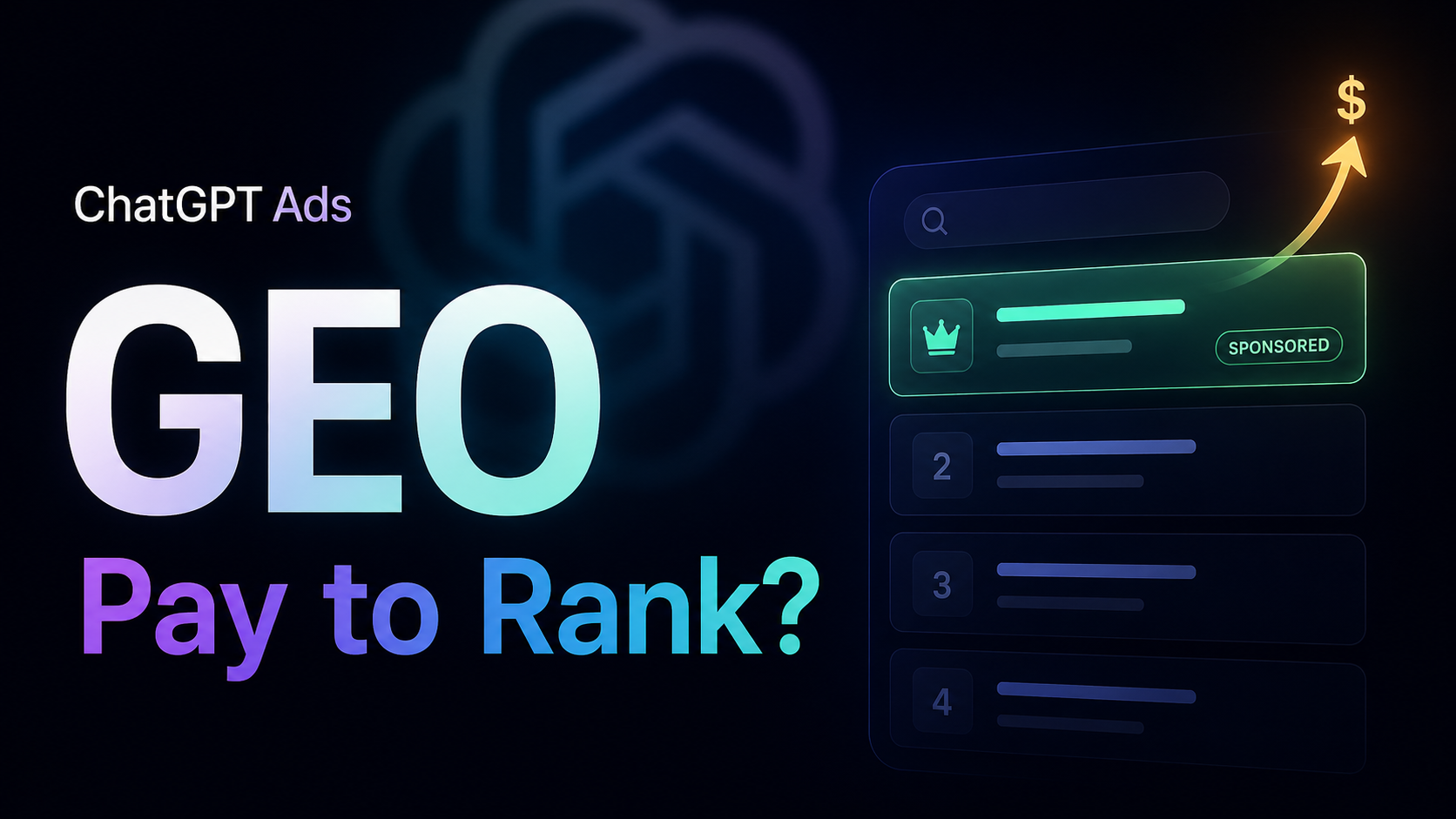
title: "If ChatGPT Sells Ads, Will GEO Become Pay-to-Rank?"
english_title: "If ChatGPT Sells Ads, Will GEO Become Pay-to-Rank?"
seo_title: "ChatGPT Ads Are Here—Will GEO Turn Into Bidding Rankings?"
seo_description: "When conversational AI introduces ads, brands' biggest fear is: will GEO shift from trusted recommendations to whoever bids highest? This article breaks down ads, organic results, and AI answers, and offers guidance on how brands should position themselves."
seo_keywords: "ChatGPT ads,GEO,generative engine optimization,AI search optimization,AI recommendations,ChatGPT search,AI SEO,brand visibility,We0 AI"
cover_zh: "https://we0-cms.oss-cn-beijing.aliyuncs.com/ai-upload/4a3f6f52-bebf-49b6-877a-3addbbbcf94b.png"
cover_en: "https://we0-cms.oss-cn-beijing.aliyuncs.com/ai-upload/e166454b-c675-4ed7-8979-3d56106d228c.png"


If ChatGPT Sells Ads, Will GEO Become Pay-to-Rank?
Here's the bottom line: Ads will make AI traffic more like a "two-track market," but they won't necessarily reduce GEO to pure bid-based ranking.
But don't rush into optimism.
As soon as conversational AI starts carrying commercial displays, the already fragile trust relationship among users, brands, and platforms will be repriced. Previously, when people discussed GEO—Generative Engine Optimization—the core question was: how to make models more willing to understand, cite, and recommend you.
From now on, another question emerges: will platforms carve out a portion of "willingness to recommend" and sell it to the highest bidder?
This isn't paranoia. Search ads have already proven that once monetization finds an entry point, it keeps pushing closer to the moment of decision. And the chat interface sits in a dangerous yet highly valuable position: users aren't casually browsing—they're asking "which one should I buy," "which one should I use," "who's better for me."

Ads can buy a chance to be seen; GEO pursues the qualification of being considered "worth answering" by the system.
The two influence each other, but they are not the same thing.
First, Let's Separate the Three Things People Most Often Confuse
When many people see "ads in AI," their brains immediately translate it to: SEO is over, GEO is over, everyone will have to pay up.
That reasoning skips a few steps. Because in AI search or AI assistants, there are at least three completely different distribution logics:
| Layer | What It Solves | Core Signals | Can Brands Buy It Directly? |
|---|---|---|---|
| Ad slots | Getting explicit exposure | Bid, audience, commercial relevance, creative quality | Usually yes |
| Organic search results | Matching web pages to queries | Relevance, quality, authority, crawlability | Can't buy rankings directly |
| Generative answers / citations | Organizing answers and offering recommendations | Factual verifiability, source quality, entity clarity, task fit | "True recommendations" shouldn't be directly purchasable |
What you really need to watch isn't the buzzword "ads"—it's whether ads are clearly labeled, whether they're isolated from the model's organic judgment, and whether they end up contaminating citations and recommendations.
If ads are displayed separately, clearly marked as "sponsored," and users understand why they appear, then it's more like a commercial entry point in traditional search. You might not like it, but the rules are transparent.
The worse scenario is when paid information is packaged into seemingly neutral answers, and users can't tell the difference between "the model's evidence-based recommendation" and "what a client paid to have shown." At that point, the problem isn't just GEO—it's whether the answer itself can still be trusted.

GEO's "Ranking Higher" Has Never Equaled Search Ranking
In the SEO world, people obsess over positions 1, 2, and 3. GEO isn't that neat.
When a model answers "which customer service tools are good for small teams," it might list three brands; when asked "how to choose a certain type of tool," it might only cite one review; rephrase the question, and it might not even mention any brand, just offer a decision framework. GEO isn't a fixed list of ten blue links—it's a dynamic filter over who earns the right to be part of the answer.
So, the core assets in GEO have never been about "climbing to a certain spot." They are:
- Who you are: Are your brand, product, and service scope clear?
- What problem you solve: Does your page answer a specific task, rather than just shouting slogans?
- Why you're credible: Can your case studies, data, pricing, usage boundaries, authors, and sources be verified?
- What others say: Do independent media, user reviews, industry directories, and community discussions form a consistent signal?
- Can the system understand you: Is your structured content, clear headings, accessible pages, and stable entity information in place?
Money can expand reach; it can't automatically generate credibility.
Of course, ads aren't entirely irrelevant to GEO. They can bring more brand searches, more visits, more user discussions, and even more third-party mentions. In the long run, these "second-order signals" might help a brand become more recognized. But the path is "ads → awareness → real usage and discussion → verifiable signals," not "ad spend → the model automatically trusts you."
That difference determines whether what you're doing is growth—or just renting traffic.
The Real Risk: Not the Presence of Ads, but the Blurring of Boundaries
For platforms, ad revenue is tempting; for users, one seemingly direct recommendation carries more weight than ten banners; for brands, a single name mentioned in an answer could be a high-intent lead.
So, there are four things worth watching closely going forward:
- Whether paid content has prominent disclosure. Can users tell at a glance that it's an ad?
- Whether natural citations retain their sources. Can readers trace why the model said what it said?
- Whether advertisers can buy "recommended slots" under certain questions. Buying keywords is fine; buying the tone of a "best answer" is dangerous.
- Whether the model can still deliver judgments that go against advertisers' interests. For example, clearly stating that a product isn't suitable for a certain budget, industry, or use case.
The bar is actually quite simple: when ads and answers are mixed together, users start doubting every answer; when the two are clearly separated, GEO becomes even more valuable.
Because in an environment with more and more ads, what's truly scarce isn't exposure—it's brand information that is credible, verifiable, and able to withstand scrutiny.
To be continued: the next section analyzes the real possibility of "whoever pays ranks first," and how brands should allocate GEO, content sites, and paid distribution.
Will "Paid GEO" emerge? Yes, but it shouldn't be called GEO
More precisely, three types of commercial products are likely to emerge:
- Conversational ads: sponsored content shown in specific intent or context;
- Paid distribution enhancement: pushing content into more commercial touchpoints where it can be searched, compared, or explored;
- Merchant tools and data products: helping brands understand how users ask questions, which pages are cited, and which topics have content gaps.
All of these are reasonable. Platforms need revenue, brands need customers, and users aren't necessarily opposed to relevant ads.
But calling "paid exposure" GEO outright is a bait-and-switch. The core of GEO should remain earned visibility: your information is more complete, more credible, and more relevant to the question, so the system selects it.
If a platform lets brands pay to make the model "favor them" without disclosure, that's not GEO evolving—it's a new advertising system. It might work, but it must be clearly named, clearly labeled, and clearly measured.
| What you're buying | Acceptable forms | What it shouldn't be disguised as |
|---|---|---|
| Reach and exposure | Sponsored placement, clearly marked ad slots | "Objective recommendation" |
| Testing and conversion | Paid traffic, landing page tests, retargeting | "The model naturally trusts you more" |
| Credibility | Cannot be bought directly; only built over time | "Paid authority" |
| Citation eligibility | Earned through high-quality content | "Stealth bidding for answers" |
So the answer isn't "stop doing GEO and just buy ads"—it's treating paid and organic as two systems that need to work together but never be conflated.
For brands, the biggest danger isn't a lack of budget—it's having no "place to be verified"
Many brands today have plenty of social media accounts and run ads, yet their official website is just an electronic business card.
This will become an increasing disadvantage in the AI discovery era.
Both models and users need somewhere to land: who you are, what you do, who you serve, how you work, pricing or partnership models, customer case studies, and evidence for your claims. Without these, clicks from ads quickly dissipate, and the factual anchors GEO requires have nowhere to attach.

The official website is not an accessory to ad landing pages. It should be a brand's "verifiable knowledge base" in the AI era.
This is also what We0 AI aims to solve—not just helping you piece together a page with AI.
For SaaS teams, companies going global, consultants, agencies, indie developers, and creators, what's really needed is a sustainable growth system for showcase websites: organizing brand and product information clearly, building a launch-ready official site with service pages, case studies, and content pages, and then continuously handling SEO/GEO fundamentals, content updates, page optimization, traffic monitoring, and lead conversion.
In other words, the journey doesn't end with "Build a pretty page." It's:
Build → Showcase → Grow → Leads
Build a site → Showcase → Grow → Acquire customers.

6 things you can do right now: don't stake GEO on "model favoritism"
1. Turn brand claims into verifiable facts
Cut down on words like "leading," "best," and "game-changing." Instead, be specific about who you serve, what you deliver, your integrations, pricing logic, case results, and who you're not for. Being specific isn't being conservative; being specific is what lets both people and models understand you.
2. Build pages for high-intent questions, not just keywords
"AI website builder" is a keyword; "How to build an export-facing B2B website that handles English content, inquiries, and AI search visibility at the same time" is a question.
Build service pages, comparison pages, case studies, FAQs, and methodology pages around real decision-making questions. Let every page stand on its own as an answer, rather than relying on one big, vague brand introduction.
3. Keep entity information consistent
Company name, product name, founder, contact info, location, pricing, social media handles, and product descriptions should be as consistent as possible across your website, press materials, directories, and third-party platforms. What AI systems fear most isn't too little information—it's conflicting information.
4. Turn "evidence" into content assets
Case studies should include background, process, results, and limitations; claims should have sources; data should be timestamped; product updates should leave a trail. The content that truly gets cited isn't the most emotionally charged piece—it's the one others are willing to cross-check.
5. Use ads for testing, not as a substitute for building
Do run ads—in fact, you should. Use them to test which questions have demand, which value propositions drive inquiries, and which landing pages convert. But the insights you gain from ad campaigns should be fed back into your website and content library, becoming reusable organic assets.
6. Measure "quality of mentions," not just exposure
Going forward, look beyond clicks and impressions. Pay attention to: In which questions is the brand mentioned? Is the mention accurate? Does it include a source? Does it appear alongside competitors? Does the user end up on a convertible page? Being mentioned once doesn't mean being correctly understood once.
A more realistic budget model: 70% building assets, 30% buying learning
There's no universal ratio for every company, but for most teams still building their brand foundation, a framework worth considering is:
- 70% on long-term assets: website structure, product and service pages, case studies, content, technical SEO, GEO fundamentals, data and conversion paths;
- 30% on paid learning: ad testing, audience validation, creative and landing page experiments, retargeting.
Mature brands can be more flexible; highly competitive industries may require a higher ad spend ratio. But the underlying principle shouldn't be reversed: ads accelerate; assets endure.
This image is in the "FAQ" section and is used to visually illustrate the question of whether GEO (Google Effects Marketing) is still necessary after ChatGPT starts selling ads. The items on both sides of a balance scale symbolize advertising and assets, hinting at the balancing relationship between the two in marketing.](https://we0-cms.oss-cn-beijing.aliyuncs.com/cms-assets/image/2026/08/900a0ed0-e53a-47b2-8633-50aa51d2f512-71adb031-37b9-4256-9aad-8e60c10690c8.png)

FAQ
Now that ChatGPT has ads, is GEO still worth doing?
Yes, and it may become even more important. Ads add to the commercial noise; the more noise there is, the more you need clear, credible, and verifiable brand content to earn organic citations and recommendations.
Can GEO be directly bought with money?
Ad placements and paid distribution can be purchased, but undisclosed model recommendations should not be treated as purchasable products. True GEO still relies on content quality, entity clarity, third-party signals, and page accessibility.
Will ChatGPT ads replace SEO?
No. Ads solve immediate reach, while SEO and GEO build long-term discoverability. They will work more closely together, but neither can replace the other.
How can small teams with no big budget gain visibility in AI search?
First, turn your website into infrastructure that can answer questions, showcase case studies, and handle inquiries. Then focus on a small number of high-intent topics. Don't blast out content everywhere from day one, and don't dump all your money into short-term exposure.
Related Tools
- We0 AI: Showcase Website Growth and Lead Acquisition Platform: From website building and content accumulation to SEO/GEO and lead handling, it helps turn your website into a long-term growth asset.
- Google Search Central: Understand the foundational principles of crawlability, structured data, and high-quality content.
- Schema.org: Build clearer machine-readable semantics for products, organizations, articles, and FAQs.
Sources
- OpenAI — ChatGPT Search: Learn how conversational search cites web sources.
- OpenAI — ChatGPT Search publisher and website guidance: Learn how websites appear and are crawled in ChatGPT Search.
- Google Ads & Commerce Blog: Track public developments in the commercialization of search and AI products.
- Google Search Central: Official guidance on creating helpful, reliable, people-first content.
Ready to Build?
If you don't want to stake your growth on a single ad campaign, a platform's algorithm, or a model's preferences, start by building your own "information stronghold."
We0 AI isn't just about getting a page live for you. It's better suited to helping teams connect brand websites, product showcases, case content, SEO/GEO foundations, and lead paths into one continuous growth system. You can start with a showcase site that actually answers customer questions, and let it gradually become an asset that drives traffic, inquiries, and customers.
Conclusion
The addition of ads to ChatGPT or any conversational AI will not automatically spell the death of GEO.
What will really change is the competitive landscape: brands need to learn how to buy distribution, but they also need to take more seriously the work of building facts, content, and websites worth being cited. Paid media can get you into the spotlight; credibility is what keeps you in the answer.
So don't ask, "Is it just whoever pays the most gets ranked first from now on?" The better question is: as paid information grows, does your brand have a place that is clear enough, credible enough, and capable enough of receiving customers that both people and AI are willing to include you in the answer?