Are Customers from ChatGPT and Gemini More Valuable? Should Companies Still Focus Only on Google SEO Traffic?
Are ChatGPT and Gemini Customers More Valuable? Should Businesses Still Only Chase Google SEO Traffic?
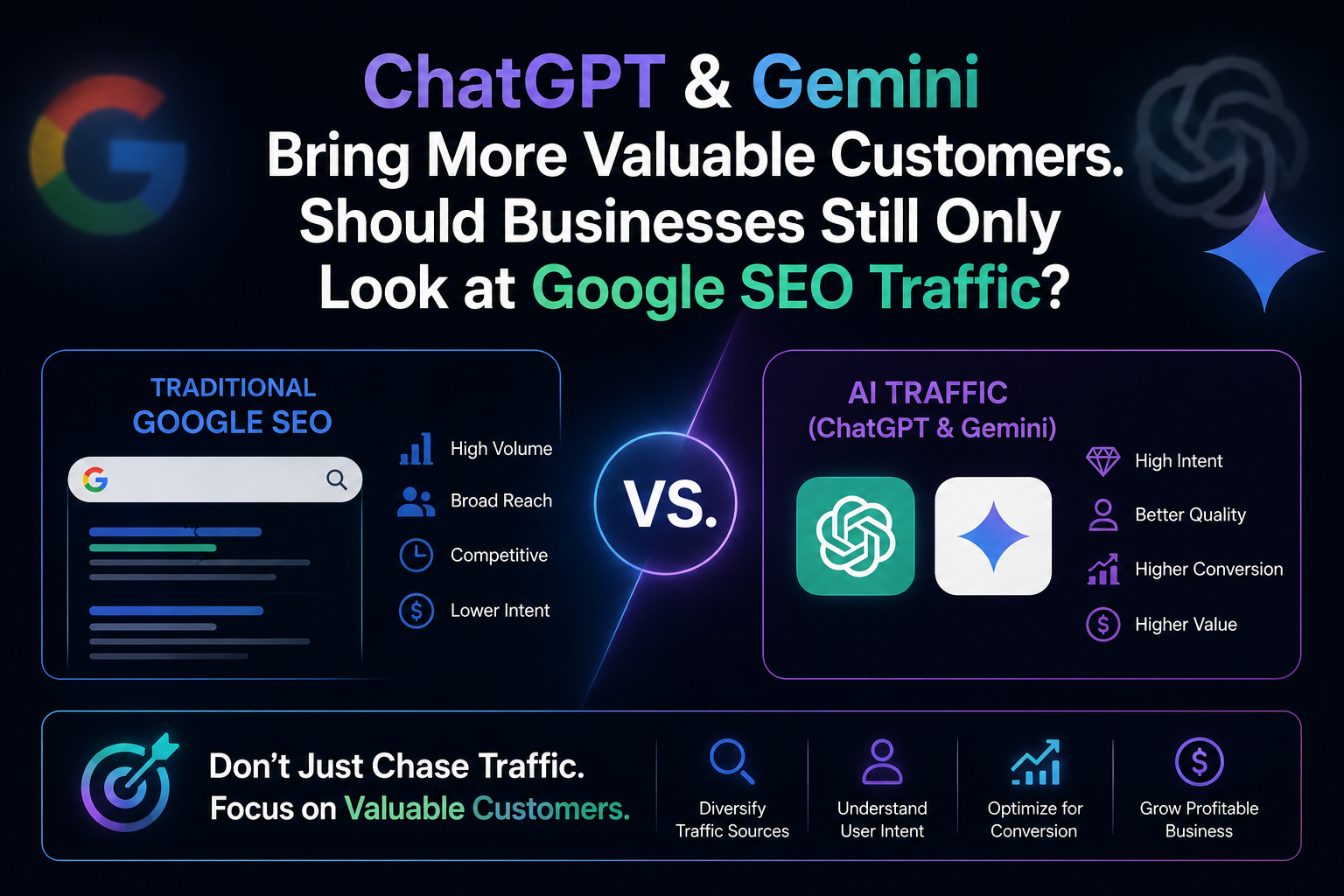
english_title: Are ChatGPT and Gemini Customers More Valuable? Should Businesses Still Only Chase Google SEO Traffic?
seo_title: Are ChatGPT and Gemini Customers More Valuable? Businesses Shouldn't Only Chase Google SEO Traffic
seo_description: AI conversation entry points like ChatGPT and Gemini are turning "searching for information" into "making decisions." Businesses don't have to abandon Google SEO, but they should shift from a traffic mindset to high-intent customers, AI visibility, and convertible content assets.
seo_keywords: ChatGPT traffic, Gemini traffic, Google SEO, AI search, GEO, AI recommendations, high-intent customers, B2B lead generation, SEO strategy, AI website building, We0 AI
cover_zh: https://we0-cms.oss-cn-beijing.aliyuncs.com/ai-upload/7b886876-c5e6-48b5-a452-e3f34bce6f0f.png
cover_en: https://we0-cms.oss-cn-beijing.aliyuncs.com/ai-upload/beeb9a72-db6d-4699-9798-dd120794d77d.png
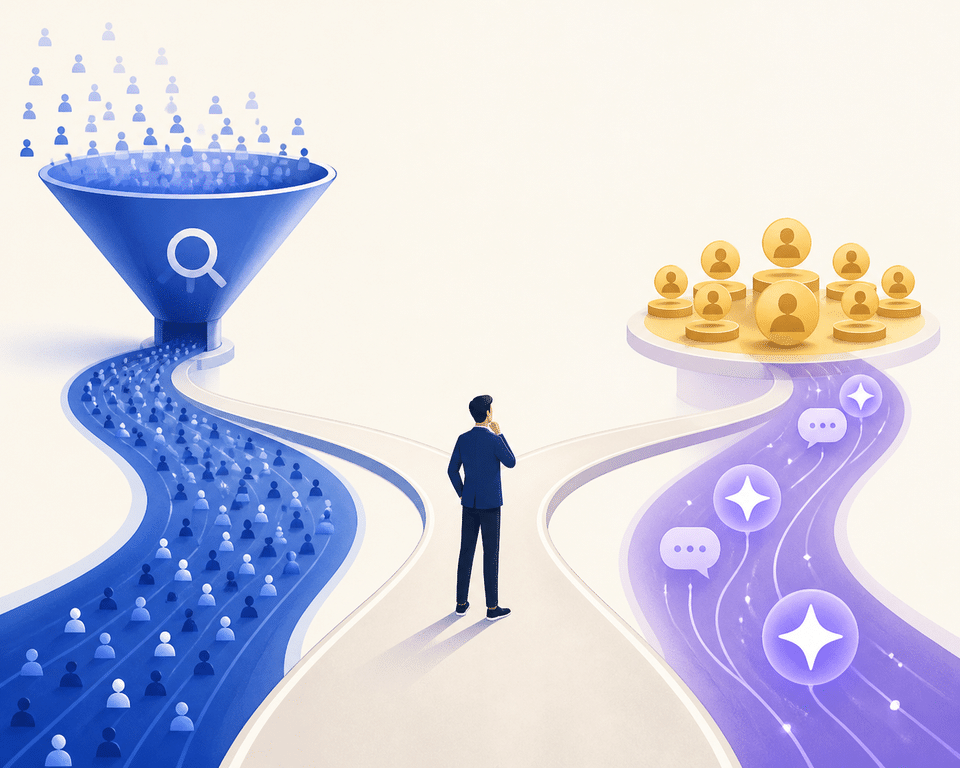
seo_cover_brief: Use the visual contrast between "wide but shallow search traffic" and "narrow but deep AI conversation customers" to convey that SEO and AI visibility shouldn't be an either/or choice.

Are ChatGPT and Gemini Customers More Valuable? Should Businesses Still Only Chase Google SEO Traffic?
Let's start with the conclusion: No, you shouldn't only chase it. More precisely, you should no longer use "how much organic traffic" as the sole criterion for deciding whether a channel is worth investing in.
Many businesses are still growing with a familiar formula: find keywords, write articles, build backlinks, wait for rankings, and watch Sessions. That logic isn't wrong, and Google SEO is still important. The problem is that user behavior has changed.
In the past, users would search for "best CRM," "comparison of certain types of software," or "recommended service providers," then open a dozen browser tabs themselves.
Now, more and more users go straight to ChatGPT, Gemini, or other AI assistants and ask:
"We have a 20-person sales team, a limited budget, and want a CRM that can integrate with our existing tools. What are our options?"
This isn't an ordinary keyword. It already carries scale, budget, use case, constraints, and purchase intent.
So, traffic coming from AI conversation entry points often isn't "bigger traffic"—it's traffic closer to the last mile. It may not be large in volume, but it could be far more valuable.
Google SEO answers: Can you be found?
AI visibility answers: When users are making a decision, will you be recommended?
The real question isn't "Will ChatGPT replace Google?" It's: When customers have already moved from searching words to asking, filtering, comparing, and validating, does your website qualify to be part of the answer?
1. Why customers brought in by AI may be more valuable?
The word "may" matters. Not every AI-driven visit converts better, and you shouldn't treat ChatGPT or Gemini as some new traffic miracle.
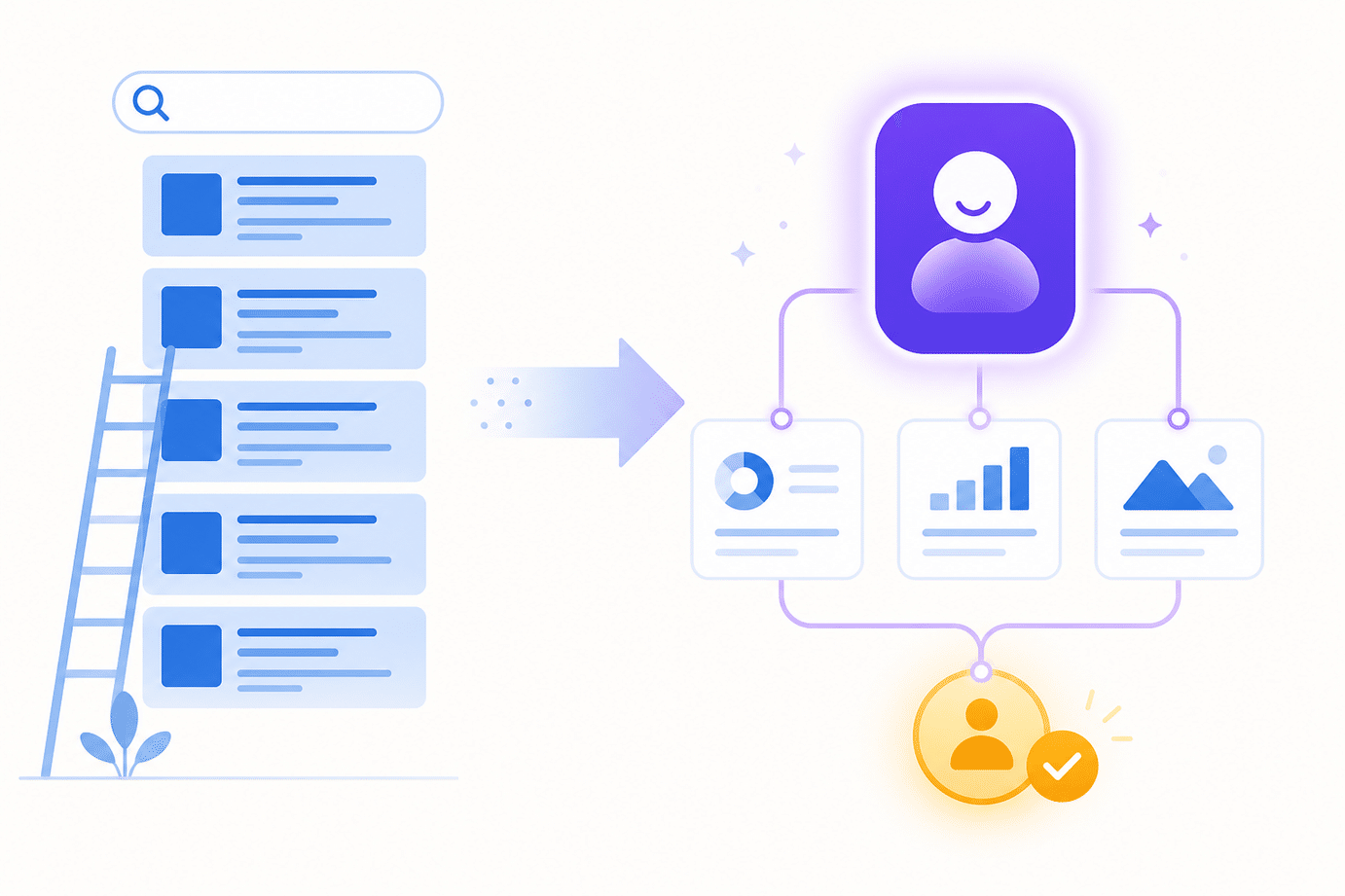
But in scenarios like B2B, tool-based products, professional services, cross-border procurement, and high-ticket consulting, AI-driven visits often naturally carry stronger intent. The reason is simple: users have already done a round of information compression for themselves in the conversation.
| Dimension | Traditional Google Search Visit | ChatGPT / Gemini AI Conversation Visit |
|---|---|---|
| User's starting point | Vague questions, broad exploration | Specific tasks, questions with constraints |
| Information processing | Users browse results and filter themselves | AI aggregates, explains, and compares first |
| State before clicking | Might just be browsing | Often already in validation or shortlist mode |
| Better suited for | Broad needs, long-tail content, brand exposure | Comparisons, case studies, solutions, pricing, landing pages |
| Core metrics | Rankings, impressions, clicks | Citations, recommendations, quality visits, lead quality |
Google is still great for answering "What should I learn about?"
AI conversations are more likely to appear at the stage of "What should I choose now, how should I do it, and which provider fits me better?" It's not about one being superior to the other—it's that they sit at different points in the user journey.

An uncomfortable truth: SEO traffic can be huge, but business signals are scarce
An article getting 100,000 visits sounds great. But if it solves a broad educational question and readers leave without remembering your brand, without visiting your product pages, case studies, or contact pages, then those 100,000 visits may mean very little to your sales team.
On the other hand, a product comparison, an industry solution, or a real customer case study might not get much traffic, but it can consistently attract people who look more like actual customers.
So, don't read this as "no need to do SEO anymore." Quite the opposite: You need to make SEO more like a business engine, not a traffic factory.
You need to start looking at three layers of data simultaneously:
- Discovery layer: Impressions, rankings, non-branded keyword coverage, whether AI can find your pages;
- Consideration layer: Time on key pages, case study reads, pricing page visits, returning visits, branded keyword searches;
- Conversion layer: Qualified inquiries, demo bookings, trials, closed deals, and the average order value and sales cycle associated with each lead source.
If you only look at the first layer, AI channels will always seem "small." But sales teams don't just ask about traffic volume.
What sales actually care about: is this person someone who already knows what problem they need to solve?
2. The change isn’t just "traffic moving from Google to ChatGPT"
That framing is far too simplistic.
Search hasn’t disappeared. Google is embedding AI capabilities directly into the search experience; ChatGPT and Gemini, meanwhile, let users consolidate questions that used to be scattered across search boxes, documents, emails, and conversations with colleagues into a single Q&A entry point.
The core shift is this: the search results page is evolving from a "list of links" into "context-aware answers with next-step recommendations."
This produces two outcomes:
- For certain simple questions, users no longer click through to websites;
- For certain complex questions, users arrive at websites with clearer, better-defined needs because AI has already explained and filtered.
For businesses, this doesn’t mean "traffic goes to zero." It means content can no longer be written just to rank for a keyword. Content has to withstand follow-up questions: Who is it for? Who isn’t it for? How does it differ from alternatives? What does implementation cost? Is there evidence?
What kind of websites is AI more likely to cite?
No platform has publicly committed to a fixed "AI ranking formula." But from the nature of user questions, it’s safe to infer that vague, generic pages lacking evidence are unlikely to become citable answers.
The content more likely to be understood, referenced, and clicked tends to be:
- Clearly explaining what problem a product or service actually solves;
- Including explicit use cases, boundaries, and comparisons;
- Featuring case studies, customer testimonials, methodology, or verifiable data;
- Keeping key facts readable and crawlable on the page, not hidden inside images or PDFs;
- Maintaining a clean page structure with complete titles, FAQs, product information, and action prompts;
- Keeping brand information consistent across the official website, content pages, and third-party mentions.

This may sound like GEO, but it’s really fundamentals first.
A corporate website that even customers can’t understand won’t get seriously recommended by models just because it’s been tagged with a few "AI SEO" labels. What you give AI isn’t slogans; what you give users isn’t pretty empty pages. What you need is a set of understandable business evidence.
3. Don’t rush to kill SEO: Google is still your foundation
If someone tells you "AI is here, SEO can be dropped," they’re basically selling you the opposite extreme.
Google Search still handles a huge volume of high-intent discovery: brand terms, question terms, local terms, product terms, comparison terms, tutorial terms. More importantly, the content assets built through SEO are often the raw material that AI systems use to understand you.
Without a clear website structure, without stable product pages, case pages, knowledge bases, and FAQs, without continuously updated credible content—where would AI even get the material to understand you?
So the more sensible framework isn’t SEO vs. GEO, but this:
SEO is the infrastructure for content discovery; GEO/AI visibility is the extension of content into recommendation and decision-making flows.
What companies should abandon isn’t Google SEO; it’s the kind of SEO that only chases clicks without designing a conversion path.
4. What to do next: shift from "grabbing traffic" to "earning the right to be considered"
You don’t need to move all your budget from SEO to studying ChatGPT tomorrow. A more realistic approach is upgrading your existing website and content into an asset that serves search, AI recommendations, and conversions simultaneously.
1. Start with an audit: which pages are closest to closing deals?
Don’t start with "let’s write 100 more articles."
Open your analytics tools and identify the pages that—despite modest traffic—most often lead to trials, bookings, inquiries, or high-quality return visits. These are usually:
- Product feature pages;
- Industry/use-case solution pages;
- Customer case study pages;
- Competitor or alternative comparison pages;
- Pricing, service scope, and implementation explanation pages;
- In-depth FAQs that clearly answer a purchase-related question.
These pages are where you should prioritize adding facts, evidence, structure, and CTAs.
2. Content shouldn’t just answer "what it is"—it should answer "whether I should choose you"
A lot of SEO content stops at definitions. For example, after reading "what is AI website building," users may understand the concept but still not know: Is it right for my export company’s website? What do I need to prepare? After launch, who keeps producing content and optimizing?
Pages that actually drive decisions address these follow-up questions explicitly:
| Content layer | Common approach | Approach better suited for AI and conversions |
|---|---|---|
| Conceptual content | What is XX | When XX is worth using, and when it isn’t |
| Feature content | We have features A, B, C | Which specific business bottleneck each of A, B, C resolves |
| Case content | Customers got good results after using it | Where the customer was stuck, what they did, what results they achieved |
| Comparison content | We’re better than others | Who fits you, who doesn’t, and what the switching cost is |
| FAQ | One-line dismissive answer | Provide constraints, concrete processes, and next-step entry points |
AI doesn’t just need answers—it needs material that supports answers. Customers need the same.
3. Upgrade your brand website from a digital business card to a content and evidence hub
Many corporate websites have beautiful homepages but thin inner pages. Products, case studies, service boundaries, delivery processes, and industry experience all live inside salespeople’s heads or scattered documents.
This is bad for Google, bad for AI, and—more directly—bad for customers.
A display-focused website capable of continuously acquiring customers should at minimum let a first-time visitor quickly understand:
- Who you are and who you serve;
- What specific problems you solve;
- Why you’re trustworthy;
- What verifiable cases or evidence exist;
- How to contact, try, or book a next step.
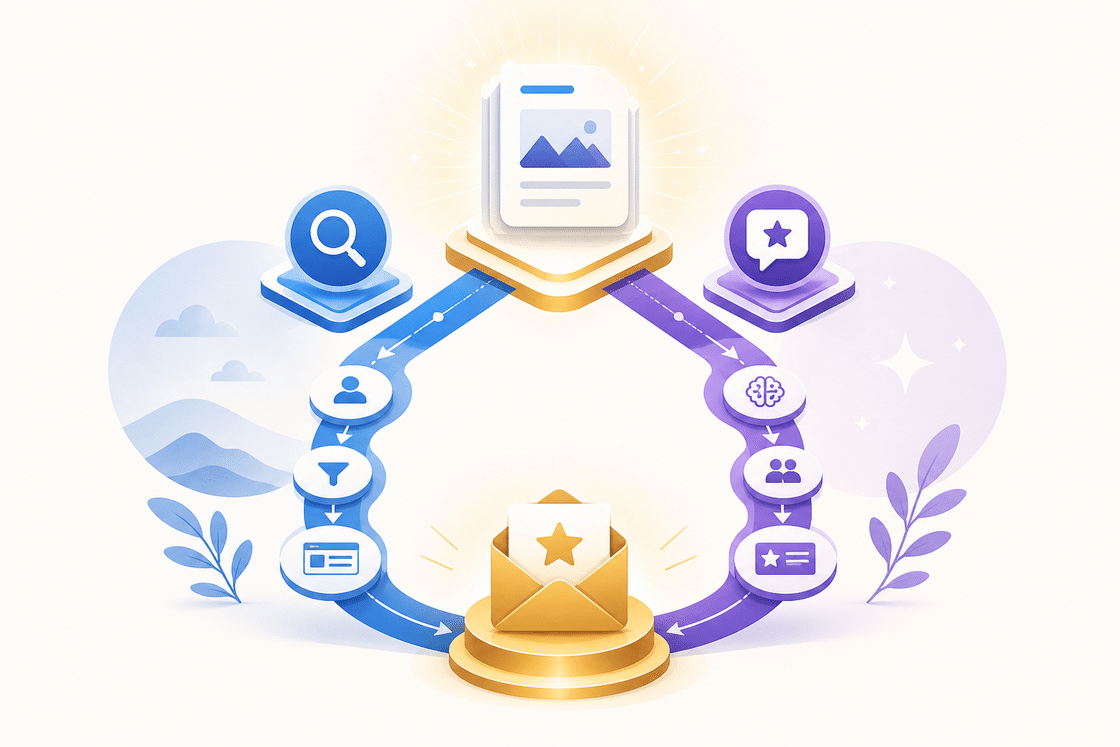
This is also the starting point of We0 AI: not to hastily generate a page for businesses, but to turn the website into a long-term asset that can showcase, operate, grow, and capture leads.
From site-building onwards, organizing brand information and page structure, to SEO/GEO baseline configuration, content production, data monitoring, continuous optimization, and review—the focus is never "launch day," but whether the site can continuously accumulate opportunities to be discovered, understood, and chosen after launch.
4. Add a new metric: "effective conversations" driven by AI touchpoints
In the short term, you may not be able to attribute every impact from ChatGPT or Gemini accurately. Users complete decisions across devices, channels, and multiple visits. Don’t pretend it doesn’t exist because of that.
For now, start with a simple dashboard that puts channels back into a business context:
- Brand-term search growth by source;
- Arrival rates from each source to product/case/pricing pages;
- "How did you hear about us" fields in forms;
- Self-reported sources during sales’ first conversations;
Conversion rate, average order value, and sales cycle length by lead source;
- Pages where AI mentions or cites you, and the behavior that follows on those pages.
What you should track is not a vanity metric, but: whether AI is helping you reduce customer education costs and improve their level of understanding before they enter a sales conversation.
5. A Better Allocation Model for Today: 70 / 20 / 10
There is no ratio that works for every company, but if you are shifting from pure SEO to "search + AI visibility," this framework can serve as a starting point:
- 70%: Build a solid SEO foundation. Technically crawlable pages, core product and service pages, topical content clusters, case studies, brand terms, and high-intent keywords;
- 20%: Fill in decision-making content. Comparisons, alternatives, selection guides, industry solutions, implementation details, pricing and boundaries, real FAQs;
- 10%: Run AI visibility experiments. Continuously test which content is more likely to be cited in AI conversations, which referral paths drive more effective visits, and update the evidence on your site accordingly.
This is not a fixed formula. Early-stage brands may need to invest more effort in building out their website and foundational content first; teams that already have significant SEO content should focus more on retrofitting high-value pages with greater "evidence density."
Don't treat AI traffic as another new number to chase. See it as a reminder: customers are searching more like they would consult an advisor.
6. The Bottom Line: Companies Should Shift from "Traffic-Driven" to "Customer-Value-Driven"
ChatGPT and Gemini will not make Google SEO obsolete overnight. Google SEO remains a long-term, compounding, reusable customer acquisition foundation.
But focusing only on Google rankings and organic visits is no longer enough.
The websites that matter most in the future are not just those that rank high. They must also:
- Be understandable to search engines;
- Be cited by AI as a reliable option;
- Enable customers to quickly verify value;
- Turn a single visit into an effective conversation.

SEO should not be abandoned. It should be upgraded.
Upgrade from "how do I get more clicks" to "how do I get seen, trusted, and contacted when customers are actually making decisions."
title: Are ChatGPT and Gemini Customers More Valuable? Should Businesses Still Only Chase Google SEO Traffic?
chinese_title: ChatGPT 和 Gemini 带来的客户更值钱,企业还应该只看 Google SEO 流量吗?
seo_title: Are ChatGPT and Gemini Customers More Valuable Than Google SEO Traffic?
seo_description: ChatGPT, Gemini, and other AI
assistants are turning search into a decision process. Don't abandon Google SEO—upgrade toward high-intent customers, AI visibility, and conversion-ready content assets.
seo_keywords: ChatGPT traffic, Gemini traffic, Google SEO, AI search, GEO, generative engine optimization, AI recommendations, high-intent customers, B2B lead generation, We0 AI
cover: https://we0-cms.oss-cn-beijing.aliyuncs.com/ai-upload/beeb9a72-db6d-4699-9798-dd120794d77d.png
seo_cover_brief: Contrast a wide but shallow search-traffic stream with a narrower, deeper AI-conversation path that delivers high-value customers.