ChatGPT Free Gets GPT-5.6 Luna and Unlimited Text Chats
OpenAI is giving the free version of ChatGPT one of its biggest model-access upgrades yet
ChatGPT Free Gets GPT-5.6 Luna and Unlimited Text Chats
Introduction
OpenAI is giving the free version of ChatGPT one of its biggest model-access upgrades yet.
GPT-5.6 Luna is becoming the default model for Free and Go users, and OpenAI says those users will also receive unlimited text chats plus a new Think button for questions that need more reasoning.
The rollout is not the same as giving free users unrestricted access to every GPT-5.6 model or every ChatGPT tool. Free and Go users receive GPT-5.6 Luna in normal ChatGPT conversations. They do not receive GPT-5.6 Sol in standard chat. File uploads, image generation, and other tools continue to have separate limits, and unlimited text chat remains subject to abuse-prevention guardrails.
Paid users are getting a different upgrade. Plus and Pro users can use an updated version of GPT-5.6 Sol that OpenAI has specifically tuned for everyday ChatGPT conversations. The model is designed to be more focused, more reliable with facts, and more consistent when moving from quick answers to deeper reasoning. OpenAI is also adding a slider that lets paid users choose how much thought the model should put into a response.
The update applies specifically to the Chat experience in ChatGPT. The GPT-5.6 Sol versions used in Work and Codex are not being replaced by this Chat-optimized release.
GPT-5.6 Sol Is Being Tuned for Chat Again
Much of the AI industry’s recent model competition has centered on coding agents, tool use, long-running workflows, cybersecurity, and autonomous research. Those capabilities matter, but they are not how most people use ChatGPT every day.
OpenAI says roughly one billion people use ChatGPT every week for a much wider mix of tasks, including quick questions, web search, planning, research, advice, writing, and complex decisions.
The August update to GPT-5.6 Sol is designed around that full range of ordinary ChatGPT use.
OpenAI says the updated model now:
- answers the real question more directly;
- adapts the amount of detail to the request;
- uses tighter formatting;
- avoids unnecessary structure when it does not help;
- provides useful correction instead of simply agreeing;
- maintains a more consistent tone between quick and deeper responses.
The point is not to make Sol less capable. It is to make its capability feel more natural in conversation.
More Focused Answers
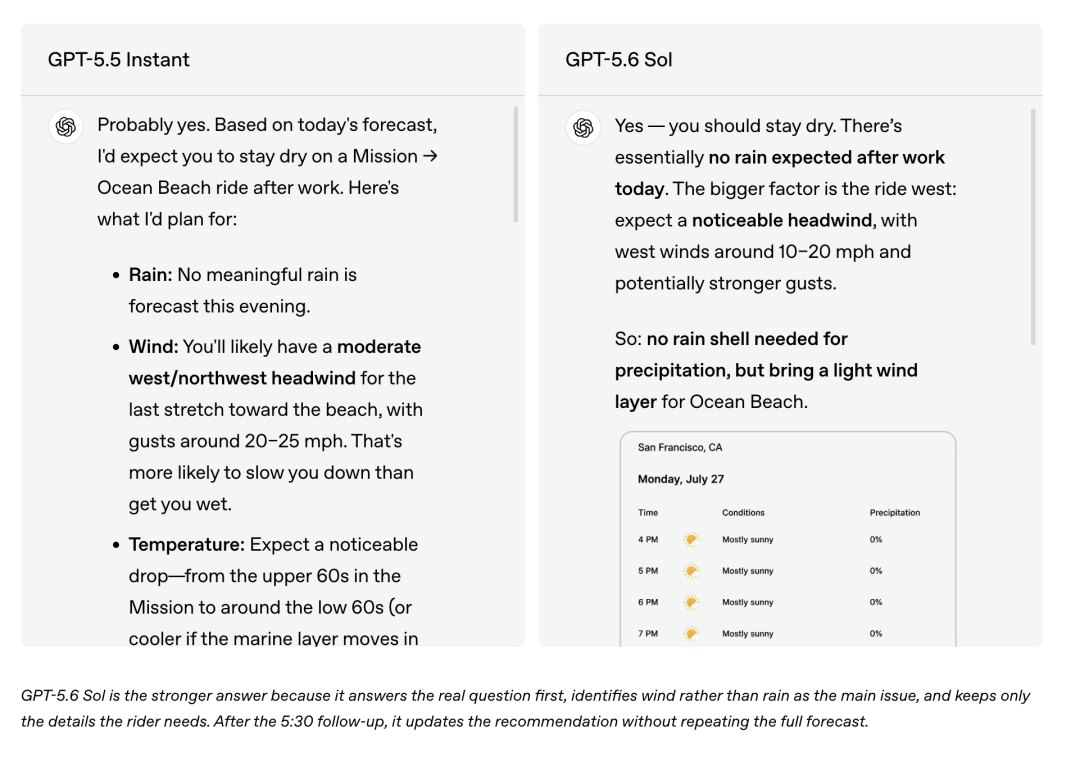
OpenAI’s main example compares GPT-5.5 Instant with the updated GPT-5.6 Sol on a simple question about cycling from San Francisco’s Mission district to Ocean Beach after work without getting soaked.
Both models can read the forecast. The difference is presentation and prioritization.
GPT-5.6 Sol begins with the answer the rider actually needs: rain is unlikely to be the problem. The more important factor is a westward headwind.
Instead of giving a long weather summary first, the model surfaces the decision-relevant information and then adds only the context needed to act on it.
For a simple question, the model should give a simple answer. For planning, research, writing, or a complicated decision, the same model can expand into a fuller response without losing the main recommendation inside excessive detail.
The Update Is Also About Factual Reliability
OpenAI says the new GPT-5.6 models make fewer factual mistakes than GPT-5.5 Instant in internal evaluations.
In one evaluation covering high-stakes prompts in finance, medicine, and law, OpenAI measured whether a response contained at least one factual error.
| Model | Reduction vs. GPT-5.5 Instant |
|---|---|
| GPT-5.6 Luna | About 62% |
| GPT-5.6 Sol | About 68% |
These are internal evaluation results, not a guarantee that either model is error-free.
OpenAI’s August safety documentation gives a broader version of the same finding. It says Luna reduced factual error rates by more than 60% on high-stakes prompts, while Sol delivered more consistent improvements across several factuality prompt sets.
Users should still verify consequential information, especially when a response depends on dates, numbers, laws, regulations, medical facts, or assumptions.
Instant and Deeper Reasoning Should Feel Like the Same Assistant
Another goal of the update is consistency.
Historically, switching from a fast model to a reasoning model could feel like changing assistants entirely. OpenAI says it wants the transition from fast to deeper reasoning to feel more like giving the same assistant more time.
For Plus and Pro users, GPT-5.6 Sol can now cover quick answers and deeper reasoning while keeping a more consistent tone.
A New Reasoning Slider for Plus and Pro
Plus and Pro users can now adjust how much reasoning effort GPT-5.6 Sol uses in ChatGPT through a slider.
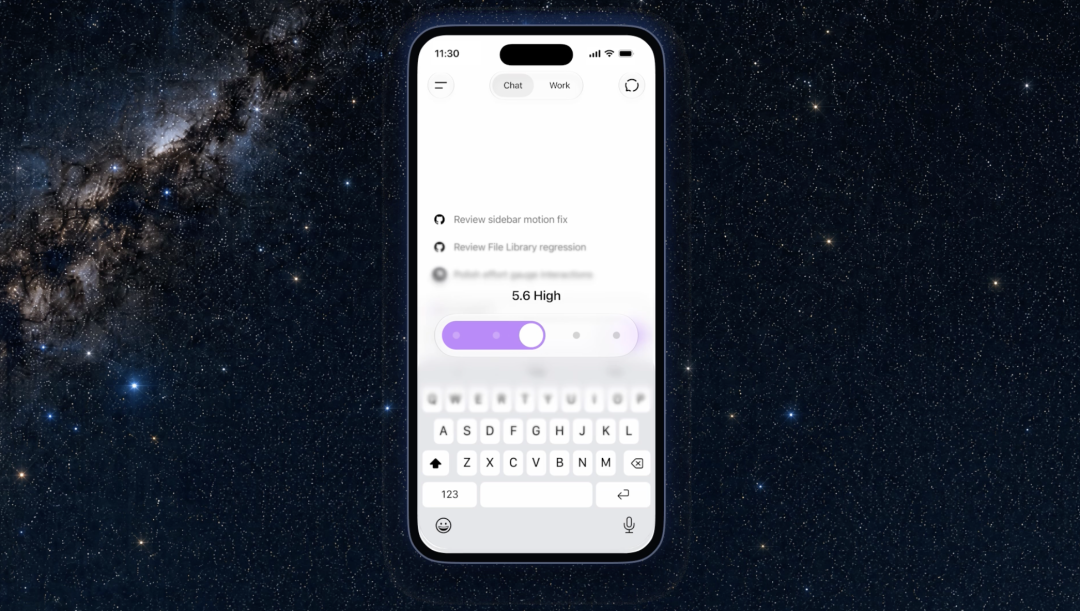
The slider is available across web, mobile, and desktop as the rollout reaches eligible users.
The idea is straightforward:
- Keep the setting low for fast everyday questions.
- Increase it for planning, research, writing, coding, or decisions that need more careful reasoning.
OpenAI’s current help documentation describes paid-plan reasoning levels such as Medium, High, and Extra High, with exact options depending on the plan.
This is different from the old experience of choosing between several model names and then separately thinking about reasoning effort. OpenAI is moving toward a simpler interaction in which the user chooses how much effort the same model should spend.
The exact controls available can differ by plan and may change as the rollout continues.
Free Users Get GPT-5.6 Luna as the Default Model
The larger accessibility change is on the free tier.
GPT-5.6 Luna is becoming the default model for Free and Go users.
Luna is the fastest and lowest-cost member of the GPT-5.6 family. It is not the same model as Sol, but it brings the latest GPT-5.6 generation into everyday free ChatGPT use.
OpenAI says the rollout is gradual. Its August 6 announcement said Luna would become the default model for Free and Go users that week, with unlimited text chats and the Think button beginning the following week.
Because the deployment is progressive, an individual account may not receive every part of the update at exactly the same time.
What “Unlimited Text Chats” Actually Means
The phrase “unlimited ChatGPT” can easily be misunderstood.
OpenAI is specifically describing unlimited text chats using GPT-5.6 Luna for Free and Go users.
It does not mean every ChatGPT capability becomes unlimited.
OpenAI explicitly says that limits still apply to:
- file uploads;
- images and image generation;
- other tools and features.
The unlimited text-chat access is also subject to abuse guardrails. OpenAI may still apply safeguards or temporary restrictions when activity triggers misuse protections.
So the practical interpretation is:
| Feature | Free / Go Update |
|---|---|
| Standard text chat | Unlimited with GPT-5.6 Luna as rollout completes |
| Default model | GPT-5.6 Luna |
| Harder-question reasoning | New Think button using GPT-5.6 Luna |
| GPT-5.6 Sol in standard Chat | Not included |
| File uploads | Separate limits remain |
| Images / image generation | Separate limits remain |
| Other tools | Separate limits remain |
| Abuse safeguards | Still apply |
This is a major expansion of ordinary conversation access, but it is not an unlimited entitlement to every paid model and tool.
The Think Button Gives Luna More Time
Free and Go users are also getting a new Think button for more difficult questions.
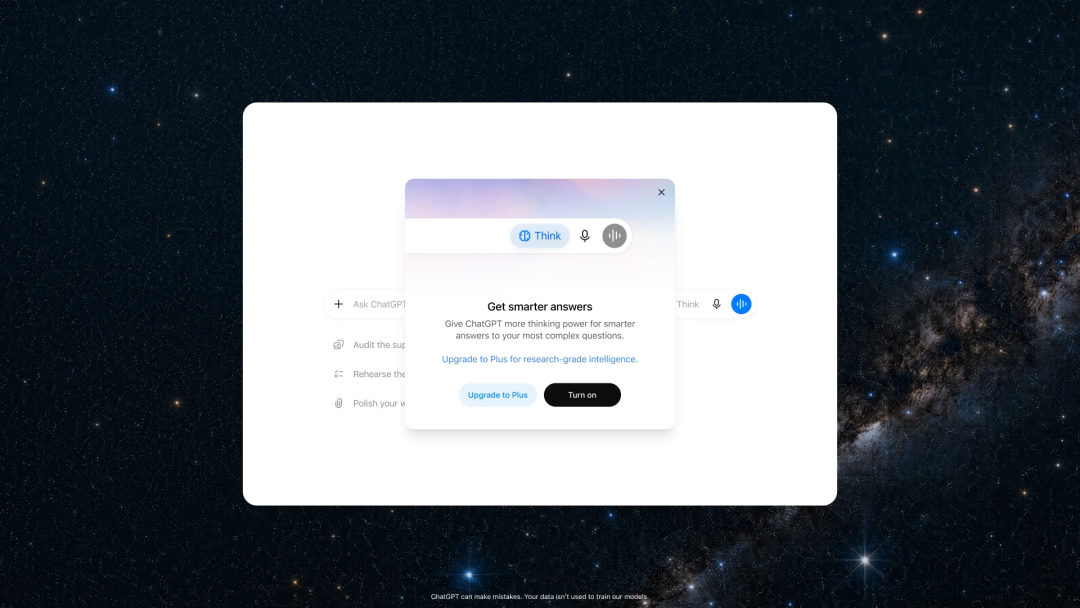
When the user taps Think, ChatGPT gives GPT-5.6 Luna more time to work through the response.
OpenAI’s help documentation makes one point especially clear: the Think button does not switch free users to GPT-5.6 Sol.
Think still uses GPT-5.6 Luna.
That distinction matters because a headline saying “GPT-5.6 is free” can suggest that the flagship Sol model is being opened to everyone. The official product documentation does not say that.
Free and Go users receive the Luna experience, including Luna-powered deeper reasoning through Think.
The Chat Update Does Not Replace GPT-5.6 in Work or Codex
OpenAI is maintaining different GPT-5.6 releases for different product surfaces.
The August Chat-optimized GPT-5.6 Sol is specifically for everyday ChatGPT conversations.
OpenAI says the versions of GPT-5.6 Sol and Luna already used in ChatGPT Work and Codex are not changing as part of this release.
That means users should not assume a change observed in normal Chat automatically applies to:
- Work;
- Codex;
- the OpenAI API.
OpenAI’s current help center lists GPT-5.6 availability separately by product.
| Product | Current GPT-5.6 Availability |
|---|---|
| Standard ChatGPT for Free / Go | Luna |
| Standard ChatGPT on eligible paid plans | Sol reasoning options |
| ChatGPT Work | Sol, Terra, and Luna on eligible paid plans |
| Codex | Terra for Free/Go; Sol, Terra, and Luna on eligible paid plans |
| OpenAI API | Sol, Terra, and Luna |
Product availability and usage policies can change, so developers and managed-workspace users should use the current help center rather than assuming the consumer Chat rollout applies everywhere.
Why OpenAI Is Paying Attention to Ordinary Conversation
The source article ends with a broader observation.
In 2026, frontier-model competition has been heavily shaped by coding agents. Models are increasingly evaluated on their ability to modify repositories, use terminals, operate tools, and complete long-running technical work.
Yet consumer AI is not only a productivity system.
Many users still open ChatGPT to:
- ask a quick question;
- think through a decision;
- talk through an idea;
- search for information;
- plan a trip;
- rewrite something;
- explore a topic out of curiosity.
OpenAI’s update is a reminder that conversational quality itself remains a major product surface.
A model can gain stronger coding and agent abilities while still needing separate work on brevity, factual grounding, tone, prioritization, and natural back-and-forth conversation.
The source article connects this shift to a recent ByteDance Seed all-hands meeting reported by LatePost. ByteDance founder Zhang Yiming reportedly said coding is an important current direction but only one of the present hotspots, and that larger opportunities exist beyond programming.
That comment comes from media reporting on an internal meeting rather than an official ByteDance model announcement, so it should be read as industry context rather than a product specification.
The larger pattern is credible: leading AI labs are competing on coding while also returning attention to general intelligence and everyday interaction.
Safety Still Applies to the Expanded Access
OpenAI’s August GPT-5.6 update retains the safety systems used for the broader GPT-5.6 family.
The company classifies the updated Sol and Luna releases as High capability under its Preparedness Framework for cybersecurity and biological/chemical capabilities, while keeping them below the High threshold for AI self-improvement.
That is one reason expanded access does not mean removing safeguards.
OpenAI says GPT-5.6 includes:
- model-level safety training;
- real-time checks and monitoring;
- access controls;
- additional protections for higher-risk requests;
- specific protections for users believed to be under 18.
Some legitimate cybersecurity or biological requests may still encounter refusals or additional checks.
For ordinary Free users, the most visible practical point is simpler: unlimited text conversation does not remove platform rules or misuse protections.
What Changes by Plan
The update is easiest to understand as two separate tracks.
Free and Go
Users receive:
- GPT-5.6 Luna as the default Chat model;
- unlimited text chats as the rollout completes;
- a Think button for harder questions;
- existing limits on files, images, and other tools.
They do not receive standard-chat access to GPT-5.6 Sol.
Plus
Users receive the updated GPT-5.6 Sol for eligible reasoning experiences and the new effort slider.
OpenAI’s current help documentation says Plus includes Medium and High GPT-5.6 Sol reasoning levels, while exact availability can continue to evolve.
Pro
Pro users receive broader GPT-5.6 Sol reasoning access, including higher-effort options and Pro-class capability where available.
The important distinction is that paid plans are not simply buying “more chats.” They provide access to stronger reasoning modes and higher-capability model options.
What Users Should Check During the Rollout
If the new controls do not appear immediately, that does not necessarily indicate a problem.
OpenAI says GPT-5.6 is rolling out gradually.
Users can check:
- Whether ChatGPT shows GPT-5.6 Luna as the default experience.
- Whether the Think button is visible on Free or Go.
- Whether the reasoning slider appears on an eligible paid plan.
- Whether the model picker or Configure control has changed.
- Whether the account is in a managed Business or Enterprise workspace with administrator-controlled access.
Enterprise users may temporarily continue to see an older model picker until the new interface reaches their workspace.
常见问题
Is GPT-5.6 free in ChatGPT?
GPT-5.6 Luna is becoming the default model for Free and Go users. Free users are not getting GPT-5.6 Sol in standard ChatGPT conversations.
Are ChatGPT messages now unlimited for free users?
OpenAI says Free and Go users will receive unlimited text chats with GPT-5.6 Luna as the rollout completes. The access remains subject to abuse guardrails, and separate limits still apply to files, images, and other tools.
What does the ChatGPT Think button do?
Think gives GPT-5.6 Luna more time to reason about a difficult question. It does not switch a Free or Go user to GPT-5.6 Sol.
What is the difference between GPT-5.6 Luna and GPT-5.6 Sol?
Luna is the fastest and lowest-cost model in the GPT-5.6 family and is being used for the Free and Go default experience. Sol is the flagship model and powers higher reasoning options on eligible paid plans.
Did GPT-5.6 Sol become more accurate?
OpenAI reports substantial factuality improvements in internal evaluations. In one high-stakes test, responses containing at least one factual error were about 68% less common with updated GPT-5.6 Sol than with GPT-5.5 Instant.
What is the new GPT-5.6 reasoning slider?
The slider lets eligible paid users choose how much reasoning effort GPT-5.6 Sol should use. It is intended to make the same model work for both quick everyday answers and more demanding research, planning, writing, coding, or decision tasks.
Does this update change GPT-5.6 in Codex or ChatGPT Work?
No. OpenAI says this August update applies to the Chat experience. The GPT-5.6 versions already used in Work and Codex remain unchanged as part of this release.
Why don’t I see the new GPT-5.6 features yet?
OpenAI is rolling the update out gradually. Availability can depend on plan, account, workspace settings, and rollout timing.
相关工具
- ChatGPT: OpenAI’s conversational AI product where GPT-5.6 Luna and the updated Sol experience are rolling out.
- GPT-5.6: OpenAI’s official overview of the Sol, Terra, and Luna model family.
- ChatGPT Work: OpenAI’s agentic workspace for longer-running research and knowledge-work tasks.
- Codex: OpenAI’s coding-agent environment, which uses its own GPT-5.6 availability and limits.
- OpenAI Deployment Safety Hub: Official system cards and safety evaluations for deployed OpenAI models.
Related Links
- Improving GPT-5.6 Sol in ChatGPT: OpenAI’s official August 6 announcement covering focused answers, factuality, the reasoning slider, Luna, and unlimited text chats.
- GPT-5.6 in ChatGPT: Current plan-by-plan documentation for GPT-5.6 models, reasoning levels, usage limits, and product availability.
- ChatGPT Release Notes: Official rollout notes for the August GPT-5.6 ChatGPT update.
- GPT-5.6 August Safety Update: OpenAI’s factuality, safety, capability, and safeguard evaluations for the updated Sol and Luna models.
- GPT-5.6 Model Overview: Official model-family capabilities and benchmark information.
- GPT-5.6 System Card: The broader technical and safety documentation for the GPT-5.6 family.
- OpenAI: How the World Is Putting ChatGPT to Work: Current OpenAI data describing usage by more than one billion people.
Summary
OpenAI is splitting the August ChatGPT upgrade into two experiences. Free and Go users are moving to GPT-5.6 Luna as the default model, with unlimited text chats and a Luna-powered Think button. Plus and Pro users receive an updated GPT-5.6 Sol designed to be more focused, more factual, and more consistent across fast and deeper reasoning.
The phrase “unlimited” applies to text conversation, not every ChatGPT tool. Files, images, and other features keep their own limits, and platform abuse safeguards still apply.
The Sol update is also intentionally limited to normal ChatGPT conversations. Work and Codex continue using the previously released GPT-5.6 versions.
The bigger change is not simply that Free users can send more messages—it is that OpenAI is making the latest GPT-5.6 generation the default everyday conversation layer while simplifying how users move between fast answers and deeper reasoning.