ChatGPT, Claude, or Gemini? How Big Pharma Is Rebuilding Its AI Stack
The relationship between artificial intelligence and pharmaceutical research is changing.
ChatGPT, Claude, or Gemini? How Big Pharma Is Rebuilding Its AI Stack
Introduction
The relationship between artificial intelligence and pharmaceutical research is changing.
For several years, the most visible partnerships in AI-driven drug development involved specialist companies working on target identification, protein structure prediction, molecular generation, virtual screening, or laboratory automation. Pharmaceutical groups also relied heavily on cloud providers, chip companies, and data-platform vendors for the infrastructure behind those projects.
A second group of suppliers is now moving deeper into the industry. OpenAI, Anthropic, and Google are no longer being considered only as providers of general chatbots or office assistants. Their models are entering scientific research, clinical development, medical writing, regulatory work, coding, data analysis, manufacturing investigations, and enterprise decision-making.
The strategic question for a pharmaceutical company is therefore becoming broader than “Which chatbot should employees use?”
The real question is:
Which combination of models, data systems, scientific tools, security controls, and human-review processes can become a dependable intelligence layer for the company?
A Snapshot of Big Pharma’s Frontier-AI Partnerships
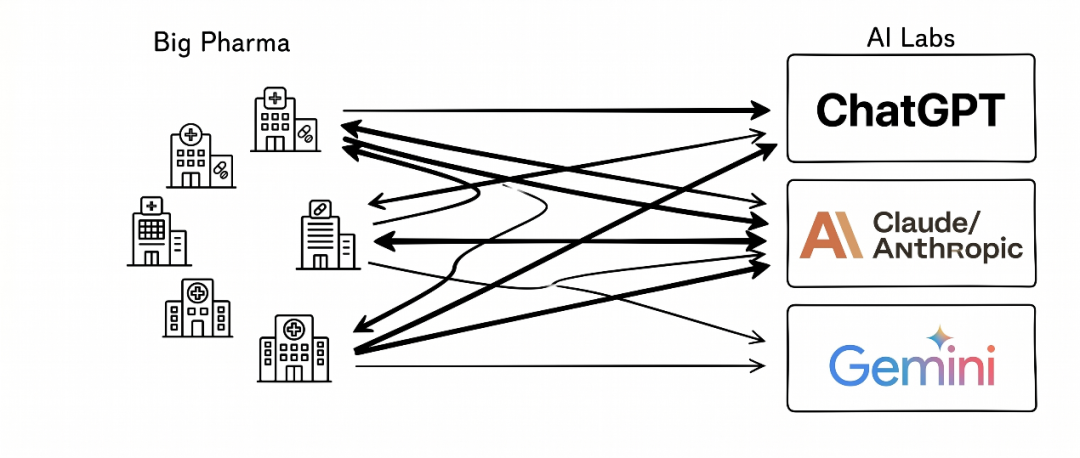
A May 2026 analysis published by Big Pharma Sharma tracked 27 confirmed strategic partnerships involving 21 major pharmaceutical companies and three frontier-AI ecosystems: OpenAI, Anthropic, and Google Gemini.
The dataset reported the following approximate distribution:
| Finding | Reported Result |
|---|---|
| Confirmed partnerships tracked | 27 |
| Major pharmaceutical companies represented | 21 |
| Partnerships involving Anthropic | About 52% |
| Partnerships involving OpenAI | About 41% |
| Partnerships involving Gemini | 2 |
| Companies working with both OpenAI and Anthropic | At least 6 |
| Partnerships involving research or discovery | About 82% |
These figures are useful as a market snapshot, but they are not an official census of every pharmaceutical AI project. Private pilots, cloud contracts, internal model deployments, specialist-model partnerships, and undisclosed experiments may not appear in the dataset.
The numbers also do not mean that the pharmaceutical industry has split neatly into an OpenAI camp, a Claude camp, and a Gemini camp.
The more important pattern is multi-model experimentation. Large companies are testing different systems for different tasks while building a broader technology stack around proprietary data, validated tools, enterprise permissions, and human oversight.
Big Pharma Is Choosing Infrastructure, Not Just a Chat Window
For an individual user, a frontier model may be used for writing, searching, summarizing, brainstorming, or coding.
A pharmaceutical deployment has additional requirements.
The model may need to:
- Run inside an enterprise-controlled environment.
- Respect role-based access to sensitive data.
- Connect to internal research databases and document repositories.
- Use validated scientific and statistical tools.
- Preserve citations and provenance.
- Generate reviewable artifacts.
- Record actions for audit purposes.
- Support regulated workflows.
- Escalate uncertain or high-impact decisions to qualified specialists.
This creates at least three levels of adoption.
Level 1: Enterprise Productivity
At the first level, a company makes an AI assistant available to a large group of employees.
Typical use cases include:
- Searching internal knowledge.
- Summarizing long documents.
- Drafting reports.
- Generating code.
- Preparing presentations.
- Reviewing policies.
- Supporting routine knowledge work.
Moderna was an early example of this approach. The company worked with OpenAI from 2023, initially building an internal assistant called mChat and later deploying ChatGPT Enterprise to thousands of employees across business functions.
Bristol Myers Squibb took a similarly broad approach in 2026 by announcing that Claude would be deployed across research, clinical development, manufacturing, commercial, and corporate functions. The rollout was designed to reach more than 30,000 employees and connect Claude to thousands of internal data sources.
Level 2: AI Embedded in a Specific Workflow
The second level moves beyond a general assistant.
The model is incorporated into a defined process such as:
- Clinical study report preparation.
- Regulatory document generation.
- Protocol design support.
- Trial-data analysis.
- Patient-recruitment workflows.
- Bioinformatics.
- Manufacturing-deviation investigation.
- Medical and scientific writing.
At this level, the AI system is no longer simply helping an employee write faster. It is becoming part of the process itself.
A useful deployment needs approved templates, retrieval from reliable source material, structured output, version control, quality checks, and expert review.
Level 3: An Agent Platform Across the R&D Lifecycle
The third level is an agentic platform capable of coordinating several tools and information sources.
An agent may:
- Interpret a research or business goal.
- Break the goal into smaller tasks.
- Retrieve internal and external evidence.
- Call databases, scientific software, or enterprise services.
- Run analyses.
- Generate artifacts.
- Check results.
- Submit the work for human approval.
Merck’s multi-year partnership with Google Cloud illustrates this direction. The collaboration, valued at up to $1 billion, is intended to deploy an agentic platform using Gemini Enterprise across R&D, manufacturing, commercial operations, and corporate functions.
At this level, the competition is not about which logo appears in an employee’s browser tab. It is about which platform can coordinate the company’s next generation of scientific and operational workflows.
Why Claude Has an Early Lead in the Partnership Map
Anthropic held the largest share of the partnerships counted in the Big Pharma Sharma dataset.
That early position is consistent with Claude’s enterprise and life-sciences strategy.
Pharmaceutical teams often need a model to work with:
- Long clinical and regulatory documents.
- Structured scientific writing.
- Code and data-analysis workflows.
- Detailed instructions.
- Source-linked evidence.
- Enterprise security controls.
- Repeatable, auditable processes.
These needs align closely with the way Anthropic has positioned Claude.
Claude for Life Sciences
Anthropic introduced Claude for Life Sciences in 2025, adding integrations and connectors for scientific platforms and information sources.
The announced ecosystem has included services such as:
- Benchling.
- PubMed.
- BioRender.
- 10x Genomics.
- Synapse.org.
- Wiley Scholar Gateway.
- ClinicalTrials.gov.
- Medidata.
The aim is to let Claude work closer to the tools scientists already use rather than requiring every task to begin with manually copied text.
Anthropic expanded this approach in 2026 with Claude Science, a scientific workbench designed to integrate research tools, computing resources, and auditable artifacts.
Bristol Myers Squibb: Claude as a Shared Intelligence Layer
Bristol Myers Squibb announced a strategic agreement with Anthropic in May 2026.
The company said Claude Enterprise would be deployed across its global operations, including:
- Research.
- Clinical development.
- Manufacturing.
- Commercial functions.
- Corporate functions.
BMS described Claude as a shared intelligence platform rather than a single-purpose application. The goal is to connect employees and agents to internal data while creating a common interaction layer across different workflows.
This type of agreement helps explain Anthropic’s partnership count. The product is being sold not only as a model API, but as a secure enterprise environment, coding tool, agent framework, and knowledge interface.
NovoScribe Shows the Value of AI in Regulated Documentation
Novo Nordisk’s NovoScribe is one of the clearest examples of Claude being used in a regulated document workflow.
The system combines:
- Claude models.
- Claude Code.
- Retrieval-augmented generation.
- Expert-approved text.
- Case-specific variables.
- Amazon Bedrock.
- MongoDB Atlas.
- Human review.
Anthropic reported that clinical study documentation that previously required more than ten weeks could be produced in about ten minutes through the platform.
That figure is a company-reported case result, not a guarantee for every clinical document. Even so, the workflow demonstrates why large language models are attractive in regulatory writing.
Clinical reports and related documents are often:
- Long.
- Highly structured.
- Repetitive in format.
- Dependent on source data.
- Required to use consistent terminology.
- Subject to extensive review.
- Expected to trace claims back to evidence.
A model can assist with information extraction, first-draft generation, formatting, and consistency. Scientific judgment, regulatory responsibility, approval, and final accountability still remain with qualified professionals.
This is an important distinction. Claude’s early success in pharma does not necessarily prove that it is better at inventing new medicines. It shows that Anthropic found enterprise workflows in which the value can be measured quickly: coding, document production, knowledge retrieval, and structured analysis.
OpenAI Is Expanding From General Enterprise AI to Life-Sciences Models
OpenAI entered the pharmaceutical industry through a somewhat different route.
Its early advantage came from:
- Broad employee familiarity with ChatGPT.
- Enterprise deployment.
- A large developer ecosystem.
- Custom GPT applications.
- API-based internal tools.
- General-purpose coding and reasoning.
Moderna: Broad AI Adoption Across the Company
Moderna began collaborating with OpenAI in 2023.
The company initially created an internal chatbot named mChat. It later expanded access to ChatGPT Enterprise across multiple business functions and encouraged employees to build specialized GPTs for recurring tasks.
This is a bottom-up productivity model. Employees in research, legal, manufacturing, commercial, and administrative teams can identify high-frequency use cases and create internal assistants around them.
The benefit is broad experimentation. The risk is fragmentation if every department builds tools without shared governance, evaluation standards, and data controls.
Sanofi, Formation Bio, and OpenAI
Sanofi announced a collaboration with OpenAI and Formation Bio in 2024 to develop AI software for drug development.
The partnership combines:
- Sanofi’s proprietary data and pharmaceutical expertise.
- OpenAI’s models and AI capabilities.
- Formation Bio’s engineering and drug-development platform.
The companies later introduced Muse, a tool designed to support patient recruitment for clinical trials.
This represents a move beyond general employee assistance and into a defined drug-development workflow.
GPT-Rosalind: A Dedicated Life-Sciences Product Line
OpenAI introduced GPT-Rosalind in 2026 as a model series built specifically for life-sciences research.
The system is designed to reason across:
- Biology.
- Drug discovery.
- Protein engineering.
- Chemistry.
- Genomics.
- Scientific evidence.
- Research tools.
- Experimental workflows.
OpenAI has also developed life-sciences plugins and scientific viewers for workflows such as literature analysis, next-generation sequencing, single-cell analysis, and molecular-structure review.
GPT-Rosalind marks a strategic shift.
OpenAI is no longer offering pharmaceutical companies only a general enterprise assistant. It is building a separate model family, evaluation framework, tool layer, and controlled-access program for life-sciences research.
The company’s own LifeSciBench results also show why caution remains necessary. GPT-Rosalind leads the evaluated model set, but its overall task pass rate remains far below perfect, especially on artifact-heavy, design-heavy, and operationally constrained work.
A domain model can improve performance without removing the need for expert validation.
Moving From Scientific Reasoning to Automated Experiments
OpenAI’s life-sciences strategy also includes work that connects models to experimental systems.
The original source highlighted projects involving Ginkgo Bioworks and Retro Biosciences.
The important direction is not one isolated result. It is the attempt to build a closed loop:
- The model reviews previous experimental evidence.
- It proposes a new design or optimization.
- Laboratory automation executes the experiment.
- Results are collected.
- The model analyzes the outcome.
- The next experiment is proposed.
- Scientists review the process and conclusions.
If this loop becomes reliable, AI’s role would extend beyond summarizing scientific information. It could participate in iterative experimental design.
That is a more demanding standard than document generation. The system must cope with noisy data, incomplete biological understanding, failed experiments, equipment limitations, and safety constraints.
Claims of scientific improvement should therefore be evaluated through reproducible experiments and real development outcomes, not only model benchmarks or press releases.
Gemini Has Fewer Counted Deals but a Broader Infrastructure Position
Google Gemini appeared in only two partnerships in the Big Pharma Sharma dataset.
That number does not capture Google’s entire position in life sciences.
Google’s offering includes:
- Gemini models.
- Google Cloud.
- Gemini Enterprise.
- Data infrastructure.
- Enterprise search.
- Workspace.
- Vertex AI.
- TPU computing.
- Agent-development tools.
- Google DeepMind’s scientific research.
- AlphaFold and related biology models.
A pharmaceutical company adopting Gemini may be buying an integrated cloud and data architecture rather than a standalone model.
Merck and Google Cloud
Merck and Google Cloud announced a multi-year partnership in April 2026, valued at up to $1 billion.
The collaboration is intended to use Gemini Enterprise and Google Cloud technology across:
- Research and development.
- Manufacturing.
- Commercial operations.
- Patient engagement.
- Corporate functions.
Google Cloud engineers are expected to work alongside Merck teams on deployment.
This is the type of large, infrastructure-level agreement that can make partnership counts misleading. Google may have fewer public deals while still securing broad strategic commitments.
AlphaFold and Google’s Scientific Ecosystem
Google also benefits from the scientific credibility of Google DeepMind.
AlphaFold changed the practical landscape of protein-structure prediction and has become an important research resource. Google DeepMind and Isomorphic Labs continue working on biology and drug-design systems.
In a pharmaceutical architecture, Gemini can serve as a natural-language and task-orchestration layer while specialized scientific models perform structure, chemistry, or biological prediction.
Google’s long-term advantage may therefore come from integrating:
- General reasoning.
- Cloud infrastructure.
- Enterprise data.
- Scientific models.
- Agent management.
- Large-scale computing.
The Industry Is Not Dividing Into Three Permanent Camps
At least six pharmaceutical companies in the tracked dataset worked with both OpenAI and Anthropic.
This is one of the most important findings.
Large pharmaceutical companies are unlikely to place every critical workflow with one model provider while capability, price, latency, product design, and regulation continue to change quickly.
A multi-model architecture allows a company to match tools to tasks.
For example:
- Claude may be used for long documents, structured writing, code, and regulated workflows.
- OpenAI may be used for broad knowledge work, domain research, tool-based scientific reasoning, and experimental systems.
- Gemini may be used with Google Cloud data, enterprise agents, and specialized DeepMind technologies.
- Smaller or open models may handle lower-cost or privately deployed workloads.
- Specialist scientific models may perform chemistry, protein, genomics, imaging, or statistical tasks.
This does not mean every company will use every provider.
It means the durable asset is unlikely to be the model brand itself.
The durable asset is the internal platform that controls:
- Data access.
- Model routing.
- Tool permissions.
- Identity.
- Evaluation.
- Logging.
- Cost.
- Provenance.
- Human approval.
- Regulatory accountability.
A Practical Multi-Model Pharma Architecture
A mature pharmaceutical AI platform may contain several layers.
| Layer | Role |
|---|---|
| User and agent interface | Receives goals, questions, and review decisions |
| Orchestration layer | Plans tasks and routes work to models and tools |
| Frontier language models | Handle reasoning, writing, coding, and coordination |
| Domain models | Perform biology, chemistry, structure, imaging, or genomics tasks |
| Data layer | Provides governed access to internal and external information |
| Scientific tools | Run validated calculations, analyses, and simulations |
| Enterprise systems | Connect clinical, regulatory, manufacturing, and business workflows |
| Evaluation layer | Measures accuracy, omissions, citations, reproducibility, and risk |
| Governance layer | Controls permissions, audit logs, retention, and approvals |
| Human experts | Review evidence, make decisions, and retain accountability |
This architecture also reduces supplier lock-in.
If a model’s quality declines, cost rises, or availability changes, the orchestration layer can route some workloads elsewhere—provided that the company has built standardized interfaces and evaluations.
Why Most Partnerships Focus on Research and Discovery
The tracked analysis reported that roughly 82% of partnerships involved research or discovery.
That concentration reflects the current strengths of large language models.
Research and clinical development contain large amounts of information that models can process:
- Scientific literature.
- Laboratory records.
- Protocols.
- Clinical-trial documents.
- Statistical outputs.
- Medical writing.
- Genomic data.
- Bioinformatics code.
- Target evidence.
- Internal knowledge repositories.
In early research, models can assist with:
- Literature review.
- Evidence integration.
- Code generation.
- Omics analysis.
- Hypothesis generation.
- Experiment planning.
- Technical documentation.
In clinical development, they can support:
- Protocol preparation.
- Trial feasibility.
- Patient recruitment.
- Study-report drafting.
- Submission preparation.
- Data interpretation.
- Medical writing.
These tasks are information-heavy and often allow expert review before a decision affects a patient or product.
Why Manufacturing and CMC Adoption Is Slower
Manufacturing and chemistry, manufacturing, and controls—commonly known as CMC—have fewer publicly disclosed frontier-model deployments.
The reason is not a lack of potential value.
Possible use cases include:
- Batch-record review.
- Deviation investigation.
- Process-knowledge retrieval.
- Quality-document drafting.
- Root-cause analysis.
- Supply-chain planning.
- Maintenance support.
- Training and standard operating procedures.
The difference is risk.
An incorrect research hypothesis can be rejected through later experiments. An incorrect manufacturing instruction may affect product quality, supply, compliance, or patient safety.
Manufacturing environments also rely on:
- Real-time equipment data.
- Validated software.
- Quality-management systems.
- Change control.
- Electronic records.
- Strict permissions.
- Documented operating procedures.
AI systems in this environment require stronger validation, narrower action boundaries, and more rigorous human oversight.
This explains why manufacturing adoption may progress through controlled use cases such as document retrieval and deviation analysis before autonomous process control.
GSK’s JulesOS Represents an Internal-Build Strategy
GSK is an important contrast to the public partnership model.
The company developed JulesOS, an internal agent-based operating system that provides access to a community of agents and specialized models.
GSK describes the platform as bringing together:
- Specialized AI and machine-learning models.
- Code-generation tools.
- Data-analysis tools.
- Internal scientific knowledge.
- Agent workflows.
- A unified experience for researchers.
This approach gives GSK greater control over orchestration, data access, validation, and the user interface.
It may also help the company capture more value from its proprietary datasets, including internal experimental results, omics information, clinical evidence, and target knowledge.
An internal platform does not mean that every component is built from scratch.
GSK may still use external cloud infrastructure, open-source software, third-party models, or specialist tools. The difference is that the company controls the integration layer and decides how those components are exposed to employees.
Build Internally or Partner Externally?
The two strategies have different advantages.
| External Frontier-AI Partnership | Internal Agent Platform |
|---|---|
| Faster access to new model capabilities | Greater control over architecture and data |
| Vendor engineering and support | Deeper customization for internal workflows |
| Easier enterprise rollout | Reduced dependence on a single supplier |
| Rapid model improvements | Stronger ownership of orchestration and evaluation |
| Potential vendor lock-in | Higher engineering and maintenance cost |
Many companies will combine both.
They may build an internal platform while using Claude, GPT-Rosalind, Gemini, open models, and specialized scientific systems underneath it.
The Most Mature Value Today Is Knowledge-Work Compression
The most measurable value from pharmaceutical LLM deployments currently comes from knowledge work.
Examples include:
- Reducing document preparation from weeks to minutes or days.
- Shortening review cycles.
- Drafting regulatory and clinical content.
- Accelerating code development.
- Searching internal scientific knowledge.
- Generating structured analyses.
- Supporting data interpretation.
- Creating reusable workflow agents.
These benefits can be observed relatively quickly.
It is much harder to prove that a frontier model has:
- Identified a better drug target.
- Produced a safer molecule.
- Increased clinical success rates.
- Reduced late-stage failure.
- Improved long-term patient outcomes.
Drug development takes years. Final outcomes depend on biology, experimental quality, toxicology, manufacturing, patient variability, trial design, clinical operations, and regulatory review.
A model cannot bypass physical validation.
This does not make document and coding productivity unimportant. Faster knowledge work can shorten cycles throughout the development process. It simply means the industry should separate workflow efficiency from scientific success.
General Models Still Depend on Specialist Data and Tools
A frontier model may be strong at language, reasoning, and planning while still lacking access to the complete data needed for a specialized pharmaceutical question.
Long-tail drug assets, historical clinical programs, proprietary experimental results, discontinued compounds, and internal decision records may not appear in public training data.
A realistic life-sciences AI architecture therefore combines:
- Frontier models for task understanding and coordination.
- Curated databases for reliable facts.
- Internal data for company-specific evidence.
- Scientific models for domain predictions.
- Validated software for calculations and analysis.
- Laboratory systems for experimental testing.
- Human experts for interpretation and accountability.
Connecting a model to a professional database through an approved tool can be more valuable than changing from one frontier model to another.
The quality of the data and tool interface may determine the result as much as the model’s reasoning ability.
AI Partnerships Are Raising the Competitive Standard for Pharma
The new partnership landscape is pushing pharmaceutical companies to improve capabilities that were already difficult.
1. Turning Internal Data Into Usable Knowledge
Most large pharmaceutical companies have extensive data.
The challenge is that the data may be:
- Stored in separate systems.
- Described with inconsistent terminology.
- Protected by different permissions.
- Missing provenance.
- Difficult to search.
- Structured for one workflow but not another.
A model cannot use information reliably if the organization has not established clear standards and access controls.
2. Embedding Models Into Real Workflows
Buying an enterprise chatbot is relatively simple.
Embedding AI into a clinical report, regulatory submission, pharmacovigilance process, quality system, or laboratory workflow requires process redesign.
Teams must decide:
- Which steps can be automated?
- Which outputs are recommendations?
- Which actions require approval?
- What evidence must be retained?
- How are errors corrected?
- Who owns the final decision?
- What happens when the model changes?
3. Building Scientific Evaluations
Public benchmarks do not answer whether a model is safe and useful for one company’s drug-development workflow.
Pharmaceutical evaluations should use realistic internal tasks and measure:
- Accuracy.
- Missing information.
- Unsupported claims.
- Citation quality.
- Reproducibility.
- Tool-use correctness.
- Robustness to incomplete data.
- Expert acceptance.
- Time saved after review.
- Performance after a model update.
An AI system that generates an impressive draft but creates more review work may provide little real value.
The Future Is a Model–Data–Tool–Experiment Platform
Claude, OpenAI, and Gemini are following different paths into pharma.
Anthropic
Anthropic is emphasizing:
- Enterprise security.
- Long-document workflows.
- Coding.
- Scientific connectors.
- Regulated documentation.
- Auditable scientific workspaces.
- A shared intelligence layer.
OpenAI
OpenAI is combining:
- Broad ChatGPT adoption.
- Enterprise productivity.
- A large developer ecosystem.
- GPT-Rosalind.
- Scientific plugins.
- Agentic coding.
- Tool-based research.
- Experimental automation.
Google is combining:
- Gemini.
- Gemini Enterprise.
- Google Cloud.
- Enterprise data infrastructure.
- Agent platforms.
- TPU computing.
- AlphaFold.
- Google DeepMind’s scientific models.
The likely outcome is not a single winner across every pharmaceutical workflow.
The more realistic future is a platform in which several models coexist and are routed according to the task.
One model may review literature. Another may generate code. A specialist model may predict molecular properties. An enterprise agent may coordinate databases, software, and approvals. A laboratory platform may test the result.
In this architecture, the model is only one layer.
The value comes from completing a reliable loop:
- Understand the scientific or business question.
- Retrieve trusted evidence.
- Use the correct validated tools.
- Produce reviewable outputs.
- Run experiments or operational checks.
- Capture the results.
- Obtain expert approval.
- Improve the next workflow.
Frequently Asked Questions
Are pharmaceutical companies choosing Claude, ChatGPT, or Gemini?
Many are using more than one. A May 2026 partnership analysis found that at least six major pharmaceutical companies worked with both OpenAI and Anthropic, suggesting that multi-model strategies are already common.
Why does Claude have many pharmaceutical partnerships?
Claude is positioned around long documents, structured writing, code, enterprise security, citations, and scientific integrations. These capabilities fit regulated knowledge workflows such as clinical writing, internal research, coding, and document review.
What is GPT-Rosalind?
GPT-Rosalind is OpenAI’s life-sciences model series for reasoning across biology, chemistry, drug discovery, genomics, evidence, and scientific tools. It is being deployed through a controlled research-preview and enterprise-access structure.
How is Gemini being used in pharma?
Google is positioning Gemini as part of a larger cloud and agent infrastructure. Merck’s 2026 partnership with Google Cloud is intended to use Gemini Enterprise across R&D, manufacturing, commercial, and corporate workflows.
What is GSK JulesOS?
JulesOS is GSK’s internal agent-based operating system. It brings together specialized models, coding tools, data-analysis systems, and company knowledge through a unified environment for researchers.
Can AI write clinical and regulatory documents?
AI can assist with source extraction, first drafts, formatting, consistency, and structured document generation. Final scientific judgment, compliance review, approval, and accountability must remain with qualified professionals.
Is AI already improving drug-discovery success rates?
Public evidence is stronger for productivity gains than for higher clinical success rates. The effect on target quality, candidate selection, safety, and trial outcomes will take longer to establish.
Why are pharmaceutical companies using multiple models?
Different models have different strengths, prices, latency, tool ecosystems, and deployment options. A multi-model platform also reduces dependence on one vendor and allows each task to be routed to the most appropriate system.
Related Tools
- Claude for Life Sciences: Anthropic’s life-sciences offering with integrations for scientific data, literature, and research platforms.
- Claude Science: A scientific AI workbench for tools, computation, and auditable research artifacts.
- GPT-Rosalind: OpenAI’s purpose-built model series for life-sciences research and scientific workflows.
- Gemini Enterprise: Google Cloud’s enterprise agent platform for connected data, applications, governance, and multi-step workflows.
- AlphaFold: Google DeepMind’s protein-structure prediction system and scientific research platform.
- GSK JulesOS: GSK’s internal operating system for scientific agents and specialized AI tools.
Related Links
- Big Pharma Sharma Partnership Analysis: The source of the 27-partnership and 21-company market snapshot.
- Bristol Myers Squibb and Anthropic Agreement: BMS’s official announcement of its company-wide Claude deployment.
- Novo Nordisk NovoScribe Case: Anthropic’s report on regulated-document workflows and reported productivity improvements.
- Moderna and OpenAI: OpenAI’s case study on ChatGPT Enterprise deployment and internal GPT adoption at Moderna.
- Sanofi, Formation Bio, and OpenAI: Sanofi’s official announcement of its AI drug-development collaboration.
- Introducing GPT-Rosalind: OpenAI’s official introduction to its life-sciences model series.
- Merck and Google Cloud Partnership: Merck’s official announcement of its Gemini Enterprise and Google Cloud agreement.
Summary
Large pharmaceutical companies are no longer evaluating ChatGPT, Claude, and Gemini as isolated chat tools. They are testing them as components of enterprise AI infrastructure that can connect internal data, scientific tools, regulated workflows, and agent systems.
Anthropic currently has the largest share in one public partnership dataset, OpenAI is expanding from general enterprise adoption into purpose-built life-sciences models, and Google is competing through a broader cloud, data, scientific-model, and agent platform. At the same time, GSK’s JulesOS shows that major drugmakers may choose to control the orchestration layer themselves.
The clearest near-term benefits are faster documentation, code, knowledge retrieval, and data analysis. Claims that frontier models can improve drug quality or clinical success still require long-term experimental and clinical evidence.
The decisive advantage will not come from choosing one model logo. It will come from building a reliable, auditable loop that connects models, proprietary data, validated tools, experiments, and accountable human decisions.