If ChatGPT Can Already Handle Enterprise AI Customer Service, Does a We0.ai Website Still Need Separate FAQ and Consultation Pages?
ChatGPT is already capable of answering many customer service queries, but FAQ and consultation pages on a corporate website still hold value. This article examines the matter from the perspectives of SEO, conversion, user experience, and lead generation pathways to explore why We0.ai focuses not just on 'building pages' but on creating websites that drive growth.
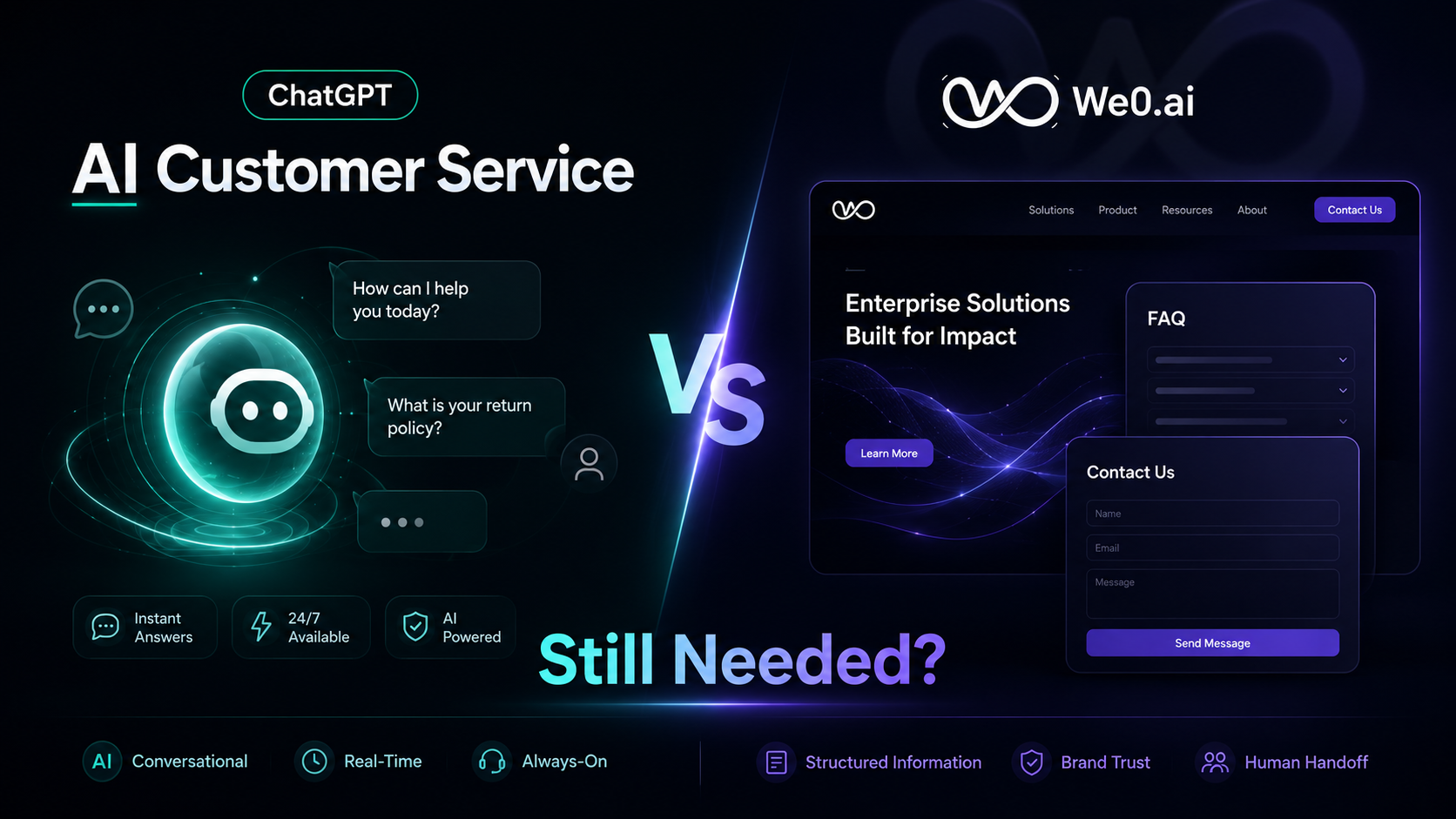
If ChatGPT Can Already Handle Enterprise AI Customer Service, Does a We0.ai Website Still Need Separate FAQ and Consultation Pages?
Let's get straight to the point: Yes, you need them, and it's best not to skip them.
An AI customer service like ChatGPT can indeed handle a large number of repetitive questions.
But what it solves is "answering questions," not "turning visitors into leads."
These are two different things.
Many official websites now make a very common mistake:
They think that with AI customer service, the FAQ page can be eliminated;
They think that with a chat box, a consultation page is unnecessary.
It sounds efficient. In reality, it often leads to more chaos.
Because the real purpose of an enterprise website is not just "answering questions."
It is to:
- Help users find answers quickly
- Help search engines understand what you're selling
- Give hesitant users a place to move forward
- Reduce friction for those who want to inquire
- Turn the website into a continuous asset for lead generation
That's why AI customer service, FAQ pages, and consultation pages should work together, not replace each other.
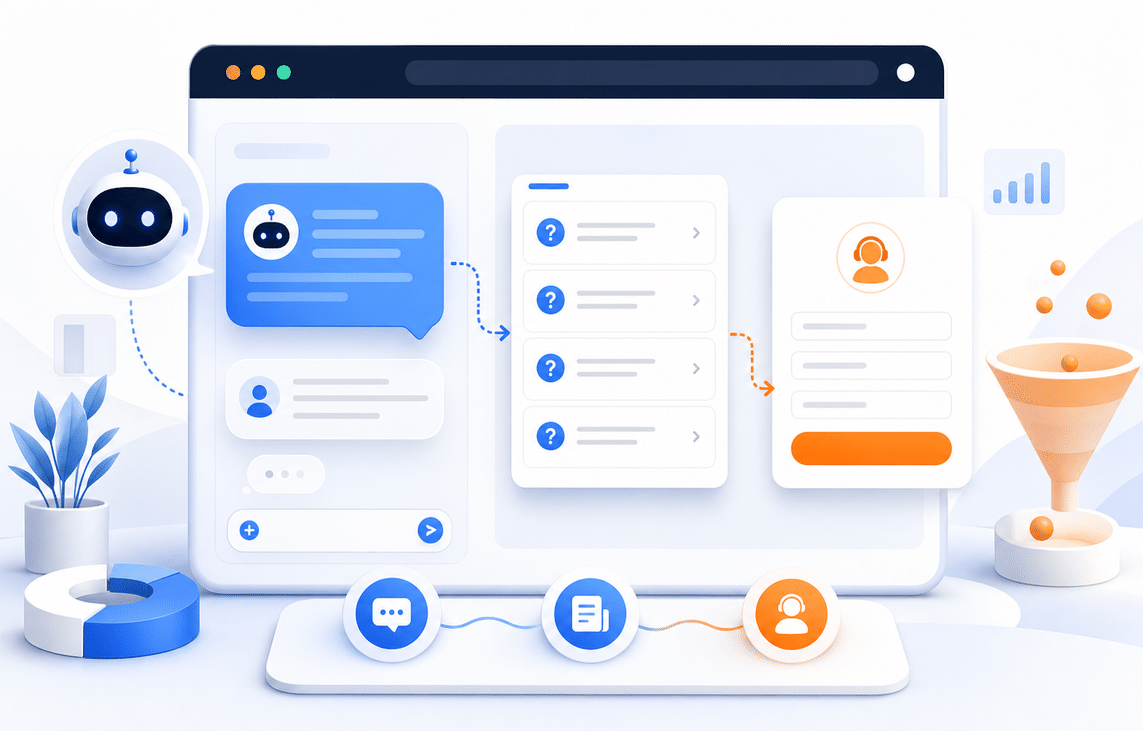
A Simple Way to Put It: AI Customer Service is for "Answering," FAQ is for "Being Found," and Consultation Pages are for "Closing"
If you think of an official website as a sales system, these three modules have clear roles:
| Module | Core Function | Best Suited For | Cannot Replace |
|---|---|---|---|
| AI Customer Service | Instant Answers | Complex follow-ups, personalized explanations, real-time conversations | Structured SEO, standardized question repository |
| FAQ Page | Centralized Answer Display | High-frequency questions, search intent, building trust | Direct sales conversion |
| Consultation Page | Lead Capture | Lead submission, bookings, inquiries, further communication | Extensive knowledge explanation |
AI customer service handles "conversations," FAQ handles "collection," and consultation pages handle "conversion."
These three tasks might seem overlapping, but they are not.
An efficient official website separates them, letting each module do what it does best.
Why Can't Even ChatGPT Save a Website Without an FAQ Page?
Because a website is not just a chat tool; it's a combination of a search entry, trust entry, and conversion entry.
1) AI Customer Service Answers Are Often Not Searchable
Visitors don't always start by talking to your AI customer service. Many people first search for:
- What services do you support?
- How much does it cost roughly?
- What industries is it suitable for?
- How long does implementation take?
- Can it support multiple languages?
These questions are fundamentally search intent.
If this content only exists within the chat box, search engines can't see it, and long-tail traffic won't be captured.
That's where the value of an FAQ page lies:
It turns high-frequency questions into indexable content that can be found through search and referenced repeatedly.
2) AI Customer Service Can Be "Correct" but Not Always "Consistent"
This is a very real concern.
AI can be fast, but its tone and expression style aren't necessarily uniform.
What companies fear most isn't a small mistake,
but different users getting different tones, emphases, or even different boundaries when asking the same question.
An FAQ page allows you to standardize the official narrative:
- What to say first
- What to say next
- What can be promised
- What cannot be promised
This is extremely important for the brand.
3) Many Users Don't Want to Chat First; They Just Want to Scan
This type of visitor is very common.
They don't necessarily want to start a conversation or even type.
They want to first see:
- Who you are
- What you do
- Who you're for
- What common questions are
- How to contact you next
An FAQ page is a classic "scanning page."
It's designed for people to quickly form a judgment.
And a consultation page is designed for those who are already interested and ready to take action.
So How Should an FAQ Page Be Designed to Not Be a "Dead Page"?
It's not enough to just pile questions up there.
If an FAQ page is just a "collection of Q&A," it will indeed be weak.
Its better role is as a search landing page + trust confirmation page + pre-conversion page.
Recommended Structure
- Start with the most frequently searched questions
- Then cover questions that cause the most hesitation
- Then address questions about pricing, delivery, and process
- Finally, include a call to action (CTA)
What Questions Should an FAQ Page Cover?
- What do you do?
- Which businesses is this suitable for?
- How long is the implementation cycle?
- Does it support Chinese and English?
- Does it support SEO / GEO?
- Can it be further optimized after delivery?
- Is there customer service or a consultation entry?
- What stage of company is it suitable for?
The purpose of these questions is not to "explain yourself."
It's to lower the barrier to the next step.
Why Can't You Skip the Consultation Page? Because AI Can't Handle the "Final Push"
What most official websites lack isn't answers, but action design.
After reading, users may be in one of three states:
- Still comparing
- Interested but don't want to fill out too many forms
- Ready to inquire but need a clear, low-effort entry point
Want to chat right away?
This is where the consultation page becomes critical.
It’s not “just another page”—it’s the bridge that turns interest into action.
What should a consultation page do?
- Let users know how to contact you
- Let users know what happens after they inquire
- Let users know what you can solve
- Let users know your response time, service scope, and how you work
Simply put, a consultation page isn’t just a place to show contact info.
It’s about turning hesitation into a next step.
Relying solely on ChatGPT customer service usually misses these three types of traffic
1) SEO long-tail traffic
FAQ pages are naturally great for capturing long-tail keywords.
For example:
- How to set up enterprise AI customer service
- How to design an official website FAQ page
- How to improve consultation page conversion
- Can AI customer service replace human agents?
These are all very natural queries.
But if you only have a chat window, there’s nothing for search engines to crawl.
2) Brand trust traffic
Some people aren’t there to buy.
They just want to confirm:
“Is this company reliable.”
FAQ and consultation pages provide exactly that sense of reassurance.
3) Conversion support traffic
Many people don’t ask right away—they first think, “Let me see if you understand me.”
FAQ and consultation pages answer that question.
A better website strategy: AI customer service, FAQ, and consultation pages working together
Don’t see them as an either/or choice.
A better approach is: front-end distribution, back-end coordination.
Recommended path
Search / Landing page → FAQ page → AI customer service → Consultation page → Lead capture / Booking / Conversion
This flow is smooth.
And it closely matches real user behavior.
A simple litmus test
If your website only does “user asks, AI answers,” that’s not enough.
You should be asking three more questions:
- Did the user find their answer?
- Did search engines index the content?
- Was the user guided to the next step?
If none of these are addressed, no matter how good your AI customer service is, it’s just a talking window.
Why We0.ai should integrate all three by design
Because We0.ai isn’t just about “making pages.”
It’s about building a website system that showcases, grows, and attracts customers.
In that context, FAQ and consultation pages are not extras.
They are part of the growth chain.
Scenarios where We0.ai excels
- SaaS website feature pages, pricing pages, FAQ pages
- Service provider website consultation pages, case study pages, service description pages
- Brand website trust-building pages
- Multilingual FAQ and inquiry pages for international trade sites
- Product support pages and waitlist pages for indie developers
Simply put, We0.ai isn’t about “making a page look good”—it’s about “making your site continuously acquire customers.”
And the FAQ page is a very valuable link in that chain.
A more practical design tip: make the FAQ and consultation pages drive traffic to each other
Don’t let them exist in isolation.
Design them like this:
| Page | User Mindset | Content Focus | Next Step |
|---|---|---|---|
| FAQ page | Just browsing | Common questions, standard answers, trust info | Go to consultation / book |
| AI customer service | Want to dig deeper | Personalized answers, additional explanations | View FAQ / Go to consultation |
| Consultation page | Ready to act | Forms, bookings, contact info, service explanations | Submit info / Start a conversation |
The best page isn’t the one with the most information.
It’s the one that moves the user one step forward.
Conclusion: ChatGPT can’t solve all website problems—FAQ and consultation pages still matter
If your website is just a chat entry point, then ChatGPT is enough.
But if your website aims to:
- Capture search traffic
- Build brand trust
- Convert consultation intent
- Consolidate standard answers
- Improve conversion efficiency
Then you can’t rely solely on AI customer service.
FAQ pages help people find you and understand you.
Consultation pages help people contact you and stay with you.
AI customer service helps people get answers faster.
These three aren’t redundant—they complement each other.
And that’s exactly where We0.ai truly shines:
Not helping you “build a website,” but helping you turn your website into a continuously growing customer-acquisition asset.
Frequently Asked Questions
1. If ChatGPT can already answer questions, do I still need an FAQ page?
Yes. FAQ pages are better for SEO, consistent messaging, quick scanning, and building trust.
2. Will the consultation page and AI customer service overlap?
No. AI customer service handles real-time conversations; the consultation page captures leads and drives action.
3. Do FAQ pages seem outdated?
Not at all. If the structure is clear, the questions are real, and the answers are concise, FAQ remains very effective.
4. What are the three essential page types for a company website?
FAQ page, consultation page, and core service page. Content expansion comes on top of these.
5. Why is We0.ai suitable for these pages?
Because it considers SEO, content, growth, and lead conversion—not just page creation.
Ready to get started?
If you already have AI customer service, take it one step further:
Can your FAQ page actually be found? Can your consultation page truly capture interest?
If you’re not sure about either answer, your website isn’t complete yet.
Summary
AI customer service is not a replacement for FAQ and consultation pages. It’s just a faster way to answer questions.
A website that truly works always combines “answering, capturing, and converting.”
This is what We0.ai does best.