After Apple Integrates Qwen into Mac, How Can Enterprises Use We0.ai for GEO Optimization Across Multiple AI Entry Points?
Apple's recent move to integrate Qwen on the Mac side gives enterprises a more direct view for the first time: there is no longer just a single AI entry point. This article breaks down GEO methods, content architecture, brand signals, and the practical implementation path with We0.ai in the era of multiple AI gateways.
Apple Brings Qwen to Mac — How Can Enterprises Use We0.ai for GEO Optimization Across Multiple AI Entry Points?
Bottom Line First: More Entry Points Means Brands Can No Longer Focus Only on Google
Apple integrating Qwen into Mac may look like a product move on the surface.
But for enterprises, it's actually a reminder of a more practical reality: users' AI entry points are shifting from a "single search box" to "multiple AI conversation entry points." Macs, browsers, system assistants, enterprise knowledge bases, AI search, content platforms — anywhere could become the first place a user gets to know you.
So the focus today isn't "whether to do GEO," but rather: Can you be consistently mentioned, referenced, and cited across multiple AI entry points?
That's what GEO looks like in the multi-AI-entry-point era.
And this is exactly where We0.ai adds value: it doesn't just help you build a single page — it unifies your website, content, brand signals, structured information, and conversion paths, so you're more likely to be discovered across different AI entry points.
1. What Did Apple + Qwen Actually Change?
Don't rush to interpret this as "a model was plugged into a computer."
The more important shift is: AI entry points are becoming systematic, device-level, and scenario-based.
In the past, when people talked about AI, the default assumption was a single entry point like ChatGPT, maybe plus Perplexity or Google AI Overviews.
Not anymore.
Enterprise users now switch between entry points across different scenarios:
- Asking the system assistant on a Mac
- Asking AI Search in a browser
- Asking the enterprise knowledge base in a workbench
- Reading AI-generated summaries on content platforms
- Asking customer support, sales, or product docs "is this actually right for me?"
The more entry points there are, the less a brand can rely on a single SEO page to carry the weight.
That's also why GEO can't be reduced to just "getting AI to cite me."
More precisely, GEO is a set of systemic capabilities that make AI more willing to include you in its candidate answer set.
2. The 3 Biggest Mistakes Enterprises Make in the Multi-AI-Entry-Point Era
1. Building Only a Homepage, Not a Content Network
Many enterprises still stick to the old mindset: just make a good official website.
The problem is, AI doesn't just look at your homepage.
It cares about whether you have:
- Product pages
- Case study pages
- FAQ pages
- Comparison pages
- Industry solution pages
- Long-tail content that answers real questions
Your homepage tells AI who you are; your content network tells AI whether you're worth recommending.
2. Writing Only Brand Keywords, Not Question Keywords
Users don't always search for your brand name.
They're more likely to ask:
- Which solution works well in a Mac environment?
- How do enterprises manage multiple AI entry points?
- What's the real difference between GEO and SEO?
- What type of content is more likely to be cited by AI?
So you can't just defend your brand keywords.
You need to own question keywords, scenario keywords, comparison keywords, and decision keywords.
3. Optimizing Only for Search, Not for "Being Summarized"
In the AI era, a lot of traffic isn't about clicking through — it's about being summarized, paraphrased, and compared first.
In other words, users may never click your website, but they've already formed a judgment in AI.
Not being clicked doesn't mean not being influenced.
That's the core problem GEO is meant to solve.
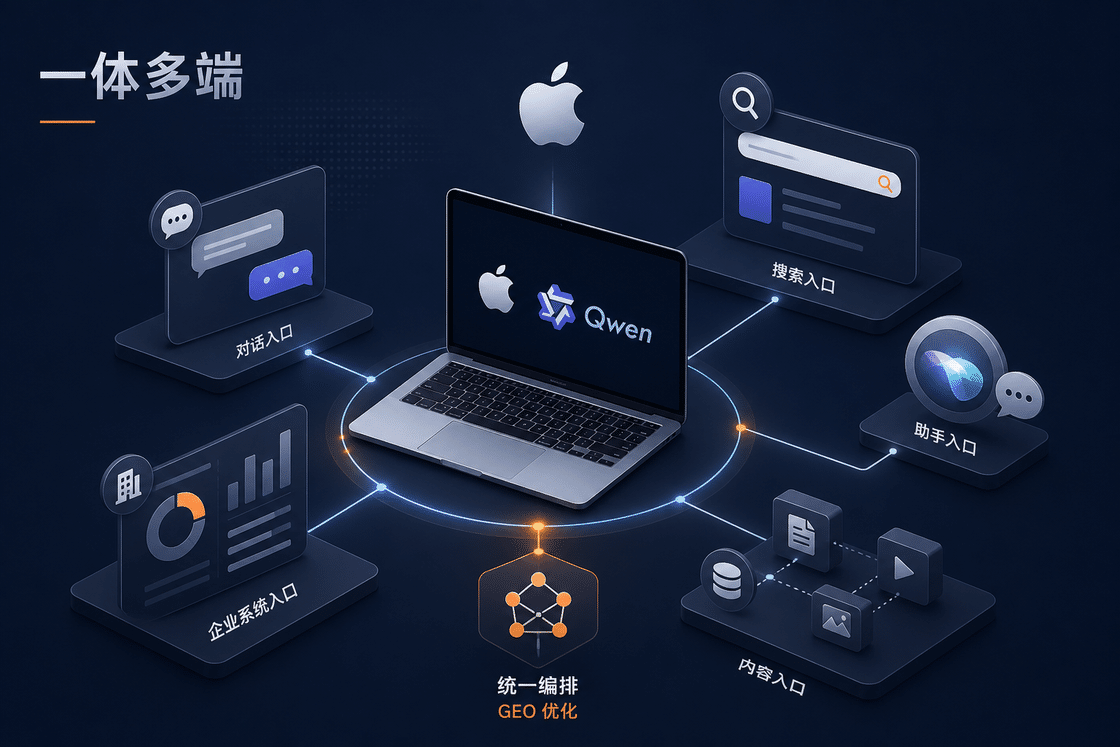
3. The 4 Layers Enterprises Should Focus on for Multi-AI-Entry-Point GEO
| Layer | What You Need to Do | Purpose |
|---|---|---|
| Entry Point Layer | Cover ChatGPT, Perplexity, Google AI, system assistants, industry tools, etc. | Get the brand to appear across more AI scenarios |
| Content Layer | Produce FAQs, comparison pages, case studies, methodology pages, solution pages | Give AI content to cite |
| Signal Layer | Strengthen brand keywords, authorship, structured data, external mentions | Make AI trust you more |
| Conversion Layer | Route AI entry points to your website, lead-gen forms, demos, booking pages | Turn visibility into leads |
If you only do the first two layers, the best you get is "being seen."
What really matters is: being seen, and then being converted.
That's also what sets We0.ai apart from ordinary website builders.
It doesn't just handle "page generation" — it connects display, content, growth, and leads into one chain.
4. How We0.ai Approaches GEO Optimization for Multiple AI Entry Points
1. First, Build a Website That AI Can Understand
What does AI like? Not flashy design, but clear structure.
Your website should at least have:
- A clear product positioning
- A well-defined target audience
- Scannable modules
- FAQ pages
- Comparison pages
- Case study pages
- Pricing / consultation / booking entry points
We0.ai's first step isn't building you "a pretty page" — it's building you "a website that both AI and users can understand."
2. Shift Content from "Descriptive" to "Answer-Focused"
Descriptive content gets skimmed and skipped by AI.
Answer-focused content gets cited.
For example:
- Don't just write "we offer GEO services"
- Write "why do enterprises need multi-AI-entry-point GEO?"
- Don't just write "we're an AI website builder"
- Write "why are showcase-style websites better than single-page landing pages for long-term lead generation?"
Question-style writing is inherently closer to how AI retrieves information.
3. Use Structured Pages to Capture Different Intentions
Your visitors have very different needs:
- Some want a quick overview
- Some want to compare options
- Some want to see case studies
- Some want pricing directly
- Some want to verify compatibility with Mac / AI / localized scenarios
So your pages can't just be one long article.
You need a "one page, one intention" structure.
We0.ai is well-suited to link these pages together:
- Homepage: brand positioning
- Product pages: capability explanation
- Case study pages: real-world validation
- FAQ pages: question capture
- GEO pages: methodology
- Contact page: lead conversion
4. Thicken Your Brand Signals
AI doesn't just read the body copy — it reads signals too.
Signals include:
- Whether the brand appears consistently
- Whether the author is credible
- Whether pages are updated
- Whether content is structured
- Whether there are external mentions
- Whether there are real case studies
GEO is essentially not about "writing more" — it's about "whether your signals are consistent enough."
5. A More Practical Framework: How Should You Prioritize?
If you have limited resources right now, start with these three things:
- Build your core pages first: homepage, product pages, case studies, FAQ pages
- Then create question-based content: write around "how to choose, how to compare, how to implement"
- Finally, build external signals: media, social media, industry platforms, third-party mentions
These three steps are far more reliable than chasing "AI rankings" from day one.
Because what AI entry points really care about isn't how strong you claim to be — it's whether the broader internet has enough signals supporting you.
6. We0.ai's Role Here Isn't Just Building Websites — It's Completing the Growth Chain
Many tools only solve the "from 0 to 1" problem.
But what enterprises truly need is:
Going from 1 to sustained growth.
We0.ai is more about completing the chain below:
Build -> Showcase -> Grow -> Leads
- Build: Get your website up and running
- Showcase: Present your products, services, and case studies
- Grow: Optimize through SEO / GEO / content / data
- Leads: Turn traffic into leads, and leads into customers
So when Apple integrates Qwen into Mac, what enterprises should really think about is not "Can I get on a new channel?"
It's: Do I have a set of content and growth assets that can be reused across all channels?
If you don't, the more channels you have, the more fragmented you become.
If you do, the more channels you have, the more opportunities you have to scale.
7. A Simple Implementation Template
You can follow these steps in order:
- Identify 5 core AI channels
- Compile 20 real user questions
- Create FAQ / comparison / case study / methodology pages
- Standardize brand terms, descriptions, and terminology
- Use We0.ai to connect pages and content into a single website
- Review mentions, citations, clicks, and lead data monthly
Don't aim for perfection in one go. First make yourself "visible," then make yourself "easier to be chosen."
8. FAQ
Q1: What's the real difference between GEO and SEO?
SEO is more about search rankings, while GEO is more about AI citations and recommendations. The former competes for search result pages; the latter competes for placement within AI answers.
Q2: Why do multiple AI channels make enterprises need a content site even more?
Because different channels ask different questions. A single page can't answer all questions at once—only a network of content can.
Q3: What types of websites is We0.ai best suited for?
It's suited for showcase sites, brand websites, product pages, case study pages, service pages, consultation pages, and waitlist pages—especially for enterprises focused on long-term customer acquisition.
Q4: For enterprises doing GEO, should they optimize content first or external signals first?
Get your on-site content and structure right first, then supplement with external signals. Without content, external mentions won't stick.
Q5: What's the real takeaway for enterprises from moves like Apple integrating Qwen?
The takeaway is that AI channels will keep multiplying. Enterprises can't bet on just one platform—they should build "growth assets that AI can understand" first.
Related Tools
Related Reading / Internal Link Suggestions
- What is GEO and how should enterprises get started?
- The difference between AI-built websites and showcase sites
- Why FAQ pages matter for AI search
- How to use content pages to capture inquiries
Ready to Get Started?
If you're already feeling that "channels are multiplying," that says one thing: your website can no longer just be for display—it must start becoming a growth asset.
That's exactly what We0.ai excels at.
Summary
Apple integrating Qwen into Mac isn't just an ecosystem news story.
It's more like a reminder: AI channels will keep multiplying, and enterprises' content, brand, and websites must evolve into "multi-channel reusable" assets as well.
Whoever gets this system in place first will find it easier to gain visibility, trust, and leads in the AI era.