Anthropic’s Talent Paradox: Dario Amodei Worries New Hires May Be Chasing Pay, Not Mission
The frontier AI talent market has become a revolving door. Researchers who helped build one lab’s most important systems can appear at a rival months later. Founders leave startups they helped create. Senior executives give up management titles to return to hands-on research. Compensation packages have climbed to levels that would have sounded implausible in most software companies only a few years ago. The latest example is Lilian Weng. Weng, a former OpenAI research and safety leader and a co-
Anthropic’s Talent Paradox: Dario Amodei Worries New Hires May Be Chasing Pay, Not Mission
Introduction
The frontier AI talent market has become a revolving door.
Researchers who helped build one lab’s most important systems can appear at a rival months later. Founders leave startups they helped create. Senior executives give up management titles to return to hands-on research. Compensation packages have climbed to levels that would have sounded implausible in most software companies only a few years ago.
The latest example is Lilian Weng.
Weng, a former OpenAI research and safety leader and a co-founder of Mira Murati’s Thinking Machines Lab, announced in late July 2026 that she was leaving the startup after months of illness and sustained stress. She said she could no longer maintain the pace required by a startup co-founder role.
Only days later, reporting from Business Insider, TechCrunch, The Information, and Axios said Weng was returning to OpenAI to lead or contribute to research focused on recursive self-improvement—the idea that AI systems could increasingly help improve future AI systems.
The sequence became an unusually vivid example of how fluid the AI labor market has become.
Axios reported on August 3 that Weng was the fourth Thinking Machines co-founder to leave within roughly a year. The same report noted that Google had recently lost Noam Shazeer to OpenAI and Nobel Prize-winning AlphaFold researcher John Jumper to Anthropic.
The difficult part is no longer only hiring exceptional researchers.
It is keeping them.
And even Anthropic—one of the biggest beneficiaries of the current talent migration—appears to be thinking about the downside.
According to a source familiar with the matter cited by Axios, Anthropic CEO Dario Amodei has expressed concern that some new talent may be coming to the company for the money rather than the mission.
That distinction is important. This was not a public Anthropic announcement or a direct Amodei quote published by the company. It was a reported internal concern attributed to a source familiar with his thinking.
The tension is still real: Anthropic is simultaneously trying to build a mission-driven safety culture and compete in a labor market where elite AI researchers can command extraordinary pay, equity, compute, and influence.
Anthropic Has Become One of the Biggest Destinations in the AI Talent Market
The original Chinese article describes Anthropic as almost “overcrowded” with high-profile new arrivals.
That phrasing is deliberately exaggerated, but the underlying hiring momentum is substantial.
Andrej Karpathy Returned to Frontier Research at Anthropic
On May 19, 2026, Andrej Karpathy announced that he had joined Anthropic.
Karpathy was part of OpenAI’s original founding team, later led AI work at Tesla, returned to OpenAI for another period, and then launched the education-focused project Eureka Labs.
At Anthropic, he joined the pre-training team under Nick Joseph.
TechCrunch reported, citing an Anthropic spokesperson, that Karpathy would start a team focused on using Claude to accelerate pre-training research.
That role is notable because pre-training remains one of the most expensive and technically demanding parts of frontier-model development.
The hire was therefore not just a recognizable name joining a growing company. It placed a researcher with experience spanning language models, computer vision, robotics, autonomous driving, and AI education directly inside Anthropic’s core model-building organization.
The Fake Jack Dorsey Hire Became a Meme
On the same day, a post claiming that Twitter co-founder Jack Dorsey had joined Anthropic went viral on X.
It was false.
Fact-checking later confirmed that Dorsey had not joined the company. The false announcement instead turned into a running joke, with users repeatedly posting variations of:
BREAKING: ______ has joined Anthropic.
The meme became so widespread that public figures from technology, sports, politics, entertainment, and even historical figures were jokingly “recruited” into Anthropic.
The meme itself is not evidence of actual hiring.
What it does show is how visible Anthropic’s recruiting streak had become. The joke only worked because a surprising number of real, high-profile people were already moving there.
The original article includes several meme screenshots from this trend. They are omitted here because they are decorative rather than necessary to understand the hiring story.
Dario Amodei’s Expanding “Dream Team” Includes Researchers, Economists, and Infrastructure Leaders
The next part of the source moves from memes to the real hiring wave.
Anthropic has not recruited only language-model researchers.
Its recent hires and appointments span:
- Frontier model research
- AI for science
- Pre-training
- Data-center infrastructure
- Compute
- Economics
- Governance
- Safety and policy
That breadth matters because a frontier AI company is increasingly closer to a vertically integrated research-and-infrastructure organization than a conventional software startup.
John Jumper Left Google DeepMind for Anthropic
In June, John Jumper announced that he would leave Google DeepMind after nearly nine years and join Anthropic after taking time to recharge.
Jumper was one of the central researchers behind AlphaFold and shared the 2024 Nobel Prize in Chemistry for work related to protein structure prediction.
His move stood out because AI for science has historically been one of Google DeepMind’s strongest areas.
A researcher associated with one of DeepMind’s defining scientific achievements choosing Anthropic reinforced the perception that Anthropic was becoming attractive to people far beyond the traditional chatbot or coding-model world.
Jonas Adler and Alexander Pritzel Were Also Reported to Be Moving From Google
Soon after Jumper’s announcement, reporting said Jonas Adler and Alexander Pritzel were also leaving Google for Anthropic.
Both had worked on major Google AI efforts, including AlphaFold- and Gemini-related research.
Their departures came during a broader period of movement inside Google’s AI organization, which was simultaneously dealing with other high-profile exits and a leadership reorganization.
The important point is not that every Google researcher was leaving.
It is that Anthropic was able to recruit people from teams normally viewed as among the strongest and best-resourced AI research groups in the world.
Chad Jones Joined the Anthropic Institute While on Leave From Stanford
Anthropic’s hiring also moved beyond computer science.
Stanford economist Chad Jones announced that, beginning June 30, he would be on leave from Stanford and join the Anthropic Institute, where he planned to continue researching AI and the economic future.
Jones is known for work on economic growth.
That kind of hire reflects a wider change in frontier AI labs: they increasingly need economists, social scientists, security experts, and governance specialists alongside model researchers.
If advanced AI materially changes productivity, wages, firm structure, or labor demand, economic research becomes part of product and policy strategy rather than an academic side topic.
Ben Bernanke Joined Anthropic’s Long-Term Benefit Trust
On July 9, Anthropic officially announced that former U.S. Federal Reserve Chair Ben Bernanke had joined the company’s Long-Term Benefit Trust (LTBT).
Bernanke is not an Anthropic employee building Claude.
The LTBT is an independent governance body designed to help Anthropic remain aligned with its public-benefit mission as advanced AI becomes more consequential.
Anthropic says LTBT trustees:
- Are independent of company management and investors
- Hold no equity in Anthropic
- Do not share in company profits
- Can influence Anthropic’s board composition
- Advise on long-term risks and societal impact
Bernanke’s appointment therefore belongs in a different category from a researcher joining the pre-training team.
Still, it shows how broadly Anthropic is building the institution around Claude—from technical capability to economic governance.
Infrastructure Talent Has Become Just as Important as Model Talent
The source also points to hires such as former xAI co-founder Ross Nordeen and former Microsoft Azure AI executive Eric Boyd.
Nordeen joined Anthropic to focus on compute after leaving xAI.
Boyd joined as Anthropic’s infrastructure chief after years of work on Microsoft’s Azure AI platform.
Anthropic has also been building teams around data centers, land, power, networking, and large-scale compute deployment.
That reflects a basic reality of frontier AI in 2026:
Research talent alone is not enough.

Models
+ compute
+ networking
+ energy
+ data centers
+ inference systems
= frontier AI capacity
A company that can recruit top researchers but cannot provide enough reliable compute will struggle to keep them productive.
The “Six Unicorn CTOs” Story Is a Social-Media Signal, Not a Verified Anthropic Statistic
The original article cites a DINGQ social-media post claiming that at least six unicorn-company CTOs had moved to Anthropic from late 2024 through 2026.

A second image in the source lists several executives and technical leaders who reportedly moved from CTO or co-founder positions into Anthropic roles, often as Member of Technical Staff (MTS) rather than as executives.
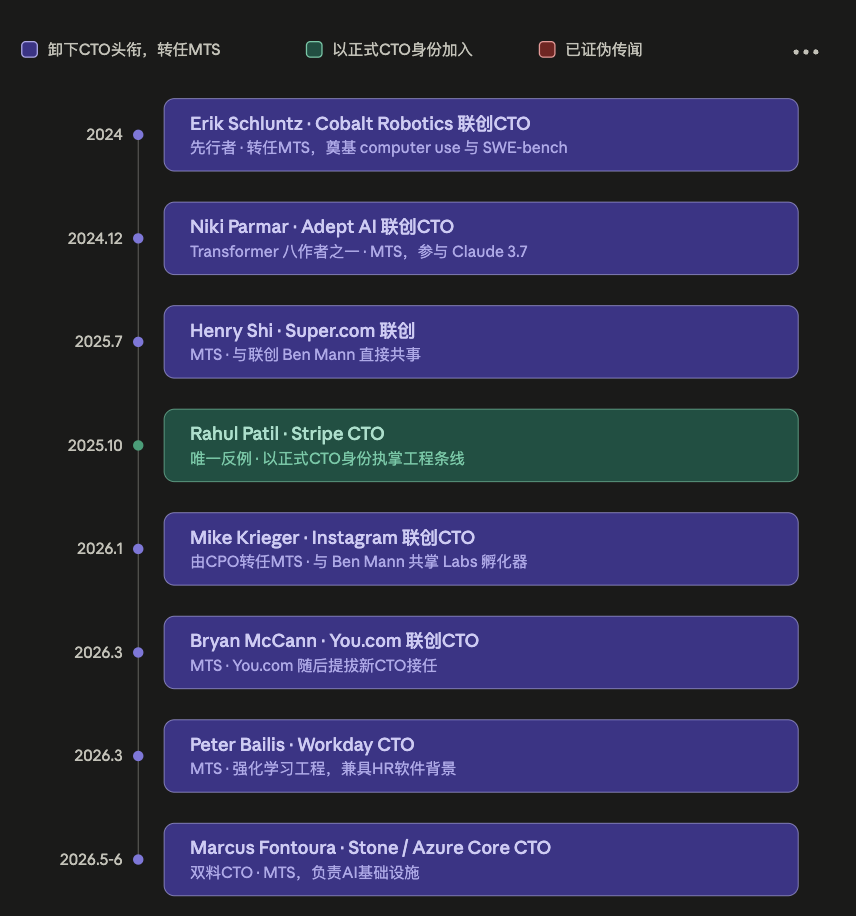
This is an interesting signal, but it should not be treated as an audited Anthropic staffing report.
The list comes from a social-media account and mixes different time periods, job titles, company stages, and types of move.
The broader pattern is easier to defend than the exact count:
Anthropic has repeatedly persuaded senior technical leaders to leave management roles elsewhere and return to hands-on technical work.
For some researchers and executives, that may be part of Anthropic’s appeal.
Instead of managing large organizations, they can work directly on models, infrastructure, or research at one of the best-funded AI labs in the world.
“They Must Know Something We Don’t” Is Speculation
The source article takes the hiring pattern one step further and suggests that these people may be seeing a capability curve that the public will not understand for another 12 to 24 months.
That is a compelling narrative.
It is also speculation.
Senior people can move for many reasons:
- Belief in model progress
- Better compute access
- Stronger colleagues
- More equity upside
- Larger compensation packages
- More technical autonomy
- Less management overhead
- Different safety philosophy
- Personal relationships
- Company culture
- A desire to work on frontier systems before the field changes further
A cluster of talented hires is evidence that a company is attractive.
It is not proof of a secret model breakthrough.
The Story Starts to Change When Money Becomes the Main Explanation
The second half of the source turns from Anthropic’s recruiting success to Dario Amodei’s reported concern.
If everyone joining Anthropic believed primarily in its mission, the cultural problem would be relatively simple.
The reality is messier.
Axios: Amodei Is Reportedly Worried Some New Hires Are Coming for the Money
Axios reported on August 3:
- Some researchers receive offers that are extremely difficult to refuse.
- Others want equity in private AI companies before a possible IPO.
- A source familiar said Amodei has expressed concern about new talent joining Anthropic for money rather than mission.
The wording matters.
This is a reported internal concern, not a public quote from Amodei saying that every new employee is a mercenary.
Axios also emphasized that compensation is only part of the story.
Top researchers care about:
- Access to compute
- Influence over what gets built
- Technical freedom
- Team quality
- Status
- Mission
- Ideology
- Equity
The AI talent market cannot be reduced to salary alone.
One Viral Hiring Anecdote Is Unverified
The source includes a social-media anecdote about an unnamed applicant who allegedly deleted public posts supporting open-source AI, practiced saying that open source was a safety risk, passed an Anthropic culture interview, and then received a roughly $1 million compensation package.
No reliable primary source was identified that independently verifies this individual case.
It should therefore be treated as an unverified social-media anecdote, not evidence of Anthropic’s standard interview process.
The anecdote is still relevant to the article’s theme because it illustrates a concern that appears in many mission-driven organizations:
If mission alignment affects hiring,
applicants have an incentive to perform mission alignment.
That does not mean the culture screen is useless.
It means cultural fit is difficult to evaluate when the job itself is extremely valuable.
Anthropic Compensation Is Extremely Competitive
Whatever role mission plays, Anthropic does not operate in a low-pay environment.
The original article includes a Levels.fyi chart showing user-submitted compensation estimates for U.S. Anthropic software engineers.
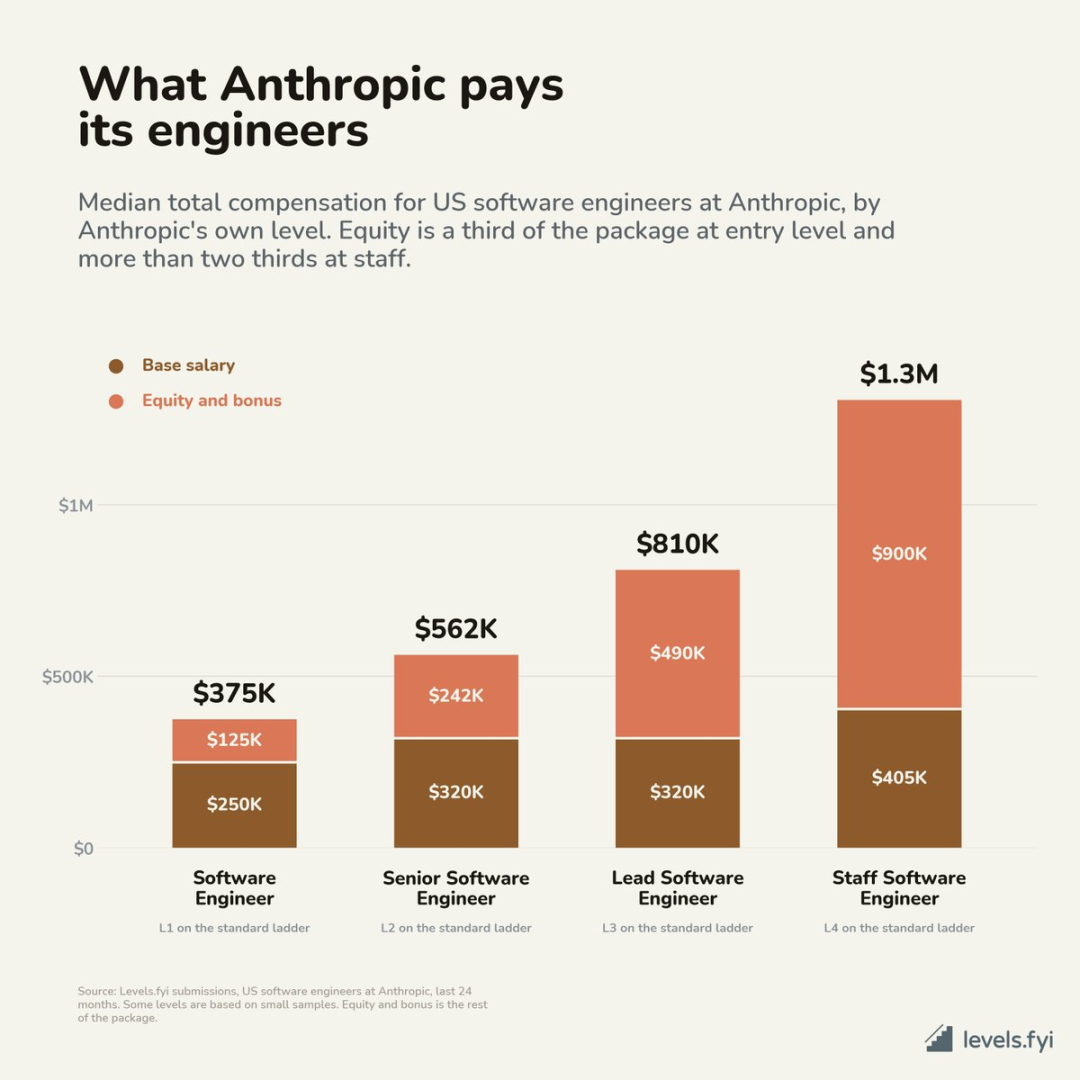
The chart shows reported median total compensation around:
| Level | Base Salary | Equity and Bonus | Reported Median Total Compensation |
|---|---|---|---|
| Software Engineer | $250K | $125K | $375K |
| Senior Software Engineer | $320K | $242K | $562K |
| Lead Software Engineer | $320K | $490K | $810K |
| Staff Software Engineer | $405K | $900K | $1.3M |
These figures are not an official Anthropic compensation schedule.
The chart itself says it is based on Levels.fyi submissions for U.S. software engineers over the previous 24 months, and some levels have small sample sizes.
Actual compensation can vary by:
- Role
- Level
- Location
- Equity valuation
- Grant timing
- Refreshers
- Performance
- Specialty
- Negotiated circumstances
Even with those caveats, the scale makes the central point clear: Anthropic can talk about mission while also offering compensation that is highly competitive by technology-industry standards.
The two are not mutually exclusive.
Amodei Has Previously Said Anthropic Will Not Match Every Rival Offer
The source then connects the 2026 “mission versus money” concern with statements Amodei made publicly during the 2025 AI recruiting war.
In an interview discussed by Business Insider and Fortune, Amodei said Anthropic did not want to abandon its compensation principles in response to giant recruiting offers from competitors such as Meta.
His reasoning centered on internal fairness.
Anthropic uses a level-based compensation structure. If one employee can dramatically reprice their package by bringing in a competing offer, colleagues doing similar work may reasonably ask why they are being paid differently.
A bidding-war approach can create a cycle like this:
Competitor offers huge package
        ↓
Company matches it
        ↓
Peers discover the new market price
        ↓
More employees seek outside offers
        ↓
Compensation becomes individually negotiated
        ↓
Internal fairness becomes harder to maintain
Amodei argued that this can damage culture even if the company can technically afford the counteroffer.
That does not mean Anthropic refuses to pay market-leading compensation.
Its reported compensation is already extremely high.
The distinction is between a systematic high-pay structure and an escalating one-off bidding war for individual employees.
The Original Article’s $300B Valuation Figure Is Outdated
The source says Anthropic’s culture helped support a valuation of roughly $300 billion.
That figure is no longer current.
Anthropic officially announced on May 28, 2026 that it raised $65 billion in Series H funding at a $965 billion post-money valuation.
That is the authoritative current financing figure for this article.
The sequence illustrates how quickly AI-company numbers can become stale:
| Date | Anthropic Financing Milestone |
|---|---|
| February 12, 2026 | $30B Series G at $380B post-money valuation |
| May 28, 2026 | $65B Series H at $965B post-money valuation |
Because private-company valuations can change again in later financings or secondary transactions, readers should always attach a date to the number.
Dario Amodei’s Net Worth Is Also an Estimate
The original article gives Amodei a personal net worth of approximately $15.6 billion.
Forbes’ real-time profile listed him at roughly $15.5 billion on August 11, 2026.
That number is an estimate, not a bank-account balance.
Most of the wealth attributed to private-company founders comes from estimated equity value, and that value can move sharply when:
- A new funding round changes the company valuation
- Shareholdings are reassessed
- Dilution changes ownership percentages
- Private-market discounts change
- The company eventually lists publicly
The number is therefore useful only as an estimate of paper wealth at a given moment.
It is not necessary to accept or reject Amodei’s cultural argument based on his net worth.
The Mission-vs-Money Tension Is Especially Sharp Because Anthropic Is Building Automation
The source closes on an irony.
Amodei has publicly warned that advanced AI could cause severe disruption to entry-level white-collar employment.
In a May 2025 interview with Axios, he said AI could potentially eliminate half of entry-level white-collar jobs and push unemployment much higher within the next one to five years.
That was a forecast, not an observed labor-market result.
Anthropic’s own Economic Index research has generally been more empirical and cautious, measuring how Claude is currently used across tasks and occupations rather than claiming that a specific level of displacement has already happened.
Still, the contrast is striking.
A company building technology that may automate large amounts of knowledge work is also competing fiercely for a very small pool of human researchers whose labor has become extraordinarily valuable.
At the frontier, AI has not reduced the value of those people.
For now, it has increased it.
Anthropic Is Not the Only Lab With a Loyalty Problem
The original article correctly broadens the issue beyond Anthropic.
AI talent now moves frequently among:
- OpenAI
- Anthropic
- Google DeepMind
- Meta
- xAI
- Safe Superintelligence
- Thinking Machines Lab
- New startups founded by former employees of those labs
OpenAI itself is one of the clearest examples of the tension between mission, governance, capital, and talent.
It began as a nonprofit research organization, later created a capped-profit structure, and then went through the 2023 governance crisis in which CEO Sam Altman was briefly removed before returning.
The details differ from Anthropic’s current challenge, but the recurring question is similar:
What happens when an organization built around a world-changing mission becomes one of the most financially valuable institutions in the world?
People can believe in the mission and still care about compensation.
They can care about safety and still want equity.
They can join for technical freedom and later leave for a better research environment.
The frontier AI labor market is difficult precisely because all of those motivations can be true at once.
What the Current Evidence Actually Supports
Confirmed or Strongly Supported
- Lilian Weng left Thinking Machines Lab after citing health and workload concerns.
- Weng returned to OpenAI days later to work on research connected to AI self-improvement.
- Axios described Weng as the fourth Thinking Machines co-founder to leave within roughly a year.
- Andrej Karpathy joined Anthropic’s pre-training organization in May 2026.
- John Jumper left Google DeepMind for Anthropic.
- Jonas Adler and Alexander Pritzel were reported to be moving from Google to Anthropic.
- Chad Jones joined the Anthropic Institute while on leave from Stanford.
- Ben Bernanke joined Anthropic’s Long-Term Benefit Trust.
- Anthropic has recruited senior infrastructure leaders including Eric Boyd and Ross Nordeen.
- Anthropic officially reached a $965 billion post-money valuation in its May 2026 Series H financing.
- Anthropic software-engineering compensation reported by Levels.fyi is extremely high by normal software-industry standards.
- Amodei has publicly argued against individually matching every massive rival recruiting offer because of fairness and culture concerns.
Reported but Not a Public Anthropic Statement
- Axios says a source familiar with Amodei’s thinking reported that he is concerned some new hires are coming primarily for money rather than mission.
Social-Media Claims or Speculation
- The exact “six unicorn CTOs” count and framing comes from a social-media analysis rather than an Anthropic staffing disclosure.
- The story about an applicant deleting pro-open-source posts to pass a culture interview is not independently verified.
- The idea that Anthropic’s new hires must have seen a secret capability curve is speculation.
- Viral posts claiming Jack Dorsey had joined Anthropic were false and became a meme format.
FAQ
Is Dario Amodei really worried that Anthropic employees only care about money?
Axios reported that a source familiar with the matter said Amodei has expressed concern about some new talent coming for money rather than mission. Anthropic has not published a statement saying that its workforce as a whole is motivated primarily by compensation.
How much does Anthropic pay software engineers?
Levels.fyi user-submitted data shown in the source suggests reported median U.S. total compensation ranging from about $375,000 for one software-engineer level to about $1.3 million for staff-level engineers. These are third-party estimates, not Anthropic’s official salary table, and individual packages vary.
Did Andrej Karpathy join Anthropic?
Yes. Karpathy announced in May 2026 that he had joined Anthropic, and the company confirmed that he was working with its pre-training organization. He is building a team focused on using Claude to accelerate pre-training research.
Did John Jumper leave Google DeepMind for Anthropic?
Yes. Jumper announced in June 2026 that he would leave Google DeepMind and join Anthropic after taking time to recharge. He is best known as a key AlphaFold researcher and a 2024 Nobel Prize in Chemistry laureate.
Is Anthropic worth $300 billion?
That figure is outdated. Anthropic officially announced a Series H financing on May 28, 2026 that valued the company at $965 billion post-money.
Does Anthropic refuse to match competing job offers?
Amodei has said the company does not want to abandon its level-based compensation and fairness principles simply to match individual mega-offers from rivals. That is different from saying Anthropic pays poorly; available compensation data indicates the company already pays at the high end of the technology market.
Why are so many AI researchers changing companies?
Compensation is one reason, but Axios and other reporting point to compute access, technical freedom, influence, team quality, equity, mission, and status as additional factors. Frontier researchers can now choose among several extremely well-funded labs, making retention unusually difficult.
Did Jack Dorsey join Anthropic?
No. The viral May 2026 claim was false. It became part of an X meme in which users jokingly announced that many unrelated public figures had “joined Anthropic.”
相关工具
- Anthropic Careers: Anthropic’s official source for current roles, teams, locations, and the company’s description of its hiring philosophy.
- Claude: Anthropic’s main AI product and the model ecosystem many of its research and engineering hires work on.
- Anthropic Research: Official publications covering alignment, interpretability, model behavior, economic impact, and frontier-model research.
- Levels.fyi Anthropic Salaries: A third-party compensation database based on employee and candidate submissions; useful as market data but not an official company pay schedule.
- Thinking Machines Lab: The AI startup co-founded by Mira Murati and Lilian Weng before Weng’s July 2026 departure.
- OpenAI Careers: OpenAI’s official hiring page, relevant to the talent movement between competing frontier labs.
Related Links
- Axios: AI’s Talent Wars Have a Loyalty Problem: The key report on researcher churn and the source-attributed claim about Amodei’s concern over money versus mission.
- Anthropic Series H: $965B Post-Money Valuation: Anthropic’s official May 2026 funding announcement and current authoritative financing valuation used in this article.
- Anthropic: Ben Bernanke Joins the Long-Term Benefit Trust: Official announcement explaining Bernanke’s appointment and the role of the LTBT.
- TechCrunch: Andrej Karpathy Joins Anthropic: Reporting with Anthropic confirmation of Karpathy’s role in pre-training research.
- Reuters: John Jumper Leaves Google DeepMind for Anthropic: Independent reporting on the AlphaFold researcher’s move.
- TechCrunch: Lilian Weng Leaves Thinking Machines and Rejoins OpenAI: Reporting on Weng’s departure and rapid return to OpenAI.
- Axios: AI Could Disrupt Entry-Level White-Collar Jobs: The original interview containing Amodei’s widely cited forecast about entry-level white-collar job displacement.
Summary
Anthropic has become one of the clearest winners of the current AI talent war. It has recruited high-profile researchers, infrastructure leaders, economists, and governance figures from organizations including OpenAI, Google DeepMind, xAI, Microsoft, academia, and other startups.
That success creates its own problem. Axios reports that Dario Amodei has privately worried that some new hires may be joining for compensation rather than Anthropic’s mission. The concern is plausible in a market where reported software-engineering packages can reach seven figures and elite researchers receive extraordinary competing offers.
The evidence does not support the simpler story that Anthropic employees are either “missionaries” or “mercenaries.” Researchers move for money, compute, autonomy, equity, colleagues, status, technical direction, and genuine beliefs about AI’s future—often at the same time.
The hardest part of the AI talent war is no longer proving that top people can be recruited. It is building an organization they still want to belong to after the next extraordinary offer arrives.