Anthropic Is Reportedly Exploring Its Own AI Chip: Samsung 2nm Talks, OpenAI Talent, and the Next Compute War
Anthropic is reportedly exploring a custom AI chip and has discussed possible Samsung manufacturing options, including advanced 2nm process and packaging technology. The project appears to be early-stage, but it fits the broader shift in AI infrastructure: model companies increasingly want more control over the hardware that powers their systems. The move does not necessarily mean Anthropic is abandoning AWS Trainium, Google TPUs, or NVIDIA GPUs. Instead, it points to a longer-term strategy: use multiple compute paths, reduce supply risk, and improve cost efficiency at frontier scale. OpenAI’s Jalapeño chip shows that custom silicon is becoming part of the frontier AI playbook. Anthropic may now be taking the first steps down a similar road. **The main point: custom AI chips are no longer just a hardware-company story; they are becoming a core strategy for the largest AI labs.**

Anthropic Is Reportedly Exploring Its Own AI Chip: Samsung 2nm Talks, OpenAI Talent, and the Next Compute War
Introduction
Anthropic has long presented itself as a company that does not want to depend on a single hardware path. Its compute strategy has been built around a mix of AWS Trainium, Google TPUs, and NVIDIA GPUs. That multi-platform approach gives the Claude maker more flexibility than a pure NVIDIA-first strategy.
But recent reporting suggests that Anthropic may now be looking at a fourth card: its own custom AI chip.
According to the original article, The Information reported that Anthropic has started early work on a custom AI chip and has discussed potential manufacturing options with Samsung Electronics. The reported options include Samsung’s 2nm process and advanced packaging, both of which are highly relevant to modern AI accelerators.
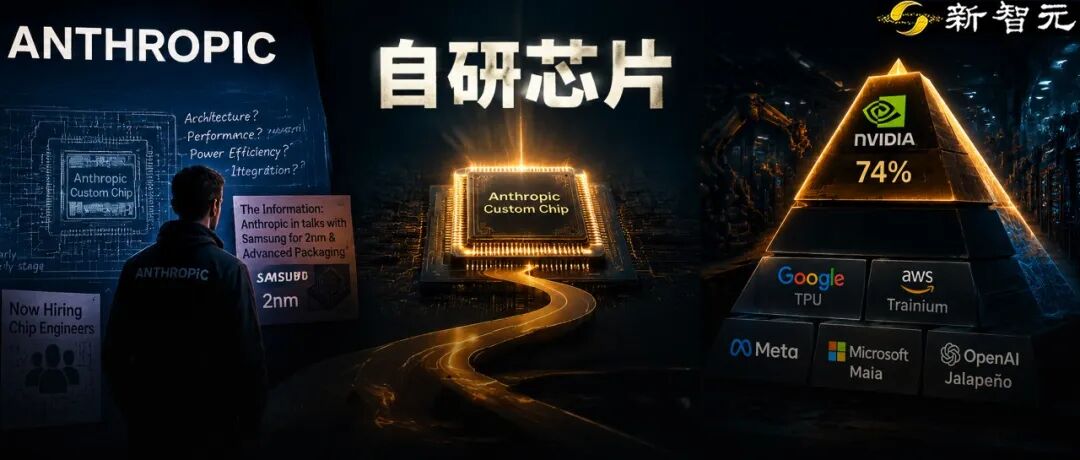
This does not mean Anthropic is ready to replace its existing compute suppliers. The project is still described as early-stage. The chip’s purpose, target performance, server integration, and cluster deployment plan have not been finalized. Still, the direction is clear: as frontier AI becomes more expensive to train and serve, the biggest AI labs are being pulled deeper into the hardware stack.
Anthropic Is Reportedly Talking With Samsung About a Custom AI Chip
The central report is simple but important: Anthropic has reportedly begun early exploration of its own AI chip and has held discussions with Samsung about manufacturing.
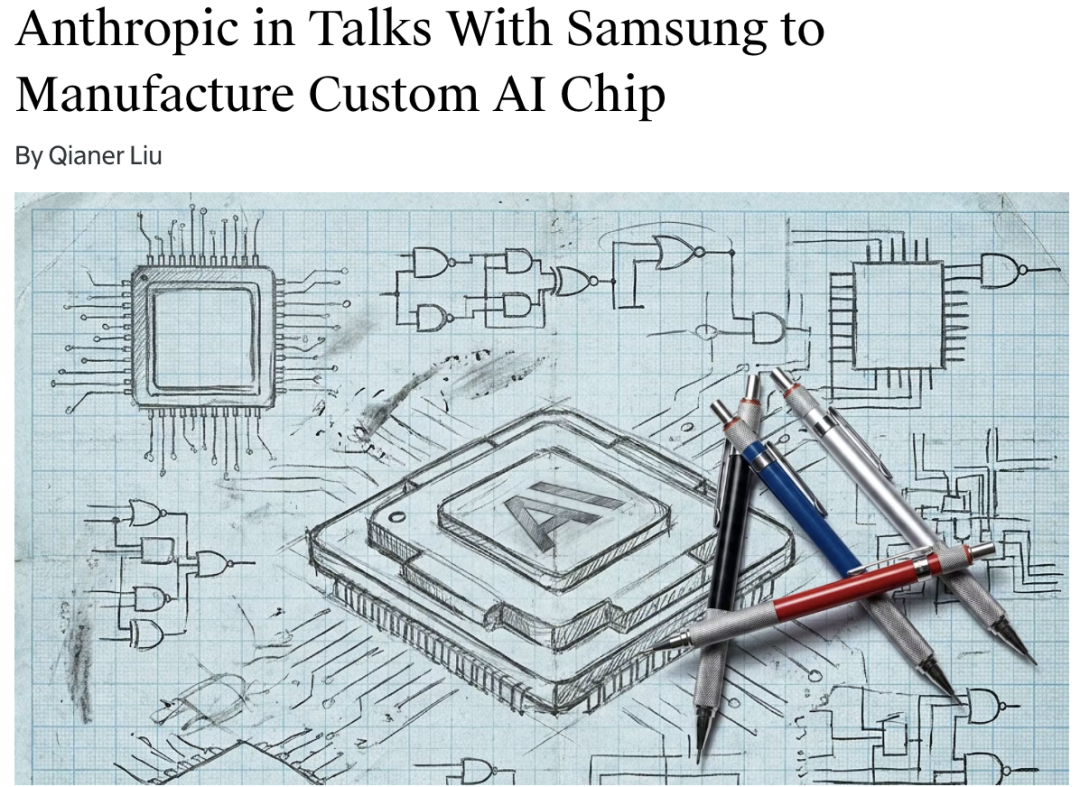
The options under discussion reportedly include Samsung’s 2nm process and advanced packaging. In AI hardware, those two points matter a lot.
A smaller process node can place more transistors into a similar chip area, improving the possibility of higher performance and better power efficiency. Advanced packaging is just as important. Modern AI chips often need to move huge amounts of data between compute units and high-bandwidth memory. The shorter and faster that data path becomes, the less time the chip wastes waiting for memory.
In July 2024, Samsung announced a turnkey semiconductor solution for Preferred Networks that combined its 2nm GAA process with 2.5D packaging. The original article points to this as the type of manufacturing and packaging combination Anthropic may be evaluating.

For now, this remains a reported discussion rather than a confirmed Anthropic product roadmap. Anthropic’s public position is still that AWS Trainium, Google TPUs, and NVIDIA GPUs remain central to how the company scales compute.
That is exactly why the story is interesting. Anthropic is not a company with no compute partners. It already has several. If it is still exploring a custom chip, the reason is probably not short-term replacement. It is long-term leverage.
Two Signals: Hiring and Foundry Discussions
The original article highlights two moves that make the report more meaningful.
The first is hiring. Anthropic reportedly brought in Clive Chan, an early member of OpenAI’s custom chip team. He had also worked on Tesla’s Dojo supercomputer project. Hardware hires like this usually do not happen by accident. They are a sign that the company wants internal capability, not just outside vendor access.

The second signal is the reported Samsung discussion itself. Earlier reporting had already suggested that Anthropic was considering custom chips as one way to deal with compute shortages. Moving from “thinking about chips” to “talking with a potential manufacturing partner” suggests the idea has moved at least one step closer to practical evaluation.
Still, the gap between an early chip project and a deployed AI accelerator is enormous. Before a chip can matter in production, a company has to define the workload, design the architecture, validate the silicon, secure packaging capacity, build boards and servers, integrate networking, and prove that the full system can run at cluster scale.
That process takes time. It also takes a lot of money.
The Fourth Card Forced by the Compute Bill
To understand why Anthropic would even consider this path, start with the size of the compute problem.
The original article points to Anthropic’s extremely fast revenue growth and the pressure that growth places on infrastructure. The more customers use Claude, the more training and inference capacity the company needs. Faster product adoption does not just create a revenue curve. It creates a compute bill.
Anthropic’s official April 2026 announcement stated that the company had expanded its partnership with Google and Broadcom for multiple gigawatts of next-generation TPU capacity expected to come online starting in 2027. The same announcement said Anthropic runs Claude on AWS Trainium, Google TPUs, and NVIDIA GPUs, with Amazon remaining its primary cloud provider and training partner.

The strategy is easy to understand: use different hardware platforms for different workloads, reduce single-vendor risk, and keep critical systems resilient.
But at frontier scale, even small efficiency improvements matter. If a model is trained or served across tens of thousands of accelerators, a few percentage points of improvement can translate into very large savings. Power, cooling, utilization, memory movement, networking, and idle time all become business issues, not just engineering issues.
That is why a custom chip can be valuable even if it never replaces every external supplier.
It gives Anthropic another lever. It may reduce cost for specific workloads. It may improve bargaining power with cloud and chip partners. It may also let Anthropic optimize hardware around the exact way its own models run, rather than adapting those models to whatever general-purpose accelerator is available.
In that sense, the reported chip effort is not a contradiction of Anthropic’s multi-platform strategy. It could be an extension of it.
OpenAI Has Already Walked This Road
The original article compares Anthropic’s reported position with OpenAI’s custom silicon path.
OpenAI began working with Broadcom on custom AI accelerators before unveiling Jalapeño, an inference-focused AI chip built around large language model workloads. OpenAI’s official announcement described Jalapeño as its first Intelligence Processor and part of a multi-generation compute platform with Broadcom.

The comparison matters because OpenAI is already further along the path. The company announced a 10-gigawatt collaboration with Broadcom for custom AI accelerators and later presented Jalapeño as a chip designed specifically for LLM inference. OpenAI also said the chip was co-developed from initial design to tape-out in nine months, accelerated in part by its own models.
That last point is especially important. AI companies are not just buying chips to run AI anymore. They are starting to use AI to help design the chips that will run future AI systems.
This creates a flywheel. Better models help design better infrastructure. Better infrastructure lowers the cost and latency of running models. Lower costs make more usage possible. More usage creates more data, more revenue, and more pressure to build the next generation of infrastructure.
Anthropic appears to be at a much earlier point than OpenAI was when Jalapeño became public. Based on the original report, Anthropic is still defining what the chip should do and how it would fit into the rest of its compute stack. That is the beginning of a long road, not the end.
Can Anyone Really Challenge NVIDIA?
The original article closes with the biggest question in AI infrastructure: can custom chips meaningfully challenge NVIDIA?
The answer is more complicated than “yes” or “no.”
NVIDIA remains the dominant force in AI acceleration, especially because it is not only selling chips. It sells a mature platform: GPUs, networking, software, libraries, systems, and developer familiarity. For many AI teams, NVIDIA is still the fastest and lowest-risk way to scale.
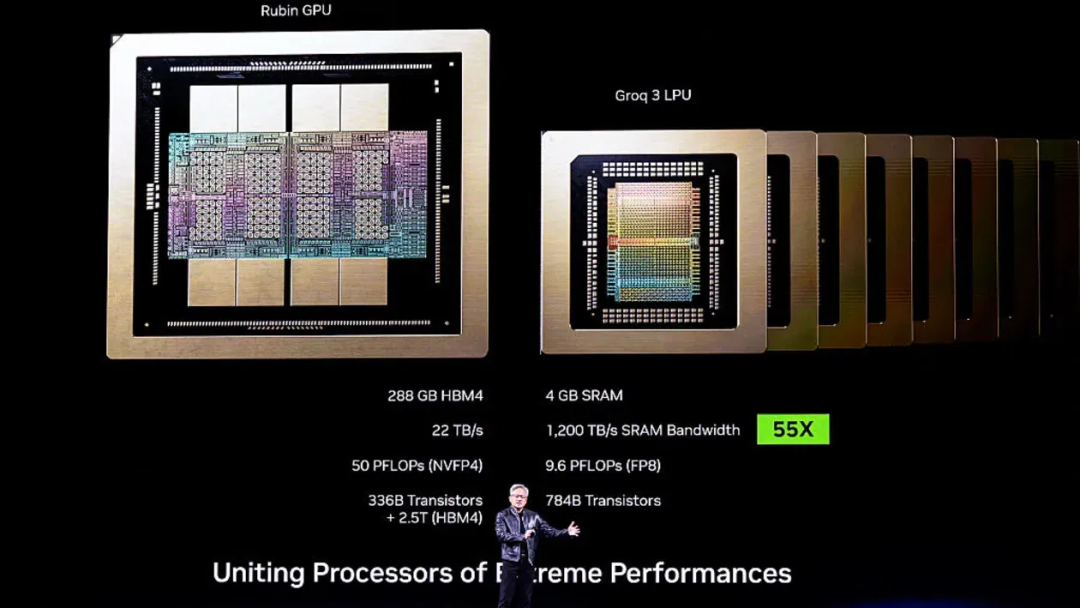
That is why custom chips should not be viewed as a simple attempt to “kill NVIDIA.” For companies like Google, Amazon, Microsoft, Meta, OpenAI, and now possibly Anthropic, the point is usually more specific.
They want better economics for their own workloads. They want more control over supply. They want stronger negotiating power. They want the ability to optimize the full stack, from model architecture to inference serving to data center design.
In other words, custom chips may not take over NVIDIA’s market overnight. But they can reshape the economics for the companies that operate at the largest scale.
For Anthropic, a custom chip would be one more long-term option. The company can keep using AWS Trainium, Google TPUs, and NVIDIA GPUs while also developing internal chip expertise. If the project works, it gains efficiency and leverage. If it does not, the existing multi-vendor strategy still gives Anthropic room to scale.
What This Means for the AI Infrastructure Race
The AI industry is moving into a phase where the model companies are no longer just software companies. The leading labs are becoming infrastructure companies too.
In the previous era, chipmakers largely defined the shape of computing, and software companies built on top of that hardware. In the AI era, the relationship is starting to reverse. The companies building frontier models are increasingly defining what they need from chips, memory, networking, power, cooling, and data centers.
Anthropic’s reported Samsung talks fit into that broader pattern.
The project may never reach mass production. Samsung may or may not become the manufacturing partner. The final chip architecture, if one exists, may look very different from what is being discussed now. But the strategic direction is clear: frontier AI companies want more control over the physical infrastructure behind intelligence.
The more expensive intelligence becomes to serve, the stronger the incentive to own more of the stack.
Source Note
This article is based on the original BAAI / 新智元 article and its listed references. The reported Anthropic-Samsung custom chip discussion is based on third-party reporting and should be treated as an early-stage, unconfirmed hardware project unless Anthropic or Samsung formally announces it.
No code blocks, command-line steps, configuration files, or technical tables were found in the original article. The original article contained several platform logos, promotional images, QR-code/contact images, and decorative banners; those were removed according to the publishing rules. One original OpenAI-related image from the BAAI page could not be fetched reliably, so the official OpenAI image from the relevant Jalapeño announcement is used instead.
Original source: https://hub.baai.ac.cn/view/56077
FAQ
What is Anthropic reportedly planning with a custom AI chip?
Anthropic is reportedly exploring an early-stage custom AI chip project and has discussed possible manufacturing options with Samsung. The chip has not been publicly confirmed as a final product, and the design target is still unclear.
Why would Anthropic build its own AI chip if it already uses AWS Trainium, Google TPUs, and NVIDIA GPUs?
A custom chip could help Anthropic improve efficiency for specific workloads and gain more control over cost and supply. It also gives the company more negotiating leverage when working with major cloud and chip suppliers.
What does Samsung 2nm mean in this context?
Samsung 2nm refers to an advanced semiconductor manufacturing process. In theory, a more advanced process can support denser, more power-efficient chip designs, although real-world performance depends on the full architecture, packaging, memory, and system design.
Why is advanced packaging important for AI chips?
AI workloads move huge amounts of data between processors and memory. Advanced packaging can bring compute and high-bandwidth memory closer together, improving data movement and reducing wasted time and power.
Is Anthropic trying to replace NVIDIA?
Not necessarily. The more realistic interpretation is that Anthropic wants another option in its compute strategy. NVIDIA GPUs may remain important while custom chips help with targeted workloads, cost control, and supply-chain flexibility.
How is OpenAI’s Jalapeño chip related to this story?
OpenAI’s Jalapeño shows how a major AI lab can move deeper into custom silicon for inference workloads. The comparison matters because Anthropic may now be starting a similar journey, though it appears to be much earlier in the process.
Is Anthropic’s chip ready for production?
No public evidence suggests that Anthropic has a production-ready chip. Based on the original report, the project is still early, and key design and deployment decisions have not been finalized.
Related Tools
- Anthropic: The AI company behind Claude and the reported custom chip exploration.
- AWS Trainium: Amazon’s purpose-built AI accelerator family for training and inference workloads.
- Google Cloud TPU: Google’s tensor processing unit platform for large-scale AI training and inference.
- Samsung Foundry: Samsung’s semiconductor manufacturing business, including advanced process and packaging services.
- Broadcom: A semiconductor and networking company involved in custom AI accelerator infrastructure.
- OpenAI: The AI company that unveiled the Jalapeño inference chip with Broadcom.
Related Links
- Original BAAI Article: The source article used for this English rewrite.
- The Information: Anthropic in Talks With Samsung: The original paywalled report cited by the source article.
- Anthropic Google and Broadcom Compute Partnership: Anthropic’s official announcement about multiple gigawatts of next-generation TPU capacity.
- Samsung 2nm GAA and 2.5D Packaging Announcement: Samsung’s official newsroom post about 2nm GAA and 2.5D packaging for Preferred Networks.
- OpenAI and Broadcom Jalapeño Inference Chip: OpenAI’s official announcement of its LLM-optimized inference chip.
- Broadcom and OpenAI 10GW Collaboration: Broadcom’s official investor announcement on the OpenAI custom accelerator partnership.
- AWS Trainium Overview: AWS documentation and product overview for Trainium AI chips.
- Google Cloud TPU Documentation: Official documentation for Google Cloud TPU architecture and usage.
Summary
Anthropic is reportedly exploring a custom AI chip and has discussed possible Samsung manufacturing options, including advanced 2nm process and packaging technology. The project appears to be early-stage, but it fits the broader shift in AI infrastructure: model companies increasingly want more control over the hardware that powers their systems.
The move does not necessarily mean Anthropic is abandoning AWS Trainium, Google TPUs, or NVIDIA GPUs. Instead, it points to a longer-term strategy: use multiple compute paths, reduce supply risk, and improve cost efficiency at frontier scale.
OpenAI’s Jalapeño chip shows that custom silicon is becoming part of the frontier AI playbook. Anthropic may now be taking the first steps down a similar road.
The main point: custom AI chips are no longer just a hardware-company story; they are becoming a core strategy for the largest AI labs.