2026 AI Website Builder Ranking: Which Tools Are Better for SEO Websites?
This article ranks and analyzes common AI website builders in 2026 from the perspectives of SEO, GEO, content growth, site structure, and lead conversion, helping SaaS teams, indie makers, service providers, and global growth teams choose tools that are truly suitable for building SEO websites.
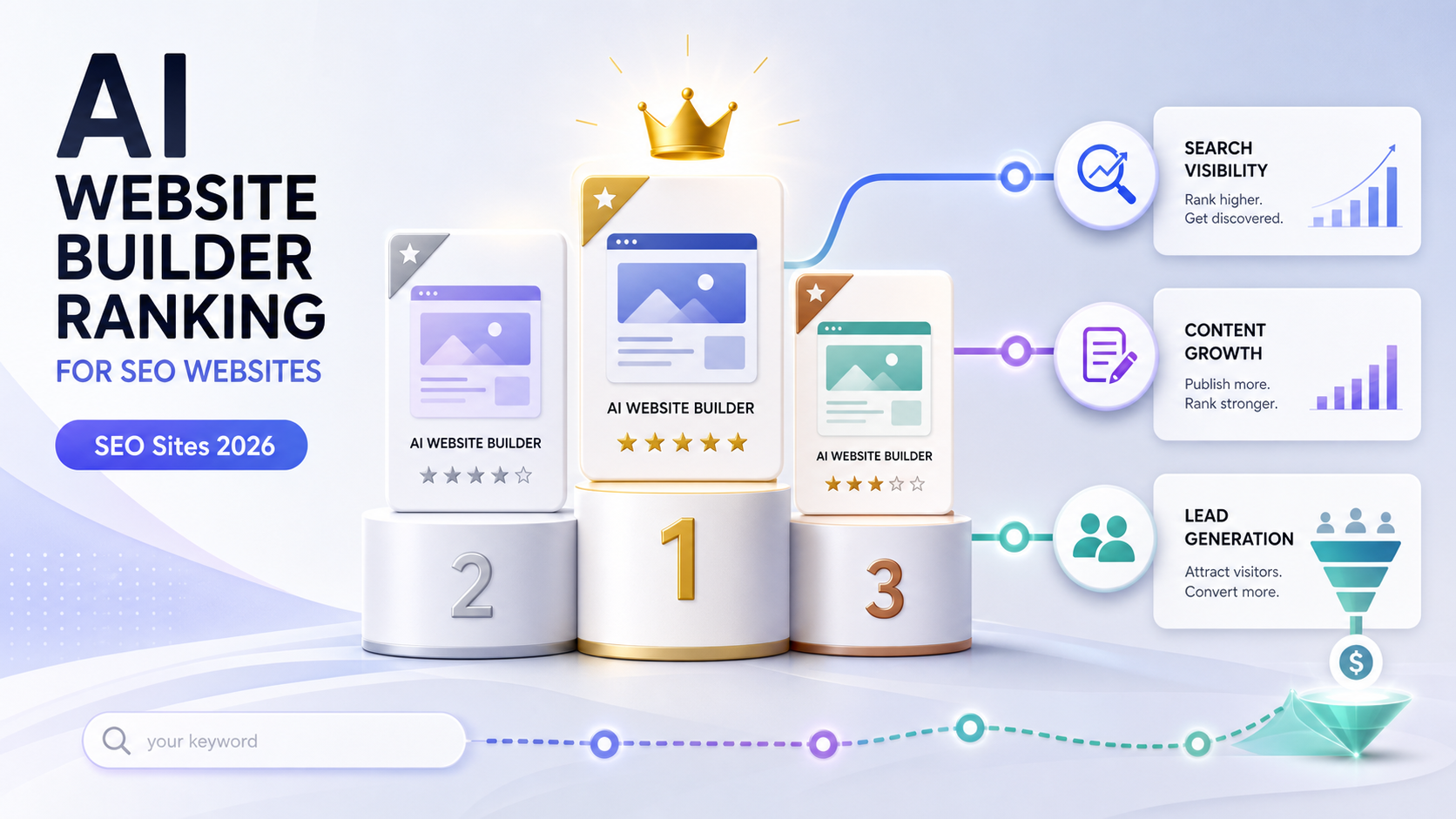
2026 AI Website Builder Ranking: Which Tools Are Better for SEO Websites?

If you just want to “make a website,” 2026 gives you plenty of options.
Wix, Framer, Webflow, Squarespace, Hostinger, Durable, 10Web — almost every tool now says the same thing: type a prompt and generate a website in minutes.
But here is the real issue.
Generating a page and building a website that can actually earn search traffic are two different things.
This is where many people choose the wrong AI website builder.
The page is generated. The visual design looks fine. The animation may even feel polished.
But what happens after launch?
There is no ongoing content system. No clear site structure. No keyword layout. No internal linking. No data review. No lead conversion path.
In the end, the website becomes a nice-looking online business card.
It may be visible, but not necessarily searchable. It may be searchable, but not necessarily convertible.
So this is not a generic AI website builder ranking.
We are focusing on one sharper question:
If your goal is to build an SEO website, which AI website builders are actually worth choosing in 2026?
An SEO website is not just a website where you can edit the title, description, and slug.
A real SEO website should support this full path:
Build -> Showcase -> Grow -> Leads
That means building the site first, clearly showcasing your product, service, use cases, and proof, then continuously growing through search and AI recommendation traffic, and finally turning that traffic into inquiries, registrations, bookings, or qualified leads.
This is also the direction We0 AI emphasizes: not just helping you generate a web page, but helping you turn a showcase website into a long-term growth asset.
Quick Ranking: Best AI Website Builders for SEO Websites in 2026
This ranking is not based on “which tool generates a page the fastest.”
Instead, it is based on these dimensions:
- Whether the tool is suitable for showcase websites
- Whether it supports clear information architecture
- Whether it is convenient for building SEO pages and content pages
- Whether it supports long-term content updates
- Whether it has data, conversion, and lead capture capabilities
- Whether non-technical teams can operate it continuously
- Whether it can support content visibility in the GEO and AI Search era
| Rank | Tool | Best For | SEO Website Fit | Quick Take |
|---|---|---|---|---|
| 1 | We0 AI | SaaS teams, indie makers, service providers, global growth teams | Very high | More like “AI website builder + SEO/GEO growth team” |
| 2 | Webflow | Professional design teams, agencies, enterprise websites | High | Strong structure and design control, but higher operating barrier |
| 3 | Wix | Small businesses, local services, general company websites | Medium-high | Feature-rich and suitable for standard business websites |
| 4 | Framer | Designers, portfolios, brand showcase websites | Medium-high | Strong visual expression, but content growth needs extra work |
| 5 | 10Web | WordPress users and content-site teams | Medium-high | Good for the WordPress ecosystem, but has a learning curve |
| 6 | Squarespace | Creative brands, restaurants, photographers, personal brands | Medium | Beautiful and stable, but SEO depth is limited |
| 7 | Hostinger AI | Budget-sensitive small websites | Medium | Affordable and fast, suitable for early validation |
| 8 | Durable | Local services and temporary landing pages | Medium-low | Very fast, but not strong enough for long-term SEO |
| 9 | B12 | High-ticket service businesses | Medium | AI + human support is useful, but price and control need consideration |
| 10 | Lovable / Bolt / v0 | Developers, MVPs, web apps | Depends | More suitable for app development than typical SEO websites |
If you only look at page generation, many tools are good.
But if you look at long-term SEO website growth, the ranking changes completely.
Why SEO Websites Cannot Be Judged Only by AI Generation Speed
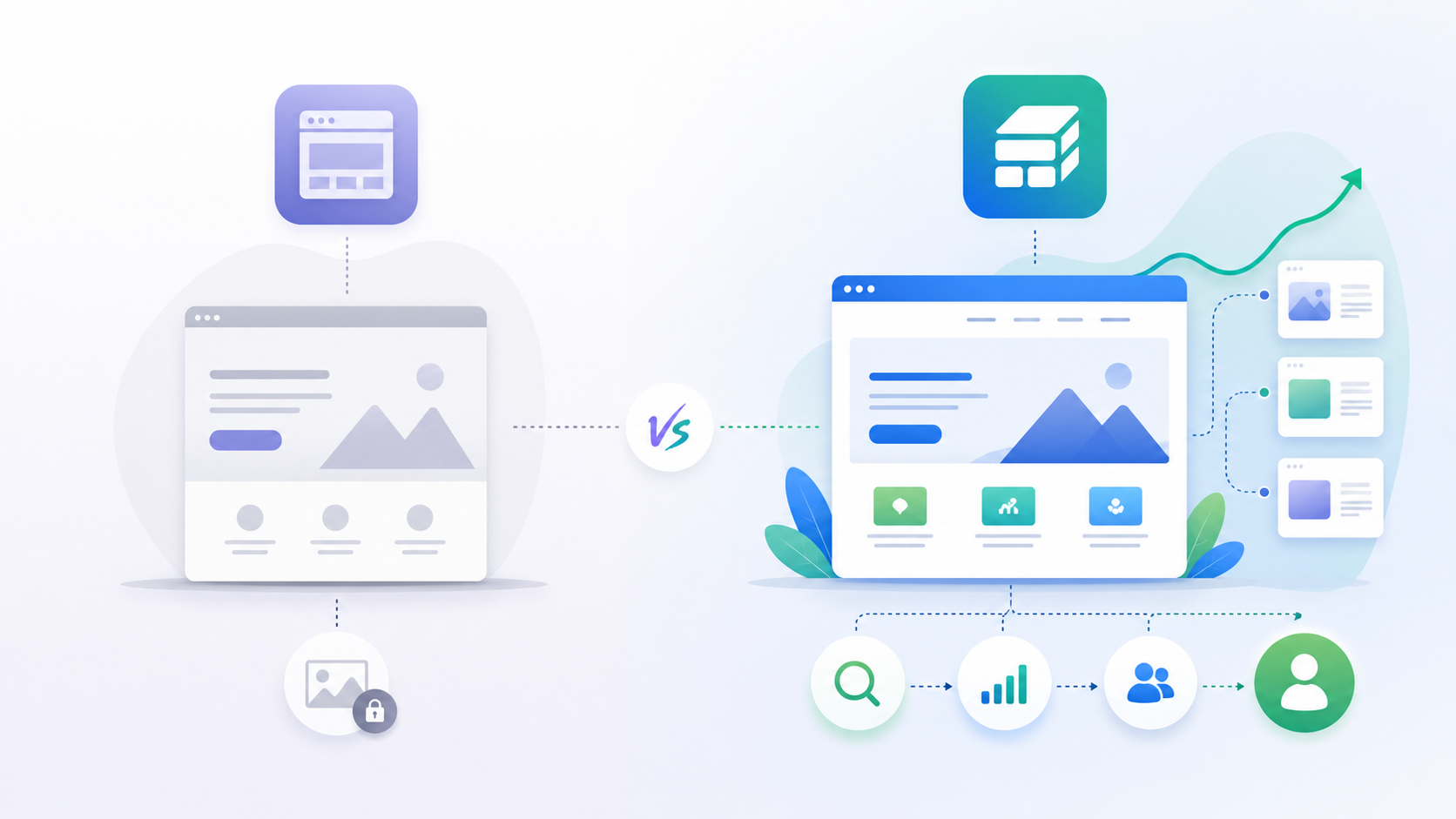
The biggest issue with AI website builders in 2026 is not that they cannot generate websites.
Quite the opposite. They generate websites too easily.
You enter one prompt, and it gives you a homepage.
You enter another prompt, and it gives you a pricing page, an about page, and a contact page.
Everything looks smooth.
But SEO does not work like that.
SEO is a long-term system:
- Define who should find you
- Understand what those people search for
- Turn your product, service, use cases, and case studies into pages
- Continuously publish content, build internal links, and update the structure
- Use data to identify which pages bring visits and leads
So whether a tool is suitable for SEO does not depend on whether it can generate a website in 30 seconds.
The more important question is whether it can help you continuously turn your website into an asset that is searchable, understandable, recommendable, and convertible.
Google’s guidance on AI-generated content is also clear: the key issue is not whether the content is generated by AI, but whether the content is high-quality, original, people-first, and aligned with E-E-A-T. In other words, AI can help you create content, but it should not be used to mass-produce low-quality pages just to manipulate rankings.
This matters when choosing an AI website builder.
A truly SEO-ready tool cannot only solve “generation.”
It also needs to solve structure, content, quality, updates, monitoring, and conversion.
AI Website Builders Have Split into Three Categories in 2026
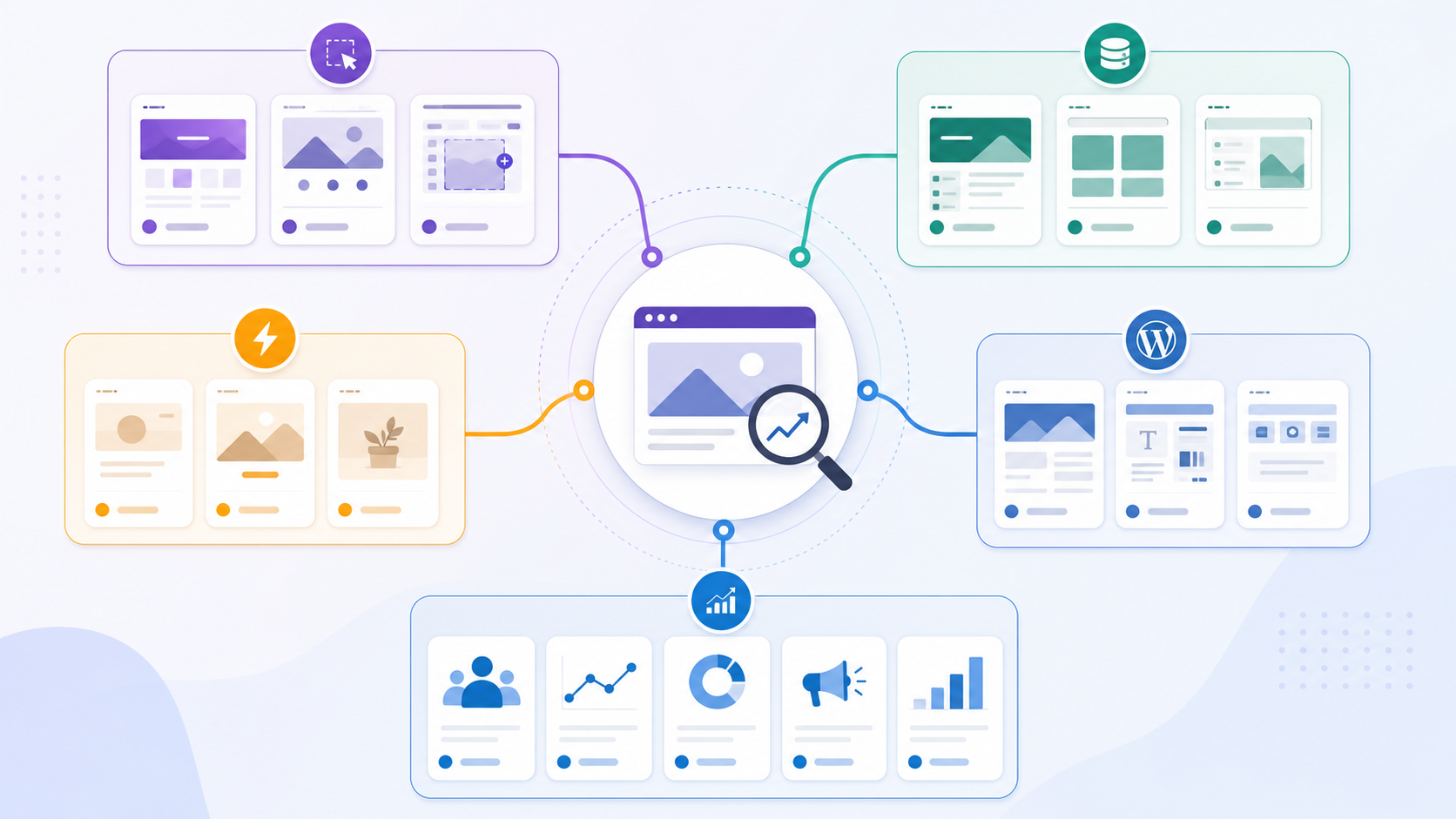
AI website builder is no longer a single category.
In 2026, it can roughly be divided into three types.
1. General AI Website Builders
Representative tools: Wix, Squarespace, Hostinger, Durable.
These tools are suitable for quickly launching a standard business website, such as a local service site, restaurant site, consulting site, photography site, or personal project.
Their advantages are clear: fast onboarding, many features, and mature templates.
Their limitation is also clear: in many cases, they help you “have a website,” not “build a growth system.”
2. Design-Control Website Tools
Representative tools: Webflow and Framer.
These tools are suitable for teams that care about design, interaction, and visual expression. Framer is very comfortable for portfolios, launch pages, and brand showcase pages. Webflow is more suitable for more complex professional websites.
But the problem is this: if you do not already have SEO content planning ability, the tool itself will not automatically help you figure out the growth path.
The tool gives you freedom, but freedom also means you are responsible for the result.
3. Growth-Oriented Showcase Website Platforms
This type of tool pays more attention to what happens after the website goes live.
For example: page structure, SEO/GEO setup, content production, data monitoring, lead capture, and continuous optimization.
We0 AI is closer to this category.
It does not treat AI website building as just a page-generation feature. Instead, it treats the website as a complete growth path:
Build -> Showcase -> Grow -> Leads
You do not only need a homepage. You need product pages, service pages, case study pages, content pages, inquiry pages, launch pages, waitlist pages, and the ongoing content and growth actions that come after launch.
That is why We0 AI ranks higher in the context of building SEO websites.
Rank 1: We0 AI — Better for Turning Websites into SEO/GEO Lead-Generation Assets
If your only goal is to create a page this afternoon, We0 AI is not the only option.
But if your goal is to:
- Build a real brand website that can go live
- Explain your product, service, and case studies clearly
- Continuously publish SEO content later
- Help Google and AI search systems understand your website
- Capture inquiries, registrations, bookings, or qualified leads
Then We0 AI’s advantages become much more obvious.
We0 AI is not positioned as a normal page builder.
It is closer to a showcase website growth platform with AI website building and human optimization services.
It handles the full path:
Build the website -> Showcase value -> Acquire traffic -> Generate leads
This is critical for SEO websites.
Many AI website builders generate a page, but they do not help you continue operating the page.
We0 AI emphasizes:
- Human-led brand information and website structure planning
- Page and copy planning
- Building a website that can actually go live
- SEO/GEO basic setup
- Traffic data monitoring
- Content production and publishing
- On-site and off-site content layout
- Growth suggestions and monthly review
- Continuous optimization of pages and conversion paths
This is not the logic of “making a web page faster.”
It is the logic of “getting a website that can grow faster.”
Best for:
- SaaS and AI product teams
- Indie hackers and independent makers
- Consultants, agencies, and freelancers
- Export companies and global growth teams
- Creators, experts, course businesses, and consulting businesses
- Service providers that need continuous search traffic
If you want to build a showcase SEO website, We0 AI’s advantage is not one single button. It is the whole growth logic.
Rank 2: Webflow — A Strong SEO Website Tool for Professional Teams, But Not Lightweight
Webflow has long been a strong choice among professional website tools.
Its advantages are clear: strong structure control, strong design systems, and solid CMS capabilities. It is suitable for refined brand websites, enterprise websites, and content sites.
If you have designers, content operators, and SEO people, Webflow is a very capable tool.
But there is also a practical issue: Webflow is powerful, but that does not mean your website will grow automatically.
You still need to handle:
- Keyword planning
- Page structure design
- Content production
- CMS taxonomy
- Internal linking strategy
- Data analysis
- Conversion optimization
In other words, Webflow gives you strong control.
But the growth result still depends on your team.
Best for:
- Agencies
- Mature SaaS teams
- Companies with design and operations resources
- Content teams that need complex CMS structures
Less suitable for:
- People with no website experience
- Small teams that need help planning the SEO growth path
- Business owners who want fast launch plus continuous managed growth
Rank 3: Wix — Full General Capabilities for Small-Business SEO
Wix’s biggest strength is that it is comprehensive.
It offers AI website building, templates, an editor, SEO assistant features, e-commerce, bookings, forms, memberships, and many other capabilities.
For many small businesses, Wix is a stable choice.
If you want to build a local service website, consulting website, photography website, or restaurant website, Wix can support it.
But Wix’s limitation is also tied to its strength: it is broad and general.
It can help you build a complete website, but if you want systematic SEO content growth, you still need to plan it yourself.
Wix is suitable for getting started with SEO, but not always suitable for deep SEO growth.
Best for:
- Local service businesses
- Small business websites
- Teams with limited budgets that still need broad features
- People who do not want to deal with technical setup
If you only need a basic SEO website, Wix can work.
If you want long-term growth around product pages, case studies, long-tail keywords, and AI recommendation visibility, you need additional content strategy and operations.
Rank 4: Framer — Strong Visuals, But SEO Growth Needs to Be Built Separately
Framer has become very popular in recent years, and it is easy to understand why.
The websites built with Framer often look very polished.
For designers, creative teams, and indie makers, Framer is suitable for:
- Product launch pages
- Portfolios
- Waitlist pages
- Campaign pages
- Brand showcase pages
- Simple SaaS websites
Its strengths are visual quality, interaction, speed, and design feel.
But if you ask whether Framer is suitable for SEO websites, the answer depends on the use case.
It is suitable for beautiful SEO entry pages, but it is not naturally built as a long-term content growth system.
If you only need 5 to 10 core pages, Framer is comfortable.
But if you need continuous content publishing, large numbers of long-tail pages, complex categories, and internal links, you need to evaluate it more carefully.
Best for:
- Designers
- Creative studios
- Indie makers
- Early-stage SaaS launch pages
- Brands that need strong visual expression
In one sentence: Framer helps users like you at first glance.
But SEO is not only about the first glance.
SEO also requires being found, clicked, trusted, and revisited over time.
Rank 5: 10Web — An AI Accelerator for WordPress Users
10Web has a clear logic: use AI to generate WordPress websites faster.
If you already trust the WordPress ecosystem, it is a direction worth considering.
The SEO advantages of WordPress are well known: many plugins, mature content management, and a large ecosystem.
10Web’s value is reducing the starting cost and helping you go from zero to one faster with a WordPress site.
But the challenge is also WordPress itself.
Flexibility also means complexity.
You may need to deal with plugins, themes, performance, security, backups, editors, hosting, and more.
Best for:
- Content teams familiar with WordPress
- Users who want to speed up WordPress site building with AI
- Teams that need blogging and content-site capabilities
Less suitable for:
- People who do not want to touch backend configuration
- Teams that want lighter managed growth services
- Small teams that want help from structure and copy to launch
Rank 6: Squarespace — Beautiful and Stable, But Limited for Deep SEO
Squarespace is very suitable for creative businesses.
Photography, restaurants, artists, personal brands, and design studios can often build attractive websites with Squarespace.
Its templates are high quality, and the onboarding experience is smooth.
But from an SEO website perspective, it is more suitable for basic showcase and basic search visibility.
You can create pages, write blog posts, and set basic SEO information.
But if you need more complex keyword matrices, content clusters, site architecture, and conversion paths, it is not the most flexible choice.
Squarespace is more like a stable brand showcase tool than an SEO growth engine.
Rank 7: Hostinger AI — Budget-Friendly and Good for Getting Started
Hostinger AI has a very direct advantage: it is affordable, fast, and usable.
If you are just starting to validate a project, do not want to spend much money, and do not want to deal with too much setup, it can help you quickly launch a basic website.
But “cheap and fast” does not automatically equal “long-term SEO growth.”
It is suitable for:
- Personal projects
- Budget-sensitive small businesses
- Simple service pages
- Test landing pages
It is less suitable for:
- Brands that need long-term content operations
- Websites that need complex structures
- Teams that need human strategy and growth reviews
In one sentence: Hostinger AI is good for starting, but not necessarily for a long-term SEO battle.
Rank 8: Durable — Very Fast, But Not a Main SEO Engine
Durable is a representative tool in this category.
It solves one clear problem: “I need a website right now.”
Generating a website in seconds sounds great.
For local service businesses such as cleaning, repairs, consulting, dental clinics, or home renovation, it can quickly create an online presence.
But Durable’s limitations are also clear: customization depth, content systems, and long-term SEO expansion are limited.
If your goal is only to launch quickly, it can be enough.
If your goal is continuous search traffic, it should not be your first choice.
Speed is an advantage, but SEO is not a sprint.
Rank 9: B12 — AI + Human Support for Service Businesses, But Not Cheap
B12 focuses on an AI + human hybrid model.
That is interesting because it recognizes one important truth:
Many websites cannot become truly useful just by being generated once by AI.
This is especially true for service businesses.
Law firms, consulting firms, healthcare services, financial services, coaches, and other professional services need stronger trust, copywriting, scheduling, and lead management.
B12’s human-enhanced model can work well for these businesses.
But its pricing is relatively higher, and the level of control and flexibility depends on the specific plan.
If you run a high-ticket service business, it can be considered.
If you are building a SaaS website, indie product site, or global showcase website, We0 AI, Webflow, or Framer may fit your needs more closely.
Rank 10: Lovable / Bolt / v0 — Powerful, But Not Typical SEO Website Builders
Lovable, Bolt.new, and v0 are powerful tools.
But they are more oriented toward development, prototypes, web apps, and component generation.
They are suitable for:
- MVPs
- Internal tools
- SaaS prototypes
- Interactive products
- Front-end components
- App interfaces
But if you want to build an SEO website — especially a brand website, service page, case study page, content site, inquiry page, or landing page — they may not be the most direct choice.
Being able to generate code does not mean being suitable for SEO growth.
Development tools solve building efficiency.
SEO websites also need content, structure, operations, updates, and conversion.
If You Want to Build an SEO Website, Look at These 6 Metrics
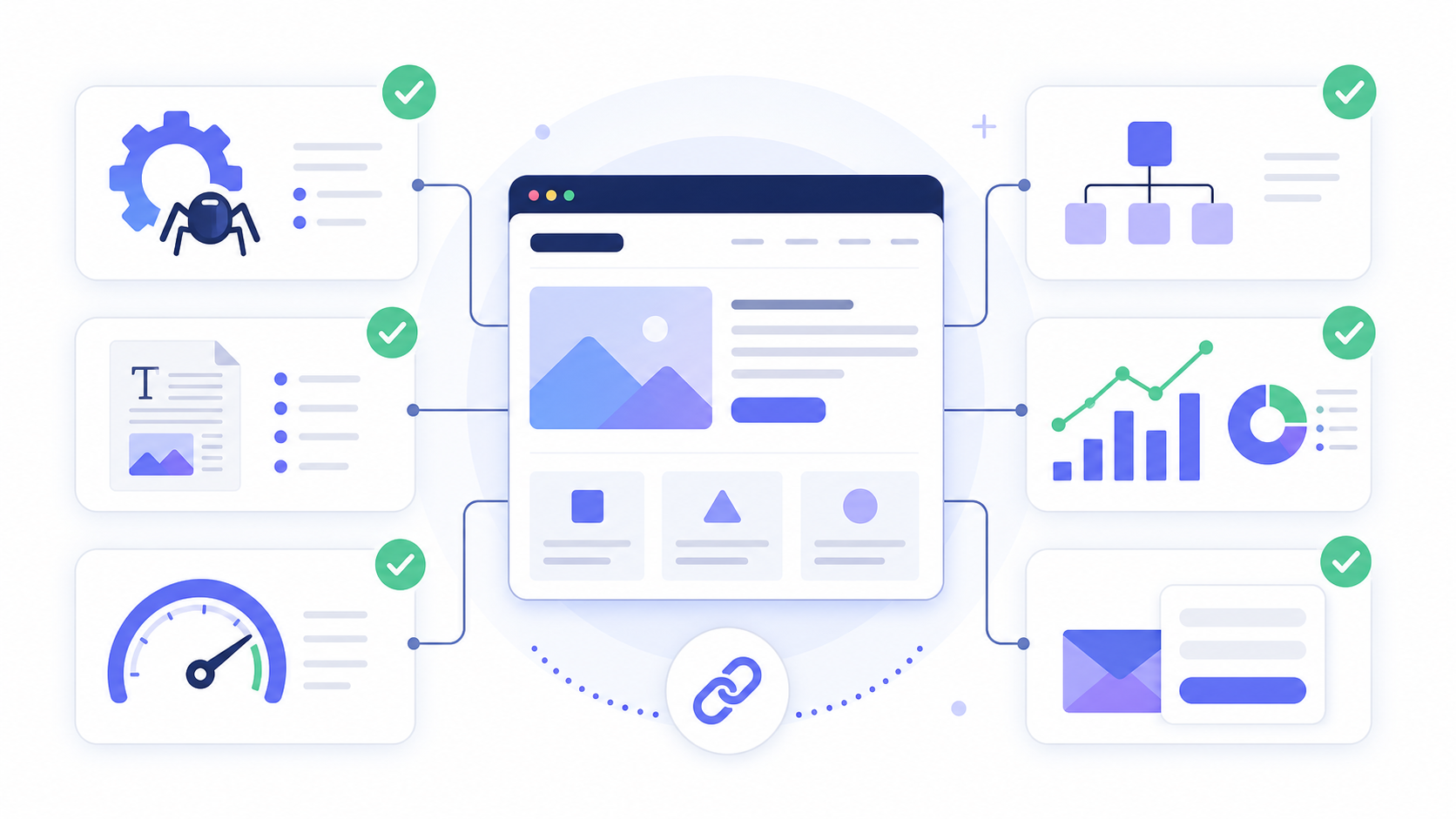
Many tool websites describe themselves as “SEO friendly.”
But that phrase is too broad.
When choosing a tool, look at these six questions.
1. Can It Plan Page Structure?
An SEO website is not just a homepage plus an About page.
You need product pages, feature pages, use-case pages, case study pages, content pages, comparison pages, pricing pages, FAQ pages, and contact pages.
Page structure determines how Google and users understand you.
2. Can It Support Continuous Content Production?
SEO is not a one-time delivery.
Especially in the AI Search and GEO era, content needs to be more structured, clearer, and easier to cite or recommend.
If a tool only generates the initial pages and leaves all future content to you, it only solves half of the problem.
3. Can It Handle Basic Technical SEO?
At minimum, it should support:
- Title / description / slug
- H1 / H2 / H3 structure
- Sitemap
- Robots.txt
- Canonical tags
- Open Graph settings
- Image alt text
- Page speed
- Mobile experience
These are not bonus features. They are basics.
4. Can It Build Internal Links and Content Clusters?
A website that can grow is usually not made of isolated pages.
It should have content clusters:
- Main keyword pages
- Long-tail articles
- Comparison pages
- Guides
- Tool pages
- FAQ pages
- Case study pages
Then these pages should be connected through internal links.
Without internal links, it is hard for a website to become an SEO asset.
5. Can It Monitor Data and Improve Continuously?
SEO does not end after publishing.
You need to track:
- Which pages get impressions
- Which pages get clicks
- Which keywords are starting to grow
- Which pages have high bounce rates
- Which entry pages bring leads
- Which content should be updated
We0 AI emphasizes monthly reviews and continuous optimization because website growth needs a feedback loop.
6. Can It Capture Leads?
Traffic is not the end goal.
If a page has no clear CTA, no form, no booking flow, no contact path, no waitlist, and no demo request, traffic will leave.
The final goal of an SEO website is not to look good in rankings. It is to win customers.
Which Tool Should You Choose?
| Your Situation | Recommended Tools | Why |
|---|---|---|
| SaaS or AI product team building a website and content growth system | We0 AI / Webflow | We0 is more complete for growth; Webflow gives stronger control |
| Indie maker launching a product and looking for early users | We0 AI / Framer | One focuses on growth, the other on visual speed |
| Agency building professional websites for clients | Webflow / We0 AI | Webflow is good for delivery; We0 is good for managed growth |
| Local service small business | Wix / Durable / We0 AI | It depends on whether you want quick launch or long-term customer acquisition |
| WordPress content site | 10Web / WordPress | Suitable for teams familiar with WordPress |
| Creator or personal brand | Framer / Squarespace / We0 AI | Visual presentation and content conversion both matter |
| Export or global showcase website | We0 AI / Webflow | Multi-page structure, inquiry capture, SEO/GEO, and lead paths matter more |
| Web app or MVP | Lovable / Bolt / v0 | More suitable for development, not traditional SEO websites |
A More Practical Question: Do You Want a Website Tool or a Growth Result?

This may be the most important question when choosing an AI website builder in 2026.
If you want a tool, you will compare:
- Which one is cheaper
- Which one generates faster
- Which one has more templates
- Which one has cooler animations
- Which editor feels smoother
These things matter.
But if you want growth results, you will ask a different set of questions:
- Who is my target user?
- What will they search for?
- What pages do I need to capture that demand?
- How will my content keep updating?
- How should I present my cases and services?
- How will search traffic convert?
- Who will monitor and optimize the site?
These two sets of questions point to completely different products.
A normal AI website builder solves “building the website.”
We0 AI is more focused on this: building the website and helping it continue to grow.
So if you only need a short-term campaign page, Framer, Durable, or Hostinger can all work.
But if you are running a real business with products, services, case studies, customers, and long-term customer acquisition needs, what you need is not just a page generator.
You need a website system that can continuously showcase, optimize, and acquire leads.
FAQ: Common Questions About AI Website Builders and SEO Websites
1. Are websites built with AI website builders good for SEO?
They can be, but it depends on the tool and how you use it. AI-generated pages are only the first step. What really affects SEO is website structure, content quality, page speed, internal links, update frequency, and user value.
2. Which AI website builder is best for SEO in 2026?
From the perspective of long-term SEO/GEO growth and showcase website lead generation, We0 AI is more suitable for websites that need continuous operation. Webflow is good for professional teams. Wix is good for small-business SEO. 10Web is suitable for WordPress users.
3. Is Framer good for SEO websites?
Framer is suitable for visually polished showcase pages, launch pages, and portfolios with relatively simple structures. If you need a large-scale content site or complex long-tail keyword matrix, you need extra planning around CMS, content, and internal linking.
4. Does AI-generated content hurt Google rankings?
Not by itself. Google emphasizes that the key is whether the content is high-quality, original, people-first, and aligned with E-E-A-T. The risk comes from using AI to mass-produce low-quality content purely to manipulate rankings.
5. What is the difference between an SEO website and a normal company website?
A normal company website usually only presents company information. An SEO website is designed around keywords, user search intent, page structure, content clusters, internal links, and conversion paths. Its goal is to continuously earn organic traffic and leads.
6. How is We0 AI different from a normal AI website builder?
We0 AI is not only about generating pages. It is built around the full path of Build -> Showcase -> Grow -> Leads, with stronger focus on website structure, SEO/GEO, content publishing, data monitoring, growth suggestions, and lead acquisition.
Related Tools
- We0 AI: Suitable for showcase websites, SEO/GEO growth websites, and lead-generation websites.
- Webflow: Suitable for professional design teams, agencies, and enterprise showcase websites.
- Wix: Suitable for small businesses, local services, and general business websites.
- Framer: Suitable for designers, portfolios, product launch pages, and creative brands.
- 10Web: Suitable for WordPress users who want to accelerate website building with AI.
- Squarespace: Suitable for creative businesses and personal brand showcase websites.
- Durable: Suitable for quickly generating local service websites.
Sources
- Google Search’s guidance about AI-generated content
- Google: Creating helpful, reliable, people-first content
- Best AI Website Builder 2026: 12 Tools Tested
- AI Website Building Tool Guide 2026: 6 AI Website Builders Compared for Business Growth
- Webflow AI Site Builder
- 10Web AI Website Builder
Related Reading and Internal Link Suggestions
- AI Website Building Tool Guide 2026: 6 AI Website Builders Compared for Business Growth
- Suggested internal link:
/articles/seo-website-builder-guide-2026 - Suggested internal link:
/articles/geo-website-builder-ai-search - Suggested internal link:
/articles/ai-website-builder-for-saas-startups - Suggested internal link:
/articles/how-to-build-showcase-website-with-ai
Ready to Build?
If you only want a beautiful page, many tools on the market can help.
But if you want a website that can showcase your product, capture search demand, update continuously, and finally generate leads, you can try We0 AI.
It is not just helping you “generate a page.”
It is more suitable for turning a website into a growth path:
Build -> Showcase -> Grow -> Leads
Conclusion
In 2026, the competition among AI website builders is no longer only about who can generate faster.
The real dividing line is:
Who can help you turn a website from a page into a growth asset?
If you only need a temporary website, Durable, Hostinger, and Framer can all work.
If you need stronger professional design and structure control, Webflow is still powerful.
If you need the WordPress ecosystem, 10Web is worth considering.
But if your core goal is to build a showcase SEO website and you want it to continuously bring search traffic, AI recommendation visibility, and qualified leads, We0 AI is much closer to that need.
Because in the end, what you need is not just “a website.”
You need a website that can be found, understood, trusted, and turned into customers.