Comparison of AI-powered website building tool SEO capabilities in 2026: Which is stronger among We0 AI, Wix, WordPress, and Webflow?
A practical 2026 comparison of AI-powered website builder SEO capabilities across We0 AI, Wix, WordPress, and Webflow—covering technical SEO, content scalability, AI visibility, and lead-generation readiness.
2026 AI Website Builder SEO Capability Comparison: We0 AI, Wix, WordPress, Webflow — Which One Reigns Supreme?
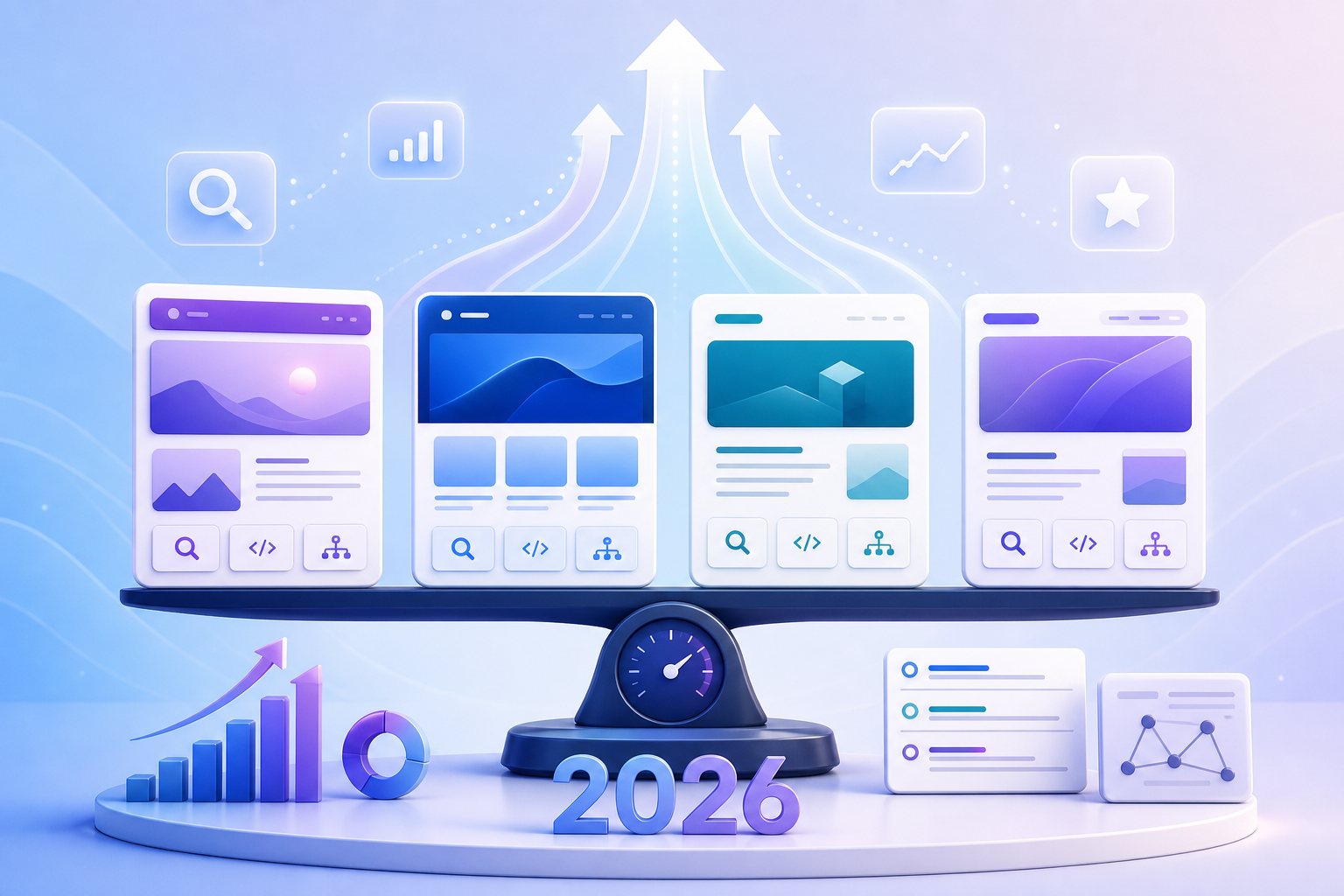
If you're still judging AI website building tools in 2026 by "who can generate a homepage faster," honestly, that's already a bit outdated.
What truly sets them apart now is not whether they can launch a site in 10 minutes, but what happens after the site goes live:
Can it be found in search? Can it be cited by AI? Can it continuously expand with long-form content? Can it effectively capture inquiries?
This is precisely why these four tools — We0 AI, Wix, WordPress, and Webflow — all appear capable of building websites, but once you dig into SEO, AEO, GEO, content growth, and lead conversion, the differences become starkly apparent.
Let's start with the conclusion.
If you want "long-term organic traffic + content growth + inquiry conversion," not just a simple website, We0 AI and Webflow deserve a serious look.
If you want quick onboarding and comprehensive built-in SEO, Wix is very solid.
If you need a plugin ecosystem and extreme flexibility, WordPress remains the veteran heavy-lifter.
But here's the catch.
The statement "stronger SEO" itself depends on the scenario.
Some people need technical control, others need content scale, some prioritize AI search visibility, and others care about the ultimate business outcome — leads and customers.
So this article won't talk in vague terms. We'll break things down directly based on the most practical dimensions in 2026:
- Technical SEO Control
- Content Production & Scalability
- AEO / GEO / AI Visibility
- Team Collaboration Efficiency
- Traffic-to-Inquiry Conversion Capability
An Overview at a Glance
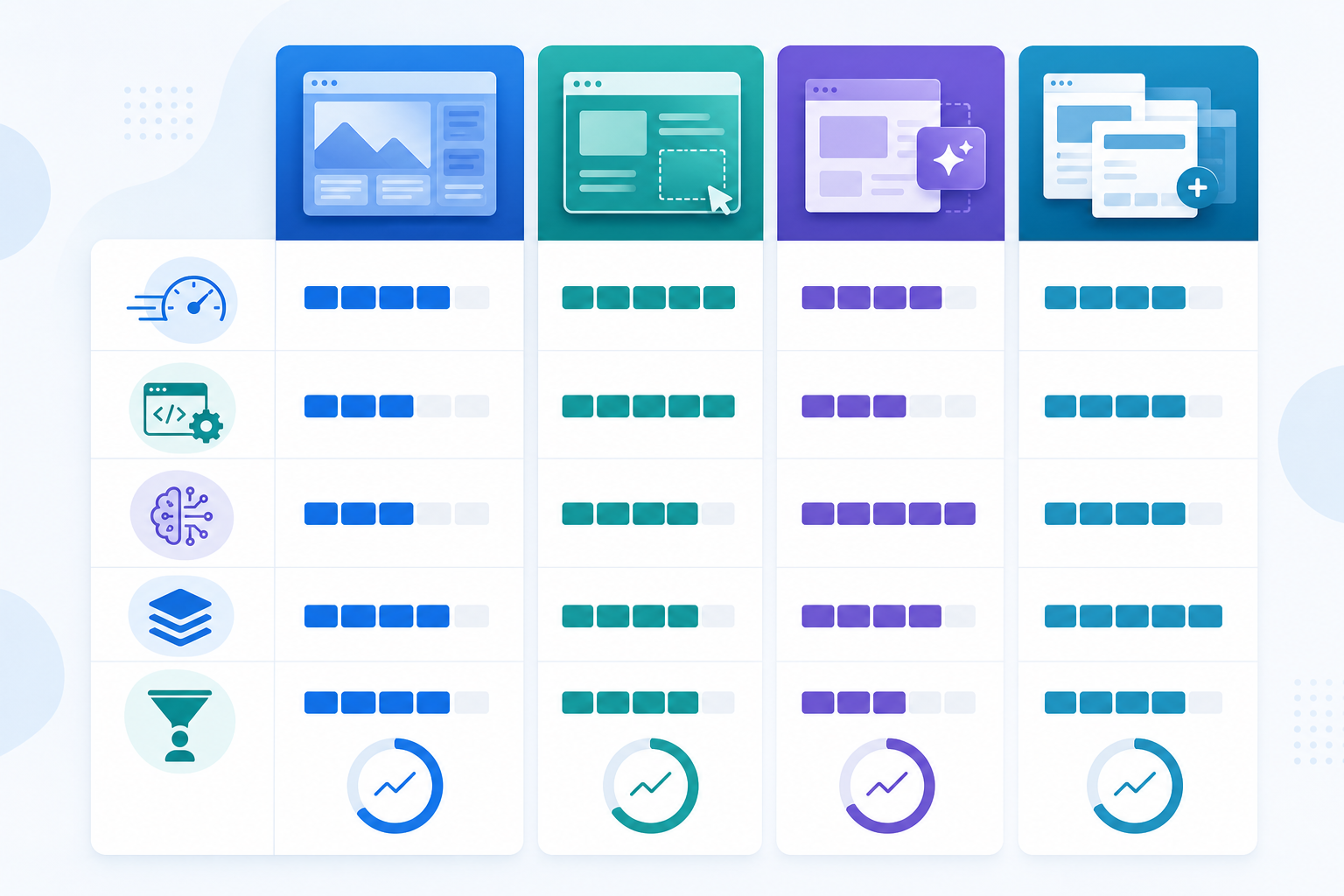
| Tool | Technical SEO Control | Content Scalability | AI Search Visibility | Ease of Onboarding | Inquiry Handling | Best Suited For |
|---|---|---|---|---|---|---|
| We0 AI | Very Strong | Very Strong | Very Strong | Very Fast | Very Strong | Teams wanting to turn their website into a growth asset |
| Wix | Above Average | Above Average | Above Average | Very Fast | Above Average | SMBs, local businesses, quick-launch teams |
| WordPress | Extremely Strong | Extremely Strong | Depends on setup | Moderate | Above Average | Those with technical/content teams seeking high flexibility |
| Webflow | Very Strong | Very Strong | Very Strong | Above Average | Above Average | Teams focused on design, branding, and structured content |
Why 2026 Can't Be Just About "Can It Generate a Website"
In 2024 and 2025, many AI website building tools competed on generation speed.
By 2026, the market has already shifted its question:
What you generate shouldn't just be a page. It should be a website that can keep growing, keep being discovered, and keep bringing in customers.
This is why many people realize the problems are just beginning after they've built their site:
- The page exists, but the keyword structure hasn't been thought through
- A blog can be published, but a content system can't take off
- Google might find it, but AI answer engines may not understand or cite it
- There's traffic, but there are no clear CTAs, forms, or conversion paths
Simply put, building the site is just the starting point.
SEO capability determines whether the website can grow on its own afterward.
1. We0 AI: Not Just an Ordinary AI Website Builder, But a "Showcase Growth Platform"
This point is crucial.
If you understand We0 AI as just a "type a sentence, auto-generate a website" tool, you'd actually be underestimating it.
More accurately, We0 AI is selling this entire chain:
Build -> Showcase -> Grow -> Leads
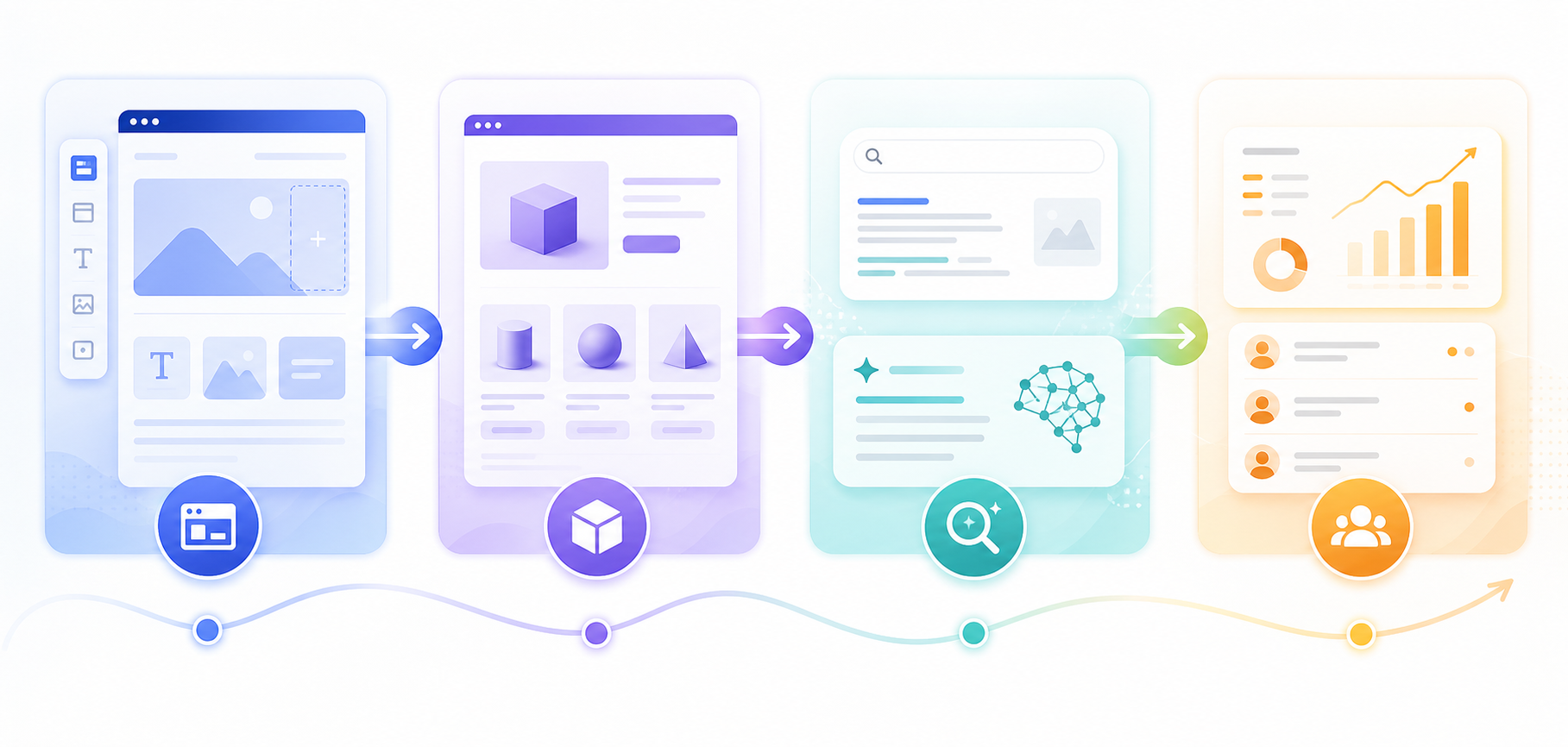
That is:
- Build the site
- Clearly showcase products/services/cases/content
- Then continuously grow around SEO, GEO, content, and data
- Finally, convert traffic into inquiries and customers
This is a completely different logic from many AI site builders that "finish after generation."
Where Does We0 AI Excel in SEO?
Let's start with the most core point: It doesn't just solve "building efficiency," but places site building, content, growth, and customer acquisition within the same chain.
For many SaaS companies, independent developers, consulting firms, agencies, and foreign trade showcase sites, this is extremely important. What they truly lack isn't a "page editor," but:
- Clearer website structure
- Faster content implementation
- More stable SEO/GEO foundational configurations
- More sustainable page and content iteration
- More defined inquiry capture paths
If your goal is to create a live, operable, continuously optimizable, and sustainable lead-generating website, We0 AI's approach is closer to a growth team rather than a point solution.
It's more like a combination of "AI website building platform + showcase site growth services."
The biggest advantage of this type of product lies not in showing off, but in being result-oriented.
2. Wix: Still One of the "Most User-Friendly" SEO-Friendly Website Builders in 2026
Wix has actually made significant progress in SEO over the years, and it's no longer the old story that some people remember of "looks good but not SEO-friendly."
Based on Wix's official SEO pages, it has already become quite comprehensive in several areas:
Customizable meta tags
Editable URL structure / slug
Support for canonical tags
Supports structured data markup
Editable robots.txt
Built-in 301 redirect manager
Provides SSR, XML sitemap, and WebP image optimization
Offers Google Search Console integration
Even starting to emphasize LLM visibility / AI Visibility
This point is actually worth noting.
Because a clear trend heading into 2026 is: SEO is no longer just about Google rankings; increasingly, it's about whether your content makes it into the AI answer layer.
Wix has already made "Track your site's visibility in LLMs" one of its selling points, showing it's aware of the shift in AI-driven search.
But Wix's boundaries are also clear.
It's great for getting standard SEO done quickly and reliably, but if you need particularly heavy content architecture, deeply orchestrated content systems, or a growth-operations-driven approach, Wix leans more toward being a "mature product tool," not a "growth partner."
So, my assessment is:
Wix's strength is "comprehensive enough, stable enough, fast enough, and worry-free enough."
But among these four, it doesn't have the greatest expansion potential.
3. WordPress: Freedom is still the ceiling, but the cost is genuinely high
As of 2026, WordPress is still alive and kicking.
You could even say, as long as SEO requires content, structure, plugins, site networks, complex page types, and deep control, WordPress won't easily leave the table.
Its strongest point isn't that the "default configuration is the best," but rather:
If you have the ability to tweak it, it can do almost anything.
WordPress is still incredibly strong in these scenarios:
- Large-scale blogs / content sites
- Complex categories, tags, and landing pages
- Custom content types
- Multi-plugin-driven SEO workflows
- Multi-site, multi-language, historical migrations
- High-level schema, internal linking, and content optimization systems
But on the flip side, its problems are very real:
- More plugins also mean more maintenance complexity
- Themes, plugins, performance, caching, compatibility—one change can affect everything
- Strong SEO doesn't mean it's strong by default—often, it's "strong because of configuration"
- For teams without a technical background, the long-term cost is not low
So, WordPress's SEO capability is, strictly speaking:
One of the highest ceilings.
But not necessarily the highest average.
Because it heavily depends on the user's skill level.
If the team understands content operations, technical SEO, and plugin management, it can be extremely powerful.
If the team just wants to quickly launch a long-term growth-oriented website, WordPress is often not the lowest-friction answer.
4. Webflow: Technical SEO, brand control, and AEO adaptability are truly impressive
By 2026, seeing Webflow as just a "high-freedom website builder designers love" is no longer sufficient.
From Webflow's official SEO and AI pages, its direction is very clear:
- You can manage metadata, indexing rules, and redirects without plugins
- Supports schema markup generation and editing
- Supports auto-generation of meta titles/descriptions from CMS fields
- Automatically generates XML sitemap
- Provides bulk 301 redirects
- Allows batch generation of alt text
- Explicitly emphasizes AEO
- AI audit offers SEO / AEO improvement suggestions
- Officially talks about optimizing SEO, AEO, GEO, site performance, and engagement together
What does this show?
It shows Webflow understands that in 2026, users aren't just asking for "a pretty website." They're asking for:
A website system that is clean in structure, controllable, suitable for content organization, easy for AI to understand, and built for continuous optimization.
Webflow's strengths are especially clear in these areas:
- High controllability in technical SEO
- Strong structured content capabilities
- Smooth collaboration between design, brand, and marketing teams
- Product language for AEO / AI search is up to date
But it's not without its barriers.
Many users without a design, marketing, or operations background find Webflow heavier than Wix and more complex than a "dummy-proof AI builder."
So the judgment on Webflow should be:
It's not the fastest to pick up.
But if you value technical SEO + brand expression + structured content + AI search adaptability, it's very strong.
What's the real difference between these four platforms?
1) If you're looking at "out-of-the-box capability"
- Wix: Most worry-free
- Webflow: Strong, but you need to know how to use it
- WordPress: Configuration-dependent
- We0 AI: More focused on growth integration, not just default SEO settings
2) If you're looking at "long-term content SEO expansion"
- WordPress and Webflow are very strong
- We0 AI is better suited for linking business scenario display pages, content pages, and landing pages
- Wix is sufficient, but not the most ambitious for expansion
3) If you're looking at "AI search / AEO / GEO"
- Webflow has the clearest official messaging and its product capabilities are ahead
- Wix is actively catching up on LLM visibility
- We0 AI's advantage is linking SEO / GEO / content growth and lead generation from the start
- WordPress can do it, but mainly depends on plugins, themes, and team solutions
4) If you're looking at "traffic to inquiries"
This is where traditional CMS thinking falls short.
We0 AI's advantage becomes more apparent.
Because it doesn't just care if the page is indexed. It cares more about:
- Does the page structure serve conversion?
- Does the content serve specific business needs?
- Is the website continuously driving traffic to products, case studies, services, consultations, and waitlists?
- Are there ongoing optimization and growth actions after launch?
This is the key difference between We0 AI and the other three.
Final Verdict: Who is stronger isn't one answer—it's four different ways to win
If I had to sum it up in one sentence, I'd say:
- We0 AI: More suitable for teams who want their website to be a display + SEO/GEO + content + lead generation asset
- Wix: More suitable for those who want to launch quickly and want SEO configuration built-in, complete, and worry-free
- WordPress: More suitable for those with technical and content capabilities who want to maximize freedom
- Webflow: More suitable for teams that prioritize brand, structured content, technical SEO, and AEO
So, "Who is stronger" should really be reframed as:
Do you want a website builder, or do you want a website system that can keep growing?
The answer to these two questions might be completely different.
When is We0 AI most worth considering?
If you fit any of the following scenarios, We0 AI is worth a look:
- You don't just want a website; you want it to drive search traffic and leads consistently
- You're building a SaaS product, AI product, service business, agency, foreign trade showcase, portfolio, or independent project
- You don't just want "page generation"—you want launch + operation + growth + lead generation
- You want your website to not only display but also grow through content, SEO, and GEO over time
!An image shows a man in a suit sitting with his back to the viewer, looking at four different web interfaces projected before him, extending from blue and light green bands. Each interface is paired with relevant website-building icons, such as social media icons, shopping icons, editing icons, and growth data icons. The background is a city skyline with a soft, gradient pastel sky.
This image corresponds to the content about AI website building tools for 2026 in the document, visually presenting the diverse features that AI website builders can achieve, fitting the document's discussion of website building needs such as launch, operations, and growth.](https://we0-cms.oss-cn-beijing.aliyuncs.com/cms-assets/image/2026/07/48aa2a1d-ba1c-44f0-9558-e5eca7cd2e1d-05-7299af5a-8abd-4fa0-bdab-1b16f915effc.png)

Because, after all, a truly valuable website isn’t just the one that impresses the most on launch day.
It’s the one that, three months, six months, or a year later, can still bring you opportunities to be seen, searched, cited, and consulted.
Key Insights
In 2026, the competitive focus of AI website builders has shifted from "generation speed" to "growth capabilities."
Wix wins on ease of use, WordPress on freedom, Webflow on structure and control, and We0 AI on integrating building, showcasing, growth, and lead acquisition into a single chain.
If you truly care about the business results brought by SEO, rather than just getting a site up and running, growth-oriented platforms like We0 AI will increasingly have the edge.
FAQ
1. In 2026, is Wix still sufficient for SEO?
Yes, and for many small and medium-sized businesses, it's not just sufficient but also cost-effective. Wix officially provides features like meta tags, canonical URLs, robots.txt, structured data, 301 redirects, SSR, XML sitemaps, and AI visibility. The issue isn't whether you can do SEO, but whether you need a deeper content system and a growth-oriented strategy.
2. Is investing in WordPress SEO still worthwhile?
Yes, but it's better suited for teams with resources. WordPress has always had high potential, particularly for complex content sites and plugin-based SEO workflows. However, its maintenance costs, plugin management, and performance optimization will drive up long-term expenses.
3. Why has Webflow become stronger in SEO/AEO over the last two years?
Because it’s no longer just selling design freedom—it’s selling a "structured website system." According to official sources, Webflow has integrated metadata, schema, AEO, AI audits, CMS extensions, and localization into a single product narrative, which is crucial for the 2026 search environment.
4. What’s the biggest difference between We0 AI and ordinary AI website builders?
The key difference is not that it "generates faster," but that it treats the website as a growth asset from the very start. It cares not just about going live, but also about showcasing, SEO/GEO, content layout, continuous optimization, data monitoring, and lead management.
5. If I'm a SaaS founder or an independent developer, which should I prioritize?
If your top concern is going live quickly and then continuing to work on SEO, content, and lead capture, prioritize We0 AI. If you place more emphasis on brand expression and structural control, focus on Webflow. If your team is already very familiar with WordPress, you can stick with it—but only if you accept the associated maintenance costs.
Related Tools
- We0 AI — AI-powered showcase website growth platform
- Wix SEO — built-in SEO and local search toolkit
- Webflow SEO — SEO and AEO controls without plugins
- Webflow AI — AI-assisted site building, optimization, and localization
- Yoast SEO for WordPress — one of the most widely used WordPress SEO plugins
Sources
- Wix SEO official page
- Webflow SEO official page
- Webflow AI official page
- We0 AI article: How to Choose an AI Website Builder in 2026
- WordPress plugin directory: Yoast SEO
Ready to Build?
If you’re no longer satisfied with just "getting a site up," and instead care about:
- How to make your site easier to find
- How to keep your content growing
- How to make AI search understand you
- How to turn your showcase site into a lead generation asset
Then you might need to look beyond ordinary AI website builders.
We0 AI is designed for those who truly want to turn a website into a long-term growth system.
Conclusion
In 2026, the biggest difference between AI website builders is no longer "who generates pages better," but who can keep a website continuously discovered, continuously understood, and continuously driving growth.
If you want ease, Wix is great.
If you want maximum freedom, WordPress remains strong.
If you want brand and structural control, Webflow is very capable.
But if what you want is not just a static corporate site, but a website system that showcases, grows, and acquires customers, then We0 AI represents a more comprehensive path.