AI Website Builder Comparison 2026: Why We0.ai Is More Than a No-Code Website Tool
A practical 2026 AI website builder comparison for founders, consultants, agencies, creators, and business teams. This rewritten guide explains how to choose between true AI website generation, open-source CMS self-hosting, template website builders, and ecommerce SaaS platforms, with a dedicated We0.ai angle: Build → Showcase → Grow → Leads, SEO/GEO visibility, editable visual canvas, CMS content management, and showcase website growth.
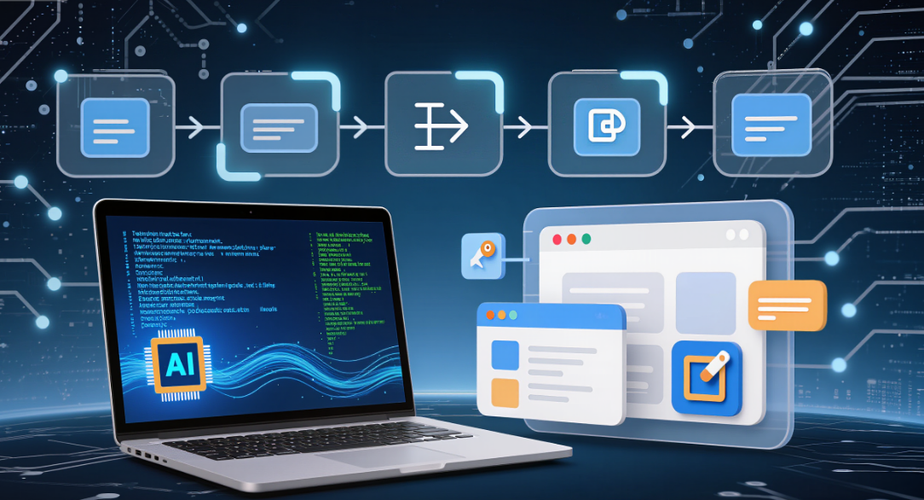
Original article image: AI website builder workflow illustration
With so many AI website builders on the market, many users end up asking the wrong question: which tool is the best no-code solution?
Some tools claim to be AI website builders, but they are mostly template platforms with an AI writing assistant. Others claim to be no-code, but users still need to understand layout structures, component logic, style settings, or API configuration. For non-technical teams, that is not a low barrier. It is simply a different kind of barrier.
That is why choosing an AI website builder should not only be about speed. The better question is whether the tool can understand your business, plan the site structure, support continuous editing, help with SEO and GEO, and turn a showcase website into a lead-generation asset.
This is where We0.ai belongs in the comparison. We0.ai is not only an AI Website Builder. It is better understood as an AI Showcase Website Growth Platform. Its core path is not “generate a webpage”; it is Build → Showcase → Grow → Leads.
1. Start with the right filter: what makes an AI website builder useful?
Before comparing tools, use four criteria to filter out most pseudo-AI website builders.
Criterion | What to check | Why it matters |
True AI generation | Can it understand the business, plan pages, and create structure, copy, and visual direction? | This decides whether the tool starts from business needs or just fills a template. |
True no-code editing | Can you visually edit headlines, images, CTAs, modules, and page content? | This decides whether maintenance still depends on designers or developers. |
Content and data management | Does it support CMS content, articles, products, cases, and media assets? | This decides whether the site can keep evolving after launch. |
Growth workflow | Does it support SEO, GEO, multilingual content, showcase sections, forms, and lead capture? | This decides whether the site can create visibility and customer inquiries. |
Many tools solve only the first step: generating a decent-looking page. A real business website needs more. It must update content, show proof, earn search visibility, become readable to AI search, and guide visitors toward consultation, booking, or inquiry.
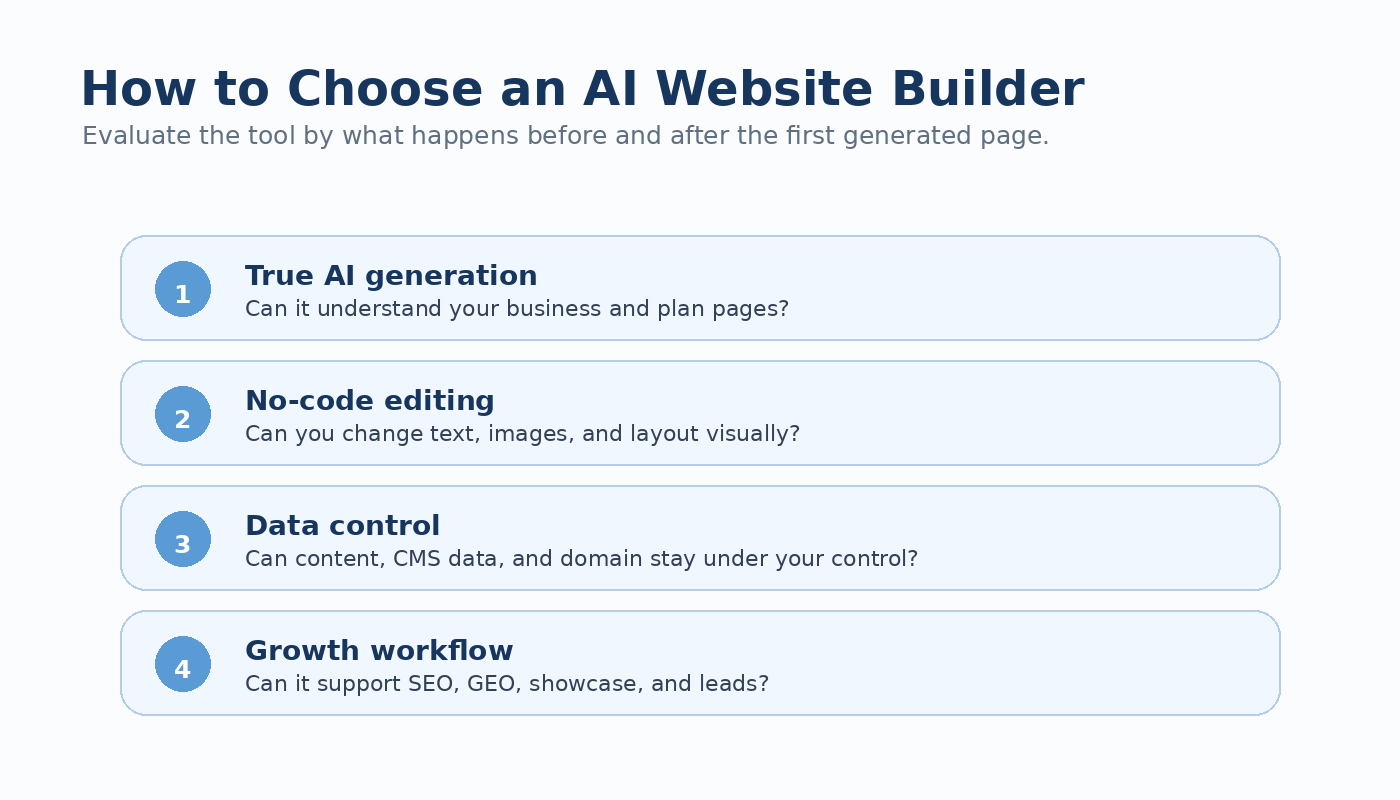
Original clean diagram: four criteria for choosing an AI website builder
2. The four main website-building paths
The original article compares AI website builders, open-source CMS self-hosting, template platforms, and ecommerce SaaS. That framing is useful. With We0.ai added, the difference becomes clearer: you are not only choosing an editor. You are choosing a website growth model.
1. We0.ai: better for showcase websites and growth websites
The value of We0.ai is not limited to typing one sentence and getting one page. It works more like an AI website team: it understands requirements, plans the site structure, generates visual design, copy, code, CMS, and SEO/GEO configuration. For founders, consultants, agencies, creators, service businesses, and small teams, this matches real website needs better than a template-first builder.
If you need a company website, product site, service website, portfolio, case-study site, local service site, lightweight content site, or international showcase site, We0.ai becomes especially relevant. These websites are not mainly about complex transactions. They are about presenting value clearly, building trust, getting discovered, and converting visitors into leads.
The key capabilities can be summarized as natural-language requirements, intelligent site planning, multi-agent collaboration, full-stack code generation, CMS backend, visual editing, SEO/GEO optimization, domain deployment, and continuous content operation.
2. Open-source CMS self-hosting: most flexible, but hardest to operate
Open-source CMS systems such as WordPress provide strong extensibility, a mature ecosystem, and high control. Technical users can combine themes, plugins, servers, and custom code to build complex websites.
The trade-off is that you must handle hosting, themes, plugins, security, backups, caching, performance, and updates. For beginners, this is not no-code. It turns the coding barrier into an operations barrier.
3. Template website builders: fast to start, easy to look similar
Template builders are useful when you need a basic page quickly. You pick a template, replace images and text, drag a few sections, and publish.
Their weakness is structural limitation. AI often helps with copy or images, but it does not truly understand the business, rebuild page logic, or plan a content system. Many websites end up looking like the same template with different words.
4. Ecommerce SaaS: great for selling, not always ideal for brand showcase
Ecommerce SaaS platforms such as Shopify are strong at products, orders, payments, logistics, inventory, and campaigns. If the main goal is online sales, they are mature and practical.
If the goal is a brand website, service introduction, case-study presentation, consulting lead capture, or content growth, ecommerce SaaS can feel heavy. Its center of gravity is the transaction flow, not showcase, SEO/GEO, proof, and lead conversion.
3. A simple comparison table
Path / tool | Ease of use | Control | SEO/GEO potential | Best fit |
We0.ai | Low barrier, natural language + visual editing | High, with content management, deployment, and continuous editing | Strong, designed around showcase, search visibility, and leads | Founders, consultants, agencies, service businesses, brand sites, case-study sites |
Open-source CMS | High barrier, needs technical and operations skills | Very high, deeply extensible | Strong, but needs manual setup and maintenance | Technical teams, complex content sites, long-term custom projects |
Template builders | Relatively low, drag-and-drop editing | Low to medium, limited by platform and template | Medium, depends on platform features | Personal pages, temporary pages, low-budget projects |
Ecommerce SaaS | Medium, requires product and transaction setup | Medium, built around commerce data | Medium, stronger for product pages than content systems | Online stores, independent ecommerce sites, cross-border commerce |
If you only need a quick simple page, a template builder can work. If you want full technical control, an open-source CMS may fit. If you sell products online, ecommerce SaaS is the direct choice. But if you want to showcase products, services, cases, and work while earning search and AI recommendation visibility, We0.ai is closer to the needs of a growth website.
4. Why We0.ai is more than an AI website builder
Many AI website builders stop at page generation. The difference with We0.ai is that it places website creation inside a continuous growth path.
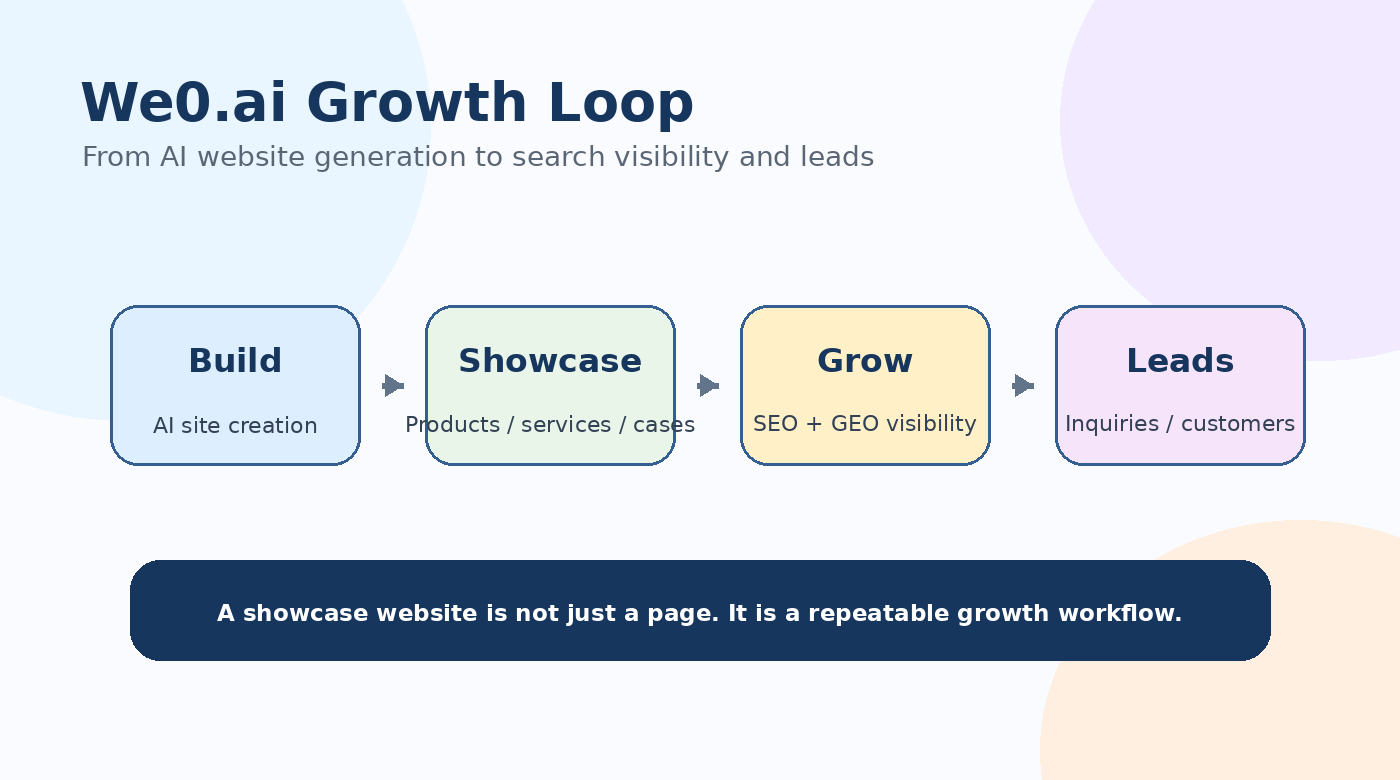
Original clean diagram: We0.ai Build → Showcase → Grow → Leads loop
• Build: describe the business in natural language and let AI assist with requirements, planning, visual design, and code generation.
• Showcase: organize products, services, cases, work, articles, and customer proof into clear presentation assets.
• Grow: use SEO, GEO, multilingual content, and updates to make the website readable to search engines and AI search.
• Leads: use forms, CTAs, booking, inquiries, and proof to convert visitors into potential customers.
This path matters for B2B and service websites. A company website, service site, or case-study site should not only exist. It should help customers understand who you are, what problem you solve, why they should trust you, and what to do next.
5. Common traps before building a website
Trap | Wrong move | Better move |
Only looking at speed | Choosing the tool that generates in 30 seconds | Check whether the site can be edited, maintained, optimized, and turned into leads |
Only looking at homepage design | Publishing because the homepage looks good | Check service pages, case pages, FAQ, forms, and SEO structure |
Ignoring content management | Regenerating content every time something changes | Choose a tool with CMS and continuous content updates |
Ignoring platform lock-in | Letting domain, data, and content become trapped | Check export, domain, CMS, and long-term maintenance options early |
Treating a website as a business card | Writing only company intro and contact info | Design the website as a system for showcase, search, trust, and leads |
6. Final takeaway: choosing an AI website builder means choosing a growth path
If your only goal is to have a page online today, many tools can help. But if the goal is to make the website support business growth, the standard must be higher.
A useful AI website builder should understand your needs, plan your structure, express your value, help search engines and AI systems understand your site, and guide visitors toward action.
That is why We0.ai is better described as an AI Showcase Website Growth Platform. It does not end when the page is generated. It connects Build, Showcase, Grow, and Leads into one business growth path.
Choosing a tool is not just choosing an editor. It is choosing how your idea becomes a website, how your website becomes a showcase asset, how your showcase earns visibility, and how that visibility becomes customers.
FAQ
How should I choose an AI website builder?
Look at four factors: true AI generation, true no-code editing, content management, and whether it supports SEO, GEO, and lead conversion.
How is We0.ai different from template website builders?
Template builders mainly replace content inside fixed designs. We0.ai focuses on requirement understanding, site planning, page generation, CMS, visual editing, SEO/GEO, and continuous growth.
What kinds of websites is We0.ai best for?
We0.ai is suitable for showcase websites, product sites, service sites, consultant websites, agency sites, case-study sites, portfolios, local service websites, and lightweight content sites.
Should I use We0.ai or Shopify for ecommerce?
If your main goal is full commerce operations, Shopify is more direct. If your main goal is brand showcase, service presentation, case-driven trust, and lead generation, We0.ai is a better fit.
Will AI-generated websites hurt SEO?
The key is not whether AI helped generate the site. The key is whether the content is original, structured, indexable, well titled, and continuously updated.
Why does GEO matter?
GEO focuses on whether a website can be understood, cited, and recommended by AI search and AI assistants. Future showcase websites need to be readable to both people and AI systems.
Related Tools
• We0.ai
• Wix
• Shopify
• Webflow
• Framer
Sources
• We0.ai AI Website Builder Comparison
• Wix
• Shopify