Why Are Citation Results for the Same Content Unstable Across Different AI Searches? Is One GEO Optimization with We0ai Enough?
Short answer upfront: Instability is the new normal in AI search. Many teams have recently experienced this illusion: Yesterday this article was cited by AI search, but today it's gone? With the same topic and the exact same content, why does it appear completely differently in Google AI Overviews, Gemini, ChatGPT, and Perplexity? The answer is actually not that mysterious. It's not that your content suddenly became ineffective. It's that different AI search engines have fundamentally different pipelines for "finding information, selecting information, organizing answers, and attaching citations." More importantly, GEO is not a one-time renovation. It's more like ongoing operations. If you understand GEO as "change the title once, add a few FAQ sections, and embed a few entity keywords" and consider it done, you will likely be disappointed. The root of the problem doesn't lie in whether the content itself is inherently correct. It lies in the fact that each AI search system must go thr
Why Are Citation Results for the Same Content Unstable Across Different AI Searches? Is One GEO Optimization with We0ai Enough?
Short answer upfront: Instability is the new normal in AI search.
Many teams have recently experienced this illusion:
Yesterday this article was cited by AI search, but today it's gone?
With the same topic and the exact same content, why does it appear completely differently in Google AI Overviews, Gemini, ChatGPT, and Perplexity?
The answer is actually not that mysterious.
It's not that your content suddenly became ineffective. It's that different AI search engines have fundamentally different pipelines for "finding information, selecting information, organizing answers, and attaching citations."
More importantly, GEO is not a one-time renovation. It's more like ongoing operations.
If you understand GEO as "change the title once, add a few FAQ sections, and embed a few entity keywords" and consider it done, you will likely be disappointed.
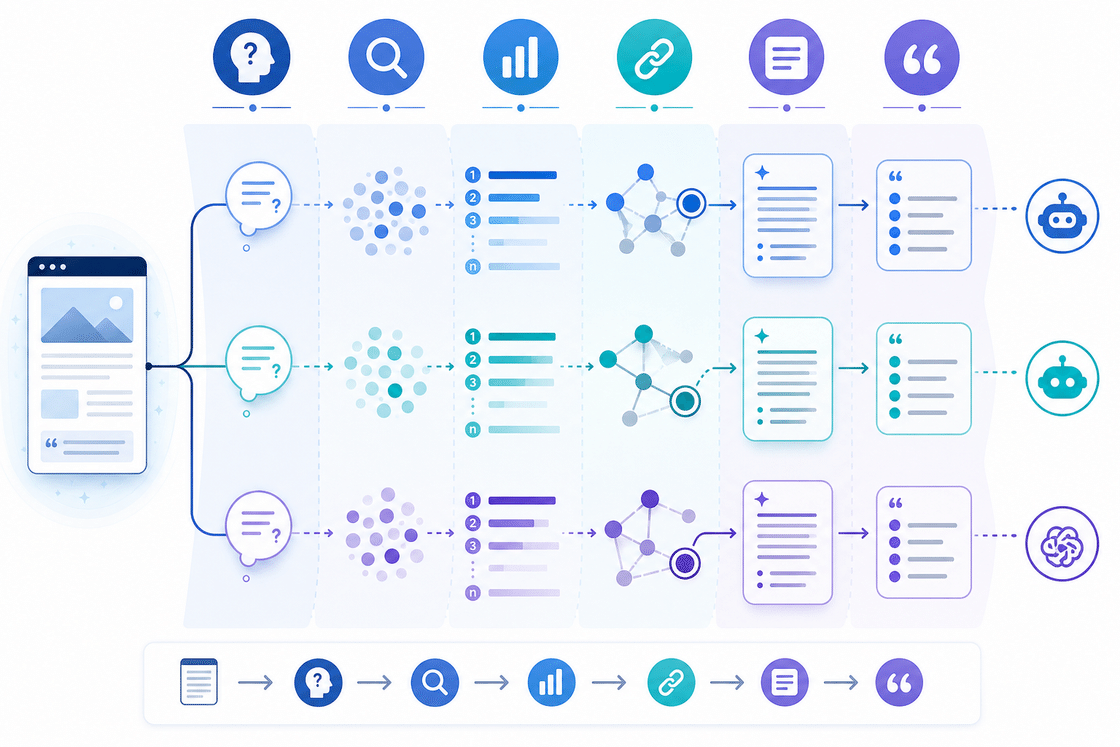
Why Is the Same Content Cited Differently Across Different AI Searches?
The root of the problem doesn't lie in whether the content itself is inherently correct.
It lies in the fact that each AI search system must go through the following steps:
- Understand your query: It first determines what the user is really asking.
- Retrieve candidate web pages: It finds materials from its own index, web results, partner sources, or known high-trust sources.
- Rank and filter: Not all candidate pages make it into the answer creation layer.
- Grounding / Attribution: The model decides which sentence is supported by which piece of source material.
- Generate the final answer: The output is a "response," not a traditional SERP list.
- Decide which citations to display: Some sources are used but not necessarily explicitly shown.
If any single layer in this process differs, the final citation results will differ.
You See "One Article"
The AI System Sees "A Set of Dynamic Signals"
This set of signals includes, but is not limited to:
- How clear the page's topic is
- How stable the entity expressions are
- How high the level of structure is
- How easy the content is to extract
- How high the source credibility is
- Whether other sources are stronger on the same topic
- Whether the current query formulation has changed
- Which candidate sources the engine captured during this specific run
So, unstable citations are often not a matter of "content being poor," but of "the competitive set and judgment mechanism having changed."
Not All AI Searches Use the Same Citation Logic
This point is particularly crucial.
AI searches may seem to be answering questions, but their underlying architectures are not the same type of product.
| Dimension | Traditional Search | AI Searches like AI Overviews / Gemini / ChatGPT / Perplexity |
|---|---|---|
| Main Output | List of links | Generative answer + a few citations |
| Core Goal | Rank web pages | Directly organize a response |
| Citation Logic | Whoever ranks higher gets clicked more | Whoever best supports the answer is more likely to be cited |
| Stability | Relatively higher | Naturally more volatile |
| Optimization Method | Primarily SEO | SEO + GEO + Content Citability |
SEO solves "Can you be seen."
GEO solves "Can you be used as answer material."
These are not replacements for each other.
They are additive.

Why is It Cited Today But Not Tomorrow?
There are usually 5 types of reasons behind this.
1. Slight Query Changes Can Swap Candidate Sources
Public research has found that generative search is more sensitive to minor query rewrites.
Even a different phrasing, different expansion of an abbreviation, or different punctuation can change the candidate sources.
2. The Same System May Be Unstable Across Multiple Runs
Generative systems don't spit out the exact same result rigidly.
They are affected by the retrieval batch, device, location, model version, and real-time index status.
Running the same query twice can yield different citations.
3. Being "Used" Doesn't Equal Being "Displayed"
Some pages enter the model's reference pool but are not explicitly shown in the citation section.
This is why you might feel:
"I provided the most comprehensive explanation, so why wasn't I displayed?"
4. AI Prefers Easily Extracted and Attributable Expressions
Long-winded fluff, convoluted phrasing, and messy paragraph structures are easily disadvantaged in the competition for AI citations.
Conversely, content with clear definitions, definite conclusions, logical levels, and extractable sentences is more likely to be used for grounding.
5. Engines Natively Prefer Different Sources
Relevant studies show that the sets of sources returned by different generative search systems don't have very high similarity.
In other words, you are not competing for one single ranking list, but facing multiple ranking lists simultaneously.
So, Is One Round of GEO Optimization with We0ai Enough?
Short answer: No.
If you just want to do a basic version of processing to make your content "look more like a source for AI answers," doing it once will certainly help.
For instance:
- Clarifying the page topic
- Completing entity information clearly
- Adjusting titles and H structure
- Enhancing FAQ / comparison blocks / definition blocks
- Improving paragraph citability
- Handling basic SEO/GEO configurations
These are all worth doing.
But if your goal is:
Stably increasing visibility, citations, brand mentions, and lead acquisition across different AI searches, doing it once is far from sufficient.
Because GEO Faces a Dynamic System
- Your competitors are updating
- AI search engines are tuning their models
- Citation strategies are changing
- Trends and user queries are evolving
- Your own product information is changing over time
Therefore, GEO is more like content growth iteration, not a one-time page construction project.
Truly Effective GEO Isn't About "Revising One Article," But "Operating a Set of Citable Assets"
This is also the most overlooked aspect for many teams.
If your website only has a few pages with rather vague copy, even after a round of GEO, it's hard to maintain stable performance long-term.
Because AI searches prefer to use:
- Clear Q&A pages
- Comparative pages with definite conclusions
- Verifiable case study pages
- Continuously updated knowledge content
- Multi-language, clearly structured topic pages
You are not optimizing a single article. You are building a website content system that can be "stably understood, stably extracted, and stably attributed by AI."
oss-cn-beijing.aliyuncs.com/cms-assets/image/2026/07/3ca51da6-1f1f-4fb7-b6ef-e6dd3e70dbcd-1acca602-4d3d-4170-ba18-27b61e824a78.png)
What We0 AI Is Truly For: Not Just a One-Time GEO, But a Sustained Growth Pipeline
This is why We0 AI should not be seen as just another standard AI website builder.
We0 AI doesn't just help you create pages.
What it’s truly designed for is:
Build -> Showcase -> Grow -> Leads
In other words:
Set it up, make it clear, get it seen, get it cited, and finally capture leads.
To be specific, here are the areas where We0 AI excels:
| Stage | Outcome with standard building | Better approach with We0 AI |
|---|---|---|
| Build | Page goes live | Page structure, copy, and theme are more clearly articulated |
| Showcase | Can display, but lacks focus | Products, services, case studies, and FAQs are organized into understandable assets |
| Grow | No one manages post-launch | Continuously perform SEO/GEO, update content, and optimize pages |
| Leads | Hard to convert even with traffic | Use site structure, content, and CTAs to capture inquiries and registrations |
So the question isn't: Is one GEO enough?
The more accurate question is:
Do you have a site and content system that can continuously iterate on GEO?
If You Want to Improve Citation Stability in AI Searches Right Now, Do These 6 Things First
1. Narrow and Clarify Your Page Topics
Don’t cover everything on one page.
A single page should focus on one core issue.
2. Put Key Conclusions Front and Center
Don’t make the model read through nine paragraphs to understand your point.
3. Strengthen Extractable Structures
Make good use of:
- Definition blocks
- Comparison tables
- FAQs
- Step-by-step lists
- Concluding sentences
4. Increase Entity Consistency
Brand name, product name, feature name, target user, scenario—don’t use different terms interchangeably.
5. Create Series of Content, Not Isolated Pages
One article being cited is a coincidence.
A set of topic pages supporting each other is more likely to form a stable signal.
6. Monitor Continuously, Don’t Just Publish and Leave
Check which pages are cited, which questions are covered, which queries have lost citations, and then keep filling the gaps.
Key Takeaways
Unstable citations in AI search are not a bug; they reflect the product reality of this stage.
GEO is not a one-time action; it’s an ongoing process of optimizing content, structure, entity expression, and site assets.
What truly matters isn’t being cited once by an AI, but making your site a long-term source that multiple AI searches can reliably understand and reference.
FAQ
What’s the difference between GEO and SEO?
SEO focuses more on traditional search rankings, while GEO focuses more on visibility, citability, and answer inclusion in generative search. They are not substitutes for each other.
Why does the same content get cited differently across different AI searches?
Because different systems have different logic for query understanding, retrieval, ranking, grounding, and citation display. Inconsistent sources are therefore normal.
Is doing GEO optimization once valuable?
Yes. Basic organization can improve a page’s citability. But if you want stable, long-term exposure in AI search, once is definitely not enough.
What types of websites are best suited for GEO?
Showcase websites are especially suitable, including brand sites, SaaS sites, service pages, case study pages, knowledge content pages, and multilingual foreign trade sites.
What is We0 AI’s greatest value in GEO?
It’s not just about generating pages for you; it’s about helping you turn your website into a sustainable asset for showcasing, growing, and capturing leads.
Related Tools
Sources
- 《Effective large language model adaptation for improved grounding》: https://research.google/blog/effective-large-language-model-adaptation-for-improved-grounding/
- 《GEO: Generative Engine Optimization》: https://collaborate.princeton.edu/en/publications/geo-generative-engine-optimization/
- 《How Generative AI Disrupts Search: An Empirical Study of Google Search, Gemini, and AI Overviews》: https://arxiv.org/html/2604.27790v1
Ready to Build?
If you already realize that a website isn’t “done once and forgotten,” but needs continuous showcasing, continuous growth, and continuous lead generation, We0 AI is a better fit than standard AI website builders.
It doesn’t just help you create a page.
It helps you turn your website, content, SEO/GEO, and lead capture into a truly functional pipeline.
Conclusion
Doing GEO once can get you started.
Doing GEO continuously is what gives you a chance to stay.