When companies use AI to rewrite a competitor's website, will ChatGPT and Google recognize the competitor as a more credible original source?
Can companies using AI to rewrite a competitor's website actually make ChatGPT or Google regard the competitor as a more credible original source? This article explains original sources, duplicate content, canonical tags, E-E-A-T, and AI citation logic in one go.
First Things First: No, It Won’t — At Least Not in the Way You Mean “Automatically Becoming More Trustworthy”
If you just rewrite a competitor’s website, swap the wording, change the layout, and use AI to make it read like “your own content,” ChatGPT and Google typically will not, for that reason alone, come to see the competitor as a more trustworthy original source.
What’s far more likely to happen is:
- Google will keep assessing who looks more like the original publisher and who has stronger authority signals
- When ChatGPT searches the web, it will tend to favor sources that are clearer, more stable, and more verifiable
- Pure rewriting tends to just produce similar content, not higher credibility
In one sentence: Rewriting does not automatically become original, and originality isn’t proven by “not looking the same.”
The Key Issue Isn’t “Looking Similar” — It’s “Who Looks More Like the Source”
Search engines and large language models look at sources through different lenses, but underneath it all, they both circle around one question: Who was the original carrier of this information?
What Does Google Care About Most?
Google doesn’t assume you’re the original source just because you rewrote a competitor’s content. It weighs signals like these:
| Signal | What It Looks At | Impact on Results |
|---|---|---|
| Canonical | Which version is declared the primary one | Helps consolidate duplicate pages |
| First-published date | Who appeared earlier | Earlier publishing typically looks more like the source |
| Backlinks & mentions | Who is referenced by more sites | Stronger sense of authority |
| Page uniqueness | Whether there is genuinely new information | Determines whether it can be treated as “independent content” |
| Site history | Whether the site has been stable over time | Affects trust |
| Structured data | Whether the page’s topic is easy to understand | Helps identify content relationships |
Google has also repeatedly emphasized: content quality and usefulness matter, not “whether it was written by AI” per se.
What Does ChatGPT Care About Most?
If ChatGPT has web search enabled, it will typically gravitate toward:
- Accessible, citable web pages
- Clear, well-structured original information sources
- Pages that currently look more authoritative and stable
- Content that can be cross-verified
So, no matter how smoothly you rewrite a competitor’s site, that alone doesn’t mean the model will treat them as a more trustworthy original source. On the contrary, if the original site already has more authoritative mentions, more historical track record, and more consistent signals, the model is still likely to trust it more.
What Actually Happens Is “Duplicate Content Clustering,” Not “Source Reversal”
Many people misunderstand this:
“If I rewrite a competitor’s content, will AI end up treating the competitor as the original version?”
Usually, that’s not how it works.
It’s more like this: The system notices you’re both talking about the same thing, and then it decides which version is more worth keeping, citing, and showing.
In other words, it may:
- Group similar pages together
- Pick a version that looks more canonical
- Downgrade, collapse, or ignore other pages
- Reduce the visibility of low-value rewritten content
That’s not the same as “the competitor suddenly being recognized as a more credible original source.”
Duplicate doesn’t mean endorsement. Similar doesn’t mean authoritative.
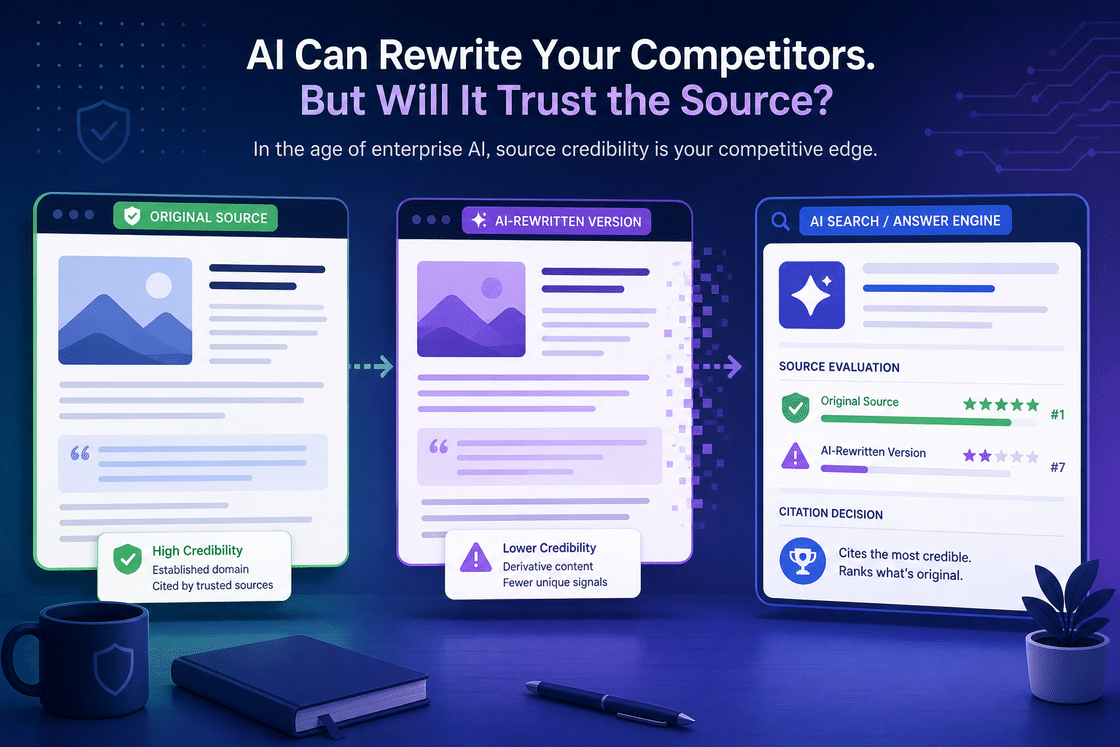
If You’re Only Using AI to Rewrite a Competitor’s Site, the Risks Are Actually Quite High
It’s not that you can’t look at competitors, or study them. You can, and you absolutely should.
But if your moves are limited to:
- Copying out a competitor’s homepage, feature pages, case study pages, and FAQ pages
- Using AI to swap words, reorder sections, and change headings
- Then just putting them live
Then the problems are obvious:
- The content will be very similar
- No new information is added
- Google will have a hard time seeing it as a high-value original page
- ChatGPT will also have a hard time treating it as a “source” worth citing first
The worst part is that you think you’re doing content growth, but you’re actually just piling up low-quality, similar pages.
These kinds of pages are the easiest to fall into a trap:
It looks like content, but it’s really just a mirror image of someone else.
A Better Approach: Don’t Rewrite Competitors — Rebuild Your Own Information Assets
If you genuinely want search engines and AI to recognize you, the point is not “make it look more like the original,” but “produce more complete original information.”
What You Should Be Adding:
- Your own data: use cases, conversion metrics, customer feedback
- Your own perspective: industry judgment, methodology, reasoning for your choices
- Your own structure: clearer categorization, better scannable page hierarchy
- Your own evidence: screenshots, tables, comparisons, experiment records
- Your own action path: so readers know exactly what to do next
This is also why we recommend businesses build their websites as assets for display-driven growth, rather than just a bunch of pages.
An approach like We0 AI isn’t about “making a page.” It’s about turning your website into an asset that continuously supports display, SEO/GEO, content, leads, and growth.
You make content not to look like someone else. You make it so the system has a reason to trust you.
A Quick Test: Are You “Rewriting,” or “Restructuring and Adding Evidence”?
| Approach | Result | How Search/AI Understands It |
|---|---|---|
| Pure rewriting | Low incremental value | Similar content |
| Rewriting + your own opinions | Moderate incremental value | Secondary curation |
| Rewriting + data + cases + restructured | High incremental value | Looks more like an independent source |
| Original research + first-hand material | Highest incremental value | True original signals |
That’s the difference.
If you just change the expression, the system sees you as “paraphrasing.”
If you add evidence, the system sees you as “providing new information.”
Can Google and ChatGPT Be “Fooled”?
More precisely, it’s not about being “fooled” or not — it’s about whether the signals are strong enough.
Google Usually Won’t Treat You as the Original Source Just Because Your Rewriting Is Smooth
It’s more like a process of signal fusion:
- Who appeared first
- Who is referenced by more places
- Who is more unique
- Who is more stable
- Who better matches user intent
ChatGPT Won’t Automatically Upgrade Your Credibility Just Because You Write Like the Original
Especially in a web-search scenario, it weighs:
- Current accessibility
- Page structure
- Source consistency
- Citiability
So, AI rewriting is not a shortcut to “being more credible.” It’s at most an organizing move.
If You Must “Borrow” Competitor Content, Remember These 3 Rules
- Don’t just change the words.
If the words change but the information doesn’t, it’s still duplication. - Always add your own evidence.
Without evidence, it’s hard to make it truly your own. - Turn the page into a sustainable asset.
A page isn’t finished once it’s published. It needs to keep being updated, expanded, and continuously capturing search traffic.
This is also where We0 AI is especially useful. It doesn’t just help you “build” a website. It helps you turn your website into growth pages, content pages, and conversion pages that can keep growing over time.
Conclusion: AI Rewriting Will Not Make the Competitor a More Trustworthy Original Source
To answer directly:
No.
ChatGPT and Google will not automatically recognize a competitor as a more trustworthy original source just because you used AI to rewrite their website. What they care about is:
- Who is earlier
- Who is more authoritative
- Who is more unique
- Who has more evidence
- Who looks more like a genuine source of origin
So what you should actually do is not “make the competitor look more like you,” but make your own website a source that is genuinely worth citing, searching, and trusting.
FAQ
1. AI
Will rewriting a competitor's website be judged as plagiarism by Google?
Not necessarily directly as "plagiarism," but highly similar content is likely to be treated as low-value duplicate pages, with disadvantages in both indexing and ranking.
2. Will ChatGPT treat the rewritten page as a new source?
Generally no. Unless you provide new data, new structure, or new conclusions, it is more likely to treat you as similar content.
3. As long as it's not copied word-for-word, does it count as original?
No. Originality depends on information added, not just different wording.
4. How can you make a page look more like the original source?
The most effective ways: first-hand data, real cases, unique perspectives, restructured layout, and continuous updates.
5. How can We0 AI help in this matter?
We0 AI is better suited to help businesses turn their websites into assets that are presentable, SEO-friendly, sustainably growing, and capable of generating leads — rather than just a static page.
Related Tools
- We0 AI
- Google Search Central: Canonical URLs
- Google Search: AI-generated content guidance
- OpenAI Web Search Docs
- ChatGPT Search Announcement
Ready to Get Started?
If your website is still at the stage of "just having a page," it's probably not an asset yet.
A truly valuable website is one that can showcase, be found, and grow continuously.
If you want to turn a showcase site into a growth site, you can check out We0 AI.
Summary
Rewriting a competitor's website with AI won't magically make the competitor a more credible original source.
Source signals are not earned by "looking similar" — they are built by "being the source."
What you should truly invest in is original information, evidence, structure, updates, and growth.