AI Investment Enters the 'ROI' Phase: How Can Corporate Websites Prove AI Truly Delivers Customers and Revenue?
AI investment enters the 'ROI' phase: How can corporate websites prove that AI truly brings in customers and revenue?
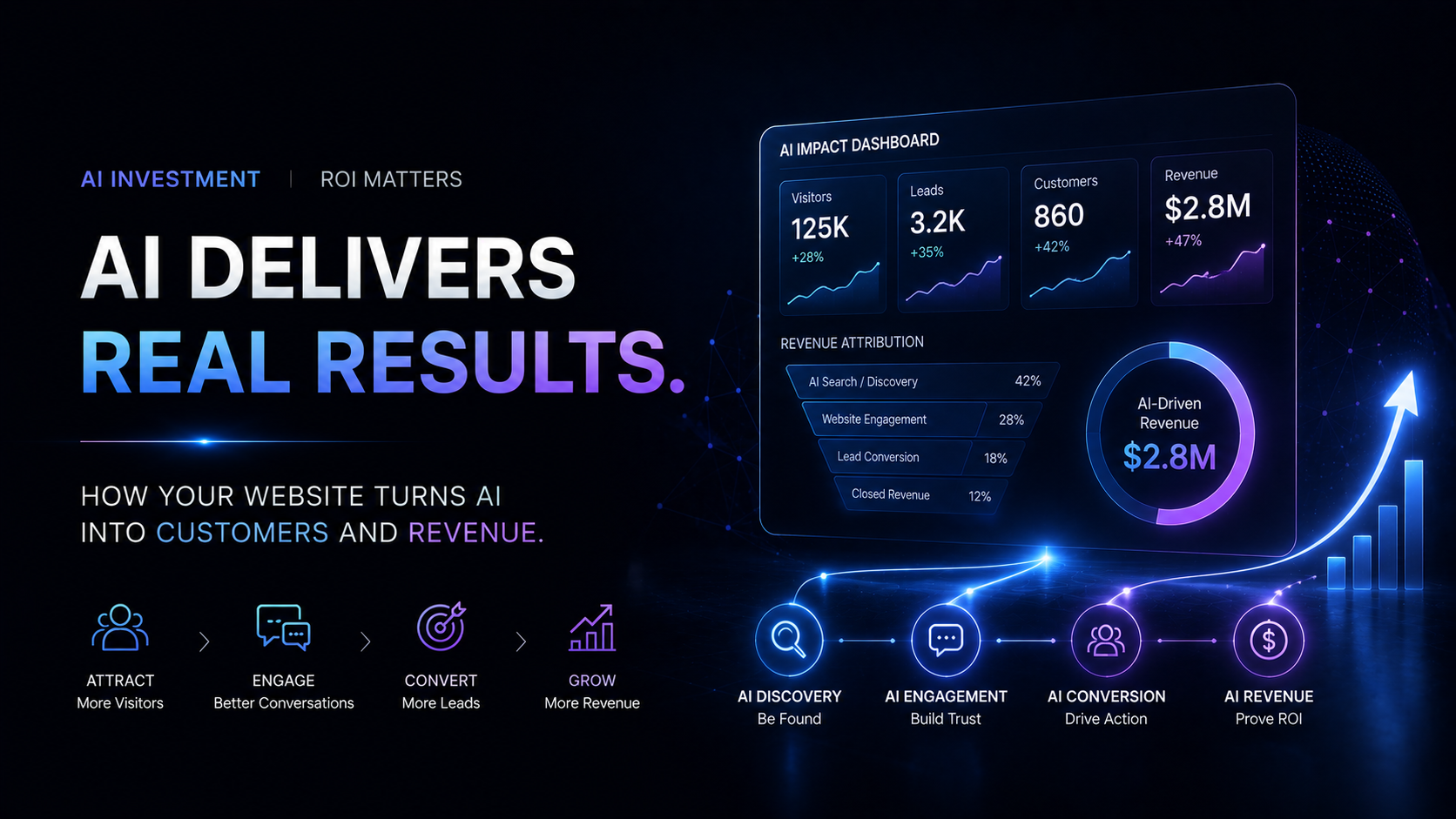
AI Investment Has Entered the ROI Stage: How Can Your Website Prove AI Is Bringing Real Customers and Revenue?
A lot of companies are no longer asking, “Should we use AI?”
They are asking a much tougher question now:
“Is this AI investment actually bringing customers? Is it creating revenue?”
That shift matters.
In the last phase, teams competed on speed, features, demos, and announcements. In this phase, leaders go deeper. They want to know:
- Is AI driving better-quality leads?
- Is the website becoming a stronger conversion channel?
- Are content, SEO, and automation turning into pipeline?
- Can any of this be connected to revenue?
In short: AI is moving from a concept budget to an operating budget.
And once that happens, the website becomes extremely important.
Not because websites suddenly became trendy again.
But because the website is still one of the few places where you can connect showcase, search, conversion, attribution, leads, and revenue in one system.
Stop celebrating activity before you measure business impact
When teams talk about AI performance, they often show things like:
- more content output
- faster page launches
- quicker support replies
- more ad creatives
- more frequent website updates
None of that is useless.
But those are process metrics, not business outcomes.
If AI only helps you publish more pages, more articles, and more automated replies, but does not improve:
- durable organic demand capture
- high-intent page journeys
- qualified form submissions, demos, or inquiries
- sales velocity
- customer acquisition efficiency
then AI has not truly entered the ROI stage.
The biggest risk is not moving slowly. The biggest risk is looking busy while revenue feels nothing.
Why the website becomes the proving ground for AI ROI
Because a website is not just a collection of pages.
A valuable website is a growth system.
It should do at least four jobs at once:
| Website role | Old mindset | What it must do now |
|---|---|---|
| Showcase | Present the brand | Help high-intent buyers understand value fast |
| Search capture | A few pages are enough | Capture SEO, GEO, and AI-recommended traffic |
| Conversion | Add a form | Build a path from reading to inquiry to meeting |
| Attribution | Check visits | Connect page performance to lead quality and revenue |
That is the real difference.
A brochure website can only explain what you launched.
A growth website can explain why customers arrived.
The chain that really matters
If you want to judge whether AI is paying off, follow this chain:
Build → Showcase → Grow → Leads → Revenue
That means:
- Build: Can you launch real pages faster?
- Showcase: Can you clearly present your product, service, proof, and differentiation?
- Grow: Can you keep attracting SEO traffic, brand demand, content traffic, and AI discovery?
- Leads: Can you convert that attention into trackable leads?
- Revenue: Can you see those leads turn into pipeline and closed revenue?
If any link breaks, AI value gets discounted.
- Build without Grow means the site simply exists.
- Grow without Leads means traffic stays noisy.
- Leads without Revenue creates internal arguments about quality.
So the question is not whether AI was added. The question is whether AI helped turn the website into a stronger customer acquisition asset.
How can a website prove AI is creating customers and revenue?
Not with one pretty dashboard.
With an evidence chain.
1) Prove AI is bringing better-fit visitors
Before you prove revenue, prove that AI is attracting the right people.
Look for signals like:
- a larger share of traffic from organic search, AI discovery, or content pages
- more visits to high-intent pages such as pricing, solutions, case studies, and contact pages
- stronger movement from article pages into product or inquiry pages
- more form submissions with clear, specific demand
The point is not traffic volume alone.
It is whether the traffic mix is improving.
2) Prove the website is turning visits into leads
This is where many teams underperform.
They publish content, improve SEO, and add AI-generated copy, but the website does not really catch intent.
At minimum, you should measure:
- growth in inquiries, bookings, demos, or consultation requests
- which pages convert best
- which CTAs actually get clicked
- which themes create the most qualified leads
- whether multilingual pages, case studies, and industry pages lift conversion
The real question is not whether a form exists.
It is whether the site has a path from interest to action.
3) Prove leads are turning into revenue
This is the hardest layer, but it is also the most valuable.
If website data is disconnected from CRM and sales workflow, you can only prove:
- people visited
- people clicked
- people submitted
You cannot prove:
“Did these people actually become customers?”
That is why you should start doing the following:
- tag leads by source: SEO, branded search, content page, AI discovery, case study page
- track which pages influence MQLs, SQLs, meetings, opportunities, and wins
- compare page themes against sales velocity and deal quality
- review closed-won customers and map where their journey began
At that point, you stop asking whether the site has traffic.
You start asking:
“Which AI-supported website actions are becoming real revenue?”
Stop being misled by vanity metrics
The metrics that matter are business metrics
| Vanity metric | Business metric |
|---|---|
| Page count | Share of high-intent pages |
| Total visits | Qualified visits from search, content, and AI discovery |
| Time on page | Path completion into product, case study, or inquiry pages |
| Total form fills | Qualified leads, booking rate, sales connection rate |
| Number of AI-generated articles | MQLs, SQLs, and pipeline influenced by content |
| Automation volume | Shorter sales cycle, lower CAC, revenue contribution |
Not every growth chart deserves celebration. Growth validated by revenue does.
Public research is already pointing in this direction
Several signals are worth noting:
- McKinsey’s The State of AI says respondents report stronger revenue benefits from AI in functions like marketing and sales. That is a clear sign the market is moving beyond pure efficiency talk.
Source: https://www.mckinsey.com/capabilities/quantumblack/our-insights/the-state-of-ai - Gartner’s 2025 press release says that in a survey of 632 B2B buyers, 61% prefer a rep-free buying experience. In other words, buyers increasingly want to do independent research before talking to sales.
Source: https://www.gartner.com/en/newsroom/press-releases/2025-06-25-gartner-sales-survey-finds-61-percent-of-b2b-buyers-prefer-a-rep-free-buying-experience
Put those together and the message is simple:
Management is asking for AI ROI, while buyers are doing more of their evaluation on the website.
If your site is still just “something the company should have,” that gap becomes expensive.
Why We0 AI should not be framed as just another AI website builder
If you describe We0 AI as “a tool that generates a website from one prompt,” you are underselling it.
A more accurate way to frame it is this:
We0 AI is an AI-powered website growth platform for showcase websites.
It does not just help teams build pages.
It helps push the website through this logic:
Build → Showcase → Grow → Leads
That means:
- build real company pages, service pages, case study pages, content pages, and inquiry pages
- clarify brand positioning, product value, and differentiation
- keep improving SEO, GEO, content updates, page performance, and growth visibility
- turn the website into an asset that can keep attracting traffic, leads, and customers
That distinction matters.
Many tools solve page generation. We0 AI is better understood as helping with what happens after generation: growth, optimization, and acquisition.
That is especially relevant for:
- SaaS and AI product teams
- indie hackers and solo builders
- agencies, consultants, and professional service firms
- export businesses and multilingual showcase sites
- personal brand, portfolio, and consulting websites
What they usually lack is not one more page.
It is a website system that can go live, explain value, get discovered, keep improving, and capture demand.
Key takeaway
Once AI investment enters the ROI stage, the company website should no longer be treated as a brand facade. It should become the operating environment where AI value gets proven.
What matters is not faster page production alone. It is:
clearer value presentation, stronger search capture, steadier lead conversion, and visible revenue connection.
FAQ
1. Why is AI now in the ROI stage?
Because companies are no longer satisfied with activity and efficiency claims alone. They want proof in leads, conversions, pipeline, and revenue.
2. Why is the website central to proving AI ROI?
Because the website is where search discovery, content, buyer education, conversion paths, and attribution can be connected in one system.
3. Is traffic enough to prove AI value?
No. Traffic is only an early signal. You also need to measure high-intent behavior, lead quality, sales progression, and revenue contribution.
4. What is a growth website?
It is a website built not only to present information, but also to capture demand, guide actions, collect leads, support SEO, and improve continuously.
5. How is We0 AI different from a normal AI website builder?
A normal builder behaves more like a page generator. We0 AI is closer to a showcase website growth platform built around Build → Showcase → Grow → Leads.
Related Tools
Ready to Build?
If you are no longer satisfied with simply launching a website, and you want a site that can showcase, operate, grow, and acquire, then the next optimization target is not only design.
It is the full website growth chain.
We0 AI fits that need better when the goal is not just to go live, but to keep turning a showcase website into a growth asset.
Conclusion
The mature stage of AI investment is not about who adopted AI first.
It is about who can prove the return first.
And the company website is one of the best places to prove it.
It is no longer just a digital facade. It is becoming a revenue system again.