2026 AI Coding Tools Shakeup: Open Source Agents, Terminal-Native Workflows, and the Next Wave of Vibe Coding
A practical 2026 analysis of the AI coding tools market, covering GLM-5.2, Kimi K2.7 Code, MiMo Code, Claude Code, Cursor, GitHub Copilot, Vibe Code Bench, BridgeBench, open-source coding agents, terminal-native workflows, and what this shift means for developers, teams, SEO/GEO content, and We0.ai showcase website growth.
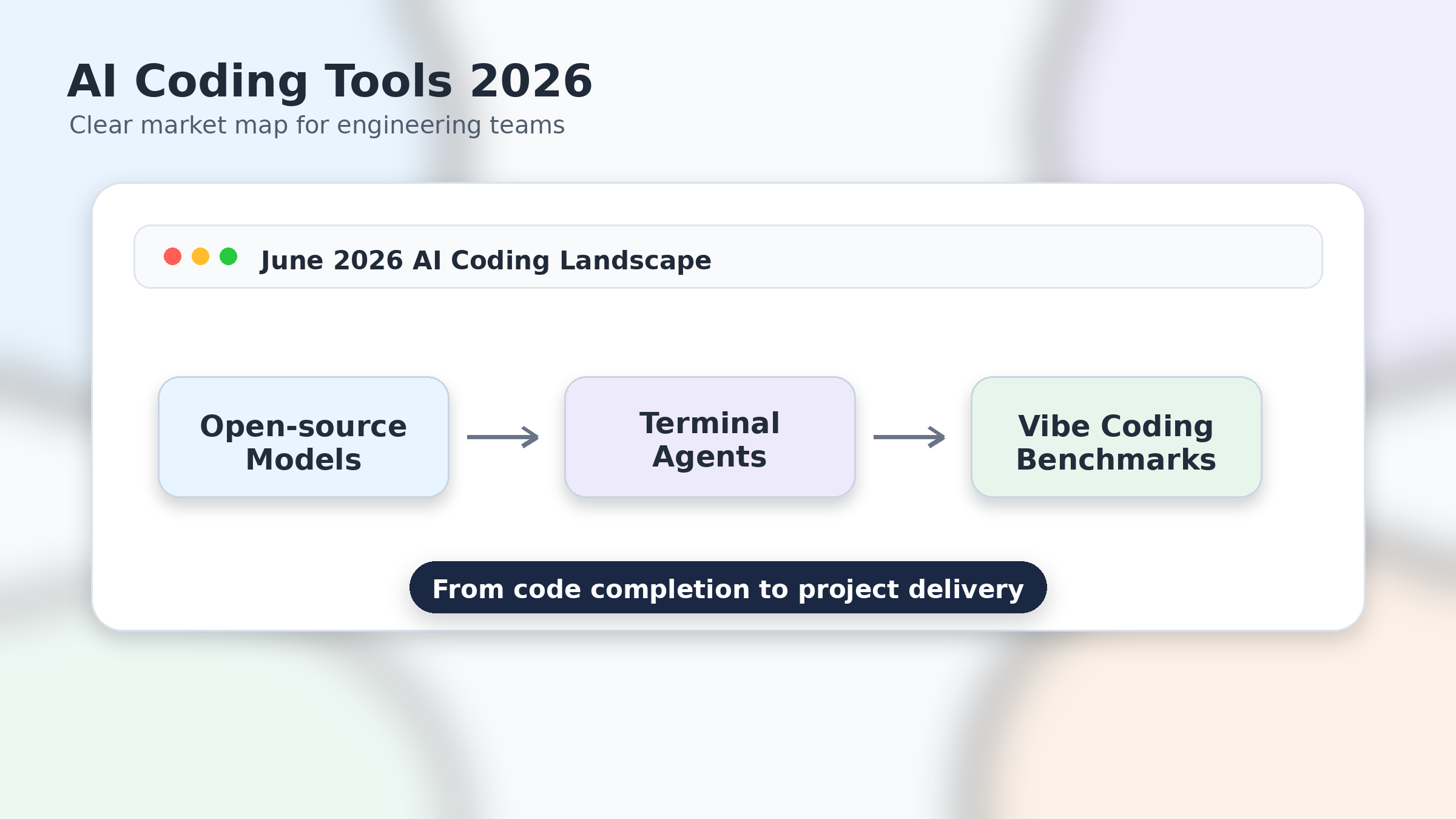
Original image: AI coding tools are moving from completion to project delivery
June 2026 has been unusually busy for AI coding tools.
If you only look at the headlines, it feels like another wave of models, tools, and leaderboards. But if you connect the events, the direction is clear: AI coding is moving from “help me write code” to “help me move a project toward delivery.”
That is why GLM-5.2, Kimi K2.7 Code, MiMo Code, Claude Code, Cursor, Copilot, and vibe coding benchmarks are being discussed in the same window. They are not only product updates. They are redefining the developer workflow.
This also matters for We0.ai. A showcase website should not stop at generating a page. It needs to move through Build → Showcase → Grow → Leads. AI coding tools are entering engineering workflows, and showcase websites need to enter search, AI recommendation, and lead-generation workflows.
1. Three events reshaped the market in one month
1.1 GLM-5.2: open-source Coding Agents enter the main stage
The signal from GLM-5.2 is direct: open-source models are no longer just cost-effective alternatives. They are entering the core competition for long-horizon coding agents.
For developers, the key question is not whether a model can write one function. The question is whether it can stay inside a project: understand the code structure, remember call chains, change multiple files, and add tests and notes.
Capability | Why it matters |
Long context and project memory | Complex engineering is not a single-file task; agents need context and past decisions |
Multi-file coordination | Real requirements often affect components, interfaces, tests, and configuration together |
Open deployment | Teams can connect private repositories and internal toolchains with less black-box dependency |
That puts open-source coding agents in the same conversation as tools such as Claude Code and OpenAI Codex. Open source is no longer just filling a gap; it is shaping mainstream choice.
1.2 Kimi K2.7 Code: the efficiency ledger starts to matter
Kimi K2.7 Code is not only about model scale. Its real message is token efficiency. Long engineering tasks require repeated context reading, reasoning, tool use, and patch generation. Small inefficiencies compound into real cost.
That is why lower token usage, steadier instruction following, and less overthinking matter. AI coding is no longer only about which model is smarter. It is also about which model is cheaper, steadier, and better suited to long runs.
1.3 MiMo Code: terminal-native agents become a standard form
MiMo Code points to another trend: the terminal is becoming an important home for AI programming again.
Claude Code is terminal-native. MiMo Code is terminal-native. That is not an accident. Many real engineering actions naturally happen in the terminal: reading files, running tests, checking logs, changing configuration, managing Git, and executing scripts.
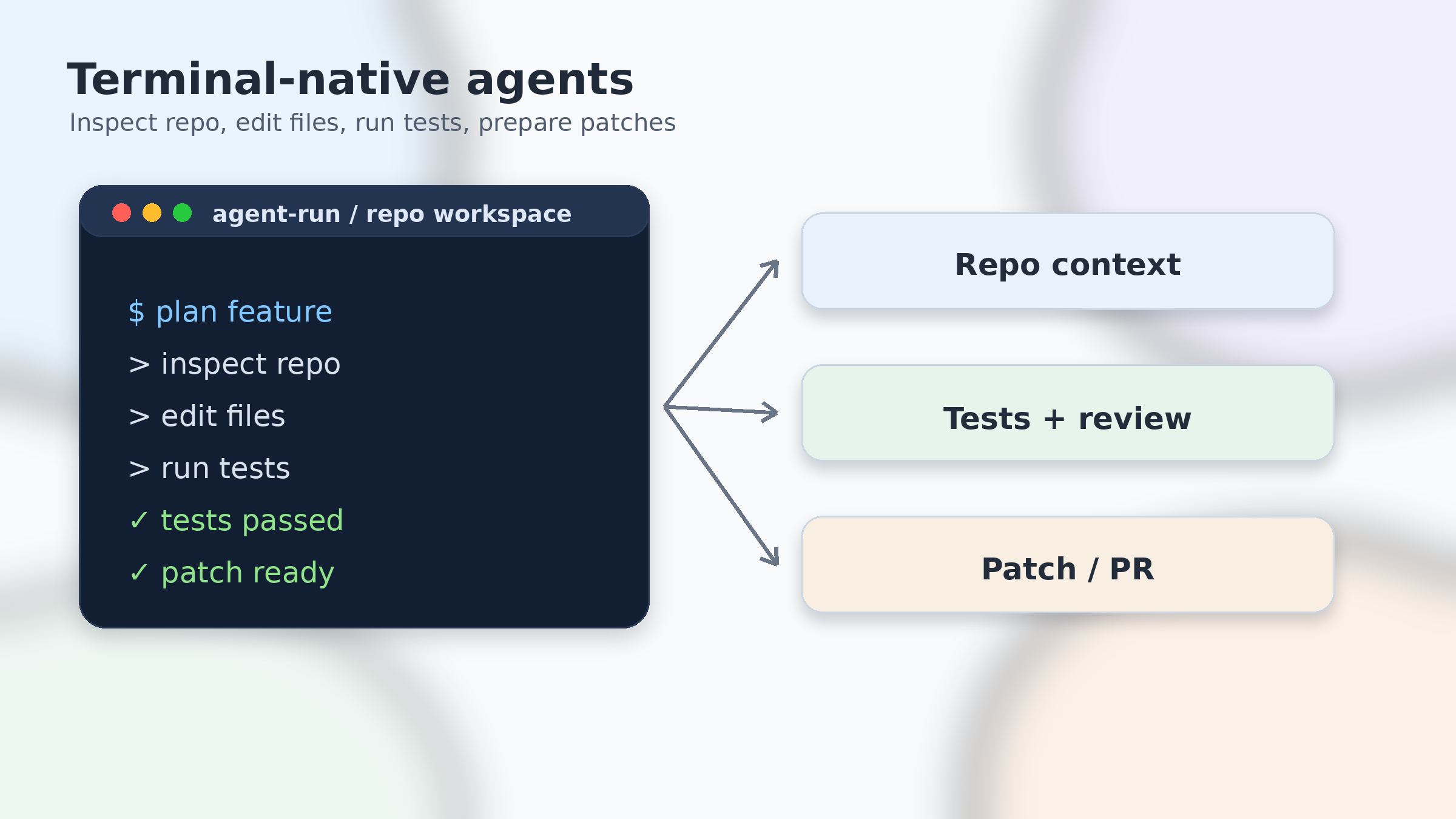
Original image: terminal-native agents connect repository context to tests and patches
IDEs are great for completion and visual editing. Terminals are better for long-running tasks and real command execution. In the future, developers will likely mix IDE agents and terminal agents instead of relying on one tool.
2. The three-pole market: what developers actually choose
The AI coding market now has three clear modes.
Camp | Representative tools | Route | Strength |
Closed terminal agents | Claude Code, OpenAI Codex | Deep repo work, command line, CI/CD, and PR workflows | Complex engineering, tool use, and review loops |
AI-native IDEs | Cursor, GitHub Copilot | Editor-native completion, refactoring, and cross-file edits | Smooth day-to-day coding experience |
Open long-horizon agents | GLM-5.2, MiMo Code | Private deployment, custom toolchains, and persistent memory | Controlled cost and stronger data boundaries |
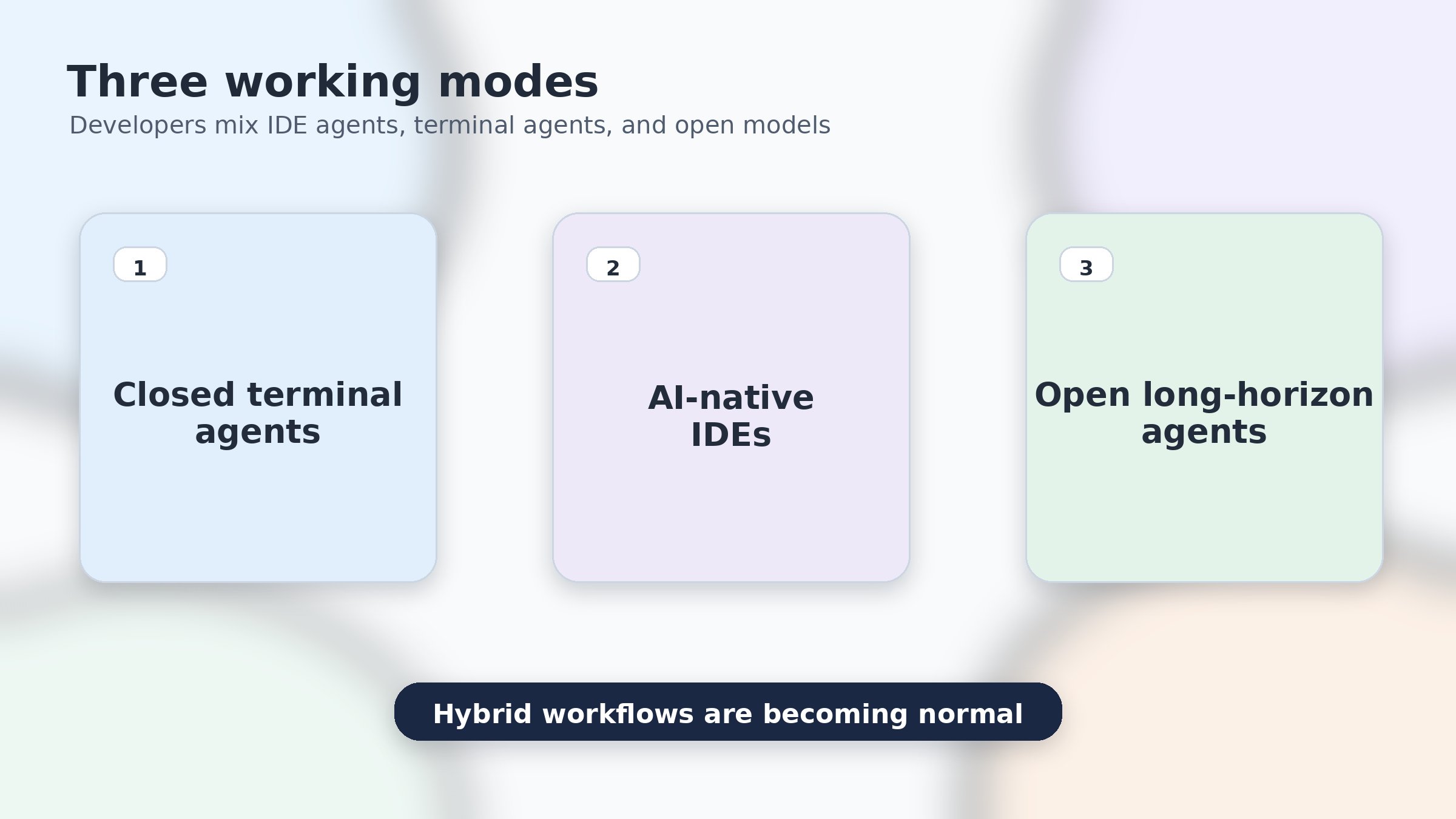
Original image: AI coding tools are forming three working modes
Real development work does not live in one interface. Small edits may happen in the IDE. Complex refactors may move to a terminal agent. Private codebase or security-sensitive tasks may use open models and internal toolchains.
The real question in 2026 is not “which tool wins.” The question is how a development team designs a hybrid workflow.
3. Vibe coding finally gets measurable benchmarks
Vibe coding used to feel like a mood: describe what you want in natural language, and the AI builds a website or app. It is exciting, but difficult to evaluate.
With benchmarks such as Vibe Code Bench and BridgeBench, the field is becoming measurable. These tests do not only ask whether a model solves an algorithm problem. They ask whether a full app runs, browser workflows pass, costs and speed are reasonable, and code quality is maintainable.
Benchmark direction | What it tests |
End-to-end app generation | From natural-language specification to working web application |
Browser workflow tests | Realistic clicks, submissions, navigation, and validation |
Speed and cost | Not only whether it works, but how expensive and slow it is |
Code quality and security | Avoiding apps that appear to run while hiding structural or security risks |
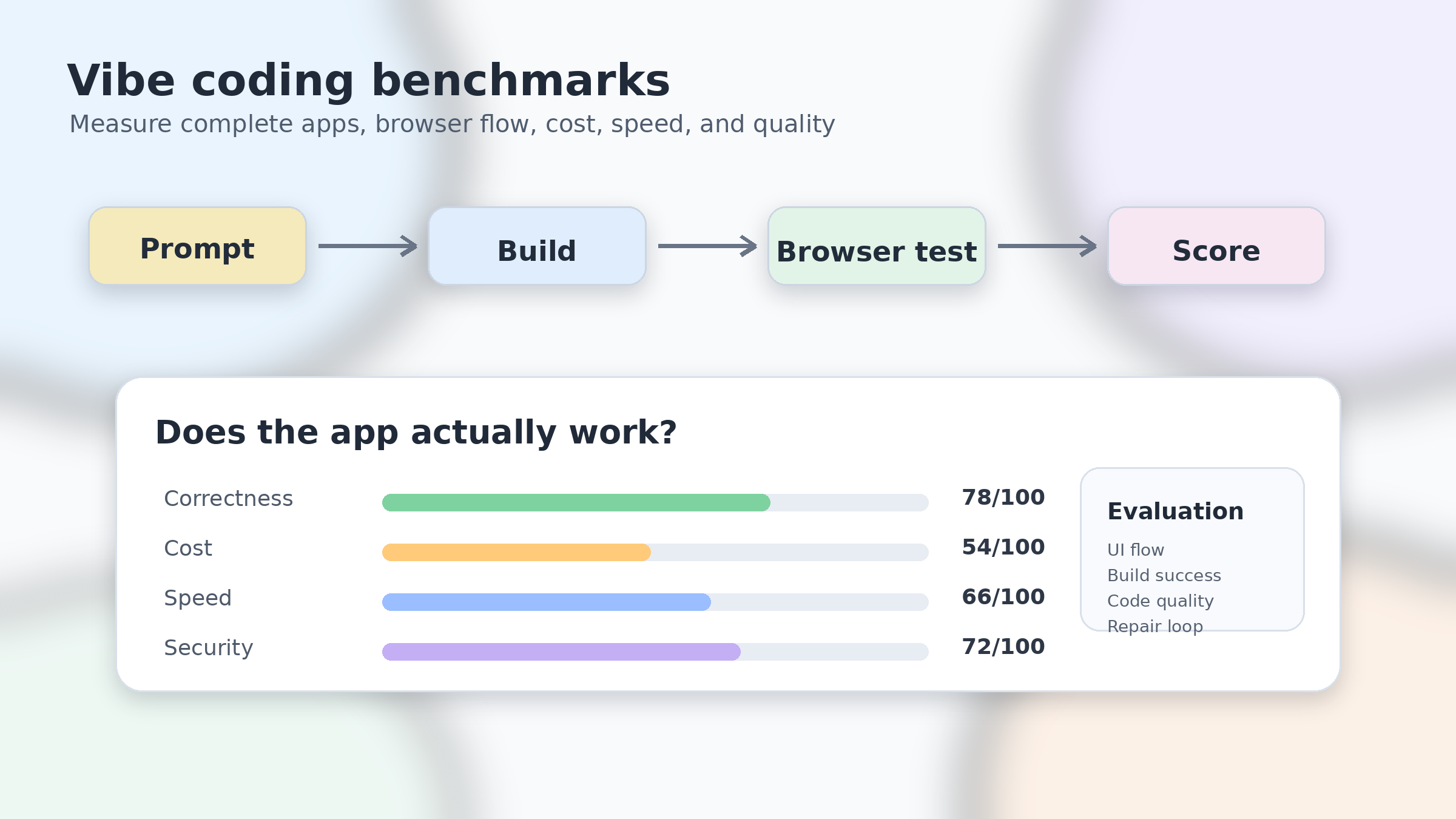
Original image: vibe coding is moving from demos to measurable workflows
That means “generate a full website from a conversation” is no longer just a trick. For businesses, it has to become measurable productivity: can it launch, be maintained, be reviewed, and support real work?
4. What this means for enterprise developers
Taken together, June 2026 sends five signals to development teams.
• AI coding is moving from snippets to engineering delivery. Function completion is not enough; agents need to understand repositories, run tests, and produce reviewable changes.
• Open-source models are no longer only backup choices. GLM-5.2 and MiMo Code show that open routes can matter in real engineering workflows.
• Cost accounting is becoming more precise. Token usage, speed, context length, and pricing now influence tool choice directly.
• Terminal-native workflows are becoming mainstream. Complex work needs command line access, file systems, Git, tests, and logs.
• Vibe coding is entering the benchmark era. It is not enough to say “it generated.” Teams need to know whether it works, remains stable, is safe, and can be maintained.
5. Practical advice for developers
Stage | Recommended action |
Beginner | Use GitHub Copilot or Cursor for completion, explanation, and small edits |
Intermediate | Try Claude Code, Codex, or similar terminal agents to understand command-line workflows |
Deep use | Combine IDE agents and terminal agents, separating daily coding from complex engineering tasks |
Private deployment | Explore GLM-5.2, MiMo Code, and open routes for internal repository access |
Team evaluation | Use vibe coding benchmarks and real project replays to evaluate cost, quality, and safety |
Developers do not need to replace every tool overnight. A more realistic path is to hand one repeatable task to an agent first, then gradually add tests, review, documentation, and deployment notes into the workflow.
6. What this means for We0.ai
The AI coding trend resembles the website growth trend: both are moving from one-time generation to sustainable workflows.
Code does not end when it is generated. A website does not end when it is published. A showcase website must keep supporting content, case studies, SEO, GEO, templates, conversion paths, and customer leads.
That is the positioning of We0.ai: AI Showcase Website Growth Platform. It is not a generic AI website builder. It helps products, brands, services, and portfolios move through Build → Showcase → Grow → Leads.
Future developers will use agents to turn requirements into code. Future businesses will need website workflows that turn business capabilities into searchable, AI-understandable, customer-trusted growth assets.
Final takeaway
The next stage of AI programming is not about who writes code faster. It is about which system can stay longer inside the project, understand more context, make more accurate changes, and avoid breaking things.
Open-source models, terminal agents, AI-native IDEs, and vibe coding benchmarks are pushing AI coding toward engineering maturity together.
For developers, the most important thing now is not chasing every new tool. It is building a practical evaluation standard: can this tool enter your real project, be reviewed, work with your existing workflow, and deliver reliably?
If the answer is yes, it is no longer just an AI tool. It is a new layer of engineering productivity.
FAQ
What is the biggest change in AI coding tools in 2026?
The biggest change is the shift from code completion to engineering delivery. AI agents now read repositories, run commands, edit multiple files, run tests, and return reviewable results.
Why are terminal-native agents becoming important?
Real engineering work often depends on the file system, command line, Git, test scripts, and logs. The terminal is close to that environment, so it fits long-horizon tasks.
What is vibe coding?
Vibe coding is a development style where users describe what they want in natural language and let AI generate an app or website. It lowers the development barrier but also requires testing, security review, and quality control.
Why do open-source coding agents matter for enterprises?
Enterprises can deploy open models in more controlled environments, connect them to private repositories and internal toolchains, and reduce dependency on black-box cloud services.
How is this related to We0.ai?
AI coding is moving from code generation to workflows. We0.ai applies the same idea to showcase websites by connecting Build, Showcase, Grow, and Leads.
Related Tools
Sources