AI Agent Website vs Traditional Website: 10 Differences That Matter for B2B Growth
A practical comparison of AI agent websites and traditional websites across architecture, content management, inquiry handling, SEO, GEO, multilingual pages, data ownership, total cost of ownership, and lead generation. The article explains why showcase websites are moving from static pages to AI-assisted growth workflows, and how We0.ai helps businesses build, showcase, grow, and convert leads.
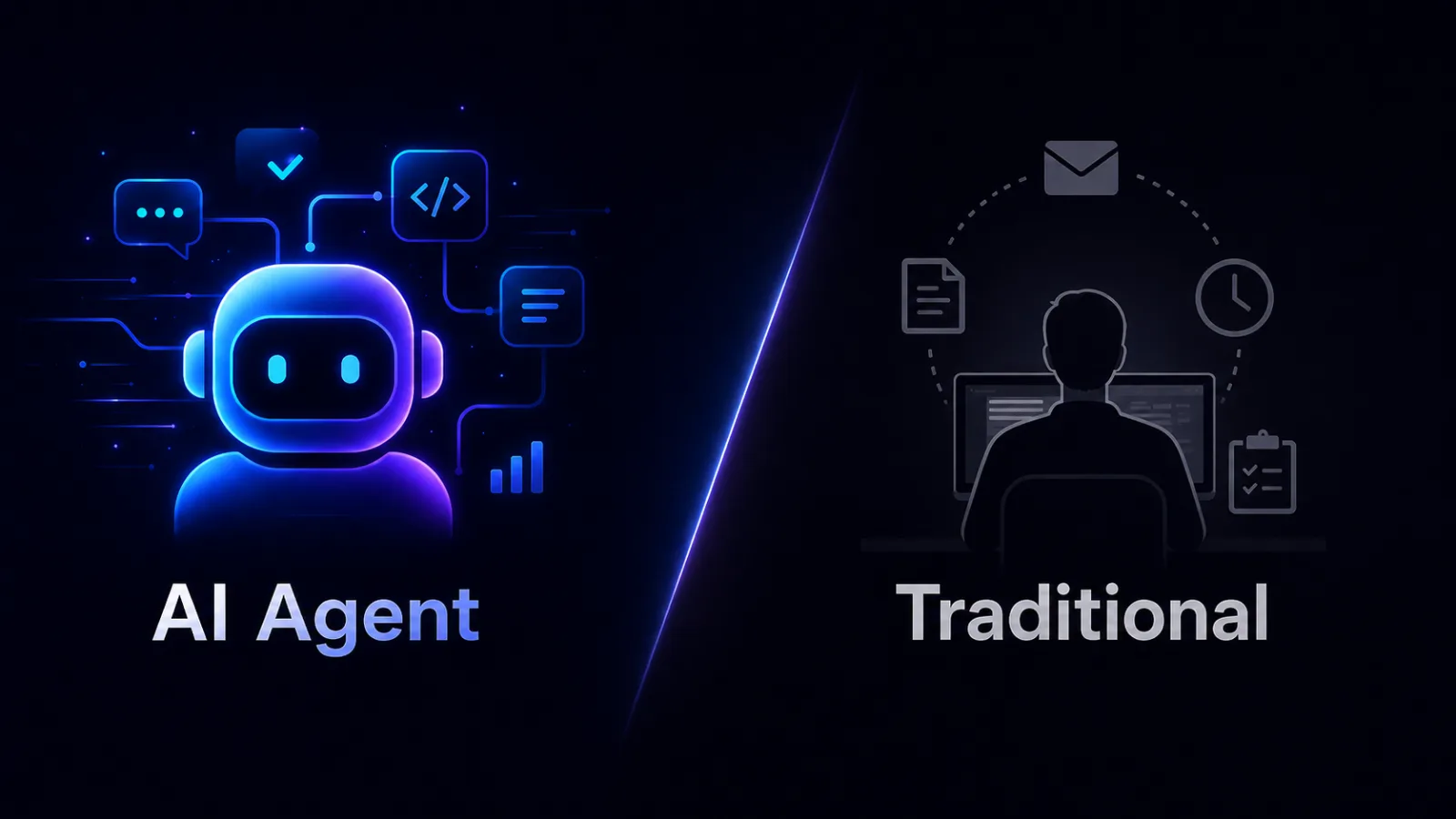
In the past, the main question for a business website was simple: does it look good, does it explain the company, and does the contact form work? In the era of AI search and AI assistants, that standard is no longer enough.
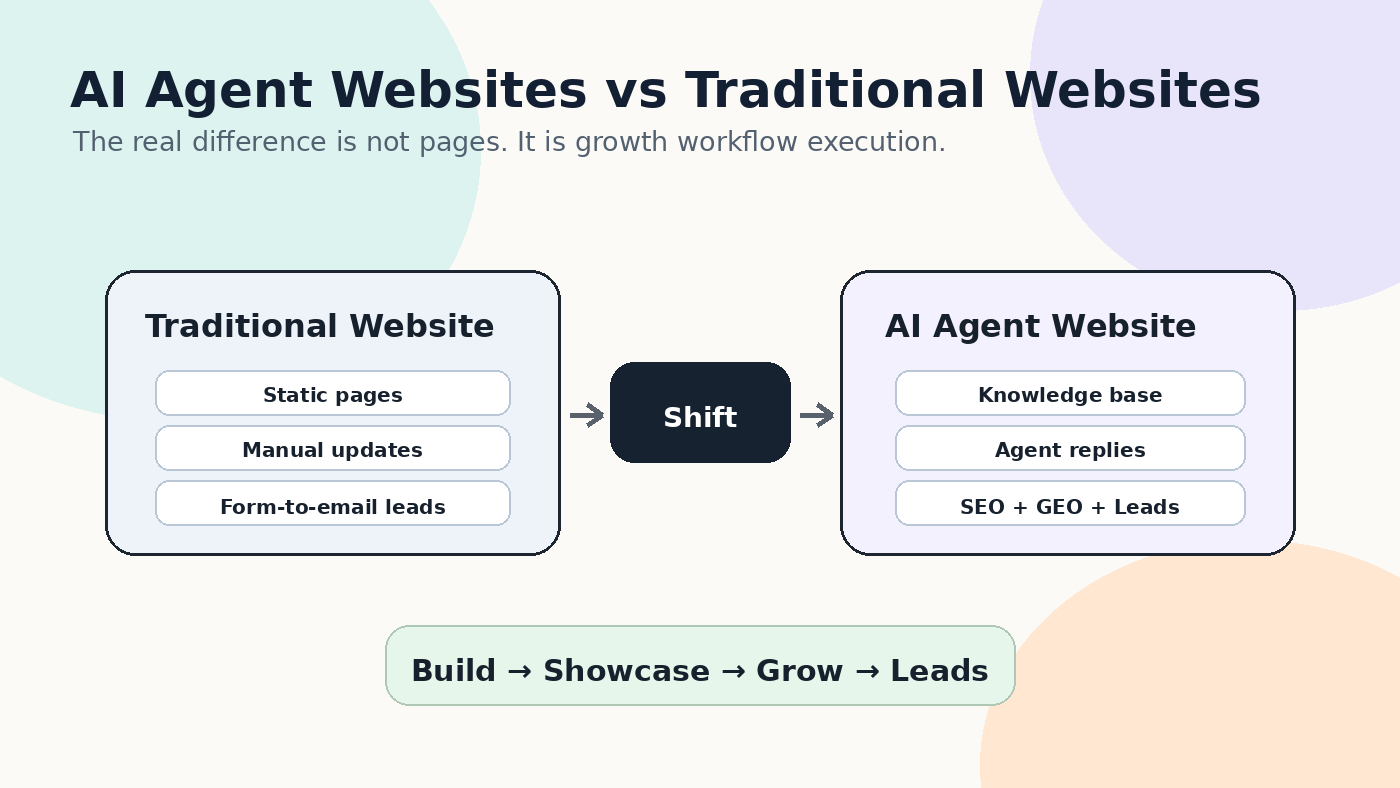
Traditional websites still matter, but they often behave like passive digital brochures. An AI agent website is different. Its goal is not just to generate more pages. Its goal is to help the website understand the business, handle inquiries, update content, support SEO and GEO, and keep turning visitors into leads.
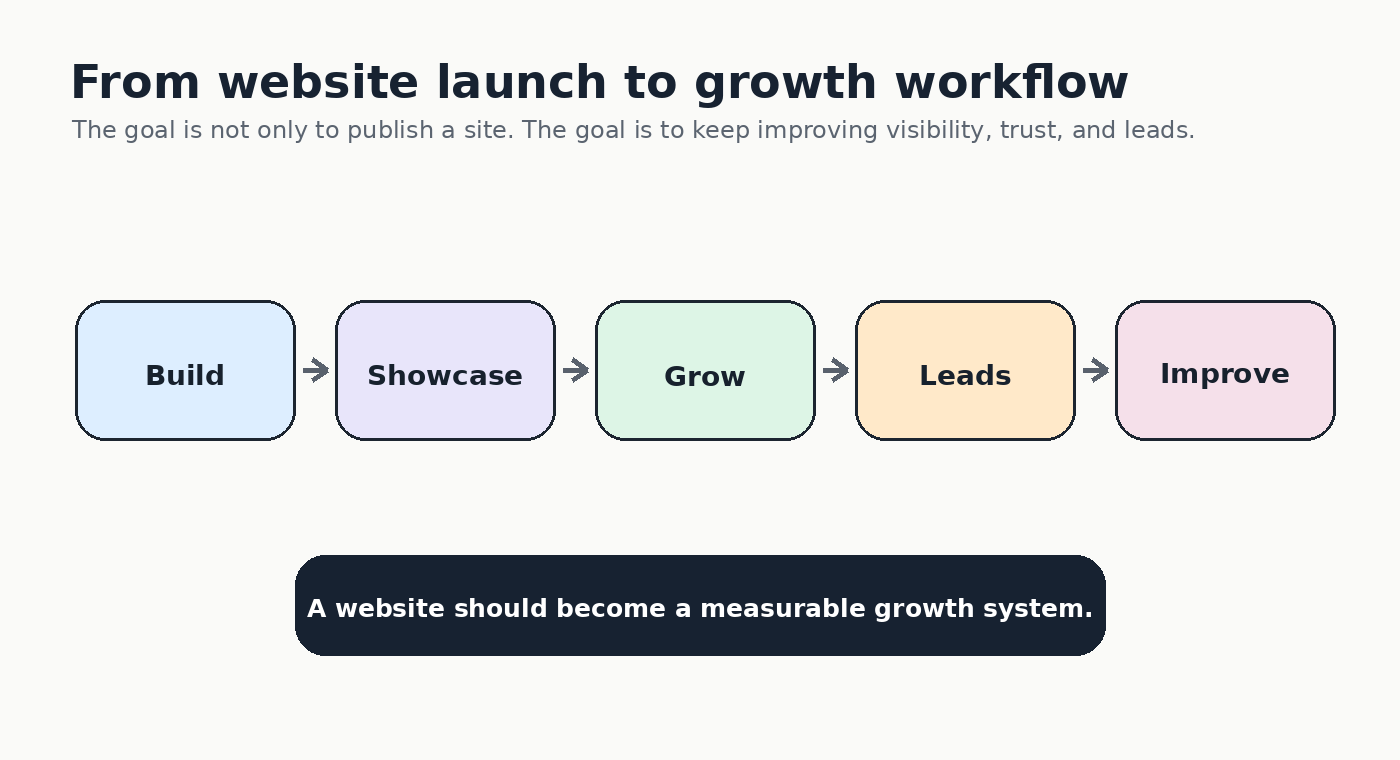
The original article compared AI agent website building and traditional website building across ten dimensions. This rewritten version reframes the topic for B2B, cross-border, service-based, and showcase website growth. From the We0.ai perspective, a website should not stop at Build. It should move through Build → Showcase → Grow → Leads.
Quick takeaway: traditional websites launch pages; agent websites run growth workflows
Dimension | Traditional website | AI agent website |
Core position | Displays company information | Connects company knowledge, content, inquiries, and conversion workflows |
Working model | Mostly manual after launch | Uses knowledge base and AI agents to assist content, replies, and optimization |
Best fit | Brand sites, basic company sites, template ecommerce | B2B, multilingual showcase sites, knowledge-heavy services, ongoing lead generation |
Key difference | Whether the company has a website | Whether the website can understand, update, be recommended, and convert |
This is not a simple case of new technology replacing old technology. The better question is what capability the business needs now. If the goal is brand display, a traditional website may be enough. If the goal is multilingual lead generation, AI visibility, and inquiry handling, the website needs to become a workflow.
1. Definition: what are the two models?
What is traditional website building?
Traditional website building usually includes template-based SaaS builders, WordPress or CMS sites, and custom development. The shared logic is: build pages first, operate manually later. Content updates, SEO work, form replies, analytics, and multilingual expansion usually require continuous human effort.
This model is mature, stable, and controllable. It works well for companies with strict brand design needs, complex business systems, or internal development teams. Its limitation is that after launch, the website does not automatically understand customer questions or turn business materials into conversion content.
What is AI agent website building?
AI agent website building is not just using AI to generate webpages. More accurately, it means putting company materials, product data, service cases, industry questions, page structure, and growth goals into a system that upgrades the website from a display layer into a knowledge layer + agent layer + conversion layer.
Such a site can do more than display products. It can support answers around customer questions, update FAQs, assist content production, organize leads, and provide clearer structured information for AI search, AI assistants, and generative engines.
2. Ten essential differences: not features, but operating logic
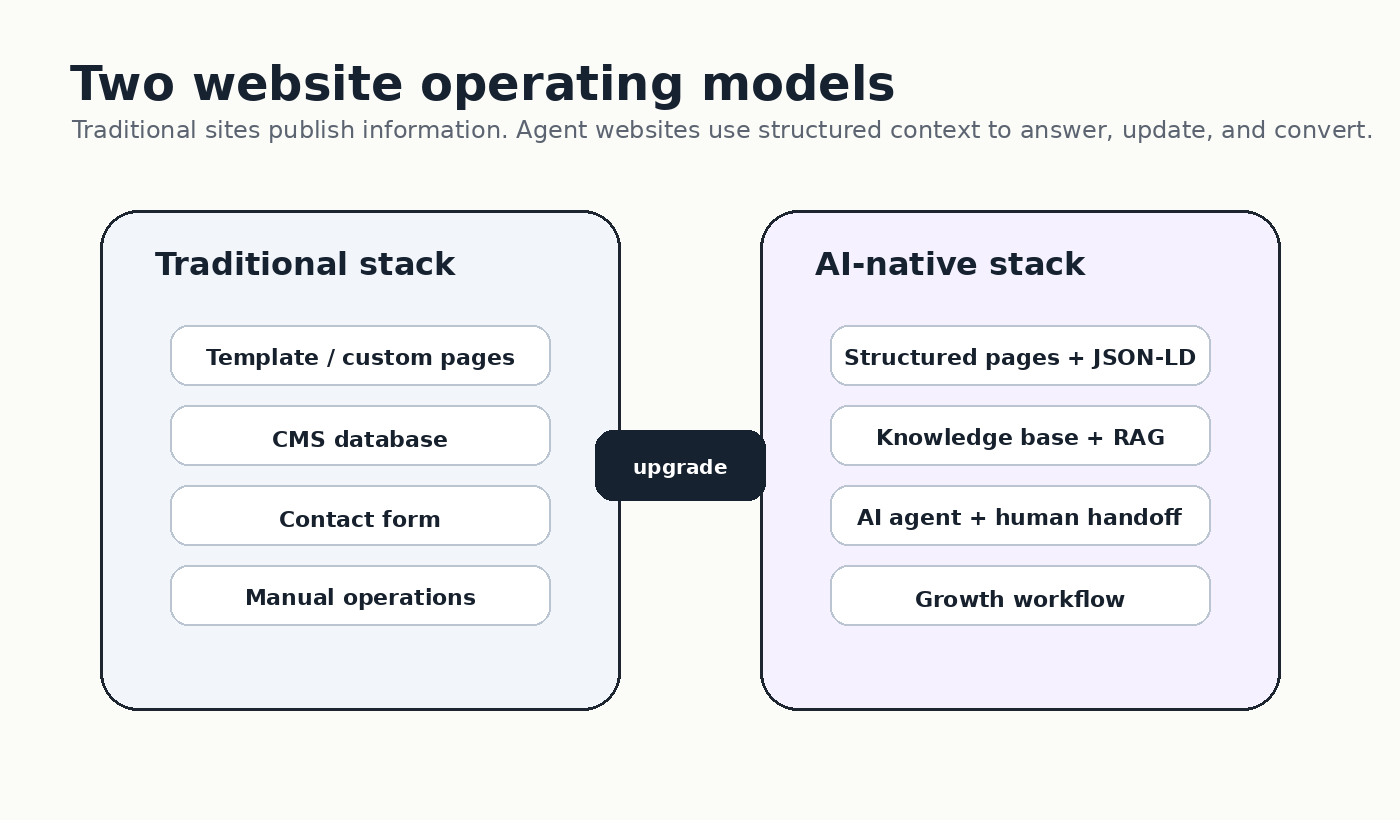
Dimension | Traditional website | AI agent website |
Architecture | Frontend pages + CMS/database + forms | Structured pages + company knowledge base + AI agent + lead workflow |
Build method | Choose a template, write requirements, design, develop, launch | Input business materials, plan structure, then generate content and pages |
Content management | Manual writing, formatting, and publishing | AI drafts from the knowledge base; humans review and publish |
Inquiry handling | Form-to-email, then manual follow-up | AI answers common questions first; complex cases go to humans |
SEO/GEO | Titles, descriptions, keywords, basic page optimization | Structured data, Q&A content, multilingual pages, AI-readable information |
Multilingual | Translation plugins or duplicated pages | Market-specific languages, content, and keywords |
Data ownership | Influenced by platform, plugins, or vendor delivery | Stronger focus on company knowledge, content assets, and lead data |
Cost model | Build fee + maintenance + operational labor | Generation/training + content/traffic + human review |
Operating rhythm | Manual iteration after launch | Continuous optimization from search, questions, and lead feedback |
Best fit | Brand display, ecommerce templates, custom visual projects | B2B, export sites, multi-product lines, knowledge-heavy services |
Across these ten differences, the most important question is not whether AI can write copy. The question is whether the website can become a continuously running business system.
3. Key difference one: display architecture vs AI-native architecture
A traditional website is designed around the idea that pages are for people to read. Pages contain headlines, images, product descriptions, buttons, and forms. If visitors are willing to read, the information can be delivered.
But in the AI search era, visitors may not open your website first. AI search engines, browser assistants, industry Q&A tools, and procurement assistants may read your pages before deciding whether to recommend your company.
This means a website must be understandable not only to people, but also to machines. Google Search Central recommends JSON-LD for structured data when the website setup allows it, because it is easier for site owners to implement and maintain at scale. For AI agent websites, structured content, FAQs, product entities, case pages, and clear page relationships all affect how well AI systems can understand the site.
The architecture focus of an AI agent website is therefore not only a beautiful frontend. It is to turn company materials into a knowledge layer that can be searched, reused, answered, and continuously updated.
4. Key difference two: from SEO to GEO, from being found to being recommended
Traditional SEO focuses on keywords, titles, descriptions, internal links, backlinks, and page quality. These still matter. But in the AI search era, companies also need to consider GEO: whether generative search engines and AI assistants can easily cite, summarize, and recommend their content.
Traditional SEO is like saying, “When users search a keyword, I want to rank higher.” GEO is closer to saying, “When users ask a question, I want AI to decide that my brand, page, case, or answer deserves to appear.”
This has a direct impact on showcase websites. A site cannot only say who the company is. It also needs to answer who it is for, what problem it solves, why it is credible, and what the next step should be. This is why We0.ai emphasizes Showcase: products, services, cases, FAQs, templates, and growth content must be structured clearly enough to become AI-readable assets.
5. Key difference three: cost is not only the build fee, but the three-year operating account
Many businesses compare website options by looking only at the first quote. A traditional website may cost a few thousand or tens of thousands. Custom development can be much higher. SaaS builders may look cheap on a monthly basis. Shopify lists its Basic plan at $29 per month, while GoodFirms shows that custom website and web application costs vary widely depending on scope.
But ROI is determined by more than the build fee. Businesses also need to ask: who updates content, who handles SEO, who answers inquiries, who maintains multilingual pages, who creates case pages, who expands FAQs, who responds at night, and where does the data go?
The value of AI agent website building is not necessarily that it is always the cheapest. The value is that it can bring many tasks that used to be scattered across operations, support, content, and engineering into one more continuous workflow.
Cost type | Common issue in traditional websites | What changes in AI agent websites |
Visible cost | Build fee, template fee, development fee, plugin fee | Generation, knowledge-base setup, AI workflow configuration |
Maintenance cost | Page updates, bugs, plugin upgrades, content scheduling | AI drafts, human review, ongoing iteration |
Inquiry cost | Manual replies are slow; cross-time-zone leads may be lost | AI answers first; complex cases hand off to humans |
Growth cost | SEO, content, and data are spread across tools | Website and content assets serve one growth goal |
6. When traditional website building still makes sense
• Brand design is extremely important, with pixel-level layout, custom motion, and strict brand guidelines.
• The business system is complex and requires deep ERP, CRM, membership, or permission integration.
• The company has a mature technical team that can keep developing, maintaining, and optimizing the site.
• The current goal is basic display, not AI search visibility, automated inquiries, or continuous content growth.
In other words, traditional website building is not outdated. It is better for projects with strong design needs, stable processes, and clear technical ownership.
7. When AI agent website building makes more sense
• B2B or export businesses need multilingual markets and cross-time-zone inquiry handling.
• The company has many product lines and complex customer questions that require a living knowledge base.
• The team lacks a full technical department and wants a lower-friction showcase website workflow.
• The business needs SEO and GEO content assets, not just a homepage.
• The website must support cases, services, FAQs, templates, and lead conversion.
For these companies, the core question is not simply whether the website looks good. It is whether customers can understand faster, whether AI systems can cite the site more easily, and whether the sales team can capture leads more effectively.
8. The practical path: upgrade, not replace
Many companies already have websites. They do not always need to rebuild from zero. A more practical path is to keep the existing site, organize product materials, cases, FAQs, customer questions, and industry content, then gradually add AI planning, content generation, structured pages, GEO content, and lead workflows.
This is why We0.ai is better described as an AI Showcase Website Growth Platform. It does not only generate a page. It connects website building, showcasing, content, SEO/GEO, and lead conversion into one flow.
Final takeaway: the future website is not just a page, but a growth system
Traditional website building answers the question, “Does the company have a website?” AI agent website building asks a more valuable question: “Can this website keep showcasing, being discovered, being understood, being recommended, and generating leads?”
If you only need a brand front door, a traditional website can still work. If you need ongoing lead generation, multilingual growth, AI search visibility, and intelligent inquiry handling, you should design the website as a continuously running growth workflow.
That is also the core value of We0.ai: Build → Showcase → Grow → Leads. Build the site, showcase products and services, gain visibility through SEO/GEO and content assets, then turn visitors into real leads.
FAQ
What is the biggest difference between an AI agent website and a traditional website?
A traditional website mainly displays information. An AI agent website emphasizes knowledge bases, agent interaction, structured content, and lead workflows.
Is AI agent website building always cheaper than traditional building?
Not always. Its value is not just lower build cost, but reducing hidden costs in content maintenance, inquiry replies, multilingual operations, and continuous optimization.
Are traditional websites still worth building?
Yes. Traditional websites still work well for strong visual branding, complex customization, and mature internal systems. For growth and AI visibility, however, they need an intelligent layer.
How are GEO and SEO related?
SEO helps people find you through search engines. GEO focuses on whether AI search and generative engines can cite, summarize, and recommend your content.
Which companies are best suited for AI agent websites?
B2B export companies, multilingual businesses, knowledge-heavy services, complex product lines, and teams without a full technical department are strong fits.
What problem does We0.ai solve here?
We0.ai helps businesses move from Build to Showcase, Grow, and Leads, so a showcase website does not only go live but keeps supporting content, search visibility, and lead conversion.
Related Tools
• We0.ai
• Google Search Central Structured Data
• GoodFirms Website Cost Guide
• llms.txt
Sources
• GoodFirms Website Cost Guide
• Google Structured Data Documentation
• Google Structured Data Guidelines