AI Coding Agent Can Already Handle Complex Development — Why Does We0.ai Still Require Human Review Before Launch?
AI programming agents are no longer just tools that "help you fill in a few lines of code."
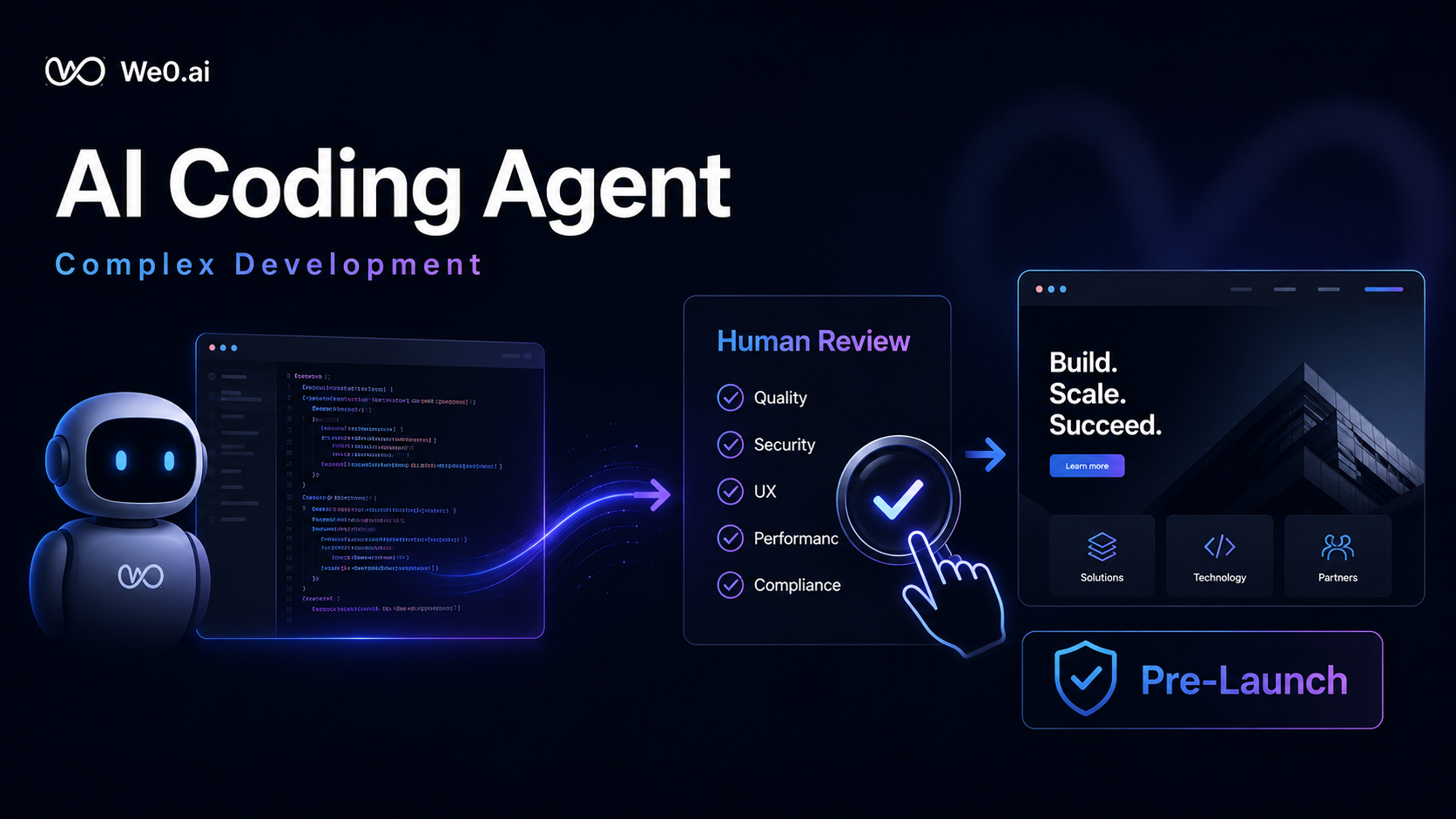
AI Coding Agent Can Already Handle Complex Development — Why Does We0.ai Still Require Human Review Before Launch?
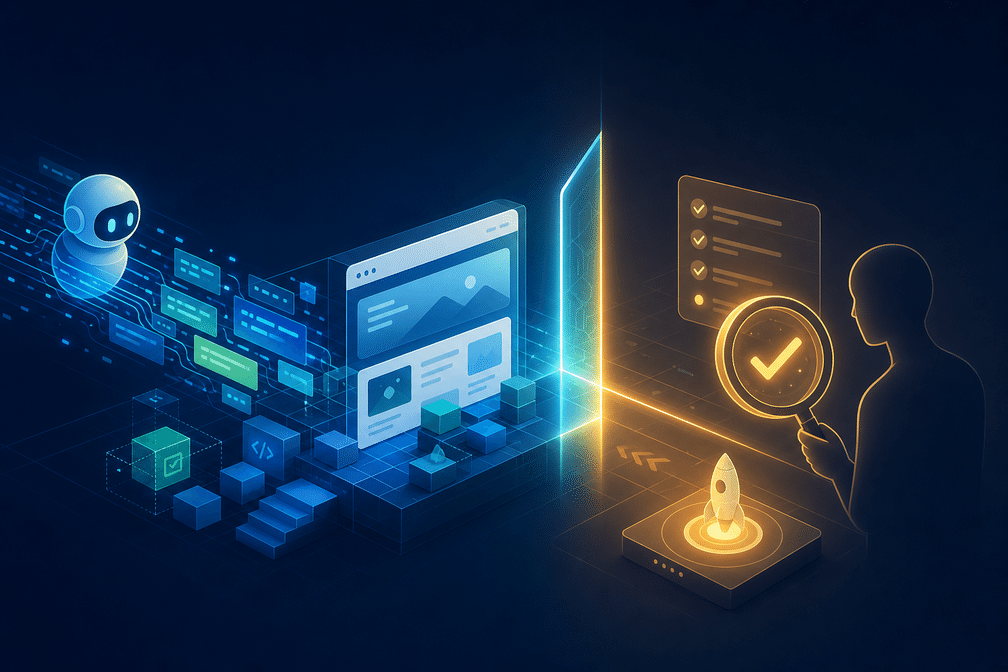
AI programming agents are no longer just tools that "help you fill in a few lines of code."
They can read codebases, break down tasks, write components, integrate APIs, fix bugs, and even build a showcase website from scratch to a previewable state. The speed is astonishing. As a result, a question is becoming increasingly common: Since the agent can handle complex development, why does We0.ai still keep manual review before its official website goes live?
The answer is straightforward: The agent delivers "a completed implementation," while manual review confirms "whether this is a business asset that should go live."
These two things may seem just one step apart, but they actually differ in brand trust, search visibility, and customer conversion.
Code that works doesn't mean customers will understand it; a page that loads doesn't mean it's worth being published, searched, or trusted.
The Agent Solves "How to Do It," Manual Review Solves "Is It Done Right"
In complex development, the advantages of AI agents are real: they don't get tired, they execute quickly, and they maintain pace in large amounts of repetitive work. For official websites, they can quickly complete page skeletons, responsive layouts, content modules, forms, and basic interactions.
But an official website is not just a "pass/fail" engineering task. It is also the first face of the brand, a sales reception desk, a gateway for SEO/GEO content, and an asset for continuously accumulating inquiries in the future.
| Dimension | AI Programming Agent Excels At | Manual Review Must Confirm |
|---|---|---|
| Development | Components, styles, logic, page assembly | Whether it aligns with real business priorities |
| Content | Generating structured copy based on input | Whether it sounds natural and doesn't overpromise |
| Brand | Maintaining a specified visual style | Whether it truly reflects the brand, not just a "generic AI website" |
| SEO / GEO | Filling in basic fields and page structure | Whether keywords, page intent, and referable information are valid |
| Conversion | Placing CTAs, forms, and entry points | Whether the customer knows what to do next |
| Launch | Build, deploy, basic checks | Whether domain, tracking, permissions, compliance, and risks are acceptable |
AI is good at making answers complete; humans need to judge whether the right questions are being asked.
For example, an agent can put "We are an innovative AI company" on the hero section. But a human will ask: Can the customer understand what you're selling within 5 seconds? Who do you serve? How are you different from alternatives? If not, no matter how polished the page is, it's just a beautiful misunderstanding.
Between "It Runs" and "It's Ready to Launch," There Are Four Gates
1. Business Context: What's Not in the Requirements Often Matters Most
AI can only work based on context. But the real business context is often scattered across the founder's expressions, sales calls, customer feedback, competitor pages, and a pile of trade-offs not written in the requirements document.
Manual review isn't just clicking through buttons. It's doing something harder: Reading the company's official website through the eyes of the target customer.
Does the hero section clearly explain the product? Are the case studies credible enough? Is the CTA "Book a Demo" or "Get a Solution"? Different choices lead to completely different customer acquisition paths. The agent can present options, but it can't make the judgment call for the business owner.
2. Brand and Trust: Similar Pages Erode Trust Most Easily
Today's AI can quickly build "good-looking" websites. This actually raises the importance of review.
Because when many pages look good, users become more sensitive to details: an exaggerated promise, an irrelevant image, a price entry that isn't explained clearly—these can all make people leave. Especially for SaaS, consulting, foreign trade, and professional service websites, trust isn't built by showing off; it's built by making sure nothing feels off.
We0.ai keeps manual review, not to slow down the AI's speed, but to remove the "template feel" in the last mile. Brand messaging, page narrative, case ordering, and tone strength often determine whether a site feels like yours.
3. SEO / GEO: Complete Fields Don't Guarantee Being Found or Cited
SEO isn't just about title, description, and sitemap; GEO isn't just about writing a few more AI-related articles.
True visibility in search and AI recommendations depends on whether the page solves a clear problem, has verifiable information, uses a structure that aids understanding, and whether pages form thematic relationships.
Manual review checks:
- What search intent does this page actually serve?
- Does the title just pile up keywords, or does it answer the user's question?
- Do services, cases, and FAQs support each other instead of being disjointed?
- Are the claims on the page backed by evidence? Could overpromising damage trust?
- Is there a path for content updates, data monitoring, and optimization post-launch?
A website doesn't start working on launch day. It should start accumulating compound interest for search, recommendations, and inquiries from launch day onward.
This is the logic behind We0.ai's Build → Showcase → Grow → Leads: first build, then showcase, then grow, and finally generate leads. Generating pages alone only completes the first step of the chain.
4. Risk and Responsibility: Behind the "Go Live" Button, There Can't Be Just "It Passed Testing"
Automated testing is important, but it can only cover a defined scope. A real launch involves form data destinations, third-party scripts, analytics tracking, permission configurations, copy compliance, critical mobile paths, and who handles things when errors occur.
The OWASP GenAI Security Project continuously emphasizes that when generative AI and autonomous agents enter critical business processes, they introduce new risks not fully covered by traditional application security practices. In other words, the stronger the automation, the clearer it must be about who is responsible for the final release.
Manual review isn't a lack of trust in the agent; it's being accountable to users, the brand, and business results.
At We0.ai, Manual Review Isn't Checking "Code Homework"
At We0.ai, what looks like the final step of manual review is actually the key link that pushes the website from an "AI-generated result" to a "sustainable customer acquisition asset."
A checklist that's closer to a real launch typically includes:
- Is the message clear?: Can users understand the business, target audience, and value proposition within 5 seconds?
- Is the brand consistent?: Is the visual, tone, claims, and cases unified?
- Is conversion smooth?: Does each key page have a logical next step? Are forms and contact entry points usable?
- Is the search foundation solid?: Are the page hierarchy, metadata, internal links, content themes, and direction for sustainable updates clear?
- Are data and risks controllable?: Are tracking, domain, basic performance, permissions, privacy notices, and third-party services checked?
This isn't "AI finishes, then humans take a casual look." More accurately, it's AI compresses a lot of the production work, while humans focus their energy on decisions that truly impact deals and long-term growth.
True Mature Human-Machine Collaboration Isn't an Either/Or Choice
Some people see this as: either trust AI, or insist on manual work.
That's not the case.
Inefficient manual work is redoing the repetitive work AI has already done. Inefficient AI is making business decisions on your behalf without review standards.
A mature division of labor should be:
- Let the agent handle high-frequency, decomposable, and verifiable production work.
- Let humans handle positioning, judgment, boundaries, trust, and final accountability.
- Let data continue to provide feedback after launch, driving ongoing optimization of content and pages.
For Owners, independent developers, consultants, agencies, or teams targeting overseas markets who need their official website to generate leads, this division of labor is particularly practical. You don't lack a page that "looks usable"; you lack a site that clearly communicates value, captures search, collects leads, and evolves with the business.
FAQ
AI Programming
Can an Agent independently develop a website?
Yes. For page building, component development, basic interactions, and common integrations, the Agent can already handle a significant amount of work. However, independently completing development does not mean independently handling brand strategy, conversion, search strategy, and launch responsibilities.
Will manual acceptance slow down website launches?
If manual effort is spent on repetitive production tasks, it will be slow; if manual focus is directed toward key decisions and launch checklists, it can instead reduce rework, broken promises, and subsequent conversion losses. Acceptance is not about adding process; it's about reducing costly rework.
What makes We0.ai different from ordinary AI website builders?
We0.ai not only helps generate showcase websites but also provides a continuous growth path around SEO/GEO, content, data monitoring, page optimization, and lead generation. The goal is not "to have a website," but "to have a website that continuously brings traffic and customers."
Related Tools
- We0.ai: From Website Building to Growth and Lead Generation
- Google Search Console: Observe Search Performance
- PageSpeed Insights: Check Page Experience
Sources
- OWASP GenAI Security Project: Security, Governance, and Assessment Resources for Generative AI and Agents
- OWASP Agentic App Security: Security Issues for Autonomous Agents and Multi-Step Workflows
- A Study of Large-Scale Human-Agent Collaborative Pull Requests (OpenReview)
Ready to Build?
If what you want is not a temporary online page, but a website asset that can showcase, grow, and generate leads, We0.ai puts AI's production efficiency and human critical judgment into the same workflow.
Start from Build, but don't stop at Build.
Conclusion
AI coding agents will become increasingly powerful. This is almost without doubt.
But the standards for launching a website will also rise accordingly. Because when "making a page" becomes increasingly easy, what is truly scarce becomes: whether it is clear, credible, searchable, convertible, and continuously optimizable.
Therefore, We0.ai retains human acceptance, not because AI is not strong enough.
Precisely because AI is already strong enough, we should place human judgment where it matters most: before launch, and before growth begins.
title: "AI Coding Agents Can Build Complex Products. Why Does We0.ai Still Require Human Acceptance Before Launch?"
chinese_title: "AI Programming Agents Can Already Complete Complex Development, Why Does We0.ai Still Require Manual Acceptance Before Website Launch?"
seo_title: "AI Coding Agents Can Build Complex Products—Why Human Acceptance Still Matters Before Website Launch | We0.ai"
seo_description: "AI coding agents can now handle complex development. But working code is not automatically a launch-ready business asset. Learn why We0.ai keeps human acceptance in the loop for brand, conversion, SEO/GEO, and growth."
seo_keywords: "AI coding agent, human acceptance testing, AI website builder, website launch checklist, AI website development, SEO, GEO, website conversion, We0.ai"
seo_slug: "why-human-acceptance-still-matters-for-ai-agent-built-websites"
AI Coding Agents Can Build Complex Products. Why Does We0.ai Still Require Human Acceptance Before Launch?
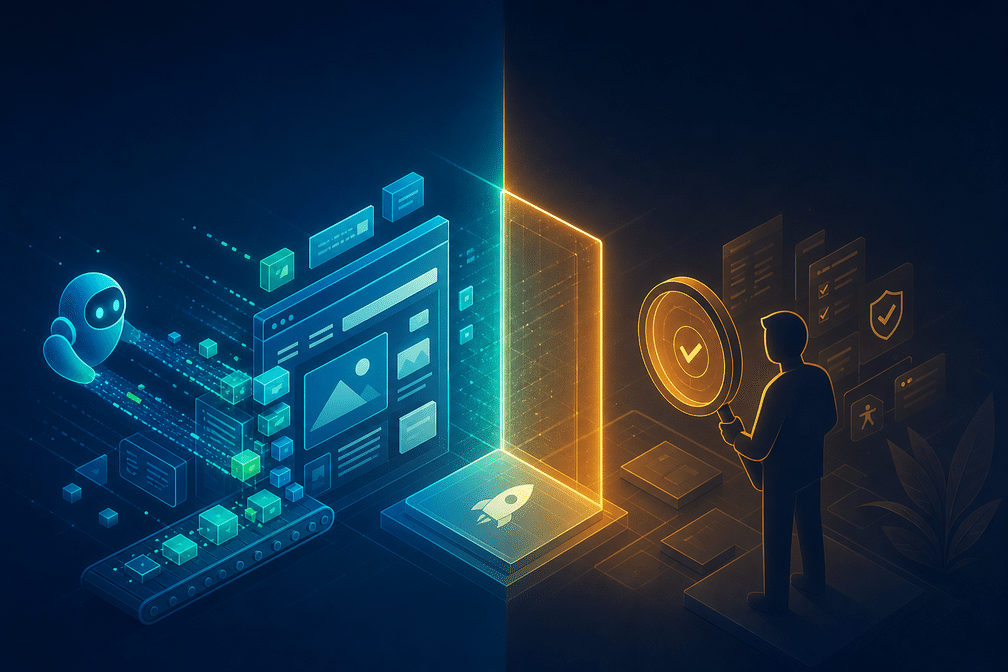
AI coding agents are no longer just autocomplete with better manners.
They can read a codebase, break down work, build components, connect APIs, fix bugs, and push a showcase website from zero to previewable. The speed is real. So a fair question keeps coming up: if an agent can handle complex development, why does We0.ai still keep human acceptance before a website goes live?
The short answer: an agent delivers a completed implementation. Human acceptance decides whether that implementation is a business asset ready to face the world.
Those sound close. In practice, the gap contains brand trust, search visibility, and conversion.
Code can run without making sense to a customer. A page can load without being ready to earn trust, traffic, or leads.
Agents solve “how to build it.” Humans decide
Whether it is the right thing to launch.
The strengths of AI coding agents are very real. They do not get tired, move quickly, and stay useful across a lot of repetitive execution. For a website, that means rapid page structures, responsive layouts, content sections, forms, and baseline interactions.
But a website is not a pass/fail engineering ticket. It is your brand’s first handshake, a sales conversation starter, an SEO/GEO entry point, and an asset that should keep collecting opportunities over time.
| Area | What an AI coding agent does well | What human acceptance must confirm |
|---|---|---|
| Development | Components, styling, logic, page assembly | The real priority of the business |
| Content | Structured copy from supplied context | Whether it sounds human and makes defensible promises |
| Brand | Following a visual direction | Whether it actually feels like this brand, not a generic AI site |
| SEO / GEO | Baseline metadata and page structure | Whether keywords, intent, and cite-worthy information hold up |
| Conversion | CTAs, forms, and navigation paths | Whether customers know exactly what to do next |
| Launch | Build, deployment, basic checks | Whether domains, analytics, access, compliance, and risks are acceptable |
AI is increasingly good at completing an answer. People still have to decide whether the question was framed correctly.
An agent can place “We are an innovative AI company” in the hero. A human reviewer should ask a harder question: can the right customer understand what you sell, who it is for, and why it is different in five seconds? If not, the site may be polished—but it is still a polished misunderstanding.
Four gates sit between “it works” and “it is ready to launch”
1. Business context: the most important things are often not written down
AI works from context. Real business context, however, is usually scattered across founder language, sales calls, customer feedback, competitor positioning, and a long list of trade-offs that never made it into the brief.
Human acceptance is not simply clicking every button. It is doing something harder: reading the website through the eyes of the customer you want to win.
Does the hero explain the offer? Do the case studies feel credible? Should the CTA say “Book a demo” or “Get a tailored plan”? That choice creates a very different lead path. An agent can surface options. It cannot own the commercial judgment.
2. Brand and trust: when every site looks decent, details matter more
AI can now create a site that looks pretty good—very quickly. That makes the acceptance step more important, not less.
When so many pages look decent, people become sensitive to small mismatches: an exaggerated claim, an image that does not belong, a pricing route that feels unexplained. For SaaS companies, consultants, exporters, and professional services firms, trust is rarely built through spectacle. It is built when nothing feels off.
We0.ai keeps a human review step not to slow AI down, but to remove the last-mile “template feeling.” Brand facts, page narrative, case-study order, and the strength of each claim often decide whether the site feels like yours.
3. SEO / GEO: Complete Fields Do Not Mean You Will Be Found or Cited
SEO is more than a title, description, and sitemap. GEO is more than publishing a few pages that mention AI.
Real search and AI-recommendation visibility depend on whether a page answers a clear question, provides verifiable information, is structured for understanding, and connects to a coherent topic system.
Human acceptance checks things like:
- What search intent does this page actually serve?
- Does the headline answer a real question, or just stack keywords?
- Do services, cases, and FAQs reinforce one another?
- Does every important claim have enough support—or does it overpromise?
- Is there a path for ongoing content, measurement, and improvement?
A website should not start working on launch day. It should start compounding for search, recommendations, and leads on launch day.
That is the We0.ai logic: Build → Showcase → Grow → Leads. Build the site, show the value, grow the visibility, and turn that visibility into opportunities. Generating a page only completes the first step.
4. Risk and Ownership: "The Agent Tested It" Is Not a Launch Decision
Automation matters, but it only covers the scope someone defined. A real launch also involves form-data handling, third-party scripts, analytics, permissions, copy compliance, mobile conversion paths, and who responds when something breaks.
The OWASP GenAI Security Project continues to document how generative AI and autonomous agents in business-critical workflows introduce risks that traditional application-security practices do not fully cover. Put simply: the more powerful automation becomes, the more clearly you need to define who owns the final release decision.
Human acceptance is not distrust of the agent. It is responsibility to users, the brand, and the business outcome.
What We0.ai Reviews Is Not a "Code Assignment"
At We0.ai, human acceptance may look like the last step. It is actually the moment when an AI-generated result becomes a website built to keep generating value.
A practical launch acceptance checklist includes:
- Clarity: Can a visitor understand the business, audience, and value within five seconds?
- Consistency: Do visual design, voice, claims, and case studies tell one coherent brand story?
- Conversion: Does every key page offer a sensible next step? Do forms and contact paths work?
- Search Foundation: Are hierarchy, metadata, internal links, content themes, and the next content moves clear?
- Data and Risk: Have analytics, domains, baseline performance, permissions, privacy notices, and third-party services been checked?
This is not "the AI finished, so a person takes a quick look." It is better described this way: AI compresses the production work. Humans reserve their attention for the decisions that affect revenue and long-term growth.
Mature Human–AI Collaboration Is Not an Either/Or Choice
Some people frame this as a choice: trust AI or insist on humans.
That is the wrong frame.
**Inefficient human work repeats production tasks AI has already done. Inefficient AI takes on commercial decisions without a clear
acceptance standard.**
A stronger division of work looks like this:
- Let agents handle high-frequency, decomposable, verifiable production tasks.
- Let people own positioning, judgment, boundaries, trust, and final accountability.
- Let live data keep feeding content and page improvements after launch.
For owners, indie builders, consultants, agencies, and cross-border teams that need a website to generate demand, this is especially practical. You do not need another page that merely looks usable. You need a site that explains value, captures search demand, collects leads, and gets better with the business.
FAQ
Can an AI coding agent build a website independently?
Yes. Agents can already handle a substantial share of page creation, component work, baseline interactions, and common integrations. But finishing development is not the same as owning brand, conversion, search strategy, and launch accountability.
Does human acceptance slow down website launch?
It does if people spend their time rebuilding repetitive work. It does not if review focuses on the few judgments that matter most. Acceptance is not an extra layer of process; it prevents expensive rework.
How is We0.ai different from a standard AI website builder?
We0.ai does more than generate a showcase website. It connects website creation with SEO/GEO, content, monitoring, page optimization, and lead generation. The goal is not simply to have a site, but to have one that keeps attracting traffic and customers.
Related Tools
- We0.ai: Build, grow, and turn your website into a lead asset
- Google Search Console: understand search performance
- PageSpeed Insights: check page experience
Sources
- OWASP GenAI Security Project: security, governance, and evaluation resources for generative AI
- OWASP Agentic App Security: security topics for autonomous agents and multi-step workflows
- A Large-Scale Study of Human–Agent Collaboration in Pull Requests (OpenReview)
Ready to Build?
If you need more than a page that is merely online—if you need a website asset that can showcase, grow, and generate leads—We0.ai brings AI production speed and human judgment into the same workflow.
Start with Build. Do not stop at Build.
Conclusion
AI coding agents will keep getting stronger. That much is not in doubt.
But the standard for a website launch will rise with them. When making a page becomes easy, what becomes scarce is whether that page is clear, credible, discoverable, convertible, and continuously improvable.
That is why We0.ai keeps human acceptance in the loop. Not because AI is not powerful enough.
Because AI is powerful enough that human judgment needs to stay exactly where it matters most: just before launch, and just before growth begins.