AI Referral Traffic Generates 41% Higher Revenue per Visit: How We0.ai Determines Whether Visitors from ChatGPT and Gemini Are Valuable
AI Referral Traffic Generates 41% More Revenue Per Visit: How We0.ai Determines Whether ChatGPT and Gemini Visitors Are Worth It
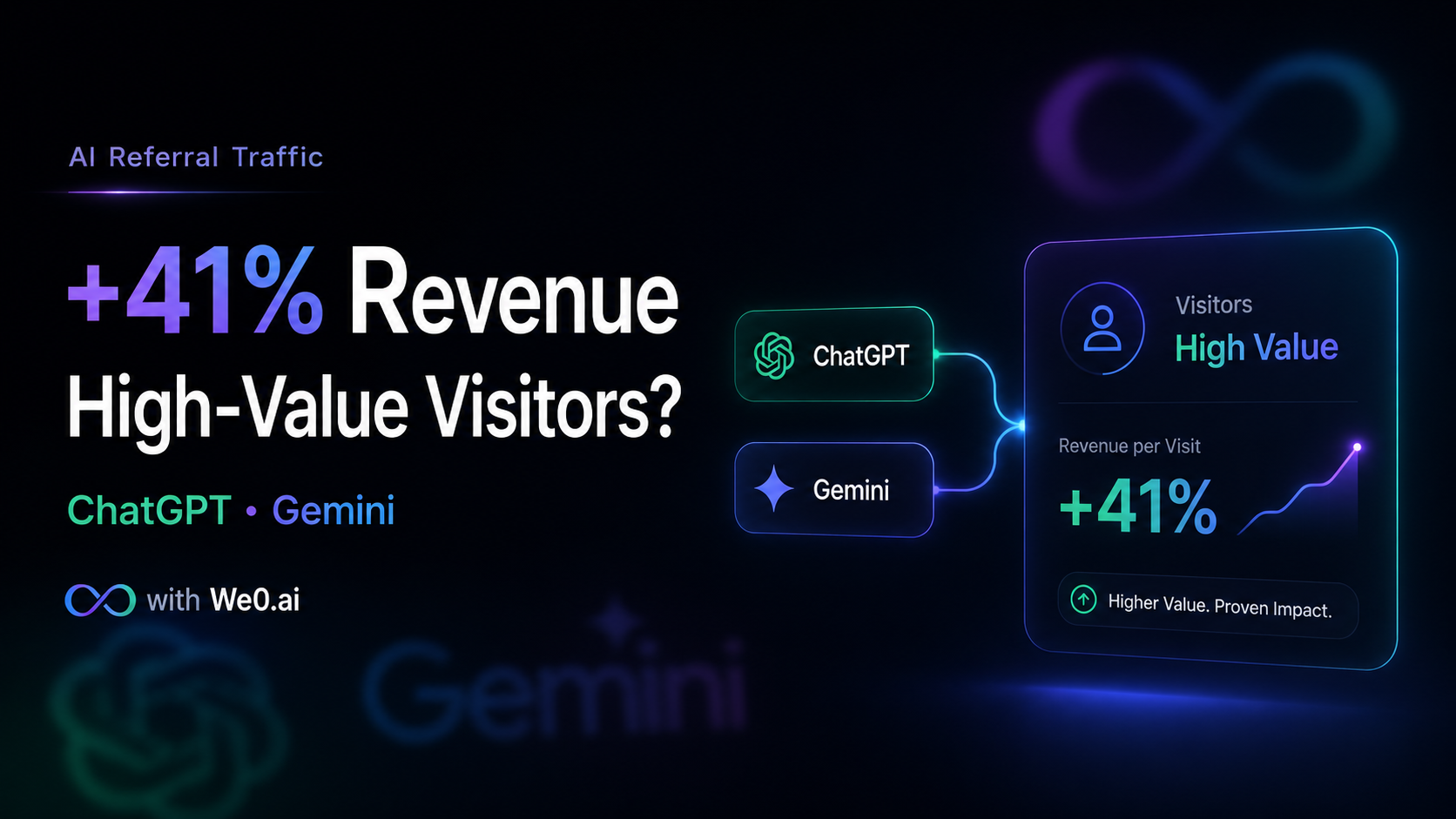
english_title: "AI Referral Traffic Can Generate 41% More Revenue Per Visit: How We0.ai Measures Whether ChatGPT and Gemini Visitors Are Worth More"
seo_title: "Are ChatGPT and Gemini Traffic Worth It? Use Revenue Per Visit to Judge AI Referral Value"
seo_description: "Don't just look at how many visits ChatGPT and Gemini bring. Use revenue per visit, lead quality, attribution completeness, and payback period to determine whether AI-referred traffic has real business value."
seo_keywords: "AI referral traffic, ChatGPT traffic, Gemini traffic, revenue per visit, AI traffic attribution, GEO, website growth, AI search optimization, We0.ai"
cover: "https://we0-cms.oss-cn-beijing.aliyuncs.com/ai-upload/9533edc3-3f8f-412b-b09f-d8324b7b1dda.png"
seo_cover_brief: "Using AI conversation entry points, website funnel, and higher revenue signals to express that 'AI-referred traffic is not about clicks, but about output per visit.'"
AI Referral Traffic Generates 41% More Revenue Per Visit: How We0.ai Determines Whether ChatGPT and Gemini Visitors Are Worth It
When many teams look at AI traffic, their first reaction is still: How many sessions did ChatGPT and Gemini bring me this month?
That question isn't wrong, but it's premature.
What you should really be asking is: How much revenue did those visits ultimately generate? How much is each visit worth?
“AI referral traffic generates 41% more revenue per visit” can be a compelling conclusion. But without specifying the sample, industry, attribution window, and revenue definition, it shouldn't be treated as a universal rule. A more accurate way to use it: treat 41% as a business hypothesis to be validated.
If your AI-referred visits genuinely show an RPV (Revenue Per Visit) 41% higher than your baseline channels, then it deserves a spot in your growth priorities. If it's only longer dwell time, very low traffic volume, or misattributed orders, it doesn't yet deserve budget.
AI traffic is not a new channel name. It's visits that come with a question in mind.
We0.ai cares less about whether “the website was mentioned by AI” and more about whether the path can be completed: Build → Showcase → Grow → Leads. Building the website is only the starting point; being discovered, understood, trusted, and then converted into leads and customers is the finish line.
First, Translate “41% More” into a Business Metric You Can Calculate
The most basic metric is just one:
RPV = Attributed Revenue ÷ Number of Visits
For example:
| Channel | Visits | Attributed Revenue | RPV |
|---|---|---|---|
| Non-brand organic search | 10,000 | ¥100,000 | ¥10.00 |
| ChatGPT + Gemini referral | 1,000 | ¥14,100 | ¥14.10 |
In this case, the RPV of AI-referred traffic is 41% higher than organic search. This comparison has value, but only if both sides use the same revenue definition, similar attribution windows, and you're not accidentally counting a one-off deal from a large customer.
Don't Substitute “Visits” for “Visitor Value”
AI engines often send users directly to more specific answer pages: product comparisons, implementation plans, pricing explanations, case studies, template downloads. The number of visitors may not be large, but the questions are usually more defined.
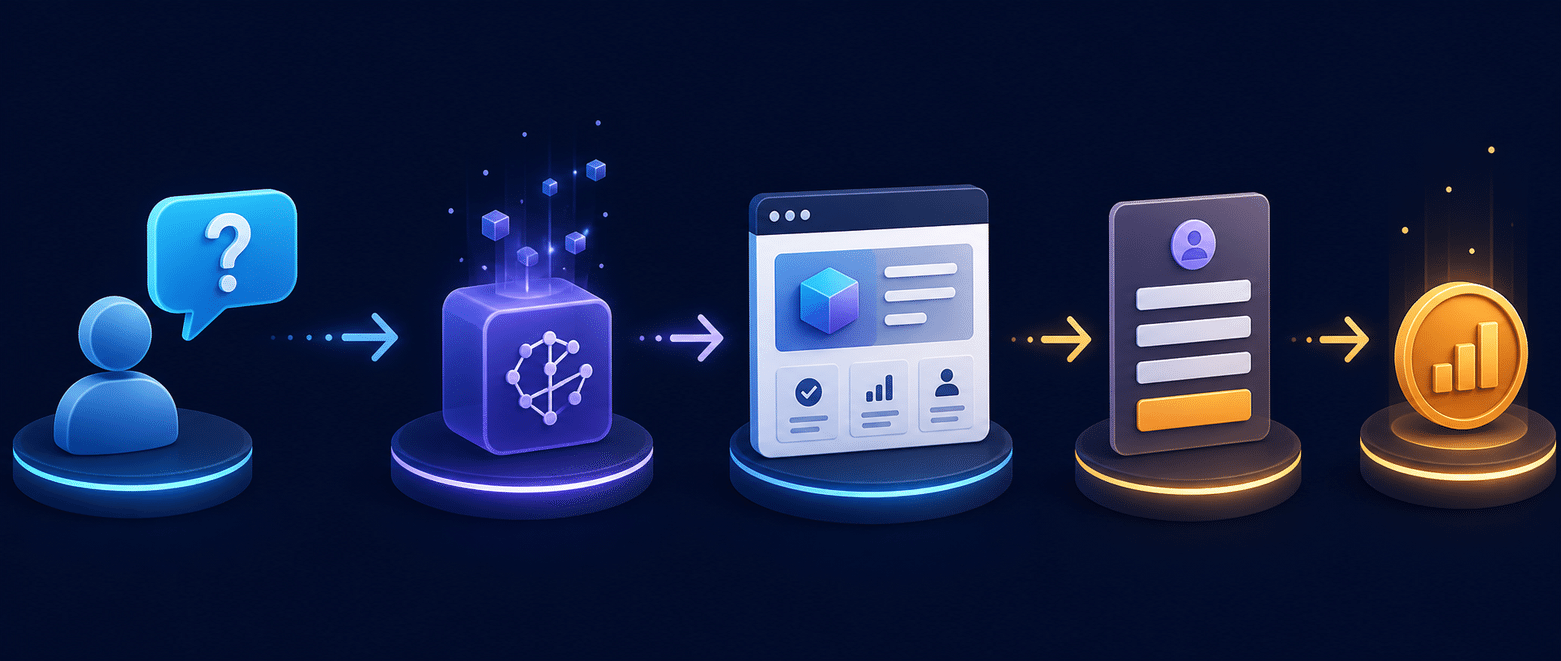
So, the logical order for evaluating AI sources should be:
- Can the source be identified;
- Which page the visitor lands on;
- What high-intent actions were completed;
- Whether it entered the CRM;
- Whether it ultimately generated revenue or verifiable opportunities.
90% fewer visits doesn't necessarily mean 90% less value. This is especially true for B2B, service-based businesses, and high-ticket SaaS.
We0.ai Uses a Four-Layer Framework to Determine Whether AI Visitors Are Valuable
Looking at RPV alone isn't enough. It's an outcome metric, easily skewed by small samples and long sales cycles. A more robust approach is to break AI-referred traffic into four layers.
| Layer | Core Question | Recommended Metrics | What Looks Good |
|---|---|---|---|
| Visibility | Does AI actually bring visitors? | sessions, referrer, landing page | Source is identifiable; visits don't all fall into direct |
| Intent | Are visitors the right people? | key page views, dwell time, return visits, CTA clicks | Visit path matches page topic |
| Conversion | Are there follow-up actions? | demo, inquiry, signup, download, booking | AI visitor CVR is not lower than core control group |
| Business Outcome | Are these actions worth money? | qualified lead rate, pipeline, revenue, RPV, CAC payback | RPV and sales efficiency hold up under review |

On the right side of the scale is a magnifying glass, revealing a rising bar chart with dollar signs that highlights the growth trend in business value. The image also includes auxiliary data visualization elements such as bar charts and pie charts, echoing the document's content on AI visitor value, traffic conversion, and business outcome assessment, directly illustrating the quantitative analysis of visitor value and revenue growth.](https://we0-cms.oss-cn-beijing.aliyuncs.com/cms-assets/image/2026/08/a7df4aa3-12c6-4b16-8e36-cf6ca77e2492-39040dc1-3bf9-4c14-8c0d-7687491ac20d.png)

Level 1: First, confirm "where it came from"
Don't treat all direct traffic as AI traffic, and don't assume that just because "chatgpt.com" appears in the referrer, attribution is done.
At minimum, it's recommended to record: source domain, first landing page, UTM, first/last touchpoint, session ID, and key events. For links you actively distribute in documents, communities, templates, or partner content, UTM remains the cleanest evidence.
For organic AI recommendations, referrers are often incomplete. The solution isn't to pretend the data is perfect, but to tag the data with a confidence level:
- High confidence: Links with UTM, clear referrers, sessions that can be linked to CRM;
- Medium confidence: Clearly landing on AI-optimized content pages, with highly consistent paths and timing;
- Low confidence: Inference based solely on a rise in direct traffic.
Incomplete attribution doesn't mean the channel has no value; but incomplete attribution also doesn't allow you to write guesses into ROI.
Level 2: Check whether "question–page" alignment works
People coming from ChatGPT or Gemini have often already asked a round of questions. If they asked "how to build a multilingual website for an international trade team" but are sent to a generic homepage, poor conversion isn't because the AI traffic is bad—it's because the landing page failed to catch them.
When We0.ai builds showcase websites, it treats pages as conversion assets rather than online business cards: service pages, industry pages, feature pages, case study pages, comparison pages, FAQ pages, and inquiry pages each need to capture different intents.

You can build a simple scoring system for each type of AI landing page:
- Is the problem being solved clearly explained above the fold?
- Are there credible case studies, pricing boundaries, or implementation details?
- Does the CTA match the user's current stage?
- Can the visitor tell within 30 seconds whether "this is designed for me"?
The value of AI recommendations is often not determined by the model, but by whether your website can turn vague interest into the next decision.
Level 3: Tier your "conversions"—don't equate downloads with deals
A template download, a whitepaper, a demo, and an SQL have completely different commercial value. It's recommended to feed data back in tiers:
| Event | Suggested Role | Can it be directly used for revenue assessment? |
|---|---|---|
| Viewed 2+ pages | Interest signal | No |
| Download / Subscribe | Micro-conversion | Needs observation |
| Submitted inquiry / Booked demo | High-intent lead | Can enter pipeline |
| CRM-verified qualified opportunity | Sales signal | Yes |
| Closed deal / Payment received | Revenue outcome | Yes |
If AI visitors have a high registration rate but the sales team reports that "they basically don't match our ICP," that at most shows the content is engaging—it doesn't mean the traffic is valuable.
Level 4: Compare channels using the same yardstick
Don't crudely compare AI-referred traffic with "all organic traffic." At least pick a comparable control group: same country, similar device, same page type, same new/returning visitor status, and ideally split by branded/non-branded keywords.
A practical review table:
| Metric | AI Referral | Control Channel | Assessment |
|---|---|---|---|
| RPV | Whether it's above baseline | ||
| High-intent conversion rate | Whether it truly brings leads | ||
| Qualified lead rate | Whether it matches ICP | ||
| Sales cycle length | Whether it shortens decision time | ||
| Refund/churn rate | Whether revenue quality is stable |
When the sample is too small, don't rush to declare victory. A better approach is to observe rolling 30-, 60-, and 90-day windows simultaneously; for high-ticket businesses, also track pipeline rather than just monthly collections.
An Executable 30-Day Validation Method
Week 1: Fill in sources. Check source, referrer, landing pages, and key events in GA4/analytics tools; add UTM to controllable distribution links.
Week 2: Fill in pages. Identify 3–5 pages where AI visitors commonly land, and add clear positioning, case studies, comparison information, FAQs, and matching CTAs.
Week 3: Fill in CRM. Make sure forms, bookings, and registration events carry source, landing page, UTM, and first touchpoint into the CRM. Sales should at least see "where this lead started."
Week 4: Run comparisons. Compare RPV, qualified lead rate, and pipeline between AI and the selected baseline channel. If AI's RPV is high but lead volume is low, prioritize expanding citable high-intent content rather than blindly chasing session counts.

What Does We0.ai Do Here?
We0.ai doesn't treat "how much traffic AI brought" as an isolated report. Instead, it helps teams connect this into a closed loop:
- Build: Build brand sites, product sites, service pages, and content pages that are truly launch-ready;
- Showcase: Make product capabilities, case studies, testimonials, pricing logic, and trust elements easier to understand;
- Grow: Continuously work on SEO/GEO fundamentals, content updates, page optimization, and data monitoring;
- Leads: Direct visits to the right inquiry, booking, registration, or contact paths, and support subsequent reviews.
This goes one layer deeper than "generating a nice-looking page"—and it's harder too. Because growth doesn't happen by pressing a single button.
If AI-referred traffic truly is more valuable, what you need isn't a prettier homepage—it's a set of growth pages that can capture intent, record paths, and continuously optimize.
FAQ
Is traffic from ChatGPT and Gemini inherently easier to close?
Not necessarily. They often arrive with more specific questions, but closing deals depends on page alignment, product pricing, trust information, sales follow-up, and attribution quality. Start with RPV
Validate against qualified lead rate—don't draw conclusions based on gut feeling.
RPV is 41% higher—should you invest more in AI content?
First, look at sample size, time window, and revenue quality. If RPV, qualified lead rate, and pipeline remain consistently better than the control group over 30–90 days, then expand content across corresponding topics, case study pages, comparison pages, and FAQ pages.
No referrer—how do you identify AI traffic?
Prioritize UTM parameters and controllable links. For organic referrals, use landing pages, session paths, time windows, and self-reported sources in your CRM as secondary signals, and clearly mark attribution confidence levels.
Are GEO and SEO mutually exclusive?
No. SEO helps you get discovered through search; GEO focuses on whether your content is easier for AI systems to understand, cite, and recommend. The foundation remains clear information architecture, credible content, accessible pages, and continuous updates.
Related Tools
- We0.ai: Turn your showcase website into a growth and lead-generation asset
- Google Analytics 4: Guide to events and attribution setup
- Google Search Console: Check search performance and page discovery
Sources
- Google Analytics Help Center: Understand traffic sources, events, and attribution
- Google Analytics Campaign URL Builder: Add UTM parameters to controlled distribution links
- Google Search Central: Create helpful, reliable, people-first content
- OpenAI Official: Introduction to ChatGPT Search
Ready to Get Started?
Want to know whether AI referral traffic is actually bringing higher value to your business? Don't chase the hype just yet. Use We0.ai to connect your website, content, SEO/GEO, data, and lead capture—and build a site that showcases your brand while driving sustained growth and leads.
Start building your growth-driven showcase website
Summary
AI referral traffic is most easily misread as "new traffic dividends." But for business, traffic is never the answer.
The answer is: For the same one visit, who brings in higher revenue, more qualified leads, and faster payback?