Agnes-2.5-Flash Review: A Free AI Coding Model Tested on Bug Fixing, App Building, and Multi-File Refactoring
The biggest problem in AI coding is no longer a lack of capable models. For many developers, it is access. Premium coding assistants are becoming more expensive, regional restrictions can interrupt established workflows, and API-heavy agent tasks can consume a budget quickly. That has created demand for a model that is capable enough for daily engineering work, stable enough to keep using, and inexpensive enough to run without constant cost calculations. Agnes AI is entering that gap with Agnes-
Agnes-2.5-Flash Review: A Free AI Coding Model Tested on Bug Fixing, App Building, and Multi-File Refactoring
Introduction
The biggest problem in AI coding is no longer a lack of capable models. For many developers, it is access.
Premium coding assistants are becoming more expensive, regional restrictions can interrupt established workflows, and API-heavy agent tasks can consume a budget quickly. That has created demand for a model that is capable enough for daily engineering work, stable enough to keep using, and inexpensive enough to run without constant cost calculations.
Agnes AI is entering that gap with Agnes-2.5-Flash, a new text model optimized for coding, agent workflows, and everyday development. The company says it will keep the Flash model available for free rather than treating free access as a short launch promotion.
The launch also includes Agnes Code, a desktop agent that can open local projects, edit files, run tools, schedule repeated work, connect to several model providers, and handle non-coding tasks such as documents, images, video, and presentations.
This article follows the original hands-on test in the same order: benchmark claims first, then a hidden-bug repair, a complete web application built from scratch, a multi-file game modification, the upcoming Pro model, and the most notable Agnes Code desktop features.
Agnes-2.5-Flash Targets Everyday Development
Agnes AI positions Flash as the main model for routine developer work rather than as a maximum-compute flagship.
Compared with Agnes-2.0-Flash, the company says the new version improves:
- Code understanding
- Repository-level issue diagnosis
- Engineering repair tasks
- Multi-step task execution
- Complex reasoning
- Agentic development workflows
The original article began with a visual comparison: both Agnes-2.0-Flash and Agnes-2.5-Flash were asked to draw a cyberpunk city on a rainy night using only HTML Canvas. The older model missed several core elements, while the new version produced a recognizable skyline, angled rain, neon lighting, and a holographic billboard.
That test is qualitative, but it illustrates the intended change. The model is expected to follow a longer specification more completely, not merely produce syntactically valid code.
Internal Coding Benchmark Results
Agnes AI published an internal comparison across seven coding benchmarks. These numbers are company-reported results rather than independently reproduced leaderboard submissions, so they should be treated as directional evidence rather than final proof.
| Benchmark | Agnes-2.0-Flash | Agnes-2.5-Flash | Agnes-2.5-Pro |
|---|---|---|---|
| Terminal-Bench 2.1 | 52.5 | 62.3 | 77.3 |
| SWE-bench Verified | 72.4 | 75.6 | 82.7 |
| SWE-bench Pro | 49.6 | 50.4 | 61.8 |
| SWE-bench Multilingual | 67.3 | 69.1 | 78.7 |
| SWE Atlas — QnA | 15.8 | 36.5 | 40.8 |
| SWE Atlas — Refactoring | 11.4 | 29.5 | 42.4 |
| SWE Atlas — Test Writing | 13.8 | 27.5 | 38.9 |
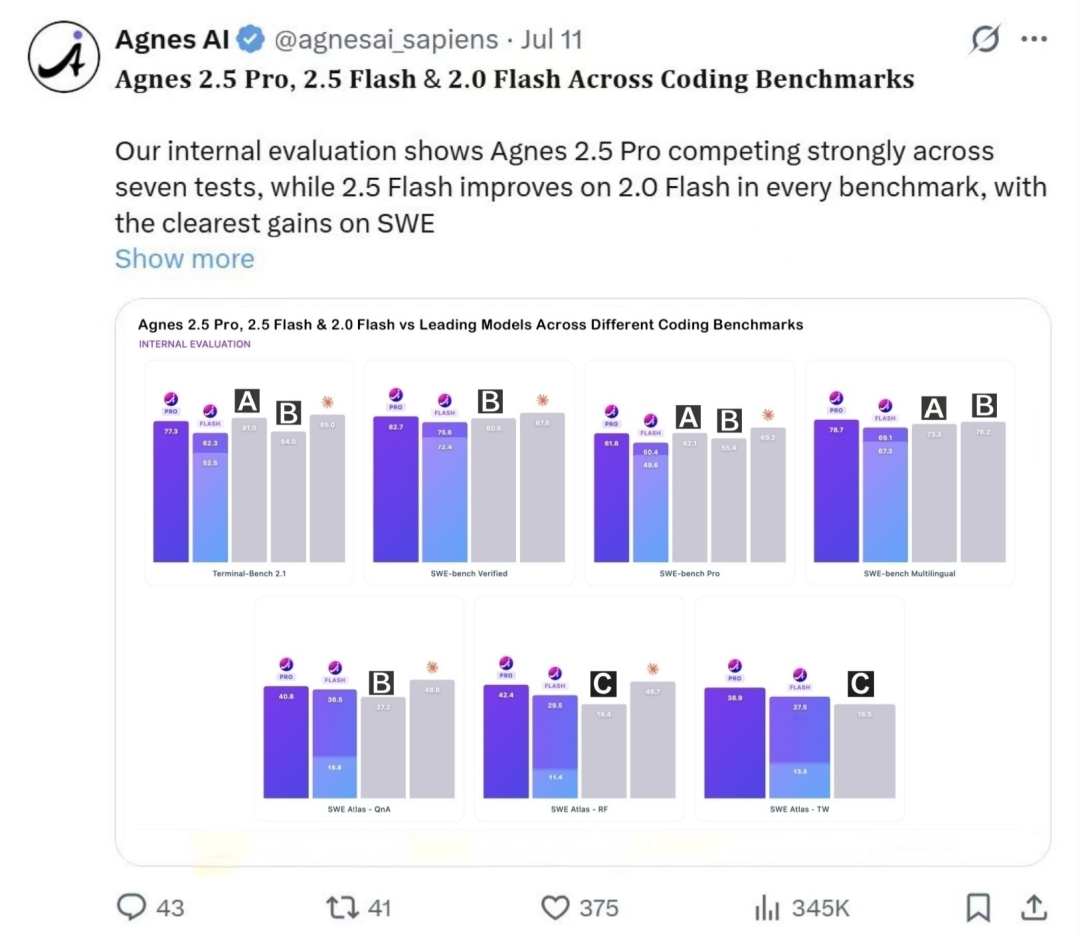
The clearest Flash improvements appear in SWE Atlas. That suite evaluates professional software-engineering workflows beyond ordinary issue resolution, including codebase question answering, refactoring, and test writing.
The chart also shows why benchmark context matters. Agnes-2.5-Flash improves across every listed test, but it does not automatically lead every competitor. Its main proposition is the combination of useful engineering capability and free access, not an uncontested claim to be the strongest model in every category.
Three Practical Coding Tests
Benchmarks are helpful, but developers usually care about a more direct question: can the model complete the work they actually give it?
The original reviewer used three increasingly difficult tests:
- Find and repair a manually inserted bug.
- Build a complete application from a single specification.
- Modify an unfamiliar project across several dependent files.
Test One: Can It Find a Hidden Bug?
The first test used Clumsy Bird, an archived open-source MelonJS implementation inspired by Flappy Bird.
The reviewer first confirmed that the game worked, then manually changed the gravity value from 0.2 to 0 inside the movement logic.
![图片展示的是在VS Code中打开的clumsy-min.js文件内容。文件中第1行代码为35,c.height=60,this._super(me.Entity,"init",[a,b,c],this.alwaysUpdate=!0,this.body.gravity=0,this.maxAngleRotation=Number.prototype.degToR。右侧代码编辑区域有搜索框,显示搜索内容为gravity,搜索结果为第1项,共8项。该图片与上文提到的测试中手动修改游戏重力值这一内容相关,展示了修改后的代码位置。](https://we0-cms.oss-cn-beijing.aliyuncs.com/cms-assets/image/2026/07/d1da3070-1269-499b-b180-960edeb2ed16-e9942322-bb30-4ed5-ae6e-54442b2f6e09.png)
The modification created an unusual failure. The application did not crash, and the bird still moved upward when the player clicked. It simply stopped falling, making the game impossible to play normally.

The full repository was opened in Agnes Code. The prompt described only the visible symptom and did not reveal the edited line.
According to the test report, Agnes-2.5-Flash took about three minutes to inspect the project and produce a diagnosis. After receiving approval to apply the repair, it completed the edit in roughly 12 seconds. The restored game again pulled the bird downward, detected pipe collisions, and updated the score correctly.
What This Test Actually Demonstrates
The important part was not changing one number. Once the location is known, the patch is trivial.
The model had to:
- Inspect an unfamiliar project.
- Connect the runtime symptom to the movement system.
- Locate the relevant implementation.
- Identify an invalid physical parameter.
- Explain the diagnosis before editing.
- Apply a minimal repair without damaging unrelated behavior.
The manually created bug was also absent from the project’s public issue and pull-request history, reducing the likelihood that the model was reproducing a memorized fix for that exact scenario.
This remains one reviewer’s test rather than a controlled benchmark, but it is a useful example of symptom-driven repository diagnosis.
Test Two: Can It Build a Complete Application From Scratch?
The second task moved beyond repair work.
The reviewer asked Agnes-2.5-Flash to build an AI Frontend Arena inside a single HTML file. The application needed to:
- Accept one shared prompt
- Provide three separate code-input panels
- Run each submission in an isolated preview
- Display the three results side by side
- Score visual quality, creativity, code completeness, instruction following, and runtime stability
- Produce a radar-chart comparison
- Rank the total scores
- Generate a one-sentence evaluation
- Open directly by double-clicking the HTML file
This is not a simple landing page. It combines an editor interface, sandboxed rendering, evaluation logic, charting, state handling, and result presentation.
The generated tool was tested with three different implementations of a code-drawn heart. The files could be loaded, rendered in parallel, and compared inside the same interface.
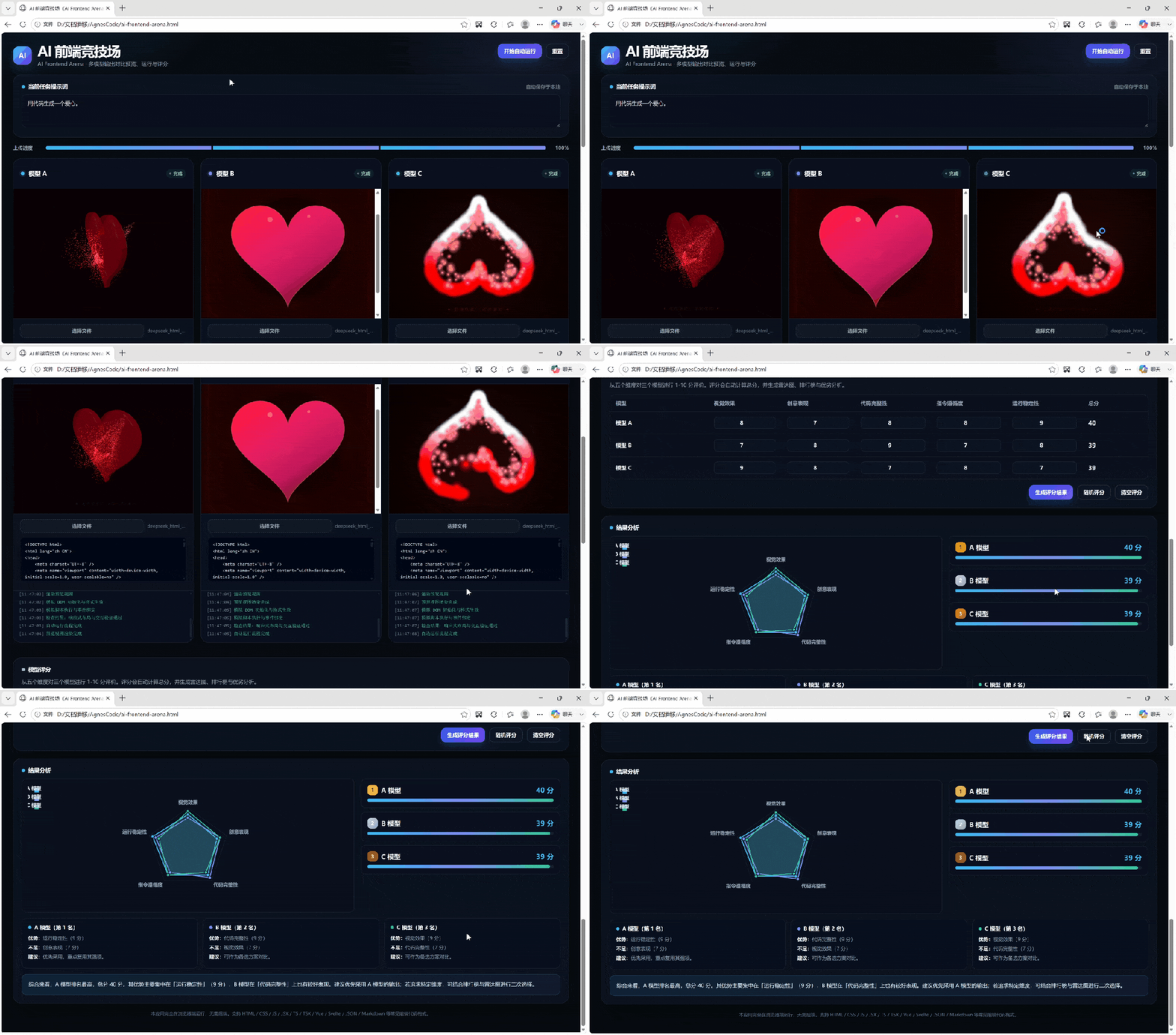
The reviewer later reused the application to compare Agnes-2.5-Flash with other models. That reuse is more meaningful than a screenshot alone: the output was functional enough to become part of the evaluation workflow that followed.
Where Caution Is Still Needed
An automatically generated scoring system should not be treated as an objective benchmark merely because it produces numbers and charts.
For real use, developers should inspect:
- Whether each scoring dimension has a clear definition
- How runtime errors affect the score
- Whether the natural-language evaluation is deterministic
- Whether untrusted code is genuinely isolated
- Whether external resources can escape the sandbox
- Whether the tool produces the same ranking across repeated runs
The test demonstrates end-to-end implementation ability. It does not independently validate the quality of the arena’s judging methodology.
Test Three: Can It Coordinate Changes Across Files?
The final test returned to Clumsy Bird, but this time the task involved a much larger modification.
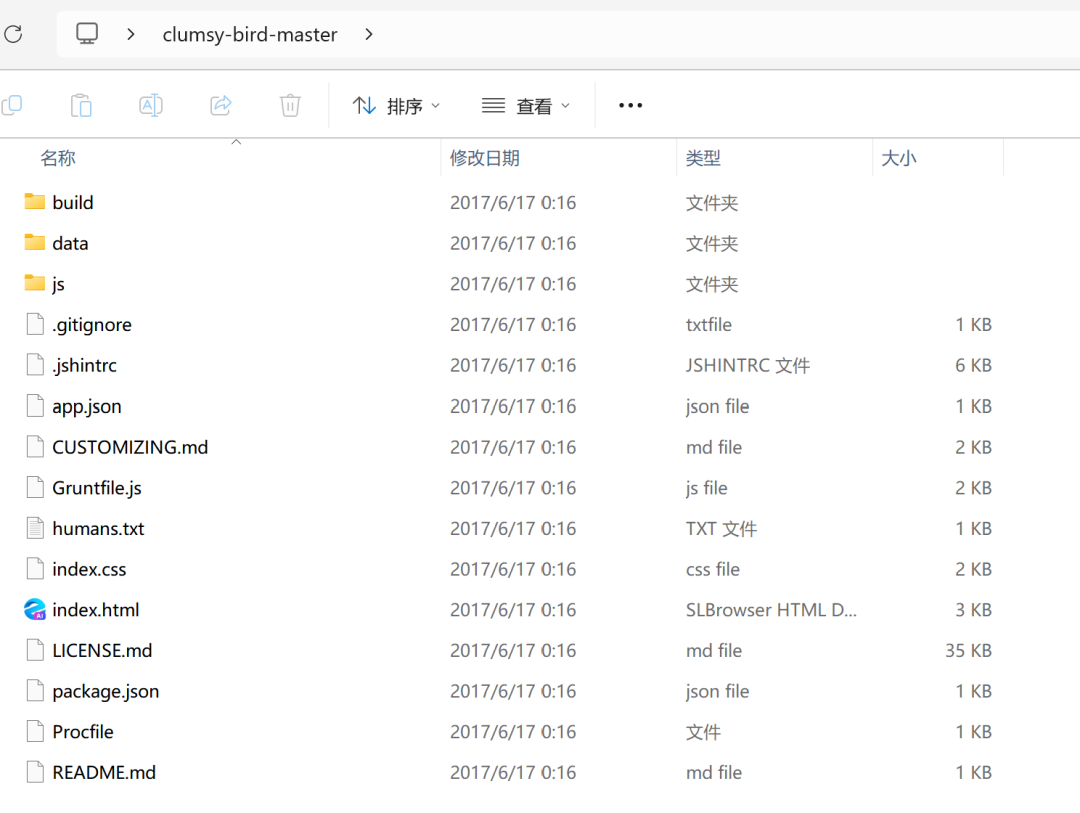
The repository contains multiple JavaScript modules, data assets, HTML, CSS, configuration files, and build-related files. A cross-file change can easily fail when one interface is updated without changing the code that calls it.
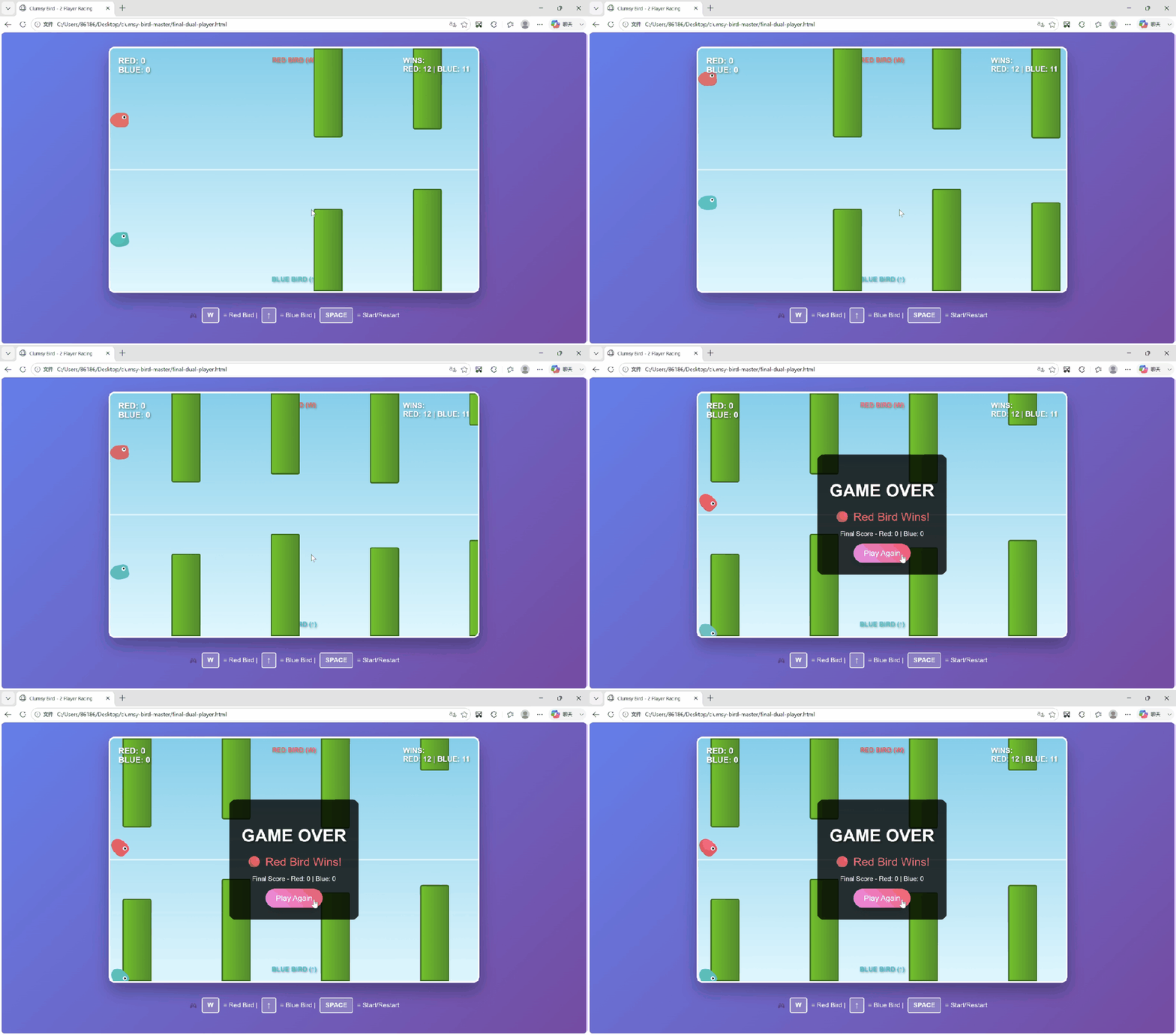
The request was to add a two-player racing mode:
Split the screen into upper and lower halves. Put a red bird in the upper area controlled by the W key, and a blue bird in the lower area controlled by the Up Arrow key. Give each player independent pipes and scoring. The first bird to hit a pipe loses, the other player wins automatically, and a WINS counter should preserve the match history.
This task required changes to game state, controls, rendering, collision handling, independent scoring, victory logic, restart behavior, and interface layout.
The run took roughly ten to twenty minutes according to the report. The final version displayed two play areas, separate birds, separate obstacles, keyboard instructions, and historical win totals.
Why the Third Test Matters
Many coding demos are completed inside one file. Real software work is rarely that contained.
Repository-level modifications require the agent to maintain a model of:
- File responsibilities
- Module dependencies
- Shared state
- Event flow
- Existing conventions
- Build and runtime behavior
- The boundary between a requested change and unrelated code
The outcome suggests that Agnes-2.5-Flash can handle a meaningful multi-file modification inside a small legacy project. It does not prove the same reliability across enterprise repositories with millions of lines, strict test suites, or complex deployment infrastructure.
For production work, a similar agent should still be required to show its plan, run tests, report modified files, and provide a reviewable patch.
What the Three Tests Suggest
Taken together, the tests create a clearer capability profile.
| Task type | Observed result | Practical significance |
|---|---|---|
| Hidden-bug diagnosis | Located a manually inserted gravity error from symptoms | Useful for unfamiliar-code investigation |
| Full application generation | Built a functioning one-file comparison arena | Shows planning across several UI and logic modules |
| Multi-file refactoring | Added a two-player mode across an existing game project | Demonstrates repository context and coordinated edits |
The model appears suitable for many common development tasks:
- Diagnosing contained bugs
- Implementing small applications
- Building internal developer utilities
- Editing existing front-end projects
- Coordinating moderate multi-file changes
- Running iterative agent workflows through a desktop client
The evidence is not enough to call it universally equivalent to the strongest paid coding models. It is enough to make free access noteworthy.
Agnes-2.5-Pro Targets Heavier Engineering Work
Agnes AI is also preparing Agnes-2.5-Pro, a higher-capability model aimed at professional software-engineering workloads.
The intended division is straightforward:
- Flash is the everyday model for frequent coding and agent tasks.
- Pro is intended for deeper reasoning, large repositories, architecture-level understanding, extended debugging, and broad system changes.
The company’s internal chart reports stronger Pro scores across all seven tests, including 82.7 on SWE-bench Verified and 78.7 on SWE-bench Multilingual.
The source article also referenced official demonstrations involving:
- High-motion web experiences with several full-screen videos
- A playable 3D game generated from a short atmosphere description
- A particle-gravity simulator with 300 particles, five color modes, adjustable gravity sources, and multiple interactions inside a 21.7 KB HTML file
These demos indicate the product direction, but demonstration quality is not the same as reproducible engineering reliability. Agnes-2.5-Pro had not formally launched at the time of the report, and its pricing and production limits were not yet public.
Agnes Code: More Than a Coding Client
A capable model still needs a practical environment in which it can inspect files, call tools, and manage long-running work.
Agnes Code is presented as a native desktop workspace for macOS and Windows. The broader official AgnesCode project also describes a desktop app, CLI, and API for local agent workflows.
The interface combines a prompt box with local project context, models, skills, applications, and generated outputs.

Unlike coding-only tools, Agnes Code is positioned for a wider set of activities:
- Code generation and repository editing
- Research and writing
- Images and video
- Presentations and office documents
- Local file processing
- Automation and scheduled work
- Tool and application connections
This broader scope matters for workflows where coding is only one part of the task. A product launch, for example, may involve implementing a page, creating visuals, drafting documentation, preparing slides, and scheduling follow-up analysis.
Custom Model Providers
The desktop app includes Agnes models and supports custom providers through OpenAI-compatible, Anthropic-compatible, and Ollama-compatible configurations.
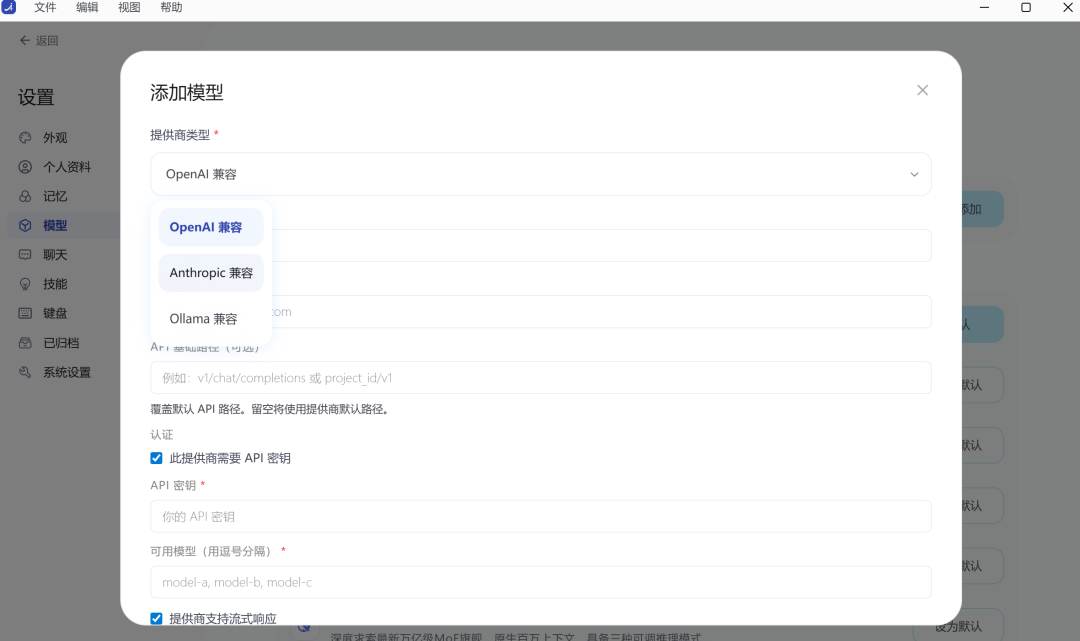
The original test interface also displayed third-party frontier models. Provider availability and subscription compatibility may change, so users should check the current application rather than relying on a launch screenshot.
Model portability can reduce lock-in. It also makes evaluation easier because the same project and task can be tested across several providers without rebuilding the surrounding workflow.
Scheduled Tasks
Agnes Code can queue recurring jobs that run without continuous supervision.
Examples include:
- Summarizing failed CI runs each day
- Preparing pull-request review notes every Friday
- Rebuilding a report on a fixed schedule
- Checking a repository for repeated maintenance issues
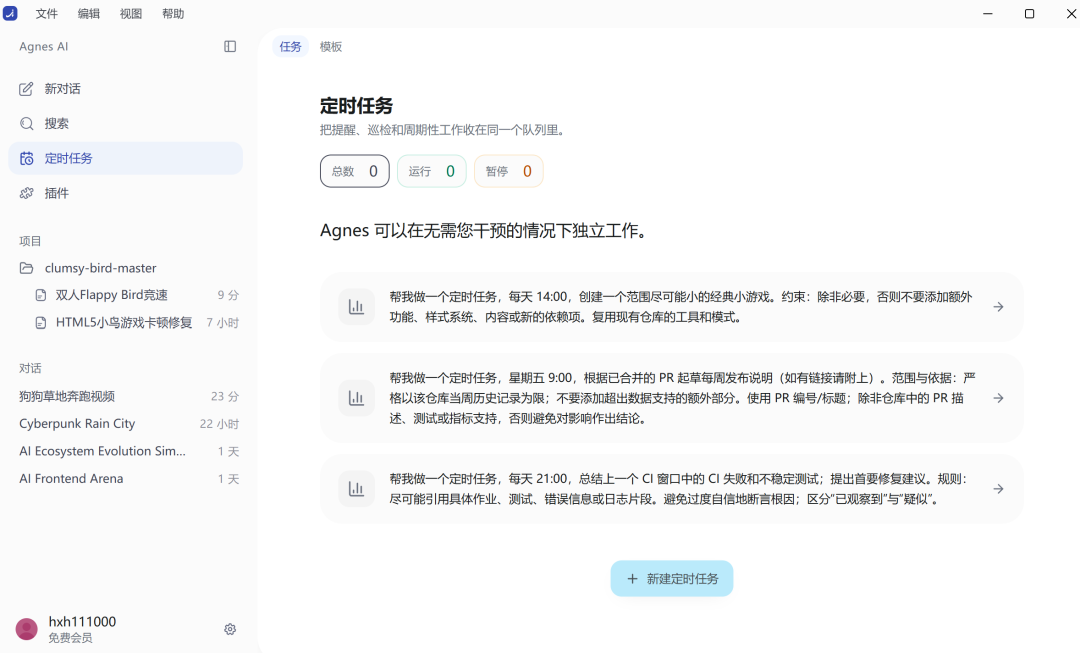
This resembles loop-based engineering workflows, where repeated operational work is handed to an agent rather than triggered manually each time.
Scheduled autonomy should be paired with guardrails. A safe recurring task needs bounded permissions, clear outputs, failure notifications, cost monitoring, and approval before destructive actions.
Preventing Sleep During Long Jobs
The desktop settings include an option to keep the computer awake while Agnes Code is running a task.
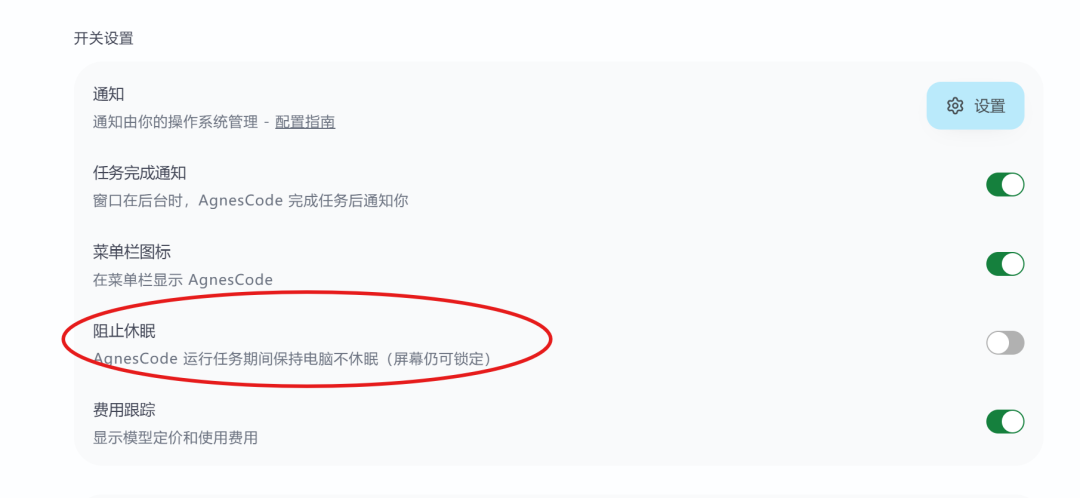
It is a small feature, but it addresses a common problem in local agent work. A long build, repository scan, or generation task can fail simply because the operating system suspends the machine.
Importing Memory From Another AI
Agnes Code also includes a workflow for importing remembered preferences and project context from another assistant.
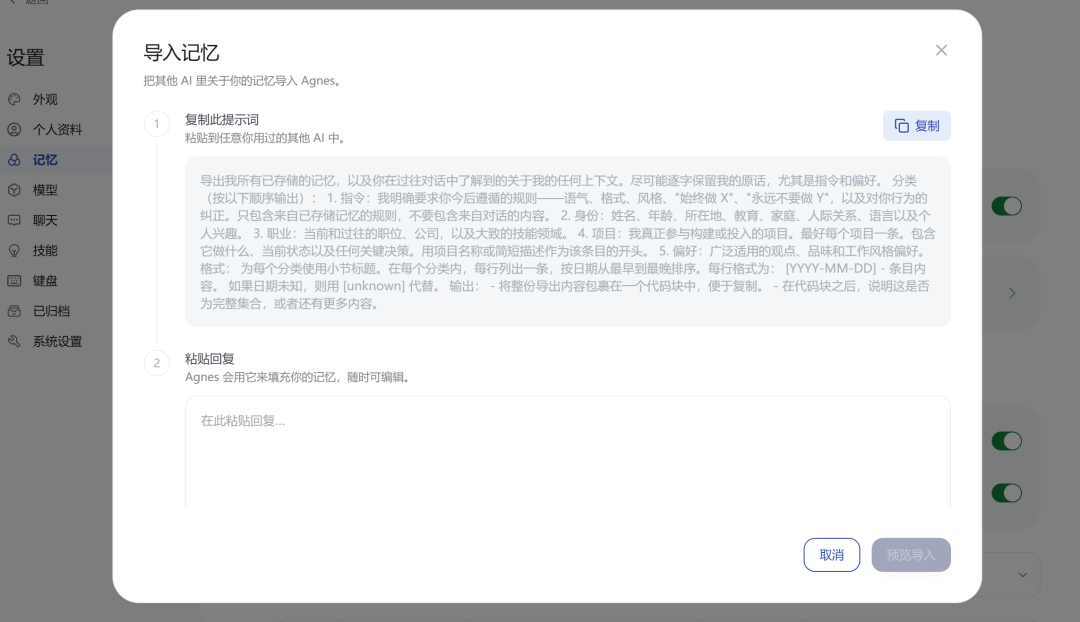
The interface provides a prompt that asks the other assistant to export structured information such as:
- Persistent instructions
- Work context
- Project descriptions
- Tool preferences
- Writing preferences
- Relevant personal settings
The exported text can then be reviewed and pasted into Agnes.
This lowers migration friction, but users should inspect the export carefully. Memory can contain private information, outdated assumptions, internal project names, or sensitive data that should not be transferred into another service.
Free Access: Important, but Not the Same as Unlimited Capacity
Agnes AI’s stated mission is to make world-class AI accessible to everyone. The company has used free access across text, image, and video services as a central product strategy.
For Agnes-2.5-Flash, the launch statement says the model will remain available free of charge rather than becoming paid after a limited trial.
That claim needs one practical clarification: free access does not necessarily mean unlimited throughput.
The public Agnes documentation describes plan-level request limits, rate limits, and quotas. Those values can change, and the public model catalog available during preparation still documented the previous text model rather than Agnes-2.5-Flash.
Developers should verify:
- Whether Agnes-2.5-Flash is enabled for their account
- The exact model identifier
- Requests per minute
- Context and output limits
- Concurrent-request limits
- Weekly or daily quotas
- Commercial-use terms
- Data-retention and privacy settings
- Whether free access applies to the API, desktop app, or both
Free access can make experimentation dramatically easier. Production reliability still depends on published limits, service availability, support, and stable documentation.
Using the Agnes AI API
Agnes AI provides an OpenAI-compatible gateway at:
https://apihub.agnes-ai.com/v1
The public documentation recommends keeping the API key in an environment variable and using the standard bearer-token format.
The following example shows the integration pattern. The model name remains a placeholder because the public 2.5 model identifier was not yet confirmed in the official documentation reviewed for this article.
import os
from openai import OpenAI

api_key = os.environ.get("AGNES_API_KEY")
if not api_key:
    raise RuntimeError("Set the AGNES_API_KEY environment variable first.")

client = OpenAI(
    api_key=api_key,
    base_url="https://apihub.agnes-ai.com/v1",
)

response = client.chat.completions.create(
    model="CONFIRM_CURRENT_AGNES_2_5_FLASH_MODEL_ID",
    messages=[
        {
            "role": "user",
            "content": "Inspect this error report and propose a minimal, testable fix.",
        }
    ],
)

print(response.choices[0].message.content)
Before production use:
- Confirm the current model ID in the Agnes platform.
- Never expose the API key in browser-side code.
- Add request timeouts and exponential backoff.
- Log token or request usage against account quotas.
- Validate tool calls before execution.
- Require human approval for destructive file or deployment operations.
- Pin versions when the platform exposes dated or stable model aliases.
FAQ
What is Agnes-2.5-Flash?
Agnes-2.5-Flash is a text model from Agnes AI optimized for coding, agent workflows, reasoning, and routine development tasks. It succeeds Agnes-2.0-Flash and is positioned as the frequently used model in the Agnes coding lineup.
Is Agnes-2.5-Flash free?
Agnes AI announced that Flash would remain free rather than being limited to a temporary promotion. Actual use can still be governed by request quotas, rate limits, account plans, regional availability, and fair-use rules.
Is Agnes-2.5-Flash available through an API?
The launch report said broader API access was expected during the same week as the desktop rollout. The public documentation had not yet confirmed the new model ID when this article was prepared, so developers should check the official platform before integrating it.
How does Agnes-2.5-Flash compare with Agnes-2.0-Flash?
Agnes AI’s internal evaluation reports higher results for 2.5 Flash across all seven published coding tests. The largest gains appear in the SWE Atlas codebase Q&A, refactoring, and test-writing tracks.
Can Agnes-2.5-Flash edit an existing repository?
The hands-on tests show it diagnosing a hidden bug and implementing a multi-file two-player game mode in a small existing repository. Larger production repositories still require test execution, patch review, permissions, and human oversight.
What is Agnes Code?
Agnes Code is a desktop agent workspace for local projects and broader productivity tasks. It supports project context, model providers, scheduled work, custom integrations, and outputs that extend beyond source code.
Can Agnes Code use models from other providers?
The reviewed desktop interface supports custom OpenAI-compatible, Anthropic-compatible, and Ollama-compatible providers. The current list of built-in providers and subscription options should be confirmed in the latest application.
Are Agnes benchmark scores independently verified?
The benchmark chart discussed here is labeled as an internal evaluation from Agnes AI. Independent leaderboard runs may use different agents, harnesses, prompts, compute budgets, and verification procedures, so direct comparisons require caution.
Related Tools
- Agnes AI: The official website for Agnes models, creative services, and product access.
- Agnes Code: The official product page for the Agnes desktop workspace.
- AgnesCode Documentation: Documentation for the desktop app, CLI, API, extensions, skills, MCP, and ACP support.
- Agnes AI Platform: The official console for accounts, API keys, plans, and model access.
- Agnes AI Model Catalog: The official OpenAI-compatible gateway examples and public model documentation repository.
- Clumsy Bird: The archived open-source game used for the bug-fixing and multi-file modification tests.
Related Links
- Agnes AI API Overview: Official information about API compatibility, authentication, capabilities, and security.
- Agnes AI GitHub Organization: Official repositories and developer resources from Agnes AI Labs.
- SWE-bench Verified: The human-filtered SWE-bench subset used to evaluate real GitHub issue resolution.
- Terminal-Bench: An official benchmark for agents completing realistic tasks in terminal environments.
- SWE Atlas Paper: The benchmark suite covering codebase Q&A, test writing, and refactoring.
- SWE Atlas GitHub: Official benchmark code and resources from Scale AI.
Summary
Agnes-2.5-Flash combines a stronger coding model with a desktop agent designed for local projects, repeated workflows, and multimodal productivity. In the original hands-on tests, it diagnosed a manually inserted bug, built a working single-file comparison application, and completed a coordinated multi-file game modification.
The company’s internal benchmark results show improvements over Agnes-2.0-Flash across seven coding evaluations, with particularly large gains on the SWE Atlas tracks. Those scores still need to be read as internal results rather than universal, independently reproduced rankings.
The free-access promise is the product’s most distinctive advantage, but developers should distinguish free pricing from unlimited capacity. Model availability, rate limits, quotas, and the exact 2.5 API identifier must be confirmed in the official platform.
Agnes-2.5-Flash is compelling not because it proves paid frontier models are unnecessary, but because it may cover a large share of everyday coding work without placing a price barrier in front of every experiment.