August 6 Article Writing: After Major Changes in Google's AI Team, Should Corporate Websites Become Official Information Sources Unaffected by AI Platform Changes?
One-sentence conclusion: Yes. But this "should" does not mean that companies should only build official websites in the future and abandon Google, ChatGPT, or social media. What it truly means is: the official website must become the source of all external information, rather than an appendage to a page on some platform.
One-sentence conclusion: Yes, it should.
But "should" here doesn't mean companies should only build official websites and abandon Google, ChatGPT, or social media. What it really means is: the official website must become the source of all external information, not an appendage of some platform page.
Why do changes in Google's AI team matter to ordinary companies?
In August 2026, significant leadership changes took place in Google's AI division. According to Business Insider, DeepMind CEO Demis Hassabis will transition to the role of Chief Scientist at Alphabet, focusing more on long-term AI research; Google's veteran engineering leader Jeff Dean will also depart to launch a new project with Sanjay Ghemawat.
External assessments of this change are mixed.
Some believe Google is further consolidating its AI strategy to reduce internal coordination costs; others worry this means the existing balance among research, products, and safety will be redefined. Regardless of which assessment ultimately holds, one thing is already clear: the organization, models, entry points, and product positioning of AI platforms can all change within a very short period of time.
For companies, the question isn't just "will Google still bring traffic." The more practical questions are:
- Could today's AI Overview change its display logic tomorrow?
- Could AI Mode lead users to click traditional search results less often?
- Why do Gemini, ChatGPT, and Claude describe the same brand differently?
- If a platform scrapes outdated company information, does the company have an official page it can proactively correct?
This leads to an easily overlooked conclusion: companies cannot anchor their official narrative to the current version of any single AI platform.
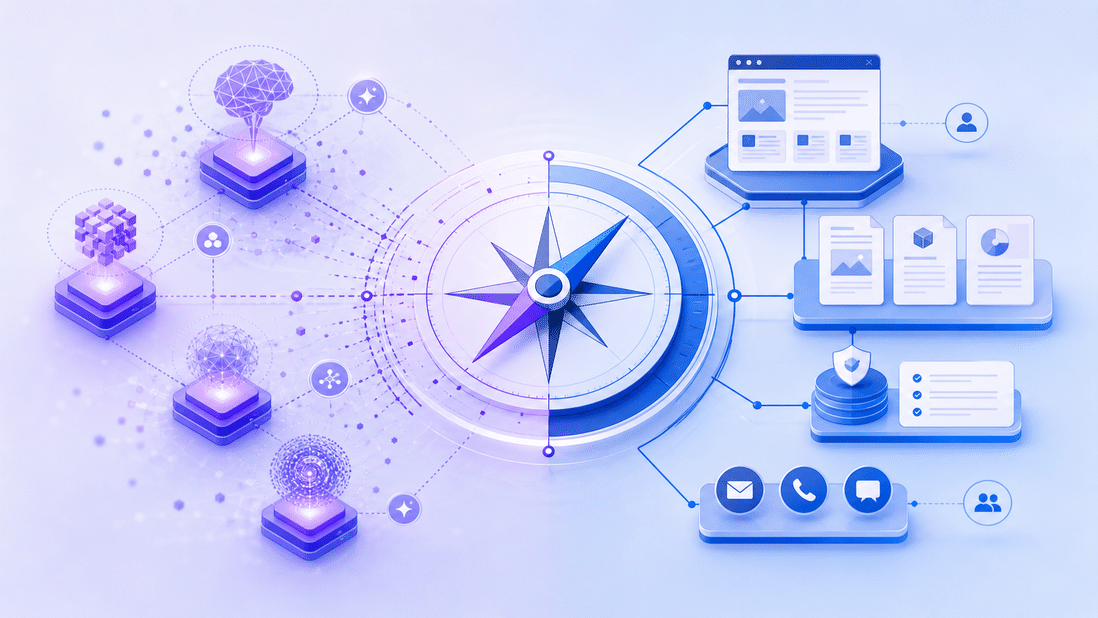
The official website isn't a "business card" — it's the company's information control layer
In the past, many companies built their official websites with a simple logic: put up a homepage, introduce the products, add contact information, and done.
But in the age of AI search, this kind of website easily loses its value. That's because AI platforms don't just read the homepage headline — they comprehensively crawl product pages, help documentation, case studies, news, FAQs, changelogs, third-party reviews, and structured data, ultimately forming an answer that looks complete but isn't necessarily accurate.
So the real role the official website should play isn't "looking professional" — it's becoming the company's source of truth.
This source of truth should at least address:
| Information Type | What the Official Website Should Clarify |
|---|---|
| Company Identity | Who we are, who we serve, which markets we operate in |
| Product Capabilities | What the product can and cannot do, which scenarios it suits |
| Pricing & Plans | Current plans, limitations, billing methods, update times |
| Evidence & Case Studies | Customer cases, data, usage conditions, real boundaries |
| Change Records | Version updates, feature retirements, policy and service adjustments |
| Trust Information | Team, authors, contact details, privacy and security statements |
| Conversion Paths | Trials, consultations, bookings, purchases, or waitlist sign-ups |
If this information doesn't have a stable, official archival location, AI platforms will only be able to piece together your brand from scattered external pages.
And a brand stitched together from fragments is usually one that the company itself doesn't control.
"Unaffected by AI platform changes" doesn't mean zero dependence on platforms
Let's correct a misconception first.
An official website can't be completely unaffected by Google, Gemini, ChatGPT, or other AI platforms. Users still need to discover you through search, recommendations, social media, and third-party content. Platforms still control distribution rules.
So a more accurate statement is:
The official website can't eliminate platform dependence, but it can reduce the single-point risk that comes with it.
A company's digital assets can be divided into three layers:
- Source layer: official website, documentation, case studies, changelogs, brand database
- Distribution layer: Google Search, AI Mode, Gemini, ChatGPT, social media, news media
- Conversion layer: forms, trials, bookings, sales communications, customer accounts
Platforms will change, distribution entry points will change, but the source layer and conversion layer should be kept as much as possible in the company's own hands.
This is also why "platform-only content" is dangerous: you might have plenty of exposure but own no information assets; you might appear in some AI answer but be unable to correct errors in time; you might get traffic but fail to convert it into leads sustainably.

Google itself has made it clear: AI search still needs websites
Google Search Central's documentation on AI Overviews and AI Mode is worth noting.
Google states that these AI features will look for supporting links from web pages to help users continue exploring complex topics. For websites to appear in AI search results, they still need to meet the foundational requirements of traditional search: pages must be crawlable and indexable, content must be reliable and user-centric, important information must be presented as text, internal links must be clear, and structured data must align with visible content.
This means AI search hasn't rendered official websites obsolete. Quite the opposite — the better AI becomes at summarizing for users, the more companies need to provide clear, complete, and continuously updated original information.
Google also pointed out that AI Overviews and AI Mode may use different models, technologies, and sets of links. Therefore, the same page won't perform identically across different AI scenarios.
The takeaway for companies is straightforward: don't aim to "please one particular AI answer." Instead, build an information system that can withstand repeated access from different entry points.
How should companies build their official website into an authoritative information source?
1. Establish a "fact list" first, then write marketing copy
Many official websites don't suffer from a lack of content — they suffer from contradictory content.
The homepage says they serve SMBs, but the product page targets only large enterprises. The pricing page lists one plan, while the sales team sends out another set of prices. Old blog posts still promote features that have been retired.
Companies should first build an internal fact list that includes at minimum: company description, product definition, core users, industry scenarios, pricing, limitations, integrations, case studies, responsible contacts, and update times. Every page should then be created from this list.
The first priority of an official website isn't "better persuasion" — it's "consistent messaging."
2. Make "updates" trackable content
AI platforms need to determine whether a piece of information is fresh and credible. Companies also need to let users know what has changed.
Product changelogs, version notes, service status, policy pages, and FAQs shouldn't be treated as afterthoughts. They are a critical part of brand credibility.
It's recommended that every high-value page include:
- Last updated time
- Applicable version or region
- Responsible team or author
- Links to related documentation
- Reason for change or scope of impact
This is not only convenient for users, but also makes it easier for search engines and AI systems to understand the page context.
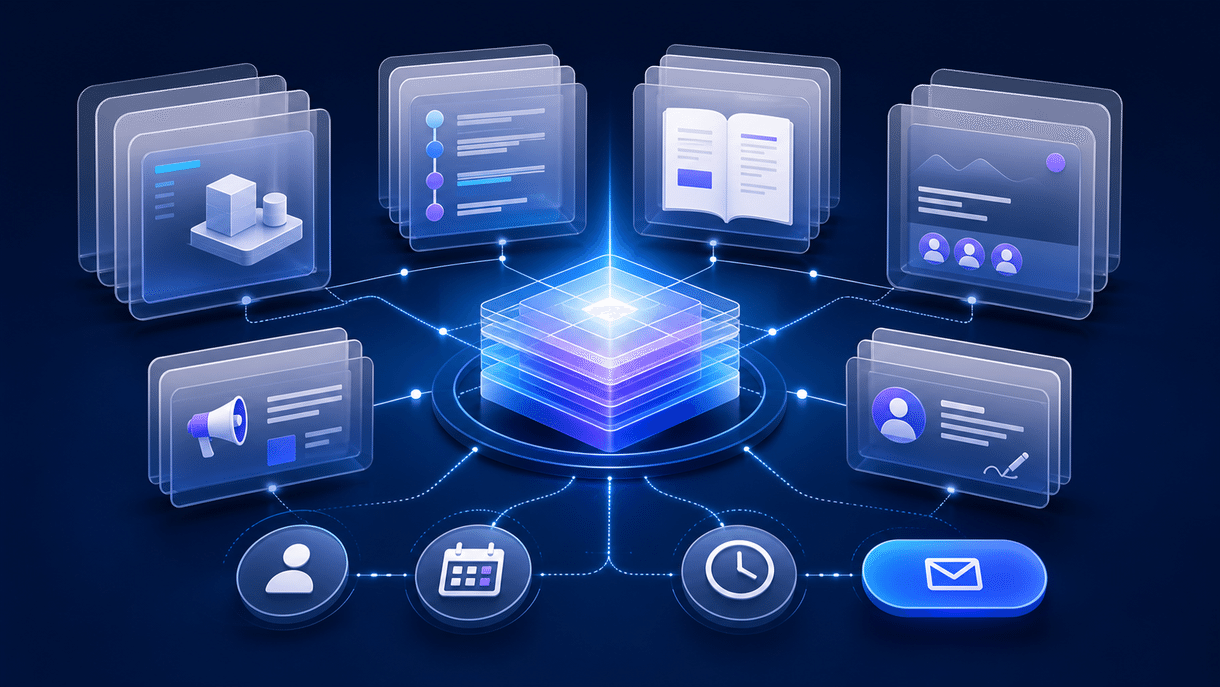
3. Don't Just Write "We're Great" — Provide Verifiable Evidence
Words like "leading," "revolutionary," and "best in the industry" don't help AI or users much.
More effective content covers: what problem it solves, who it's for, how to use it, what limitations exist, who's already using it, what results they've achieved, and where the data comes from.
This is especially true for SaaS, AI products, foreign trade services, and professional consulting businesses. The more specific your website is, the more accurately it can be understood, and the better it can capture high-intent searches.
4. Make Your Website the Hub of a Distribution Network, Not an Island
The website isn't meant to replace third-party channels — it should become the center that third-party channels cite and link back to.
A single product update can be broken down into: a website announcement, help documentation, email notifications, social posts, press materials, and sales collateral. They can all use different messaging, but the facts should trace back to the same official page.
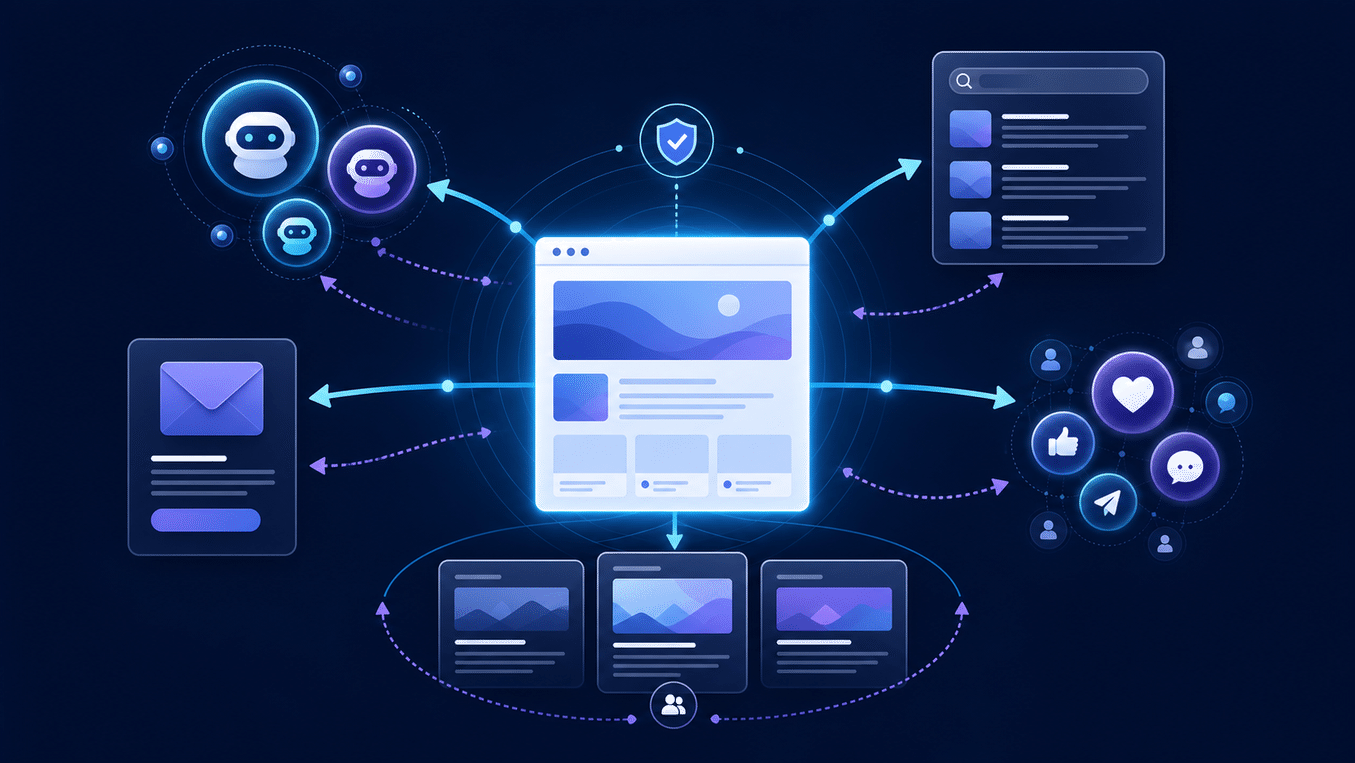
This is the complete Build -> Showcase -> Grow -> Leads loop:
- Build: Structure your brand, product, and information architecture
- Showcase: Demonstrate real capability through pages, case studies, documentation, and content
- Grow: Help SEO, GEO, search, and AI platforms discover this content
- Leads: Convert visits into trials, inquiries, bookings, and customers
A Website Checklist Businesses Can Execute Right Now
| Check Item | Evaluation Criteria |
|---|---|
| Official description | Is the company introduction consistent across the homepage, About page, and social profiles? |
| Product facts | Are features, pricing, limitations, and target users clearly stated? |
| Content freshness | Do important pages have update dates and version boundaries? |
| Crawlability | Are robots directives, indexing, internal links, and page speed working properly? |
| Text readability | Is key information not only embedded in images or complex interactions? |
| Evidence completeness | Are there case studies, authors, sources, data, and contact information? |
| AI visibility | When asking different AI platforms about the brand, can they trace back to the official page? |
| Conversion loop | Can traffic from AI or search move clearly to the next step? |
We0 AI: Advancing Your Website from "Launched" to "Continuously Growing"
If a business just needs a temporary page, ordinary website builders are sufficient.
But if the goal is to make the website a long-term information asset, you can't just focus on page generation speed. You also need to organize brand information, plan page structure, maintain content, configure SEO/GEO, monitor traffic data, and continuously optimize the user journey from search to conversion.
This is exactly the scenario We0 AI is better suited for.
We0 AI is not just a tool that generates a webpage from a single prompt, nor is it just a page builder. It's more like a combination of a showcase website growth platform + AI website-building capabilities + continuous optimization services, suitable for product websites, brand websites, case study pages, service pages, portfolios, content sites, inquiry pages, and waitlist pages.
It doesn't just care about "whether the website is live." It also focuses on:
- Whether the information structure is clear
- Whether pages can be understood by search engines and AI
- Whether content can accumulate over time
- Whether users can find credible evidence
- Whether visits can convert into leads
A truly valuable website isn't one that's finished once built — it's one that continues to be operated, updated, discovered, cited, and consistently brings in customers after launch.
FAQ
Will the Google AI team reorganization directly affect enterprise website rankings?
You can't simply infer ranking changes from a single organizational adjustment. However, Google's models, search interfaces, and AI products are constantly evolving, which changes how content is discovered, summarized, and clicked. Businesses should focus on long-term SEO fundamentals, content quality, crawlability, and brand message consistency, rather than chasing short-term tactics.
Can an enterprise website be the sole source of information for AI platforms?
It's not advisable to think of it as the "only source." The website should serve as the first-party official source and factual benchmark, while gaining external validation through media, partners, communities, and social platforms. The safest approach is: facts are published on the website, and influence is amplified through multiple channels.
How can website content be more easily cited by AI?
There's no guarantee of being cited. Reliable foundational work includes: pages being crawlable and indexable, content presented in clear text, clear headings and internal links, explicit authorship and update dates, accurate structured data, content that genuinely answers user questions, and credibility built through case studies and third-party sources.
Does GEO mean traditional SEO is outdated?
No. Google Search Central explicitly recommends that the foundational best practices of search should still be followed when optimizing for AI features. GEO is more of an extension built on top of SEO, content, brand communication, and structured information.
Do small businesses also need to build a complete website information system?
Yes, but it doesn't have to be complex from the start. A clear homepage, product or service pages, case study pages, FAQ, About Us, contact information, and an update mechanism already offer more long-term value than a bunch of scattered profiles across platforms.
Related Tools
- We0 AI Website Growth Platform
- Google Search Central: AI Features and Your Website
- Google Search Console
- Google AI Overviews
Ready to Get Started?
Your website shouldn't just be a page that barely survives after an AI platform changes.
It should be a long-term asset that your business can continuously update, validate, and use to generate traffic and leads.
Use We0 AI to build a website that showcases, grows, and acquires customers
Summary
The Google AI team reorganization is just a reminder: platforms will change people, models, and entry points — businesses can't let platforms define their official identity for them.
The website is neither the end point of traffic nor the only channel. It should be the source of all publicly available information, the anchor for all channel distribution, and the space that ultimately carries conversions.
So, the answer is yes: an enterprise website should become an official information source that isn't affected by changes to any single AI platform's version.
Not because websites never change, but because changes should be recorded, explained, and published by the business itself.