200 Million Young Adults Use ChatGPT Weekly—OpenAI Says Most Still Use It Far Below Power-User Levels
More than 200 million people aged 18 to 24 across the world use ChatGPT every week. This makes young adults one of the platform's strongest mainstream user groups. They use it for writing, analysis, coding, and studying, but OpenAI notes that most are still far from power users.
200 Million Young Adults Use ChatGPT Weekly—But Most Still Use It Far Below Power-User Levels
Introduction
More than 200 million people ages 18–24 use ChatGPT every week.
That makes young adults one of the strongest mainstream user groups on the platform. They write, analyze, code, study, calculate, create, and increasingly use AI as part of everyday school and early-career work.
Yet OpenAI says there is still a large gap between frequent student use and the way its most advanced users work with ChatGPT.
In its August 4 education announcement, OpenAI repeated a finding from its earlier education research: even advanced college-age users engage with ChatGPT's capabilities roughly 90% to 99% less than power users.
That number needs careful interpretation.
It does not mean students are using only 1% to 10% of the model's theoretical intelligence. It means their observed patterns of usage across capabilities are much less intensive than those of OpenAI's defined power-user group.
A power user might ask ChatGPT to connect tools, analyze data, build an interactive artifact, manage a multi-step project, write and test code, or coordinate an agent workflow.
Many mainstream users still interact with AI in a much simpler pattern:
ask one question
→ receive one answer
→ leave
OpenAI calls the gap between what AI can do and how people actually use it a capability overhang.
Its latest response is not another guide about writing better prompts.
Instead, OpenAI has launched three education plugins that package role-specific skills, apps, instructions, and common workflows into ready-to-use starting points for:
- K–12 educators.
- College educators.
- College students.
The goal is to move users from "What should I ask ChatGPT?" toward "Here is a complete workflow I can adapt."
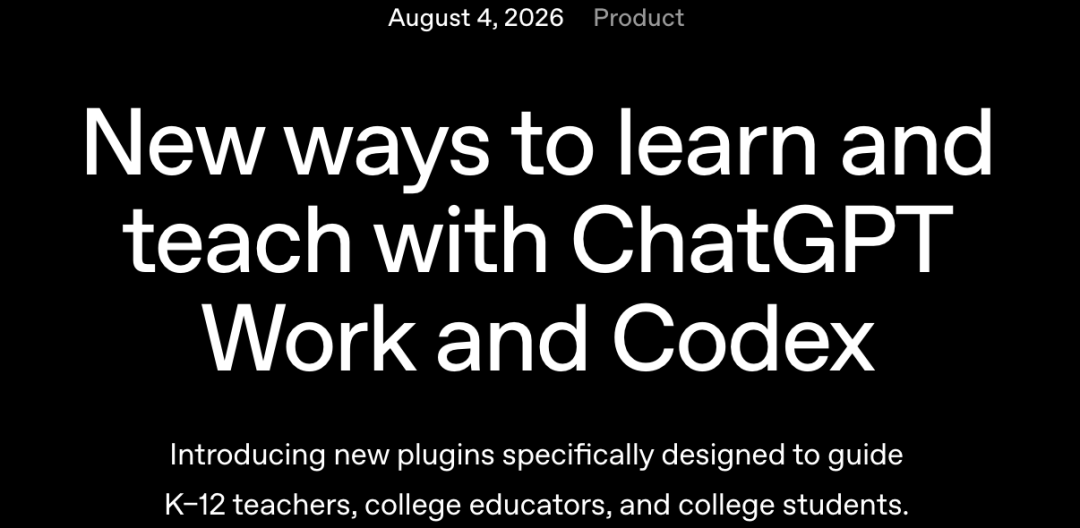
Three Education Plugins for Three Different Groups
OpenAI's new plugins are designed around different jobs rather than one generic "education assistant."
In this context, a plugin is not a browser extension.
OpenAI defines it as a package that brings together:
- Apps.
- Role-specific skills.
- Instructions.
- Common workflows.
- Relevant tools and context.
The package is intended to give teachers and students a useful starting structure without requiring them to invent a long system prompt or assemble the entire workflow manually.
The three plugins are available through ChatGPT Edu and ChatGPT for Teachers district deployments.
They can work with materials selected by the user, including documents, course materials, calendars, and other approved apps.
1. K–12 Educator Plugin
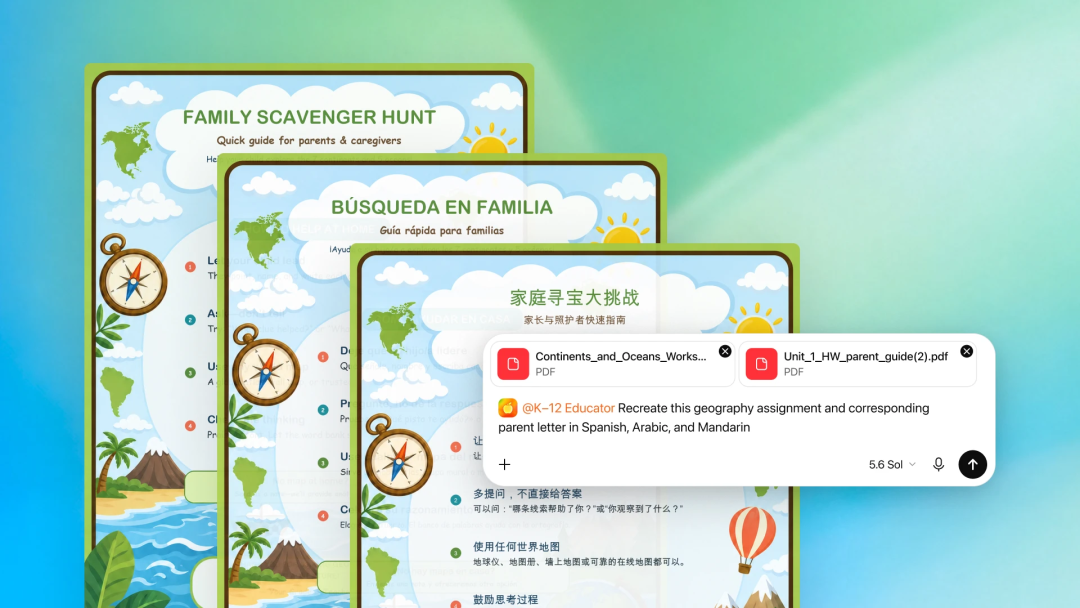
The K–12 Educator plugin focuses on recurring classroom preparation and communication work.
OpenAI highlights workflows such as:
Translating
Creating exit-ticket summaries.
Preparing family updates.
Building practice tests.
Designing differentiated resources.
Creating interactive visuals.
Working from existing classroom materials.
The plugin also integrates with Learning Commons.
OpenAI describes Learning Commons as a philanthropic organization that develops public AI datasets and resources for education.
That integration can help teachers align generated material with:
- Local academic standards.
- The learning components underneath those standards.
- The progression between prior and future learning.
The important boundary is that the plugin does not take over pedagogical authority.
OpenAI explicitly says educators remain in control of:
- Teaching decisions.
- Grading.
- Agentic actions.
- What material enters the workflow.
The product is designed to accelerate preparation, not replace the teacher's judgment about a particular class or student.
2. College Educator Plugin
The College Educator plugin moves further into course design and academic planning.
OpenAI says instructors can use it to:
- Update a syllabus.
- Create interactive teaching websites.
- Build multimedia assessments.
- Adapt materials for different learners.
- Generate course calendars.
- Prepare course materials.
- Create course posters.
- Package material for a learning-management system.
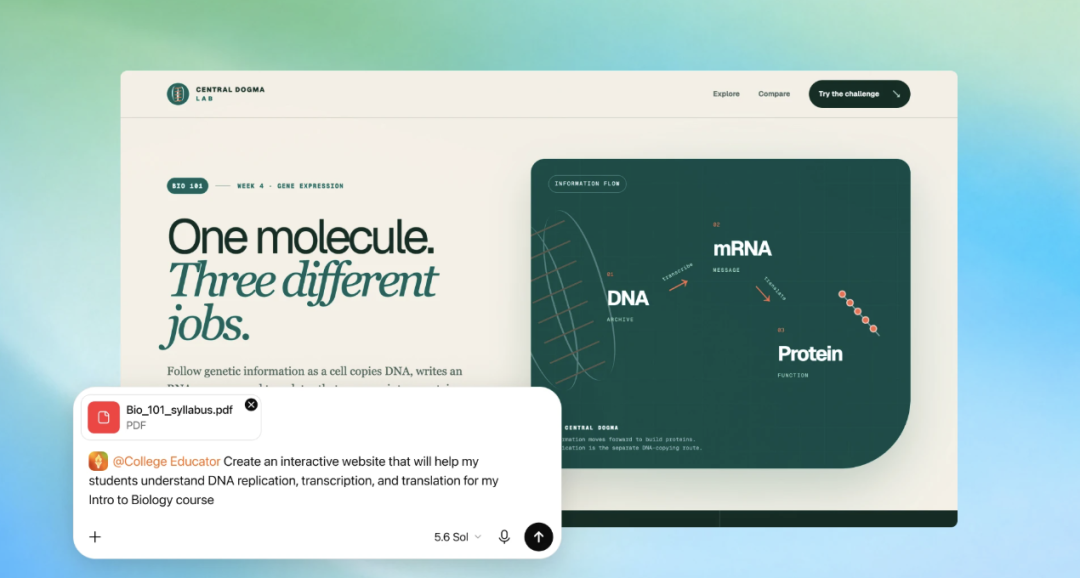
This changes the scale of the task.
A professor is no longer limited to asking:
"Can you rewrite this paragraph in my syllabus?"
The workflow can become:
course materials
→ learning objectives
→ interactive website
→ calendar
→ assessments
→ LMS-ready package
The plugin can also work with approved calendars, documents, and institutional tools so faculty do not have to rebuild the same context for every new task.
OpenAI's example is important because it shows the difference between ordinary chat and agentic work.
A prompt may still begin with one sentence, but the output can be a multi-file or multi-step artifact.
3. College Student Plugin
The College Student plugin is designed around active study rather than course administration.
Students can use materials they choose to create:
- Guided tutoring sessions.
- Practice for difficult concepts.
- Study guides.
- Quizzes.
- Flashcards.
Study plans.
- Interactive visual explanations.
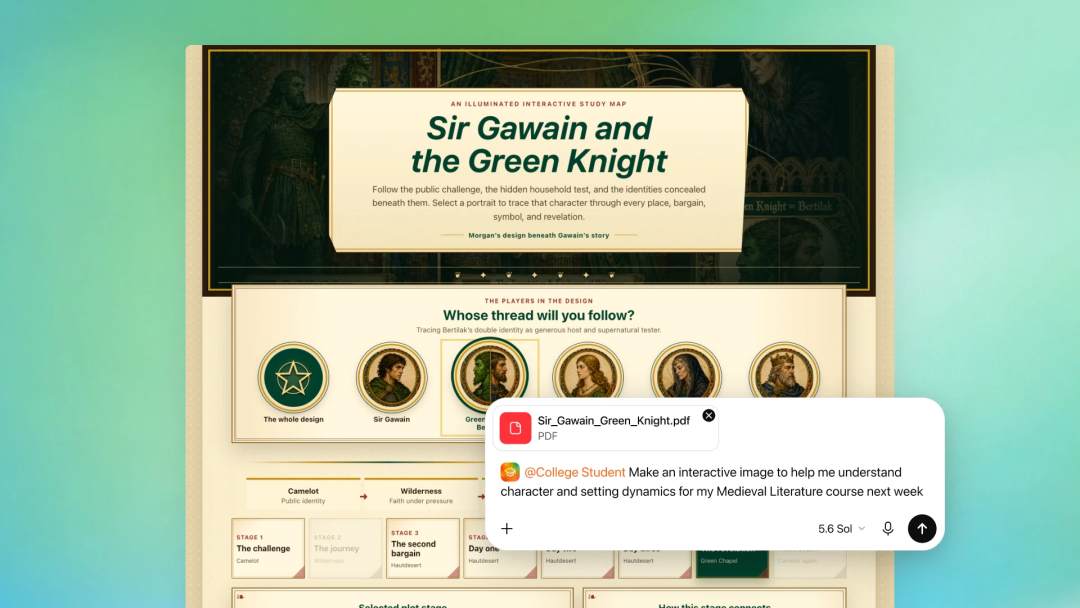
The principle is simple:
Turn the material the student is already studying into a more interactive learning environment.
That is different from handing the AI a question and requesting the final answer.
For example, a student can ask for:
- A quiz that gets harder after each correct answer.
- A flashcard set built only from assigned readings.
- A visual explanation of relationships between characters.
- A study plan based on an exam date.
- A guided tutor that asks questions instead of immediately revealing the solution.
OpenAI says the plugin was designed with university students across different majors, regions, and levels of AI fluency.
Its stated goal is deeper understanding rather than replacing the learning process with generated answers.
The Key Change Is the Workflow, Not the Individual Feature
Most of these actions were already technically possible in ChatGPT.
A user could already ask for:
- A quiz.
- A study plan.
- A translation.
- A website.
- A lesson outline.
- A calendar.
- A set of flashcards.
So why package them into plugins?
Because capability is not the same as usability.
A powerful general-purpose model still asks the user to know:
- What is possible.
- What context to provide.
- Which tools to connect.
- How to structure the task.
- How to inspect intermediate results.
- How to refine the output.
- Which actions should remain under human control.
Power users learn these patterns through repeated experimentation.
Most people do not want to become prompt engineers before they can prepare tomorrow's lesson.
A plugin turns repeated expertise into a reusable starting workflow.
Instead of:
blank chat
→ invent a prompt
→ discover missing context
→ retry
→ add tools
→ fix structure
the user begins closer to:
role-specific workflow
→ add your materials
→ customize
→ review
→ use
That is the product logic behind the three education plugins.
Stop Using ChatGPT Only as "One Question, One Answer"
The original article's second major argument is that many users are still treating ChatGPT like a more conversational search engine.
OpenAI's data suggests that advanced usage is becoming much broader.
The company analyzes 11 major capability categories, including areas such as:
- Writing.
- Analysis and calculation.
- Coding.
- Creative work.
- Education and learning.
- Information retrieval.
- Working with files and tools.
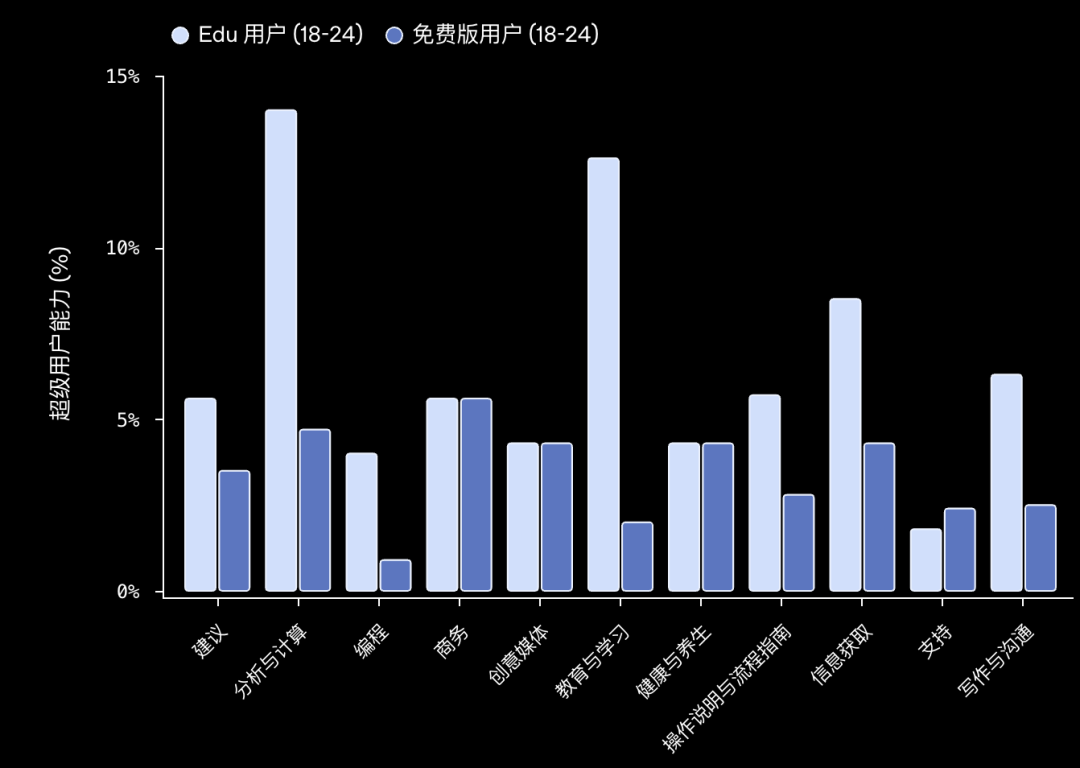
College-age users already lead or tie mainstream user groups in several of these areas.
The gap appears when they are compared with power users
rather than ordinary users.
OpenAI says advanced student users still operate roughly 90%–99% below power-user engagement across capabilities.
A useful way to understand the difference is to compare two workflows.
Basic Use
“Summarize this chapter.”
The model gives a summary.
Deeper Use
Use my course readings and exam date.
Identify the concepts most likely to need review.
Create a seven-day study plan.
Generate retrieval-practice questions.
Track the topics I miss.
Build a final review quiz.
Create one visual explanation for each weak area.
The second workflow may use the same underlying ChatGPT account.
The difference is not only a better prompt.
It includes:
- More context.
- Multiple steps.
- Reusable state.
- Tools.
- Artifacts.
- Iteration.
- Evaluation.
- A clearer goal.
That is the capability gap OpenAI is trying to close.
ChatGPT Edu Users Move Toward More Advanced Patterns
OpenAI says structured institutional access appears to help.
Across ChatGPT Edu deployments, students develop more advanced patterns of use over time.
According to OpenAI’s de-identified analysis, ChatGPT Edu users outperform free users across nearly every capability category it examined and move closer to power-user behavior.
The largest differences appear in:
- Analysis and calculation.
- Education and learning.
The company does not claim that simply buying ChatGPT Edu automatically improves grades.
The data is about usage patterns, not a randomized proof of learning outcomes.
Several factors may contribute:
- Students have managed institutional access.
- Faculty can embed AI into real coursework.
- Students receive examples and guidance.
- Relevant tools are available in one environment.
- The institution can create repeatable workflows.
- Users gain experience over time.
This is why OpenAI’s education strategy increasingly includes training, research, and measurement rather than product access alone.
The Capability Gap Is a Training Problem as Much as a Model Problem
For the first years of the generative-AI boom, product improvement was dominated by model capability.
The obvious question was:
Which model is smarter?
As models become increasingly capable, another bottleneck becomes visible:
Can users reliably turn that capability into useful work?
A model may be able to build a website, analyze a spreadsheet, plan a research project, or coordinate tools.
That capability has little practical value to a user who does not know:
- The feature exists.
- How to describe the goal.
- What context is required.
- How to verify the result.
- When not to delegate.
OpenAI’s plugins are one way of moving expertise from the user into the product design.
The product itself teaches the workflow.
OpenAI Is Building More
Than an AI Tutor
The original article then zooms out.
The three plugins are only one piece of OpenAI's education strategy.
Taken together, its recent programs cover four layers:
use
→ teach
→ deploy
→ measure
Layer 1: Plugins Make Advanced Workflows Easier to Use
The new education plugins package common tasks for students and educators.
They reduce the amount of setup required before useful work begins.
This is the use layer.
Layer 2: Teacher Training Builds AI Fluency
OpenAI is a founding partner in the National Academy for AI Instruction.
The American Federation of Teachers says the academy was launched with:
- AFT.
- United Federation of Teachers.
- Microsoft.
- OpenAI.
- Anthropic.
The five-year program aims to train 400,000 K–12 teachers, approximately 10% of the U.S. educator workforce.
The academy provides hands-on training intended to help teachers use AI safely, fairly, effectively, and ethically.
OpenAI is also working with the Walton Family Foundation to support more than 1,600 K–12 teachers, administrators, and district leaders across eight U.S. cities through free, in-person OpenAI Academy workshops.
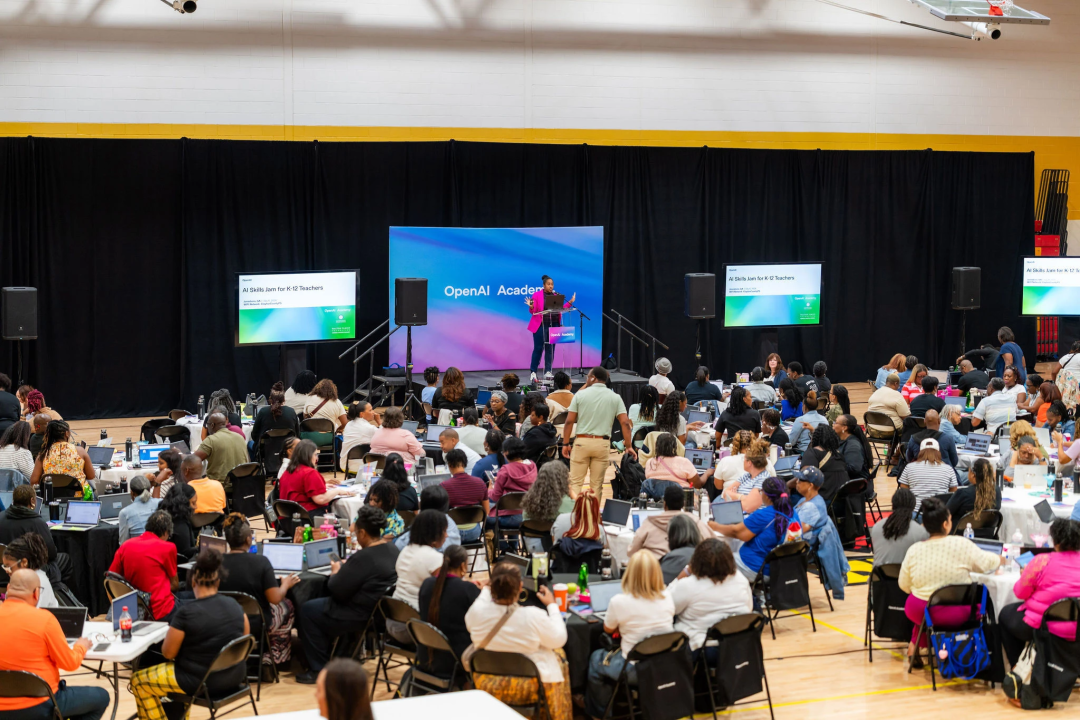
This is the teach layer.
Layer 3: Education for Countries Expands Institutional Access
OpenAI's Education for Countries program works with governments and national education systems.
Estonia is one of the clearest examples.
The country's AI Leap initiative began by targeting 20,000 high-school students and 3,000 teachers, with plans for further expansion.
OpenAI's August education announcement says ChatGPT Edu now reaches more than:
- 20,000 students
- 4,600 teachers
in Estonia, alongside a longitudinal research initiative involving the University of Tartu and Stanford.
This is the deploy layer.
The strategy is not limited to persuading individual students to sign up for a chatbot.
It places AI into managed education infrastructure.
Layer 4: Learning Outcomes Measurement Tests Whether AI Helps
More usage is not automatically better education.
A student could spend twice as long in ChatGPT while learning less.
OpenAI is therefore developing a Learning Outcomes Measurement Suite intended to help educators, researchers, school systems, and governments measure effects on:
- Reasoning.
- Critical thinking.
- Mastery.
- Learning progress.
That distinction is essential.
The useful question is not:
Did students send more AI messages?
It is:
Did students understand more,
reason better,
and retain the skill?
This is the measure layer.
OpenAI Is Also Connecting Students to Community and Careers
The education strategy extends outside coursework.
OpenAI has launched the Student Collective, a student-led
A community focused on learning, building, and shaping AI use on campuses.
Campus Leads can organize peer-led activities and hands-on projects.
OpenAI also highlights a partnership with Handshake to connect AI skills with internships and early-career opportunities.
For researchers, OpenAI now offers ChatGPT for Academic Researchers.
Eligible research faculty and postdoctoral researchers can apply for a managed workspace with:
- Up to five complimentary seats.
- 12 months of free access.
- Business-level data protections.
- Workspace controls.
- Access intended for academic research.
The program has eligibility, institution, geography, and verification requirements.
It is not a general free-Pro offer for every student.
Who Controls the Tools?
The original article ends with the most important governance question.
The new plugins are not simply being pushed to every ChatGPT user.
OpenAI says they are available through:
- ChatGPT Edu.
- ChatGPT for Teachers district deployments.
Institutions retain control over:
- Which tools are available.
- Which permissions are granted.
- Which apps are approved.
- Which materials can be connected.
- How the workspace is managed.
This is a deliberate institutional distribution model.
It gives schools and districts a stronger role than a consumer product that any teacher can independently install without organizational approval.
ChatGPT for Teachers Itself Is Broader Than the Plugin Rollout
There is a useful distinction here.
ChatGPT for Teachers is currently free for verified U.S. K–12 teachers and school staff through June 2028, and individual eligible educators can create a workspace.
However, OpenAI’s August 4 announcement specifically says the new education plugins are available through ChatGPT Edu and ChatGPT for Teachers district deployments.
So these two claims can both be true:
- Individual U.S. K–12 educators can access ChatGPT for Teachers.
- The three newly announced plugins are being distributed through institution-managed education deployments.
This distinction is easy to lose when “ChatGPT for Teachers” and “the teacher plugin” are treated as the same product.
They are related, but not identical.
Anthropic Chose a Different Distribution Route
Three weeks before OpenAI’s plugin announcement, Anthropic launched Claude for Teachers.
Anthropic offers the product free to verified U.S. K–12 educators who sign up by June 30, 2027 for a full year of access.
Its package includes:
- Premium Claude capabilities.
- Teaching skills.
- Learning Commons integration.
- Connections to K–12 tools.
- Education-oriented privacy terms.
That gives individual teachers a relatively direct path into the product.
OpenAI’s new plugin rollout places more emphasis on district-managed deployment.
Neither approach completely removes institutions from the picture.
Anthropic is working with school systems and the AFT, while ChatGPT for Teachers itself also supports individual verified educators.
The meaningful difference is how the specific new plugin package is being distributed.
Teachers Still Keep Instructional Authority
Institutional distribution
This doesn't mean the AI company decides how to teach.
OpenAI repeatedly states that educators should remain in control of:
- Pedagogical decisions.
- Grading.
- Agent actions.
- Classroom use.
The AFT makes the same point more forcefully.
At the National Academy for AI Instruction, the union says technology partners do not develop the course content.
The training environment is teacher-led.
AFT educators argue that teachers—not technology companies—need to be in the driver's seat when deciding how and when AI belongs in the classroom.
This is a useful boundary because AI can understand the text of an assignment without understanding the full human context of a classroom.
A teacher may know:
- Why one student is struggling.
- Why another student needs a different explanation.
- Which conflict happened before class.
- Which material is developmentally inappropriate.
- Whether the class is ready to move on.
- What counts as fair assessment.
A model can support those decisions.
It should not silently inherit them.
The Real Competition Is Becoming Educational Infrastructure
The surface-level competition looks like:
ChatGPT vs. Claude
The deeper competition is larger.
AI companies are building:
- Managed school workspaces.
- Teacher training.
- Academic-standard integrations.
- Student communities.
- Research programs.
- Learning-outcome measurement.
- LMS and app connections.
- Career pathways.
- Government deployments.
- Administrative controls.
That is closer to infrastructure than a standalone tutoring chatbot.
For schools, the purchasing decision increasingly includes questions such as:
- Who controls data?
- Who chooses the tools?
- Can the system align with local standards?
- Can administrators manage access?
- Can teachers override the AI?
- Is usage tied to measurable learning?
- Can the institution audit and govern deployment?
- How much training is required?
The strongest education platform may not simply be the one with the most capable model.
It may be the one that helps institutions turn model capability into repeatable, governed learning workflows.
What Students Can Learn From the "Power User" Gap
The 90%–99% figure can sound discouraging.
It is more useful as a map of where deeper AI skills are developing.
A student does not need to imitate every behavior of an extreme power user.
But several habits are transferable.
Move From Answers to Projects
Instead of asking for one output, define an end goal and let the work unfold in steps.
Give the AI Real Context
Use course materials, constraints, dates, examples, and approved tools rather than making the model guess.
Ask for Active Learning
Request questions, practice, feedback, comparison, and explanation—not only completed answers.
Build Reusable Workflows
If a task repeats every week, turn it into a consistent process instead of rewriting the prompt each time.
Verify Important Work
Use the AI to help check sources, calculations, code, assumptions, and gaps.
Know What Not to Delegate
The ability to use AI deeply includes knowing where human judgment is still the point of the exercise.
For education,
that may be the most important power-user skill of all.
What Is Confirmed and What Needs Careful Interpretation
| Claim | Status |
|---|---|
| More than 200 million people ages 18–24 use ChatGPT weekly | Confirmed by OpenAI |
| OpenAI launched three education plugins on August 4, 2026 | Confirmed |
| Plugins target K–12 educators, college educators, and college students | Confirmed |
| Advanced college-age users operate roughly 90%–99% below power-user engagement | Confirmed by OpenAI’s usage analysis |
| The statistic means students use only 1%–10% of ChatGPT’s theoretical intelligence | Incorrect interpretation |
| ChatGPT Edu users show more advanced usage patterns than free users | Reported by OpenAI |
| K–12 plugin integrates with Learning Commons | Confirmed |
| Teachers retain control over grading and pedagogical decisions | Confirmed by OpenAI |
| National Academy aims to train 400,000 teachers over five years | Confirmed by OpenAI and AFT |
| Technology companies write the academy’s teacher-training curriculum | AFT says they do not |
| New education plugins are available to every ChatGPT user | No |
| ChatGPT for Teachers itself is available only through districts | No; eligible U.S. K–12 educators can also verify individually |
| New plugins are available through ChatGPT for Teachers district deployments | Confirmed by OpenAI |
| Estonia deployment reaches 20,000+ students and 4,600 teachers | Reported by OpenAI |
| More AI usage automatically means better learning outcomes | Not established |
Frequently Asked Questions
How many young adults use ChatGPT every week?
OpenAI says more than 200 million people ages 18–24 now use ChatGPT weekly. The figure refers to young adults globally, not only university students in the United States.
What does OpenAI mean by a 90%–99% student capability gap?
OpenAI says even advanced college-age users engage with its capabilities roughly 90%–99% less than its defined power users. This is a comparison of observed usage patterns, not a claim that students access only 1%–10% of the model’s underlying intelligence.
What are OpenAI’s three education plugins?
They are the K–12 Educator, College Educator, and College Student plugins for ChatGPT Work and Codex. Each packages role-specific skills, apps, instructions, context, and common workflows to reduce the amount of setup users need to do themselves.
Can any ChatGPT user install the education plugins?
Not currently. OpenAI says the plugins are available through ChatGPT Edu and ChatGPT for Teachers district deployments, where institutions can control tools and permissions.
Is ChatGPT for Teachers free for individual teachers?
Yes. OpenAI currently says ChatGPT for Teachers is free for verified U.S. K–12 teachers and school staff through June 2028. That individual access should not be confused with the separate distribution rules for the newly announced education plugins.
What can the K–12 Educator plugin do?
OpenAI lists assignment translation, exit-ticket briefs, family updates, practice tests, differentiated resources, and interactive visuals among its workflows. It also integrates with Learning Commons for
standards-aligned material while leaving grading and pedagogical decisions with educators.
What is the National Academy for AI Instruction?
It is a teacher-training initiative involving the American Federation of Teachers, United Federation of Teachers, Microsoft, OpenAI, and Anthropic. The five-year program aims to train 400,000 K–12 educators, and AFT says the training content is teacher-led rather than written by the technology partners.
Does OpenAI have evidence that ChatGPT improves learning?
OpenAI has published usage-pattern data showing ChatGPT Edu users move toward more advanced behaviors, but usage is not the same as learning outcomes. The company is developing a Learning Outcomes Measurement Suite to study reasoning, critical thinking, mastery, and other educational effects more directly.
Related Tools
- ChatGPT Edu: OpenAI’s managed higher-education offering for institution-wide AI access, privacy, and administration.
- ChatGPT for Teachers: A secure ChatGPT workspace currently free for verified U.S. K–12 teachers and school staff through June 2028.
- Codex: OpenAI’s coding and agentic work environment, also used as a surface for the new education plugins.
- Learning Commons: An education-focused organization providing learning-science resources and standards data used by teaching AI products.
- OpenAI Academy: OpenAI’s training hub with workshops and learning resources for educators and other communities.
- Claude for Teachers: Anthropic’s free offering for verified U.S. K–12 educators, with Learning Commons and teacher-focused skills.
Related Links
- OpenAI: New Ways to Learn and Teach With ChatGPT Work and Codex: The official August 4 announcement of the three education plugins.
- OpenAI: Ensuring AI Use in Education Leads to Opportunity: The primary source for the capability-overhang and 90%–99% usage-gap data.
- OpenAI Education: Current overview of ChatGPT Edu, institutional deployments, and education programs.
- AFT: Who Gets to Lead the Nation’s Classrooms?: AFT’s description of teacher-led AI training and the 400,000-teacher academy goal.
- OpenAI Student Collective: OpenAI’s student-led community and Campus Lead program.
- OpenAI: Education for Countries: Official information about OpenAI’s work with national education systems.
- OpenAI: New Tools for Understanding AI and Learning Outcomes: OpenAI’s work on measuring the actual effect of AI on learning.
Summary
More than 200 million young adults ages 18–24 use ChatGPT every week, but OpenAI says even
Advanced college-age users engage with the product far less deeply than its power users. The 90%–99% figure describes a usage-pattern gap, not a measurement of how much of the model’s theoretical intelligence students can access.
OpenAI’s three new education plugins are designed to reduce that gap by packaging workflows for K–12 teachers, college educators, and college students. Instead of forcing users to discover advanced prompts and tools on their own, the plugins provide role-specific starting points built around real teaching and learning tasks.
The plugins are only one part of a larger education strategy that includes managed institutional access, teacher training, national deployments, student communities, researcher programs, and learning-outcome measurement.
Schools and teachers still retain an important role. OpenAI lets institutions manage tools and permissions, while both OpenAI and the AFT explicitly say educators should remain responsible for pedagogy, grading, and classroom judgment.
The next AI education gap is no longer simply access to a powerful model; it is whether students, teachers, and institutions know how to turn that model into deep, repeatable, and well-governed work.