AI Website Builders vs Lead Generation Websites: What Actually Drives Customers
Most AI website builders promise a fast way to create a website. But fast websites do not automatically create customers. Many AI-generated sites look polished, yet fail to communicate a clear offer, rank in search, appear in AI answers, or convert visitors into leads. This article explains why most AI website builders stop too early, what a customer-getting website actually needs, and how a showcase website growth approach helps founders, creators, consultants, agencies, and businesses turn a website into a working lead-generation asset. We also compare the difference between builder-only tools and growth-ready showcase websites, covering SEO, GEO, AI search visibility, content structure, proof, templates, and lead capture. The goal is not just to publish a page. The goal is to build a site that can be found, understood, trusted, and used by real customers.
Why Most AI Website Builders Fail at Getting You Customers (And We0.ai Doesn't)
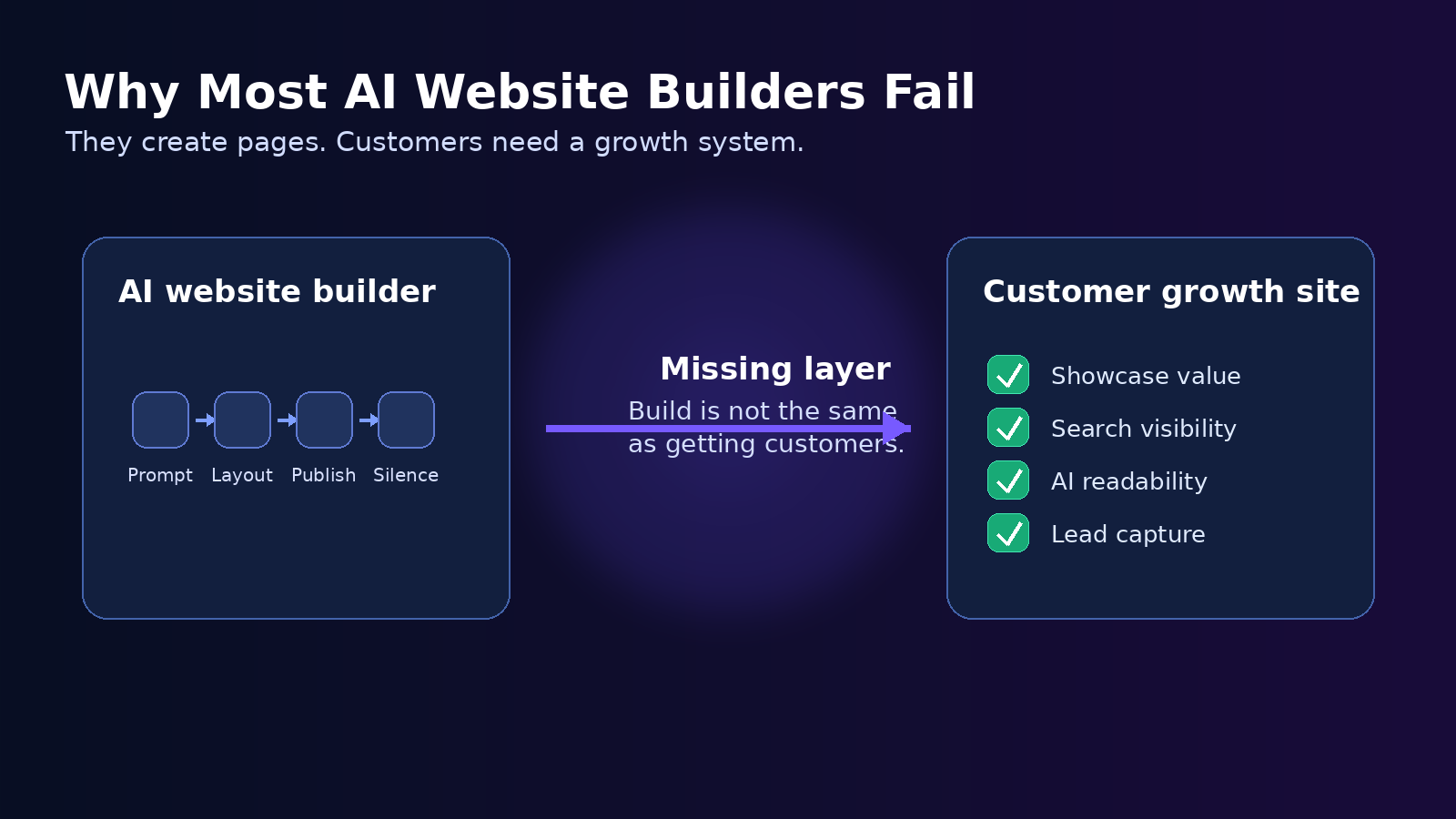
Most AI website builders are good at one thing: making something appear on the screen quickly.
You type a prompt. A layout appears. A few sections show up. Maybe there is a hero block, a pricing block, some testimonials that sound a little too perfect, and a contact button at the bottom.
It feels like progress.
But then the site goes live, and nothing happens.
No traffic. No inquiries. No booked calls. No signups. No customers.
That is the part nobody likes to say out loud: a website can be finished and still be useless for growth.
The problem is not that AI website builders are bad. The problem is that most of them stop at the easiest part of the job. They help you build a page. They do not help you build a customer path.
The uncomfortable truth: a page is not a customer system
A website is not valuable just because it exists. It becomes valuable when it helps the right person understand why they should care and what they should do next.
That sounds simple, but it is where most AI-generated websites fall apart.
They often look modern. They often have decent colors. They often use nice spacing. But they are thin where it matters most: positioning, proof, search structure, AI readability, and conversion logic.
In other words, they answer the wrong question.
They answer: How can I publish a website fast?
But founders, creators, consultants, agencies, and small businesses need a different answer: How can my website help people discover me, trust me, and become a lead?
Why most AI website builders fail
Most AI website builders fail because they treat the website as the final output. In reality, the website is only the starting point.
A customer does not arrive because a page is pretty. A customer arrives because multiple things work together: the offer is clear, the page is searchable, the content is structured, the proof is believable, the CTA is obvious, and the visitor has a reason to act now.
Here are the most common failure points.
1. They generate generic positioning
AI website builders are usually trained to produce safe website copy. That means they often write the same kind of phrases for everyone: streamline your workflow, unlock your potential, transform your business, scale faster.
Those lines are not wrong. They are just forgettable.
If your homepage could belong to any other product, agency, consultant, or service provider, it will not help a serious buyer make a decision. Buyers need to know who you help, what problem you solve, why you are credible, and what result they can expect.
Generic copy makes the site feel complete. Clear positioning makes the site useful.
2. They focus on layout before intent
A layout is not strategy. A grid, a hero image, or a fancy animation does not explain why someone should contact you.
Many AI website builders start with sections. The better approach starts with intent. What does the visitor already know? What are they unsure about? What proof do they need? What search query brought them here? What action should they take?
When you skip those questions, the page becomes decoration.
3. They do not build for search visibility
A website that nobody can find is not a growth asset.
Google Search Central describes SEO as helping search engines understand content and helping users find your site through search. That means the job is not just to publish text. The job is to make the content clear enough for both humans and search systems to interpret.
Many AI-generated websites contain short, vague sections with little depth. That makes them hard to rank for meaningful keywords. It also makes them less useful for people who are comparing options.
4. They are not ready for AI search
Search is no longer only about blue links. ChatGPT search can provide answers with links to relevant web sources, and Perplexity describes itself as an answer engine that researches the open web and returns cited answers. Google also provides guidance for AI features in Search from a site owner perspective.
That changes what a website needs to do. Your pages must be clear, structured, and easy to extract. If the content is vague or hidden inside generic marketing language, AI systems have less useful material to cite or summarize.
5. They miss the lead-generation layer
A website can attract attention and still fail to convert. The visitor needs a path. They need to know what to do next. They need a CTA that matches their level of intent.
For example, a cold visitor may not be ready to book a call. They may need a case study, a template, a demo, a comparison, or a simple explanation first. A growth-ready site does not force every person into one button. It creates a path from awareness to action.
Builder-only websites vs growth-ready websites
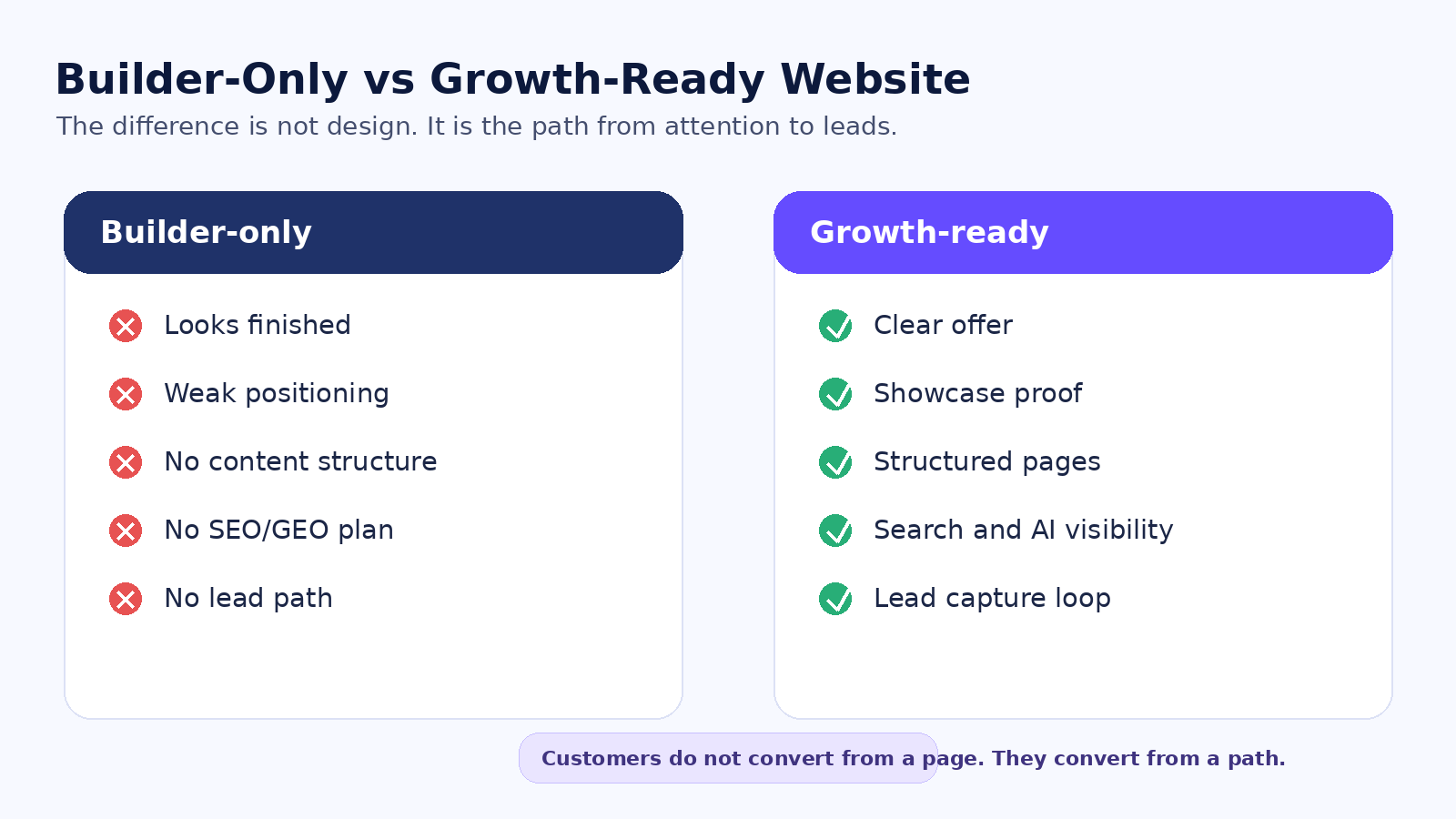
Builder-only website | Growth-ready showcase website |
Looks finished | Communicates a sharp offer |
Uses generic copy | Explains who it is for and why it matters |
Publishes a few sections | Builds a discovery-to-lead path |
Treats SEO as metadata | Uses structured content and search intent |
Has one contact button | Uses proof, examples, and clear conversion moments |
Ends at launch | Keeps improving through growth signals |
This is the real difference.
A builder-only website is a digital object. A growth-ready showcase website is a customer acquisition system.
The first one asks: Is the page live?
The second asks: Can the right customer find it, understand it, trust it, and take action?
What a customer-getting website actually needs
If you want a website to generate customers, it needs more than a homepage. It needs a few core layers working together.
Clear offer
The page should make the offer obvious within a few seconds. Not clever. Not abstract. Obvious.
A good offer answers: what is this, who is it for, what problem does it solve, and why should I care now?
Showcase structure
A showcase website is not just a portfolio. It is a structured way to present value. It can showcase products, services, work, use cases, customer examples, templates, outcomes, or expertise.
This matters because people do not buy from a claim. They buy from context. They need to see the thing, understand the use case, and imagine themselves getting the result.
SEO and GEO-ready content
Traditional SEO still matters. You need searchable pages, meaningful headings, relevant keywords, helpful explanations, and technical basics.
But AI search adds another layer. Your content should also be easy to extract and summarize. Definitions, comparisons, FAQs, examples, and structured sections all help make a page more useful in AI-assisted discovery.
Proof that feels real
Many AI-generated sites use fake-sounding testimonials or generic trust sections. That does not work anymore.
Real proof can be simple. It can be screenshots, examples, before-and-after context, client outcomes, use cases, or a small explanation of how the work happens. The key is that it should reduce doubt.
Conversion path
The CTA should not feel like a random button. It should match the page journey.
If the article educates, the CTA can invite the reader to build a page, view a template, or start a simple project. If the page compares options, the CTA can move toward a demo or signup. If the page showcases work, the CTA can invite inquiries.
Where We0.ai fits in
We0.ai is not useful because it can simply create another page. That alone is not enough.
The stronger idea is that a website should move through a bigger loop: build, showcase, grow, and generate leads. That is the difference between having a site and having a growth asset.
In this model, the website is not treated as a static brochure. It becomes a structured place where a product, service, offer, portfolio, template, or case can be presented in a way that search engines, AI systems, and real buyers can understand.
That is the part most AI website builders miss.
They optimize for speed. We0.ai is designed around the larger job: helping the website become easier to discover, easier to understand, and easier to convert from.
The customer path matters more than the tool
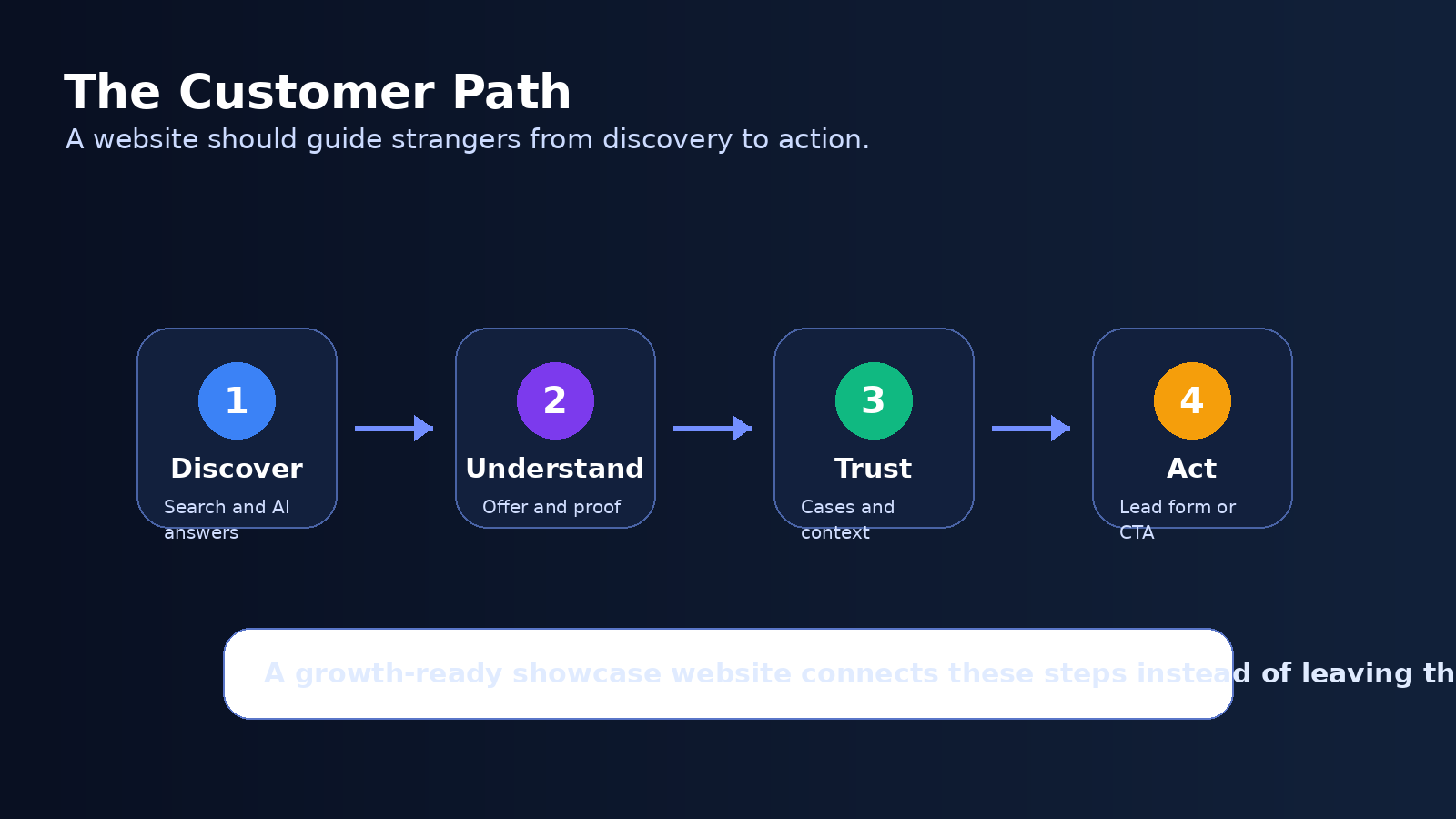
The tool is not the strategy. The customer path is the strategy.
A strong website usually follows a simple sequence: discovery, understanding, trust, action.
Discovery means the right person can find you through search, AI answers, social sharing, referrals, or direct links. Understanding means the page explains your offer without making people decode vague language. Trust means the visitor sees enough proof to believe you. Action means the next step is clear and low-friction.
Most AI builders only help with a piece of the second step. They help create a page that explains something. But the full job is bigger.
That is why so many fast-built websites quietly fail. They look like websites, but they do not behave like growth systems.
Who should care about this
This matters most if your website is supposed to bring customers, not just exist as a business card.
Founders need it because an early website often has to explain a product before the market fully understands it. Consultants need it because trust and clarity decide whether someone books a call. Agencies need it because their websites must prove taste, process, and outcomes. Creators and independent professionals need it because a portfolio is not enough if it does not create inbound opportunities.
Small businesses need it too. A local service company, boutique agency, export business, or software studio does not need a website that simply says who they are. It needs a website that answers buyer questions and turns interest into action.
A simple checklist before you publish
Before you publish an AI-generated website, ask these questions:
Can a first-time visitor understand the offer in five seconds?
Does the page explain who the website is for?
Does it show proof, examples, or use cases?
Does each section move the visitor closer to a decision?
Are the headings clear enough for search engines and AI systems?
Does the page target real search intent instead of vague buzzwords?
Is there a clear CTA that matches the reader's stage?
Can the site become a larger content and growth system over time?
If the answer is mostly no, the site is not ready. It may be published, but it is not working yet.
Final thought
AI website builders made website creation faster. That is good.
But speed is not the same as growth.
The next stage is not about generating more pages. It is about generating better paths. A useful website has to connect the offer, the audience, the content, the search layer, the AI visibility layer, and the conversion layer.
That is why most AI website builders fail at getting customers. They stop at the build.
The better question is not how fast can you launch a website. The better question is: can this website help the right customer find you, understand you, trust you, and take action?
That is the job of a real showcase website.
CTA
If your website looks finished but does not bring customers, the issue may not be design. It may be structure.
Build a showcase website that is clear, searchable, AI-readable, and ready to turn visitors into leads.
Start with We0.ai: https://we0.ai
FAQ
Why do AI website builders fail to get customers?
Most AI website builders focus on generating pages quickly, but customer acquisition requires positioning, search visibility, structured content, proof, and a clear lead path. A page alone does not create demand.
Can an AI-generated website rank on Google?
Yes, but only if the content is useful, structured, relevant, and technically accessible. A generic AI-generated page with thin copy is unlikely to perform well for meaningful search terms.
What is the difference between a website builder and a lead generation website?
A website builder helps create and publish pages. A lead generation website is designed to attract the right visitors, explain value clearly, build trust, and guide visitors toward an inquiry, signup, or purchase.
What is a showcase website?
A showcase website is a structured site that presents a product, service, portfolio, case, template, or business offer in a way that makes value easy to understand and act on.
Does We0.ai replace Webflow or Framer?
Not exactly. Webflow and Framer are strong website creation platforms. We0.ai is positioned around the showcase website growth loop: building, showcasing, growing visibility, and generating leads.
Related Tools
Sources