What Is an AI Agent Workspace? Why Persistent Cloud Environments Are the Next AI Platform Layer
An AI agent workspace is a persistent cloud environment where AI agents can keep context, access tools, execute tasks, preserve state, and return work for human review. This guide explains why persistent cloud environments are becoming the next AI platform layer, how they differ from ordinary chatbots and automation tools, and why they matter for long-running agents, knowledge work, enterprise AI, software development, SEO workflows, GEO content systems, and showcase website growth. It also explains how OpenAI Codex, Ona, Claude Code, Cursor cloud agents, and agent SDKs point toward a future where AI systems do not just answer prompts, but operate inside governed workspaces.
What Is an AI Agent Workspace? Why Persistent Cloud Environments Are the Next AI Platform Layer
For the first two years of the AI boom, the main interface was simple: a chat box.
You typed a prompt. The model answered. If the answer was not enough, you asked again. This was powerful, but it also kept AI trapped inside a short session. The model could explain work, draft work, and sometimes guide work, but it rarely had a durable place to keep working.
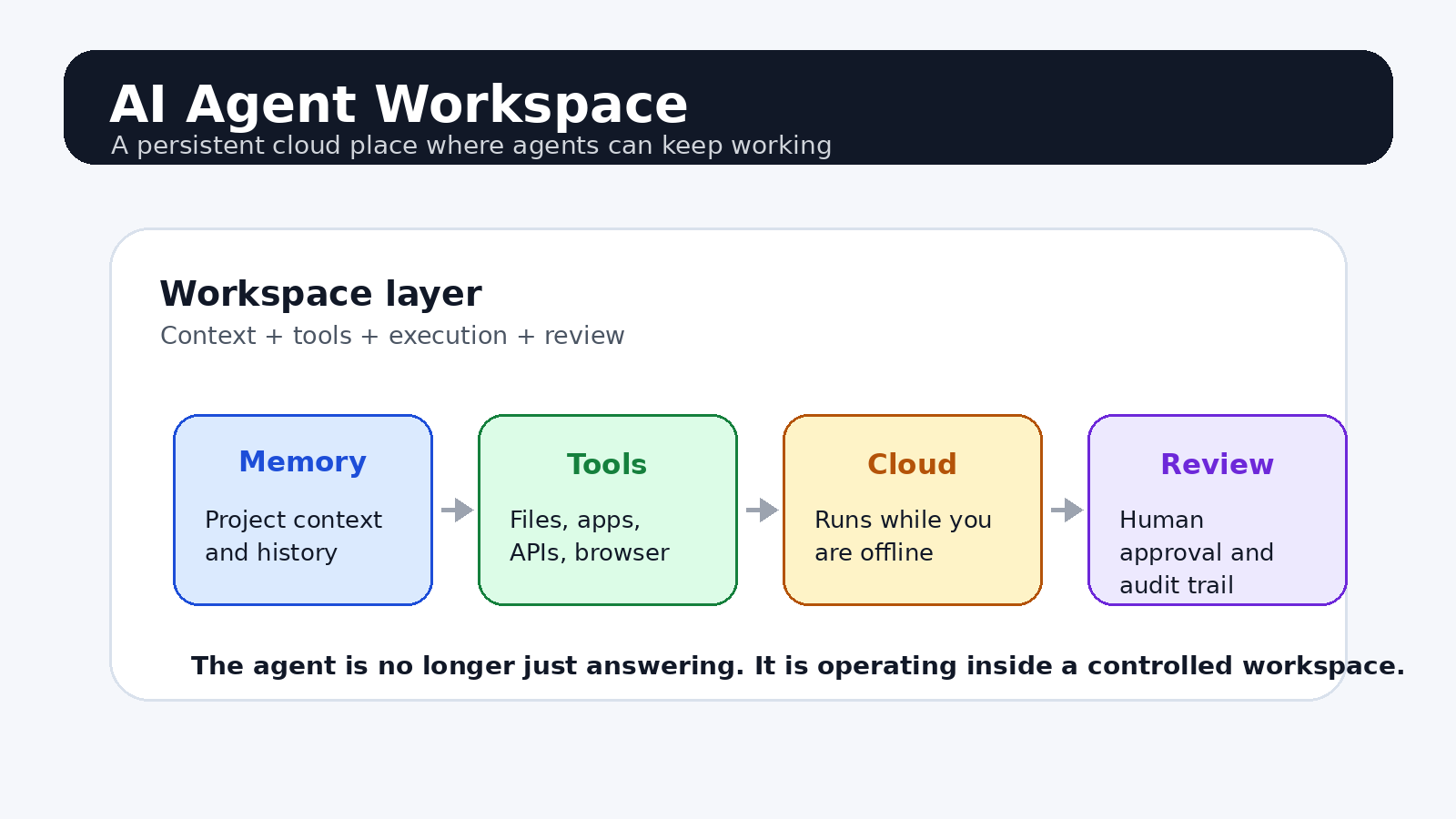
That is now changing. The next important AI platform layer is the AI Agent Workspace: a persistent cloud environment where AI agents can keep context, access tools, run tasks, preserve state, and return work for human review.
This sounds technical, but the business meaning is simple. AI is moving from answer generation to work execution. The question is no longer only whether the model is smart. The question is whether the model has a reliable place to work.
What is an AI Agent Workspace?
An AI Agent Workspace is a controlled environment where an AI agent can work across time, tools, files, data, and review steps. It is not just a chat window. It is closer to a digital office for the agent.
Inside that workspace, the agent can hold task context, read files, use approved tools, run code, search information, update documents, create outputs, and wait for approval. The workspace gives the agent continuity. It also gives the user control.
The simplest definition is this: an AI Agent Workspace is the place where an AI agent turns instructions into reviewable work products.
That last phrase matters. A chatbot returns text. A workflow automation triggers predefined steps. A true agent workspace lets AI operate in a bounded environment where work can continue even when the user is not actively prompting every step.
Why persistent cloud environments matter
Persistent cloud environments solve the biggest weakness of ordinary AI tools: reset.
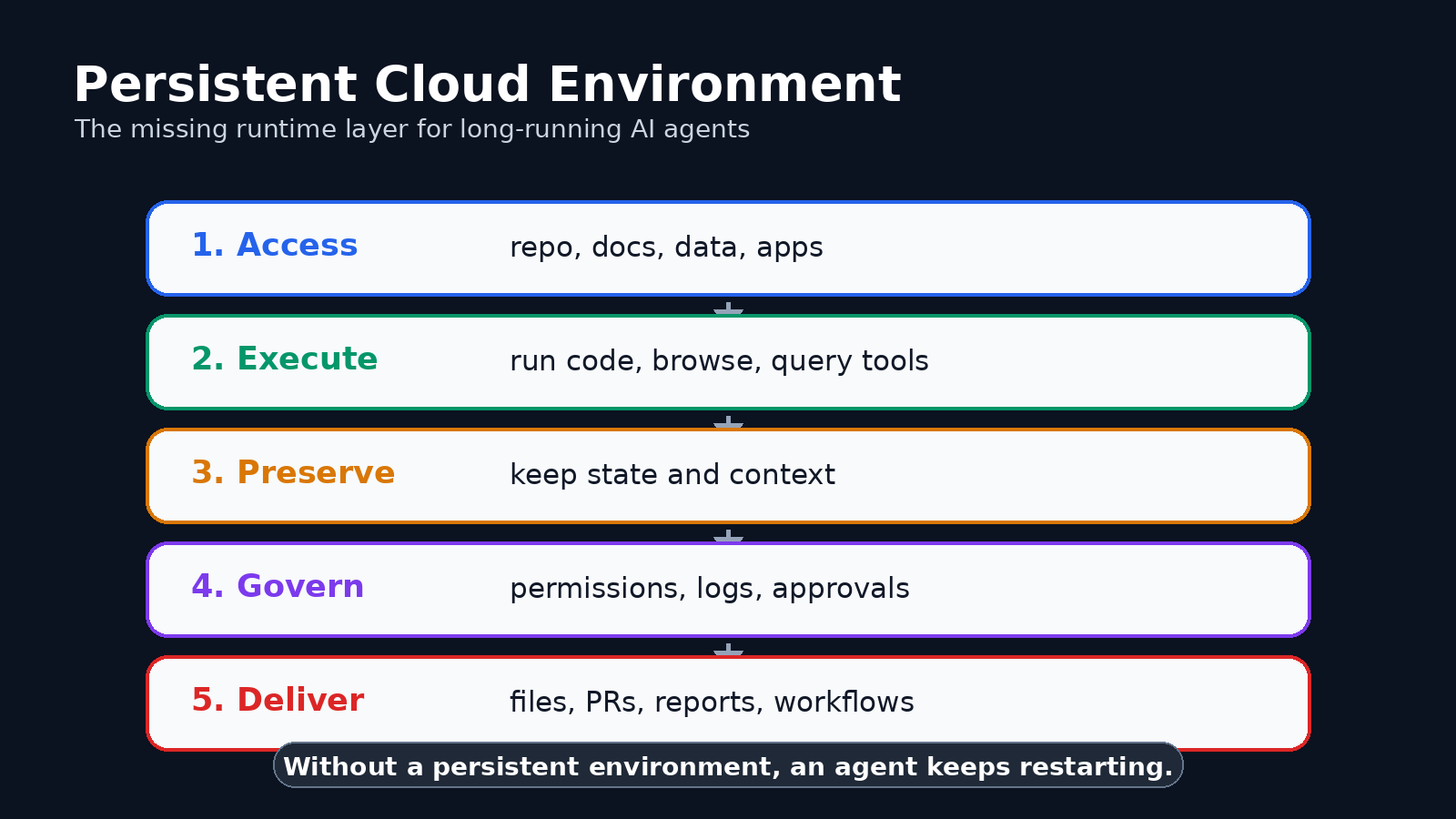
When a session resets, the agent loses the working environment. It may remember some conversation, but it does not necessarily preserve files, dependencies, tools, command history, project state, or partial results. For serious work, that is a problem.
A persistent cloud environment gives the agent somewhere to continue. It can keep the relevant repo, documents, packages, credentials, logs, and output files in one governed place. That means a task can run in the background, pause for review, resume later, and still stay connected to the original context.
OpenAI describes its planned Ona acquisition as a way to expand Codex with secure, customer-controlled cloud infrastructure for long-running agents across software and knowledge work. Codex cloud documentation also says Codex can work on tasks in the background, including in parallel, using its own cloud environment. This is exactly the direction: agents need a persistent place to work, not just a better prompt box.
The difference between chat, automation, and agent workspace
It helps to separate three concepts.
Chat is conversational. It is good for thinking, drafting, explaining, summarizing, and quick iteration. But chat depends heavily on the user to drive each step.
Automation is rule-based. It is good when the workflow is predictable: when this happens, do that. But automation struggles when judgment, interpretation, or changing context matters.
An AI agent workspace sits between and above both. It can understand natural language goals like chat, but it can also execute multi-step work like automation. The difference is that it does the work inside a governed environment that keeps context, tools, permissions, and outputs together.
Layer | Best for | Weakness | Next step |
Chat | Thinking and drafting | Short sessions | Workspace |
Automation | Repeatable rules | Limited judgment | Agent logic |
Agent workspace | Long-running work | Needs governance | Platform layer |
What belongs inside an agent workspace?
A useful agent workspace has several layers.
First, it needs memory and state. The agent should understand the project, the task, the files, and what has already happened. Second, it needs tools. These may include code execution, browser access, APIs, databases, documents, spreadsheets, design files, or internal systems. Third, it needs execution. The agent must be able to run steps, test results, and produce artifacts. Fourth, it needs governance. Humans need permission controls, logs, approval points, and safe rollback paths.
Without these layers, the agent is just a smart assistant with nowhere to operate. With these layers, the agent becomes a work system.
Why this becomes the next AI platform layer
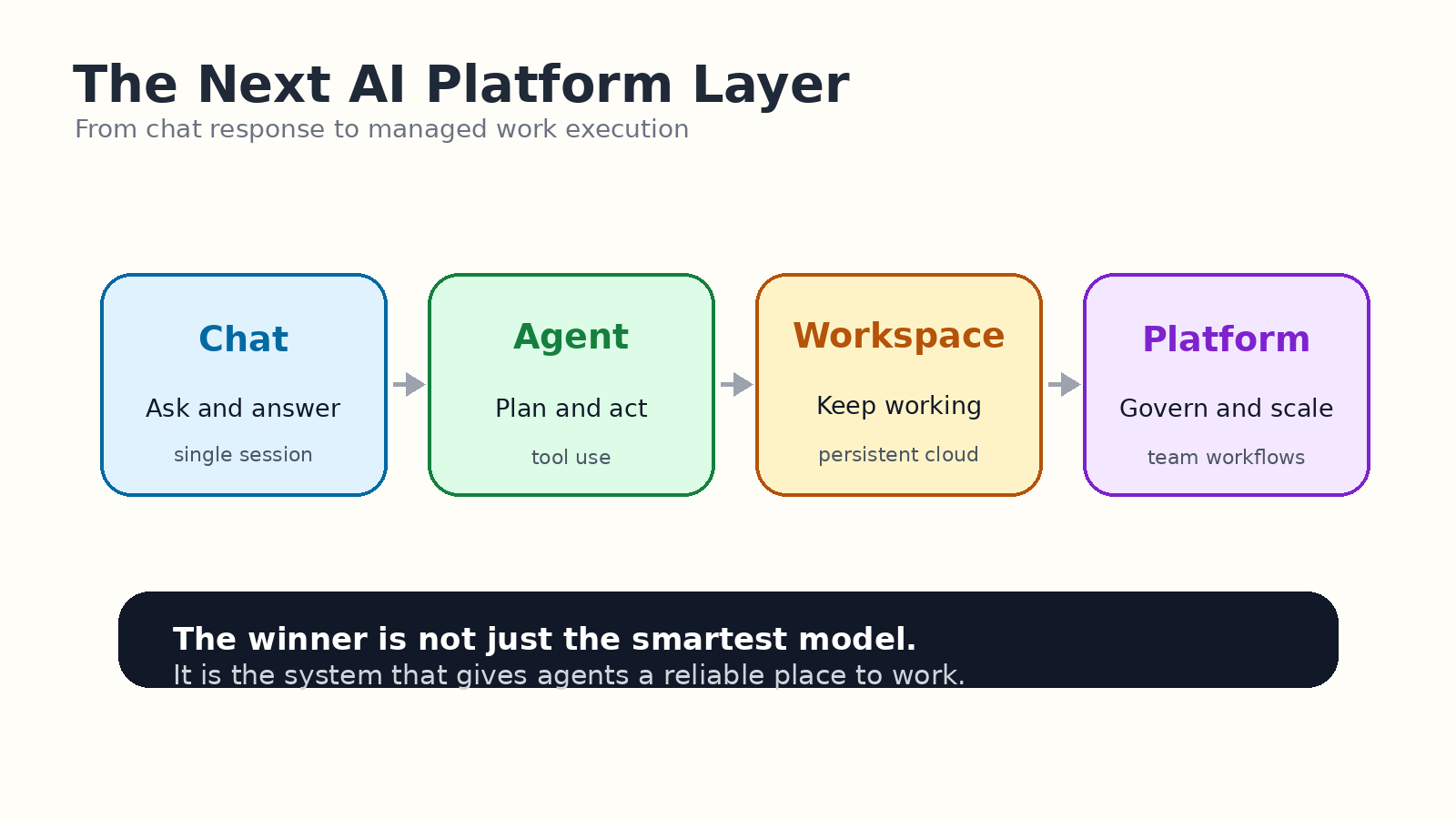
The first AI platform layer was the model. The second was the chat interface. The third was tools and integrations. The next layer is the workspace.
This matters because real work is not a single answer. Real work has files, versions, permissions, dependencies, history, stakeholders, deadlines, and review cycles. The model alone cannot manage that. The chat box cannot manage that either. The workspace can.
This is why products like Codex cloud, Ona environments, Claude Code, and Cursor cloud agents all point in the same direction. The competition is no longer only about who has the best autocomplete or the smartest coding assistant. It is about who can give agents a safe, persistent, observable place to work.
Why knowledge work needs this layer
Knowledge work is full of tasks that are too long for a single prompt and too flexible for rigid automation.
A research report may require source gathering, outlining, writing, charting, citations, and formatting. A spreadsheet model may require cleaning data, building formulas, checking assumptions, and explaining results. A content system may require keyword clustering, article drafts, image generation, internal review, SEO updates, and GEO-ready summaries.
These workflows are not just language tasks. They are artifact workflows. The agent must move from idea to file, from file to review, and from review to publishable output.
That is why persistent cloud environments matter for more than developers. Software engineering is the first obvious use case because code has tools, tests, repos, and clear outputs. But the same pattern applies to marketing, finance, operations, legal, consulting, and content teams.
What it means for SEO and GEO workflows
SEO and GEO work are perfect examples of why agent workspaces matter.
An SEO workflow may involve keyword research, competitor analysis, page outlines, draft writing, internal linking, metadata, image briefs, source checks, and publishing coordination. A GEO workflow may require answer-ready summaries, comparison tables, FAQ blocks, cited claims, and content that AI search systems can extract.
If an AI agent only writes one paragraph, it is not enough. The useful version is a workspace where the agent can maintain a content plan, update multiple pages, check structure, prepare images, track sources, and return a reviewable publishing package.
That is the shift from AI writing to AI content operations.
Where We0.ai fits into the trend
For We0.ai, the agent workspace trend is directly relevant because showcase websites are becoming living growth assets.
A showcase website does not end when the homepage is published. It needs SEO pages, GEO sections, comparison content, images, lead-generation paths, examples, and ongoing updates. That is too much to manage as one-off prompts forever.
The stronger future is a system where AI agents help build, showcase, grow, and optimize the site over time. In that model, We0.ai is not only about creating a website. It becomes part of a website growth workspace: a place where content, visuals, search visibility, AI search readiness, and lead generation can keep improving.
The risks: why governance cannot be optional
Persistent agents create new power, but also new risk.
If an agent can keep working, access tools, and make changes, the system needs boundaries. Permissions should be scoped. Credentials should be controlled. Risky actions should require human review. Logs should show what happened. Work should be easy to inspect and roll back.
This is why agent infrastructure cannot be treated as a toy layer. Enterprise AI needs governance from the beginning. The more persistent the agent becomes, the more important the control plane becomes.
Final takeaway
The AI Agent Workspace is the missing layer between model intelligence and real-world work.
Models can reason. Tools can execute. But work needs continuity. It needs a place where context, files, tools, permissions, execution, and review live together.
That is why persistent cloud environments are becoming the next AI platform layer. The future of AI is not just smarter answers. It is managed work execution inside persistent, governed workspaces.
CTA
If your website, SEO content, GEO pages, or lead-generation system still depends on one-off prompts, the next step is structure. Build a clearer workspace around your growth assets so AI can help improve them over time.
Explore We0.ai
FAQ
What is an AI Agent Workspace?
An AI Agent Workspace is a controlled environment where AI agents can keep context, access tools, execute tasks, preserve state, and return work for human review.
What is a persistent cloud environment?
A persistent cloud environment is a cloud-based workspace that keeps files, tools, permissions, state, and outputs available so agents can continue work over time.
How is an agent workspace different from a chatbot?
A chatbot mainly answers in a session. An agent workspace lets the AI perform multi-step work inside a governed environment.
Why do AI agents need cloud environments?
Cloud environments give agents compute, tools, state, files, and safe boundaries so they can work in the background or in parallel.
Does this matter outside software development?
Yes. The same workspace pattern can support reports, spreadsheets, content systems, SEO workflows, GEO pages, operations, and lead-generation assets.
How is this related to We0.ai?
It supports the idea that a showcase website can become a living growth system where AI agents keep improving content, visibility, and conversion paths.
Related Tools
- Codex
- Ona
- Claude
- Cursor
Sources
- Ona News
- Ona Env