SenseNova U1 Pro at WAIC 2026: Native 8K Image Generation Built for Delivery-Grade Design
At WAIC 2026, SenseTime introduced SenseNova U1 Pro , its next flagship multimodal model for complex visual-creation tasks.
SenseNova U1 Pro at WAIC 2026: Native 8K Image Generation Built for Delivery-Grade Design
Introduction
At WAIC 2026, SenseTime introduced SenseNova U1 Pro, its next flagship multimodal model for complex visual-creation tasks.
The launch demonstration centered on an ultra-wide Eastern-style city scroll titled The World Meets Through Intelligence. The image was created for the ninth World Artificial Intelligence Conference and compressed the event’s development from 2018 to 2026 into one continuous visual narrative.
The scroll combined city landmarks, rivers, mountains, crowds, architecture, labels, and dense historical details across an unusually wide canvas. SenseTime said the image was produced directly by U1 Pro at native high resolution rather than assembled through a separate manual design pipeline.
The model’s broader goal is more important than the single demonstration.
SenseNova U1 Pro is positioned as a delivery-grade native multimodal agent foundation model. Instead of producing one image immediately after receiving a prompt, it is designed to reason about layout, generate drafts, inspect intermediate results, revise local areas, and refine the final composition through a longer generation process.
In other words, SenseTime is trying to move AI image generation from “make something visually impressive” toward “produce an asset that can be used in a real design workflow.”
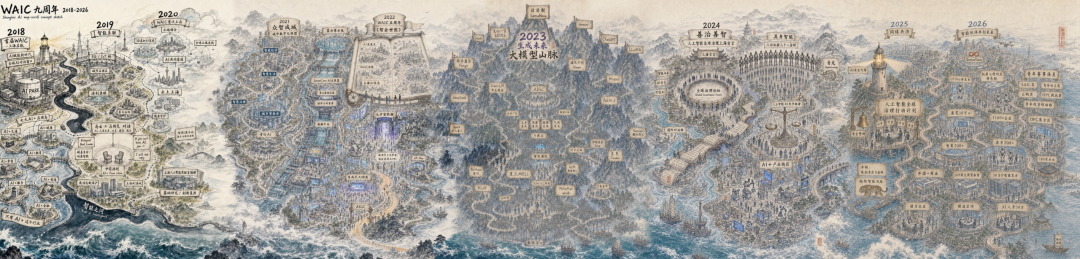
An 8K Eastern Scroll Built for WAIC
The conference scroll uses a panoramic format closer to a traditional Chinese handscroll than a standard poster or social-media image.
It connects nine years of WAIC through one continuous landscape. The composition includes:
- Mountains and water systems.
- Urban landmarks.
- Conference venues.
- Crowds and public scenes.
- Small labels and annotations.
- Shifts in visual tone across different years.
- A consistent ink-and-color aesthetic across the entire width.
Creating a large image of this type is difficult for several reasons.
First, an ultra-wide composition must remain coherent from one side to the other. A model can generate attractive local regions while losing the global structure of the scene.
Second, the image contains many small objects and labels. Errors that are barely visible in a standard preview become obvious when the image is displayed on a large wall.
Third, the composition needs continuity. Buildings, rivers, roads, mountains, and text cannot feel like unrelated fragments pasted together.
SenseTime says U1 Pro supports output up to 8K resolution and unusual aspect ratios. The official product page presents this as a production feature intended for high-resolution materials and detailed visual delivery.
The online version of the WAIC scroll is compressed, so it does not preserve the full quality of the original display asset.
Different Scenes, One Creation Model
The launch article presented U1 Pro across several visual categories rather than limiting the model to one signature style.
The examples included:
- Historical panoramic scenes.
- Suspense-film posters.
- Anime performance posters.
- Premium product advertising.
- Museum and exhibition posters.
- Science infographics.
- Tea-category information design.
- Character-setting sheets.
- Recipe illustrations.
This range matters because commercial design is not a single task.
A useful model needs to adapt its composition, typography, visual hierarchy, material rendering, color system, and information density to the intended format.
Historical Panoramas with Large Character Groups
One example recreated the Western Market of Chang’an during the Tang dynasty in a 21:9 composition.
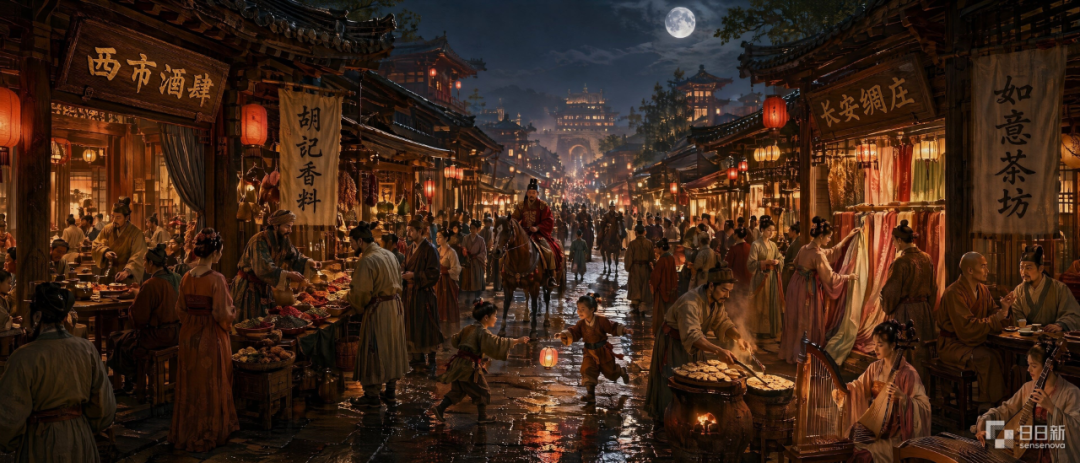
The image contains a large crowd, multiple stores, horses, musicians, merchants, children, lanterns, and layered architecture.
Large group scenes are a common failure point for image models. Repeated faces, duplicated clothing, malformed hands, inconsistent scale, and copied poses can make the scene feel synthetic.
The U1 Pro example attempts to keep each character visually distinct while preserving the larger street composition. Warm lantern light, cool night tones, reflections, and architectural depth are handled within one scene.
This is still a selected company demonstration rather than an independent benchmark. It does, however, show the type of dense composition SenseTime considers central to the model.
Posters with Narrative Space and Typography
The launch materials also included a Republican-era Shanghai suspense-film poster.
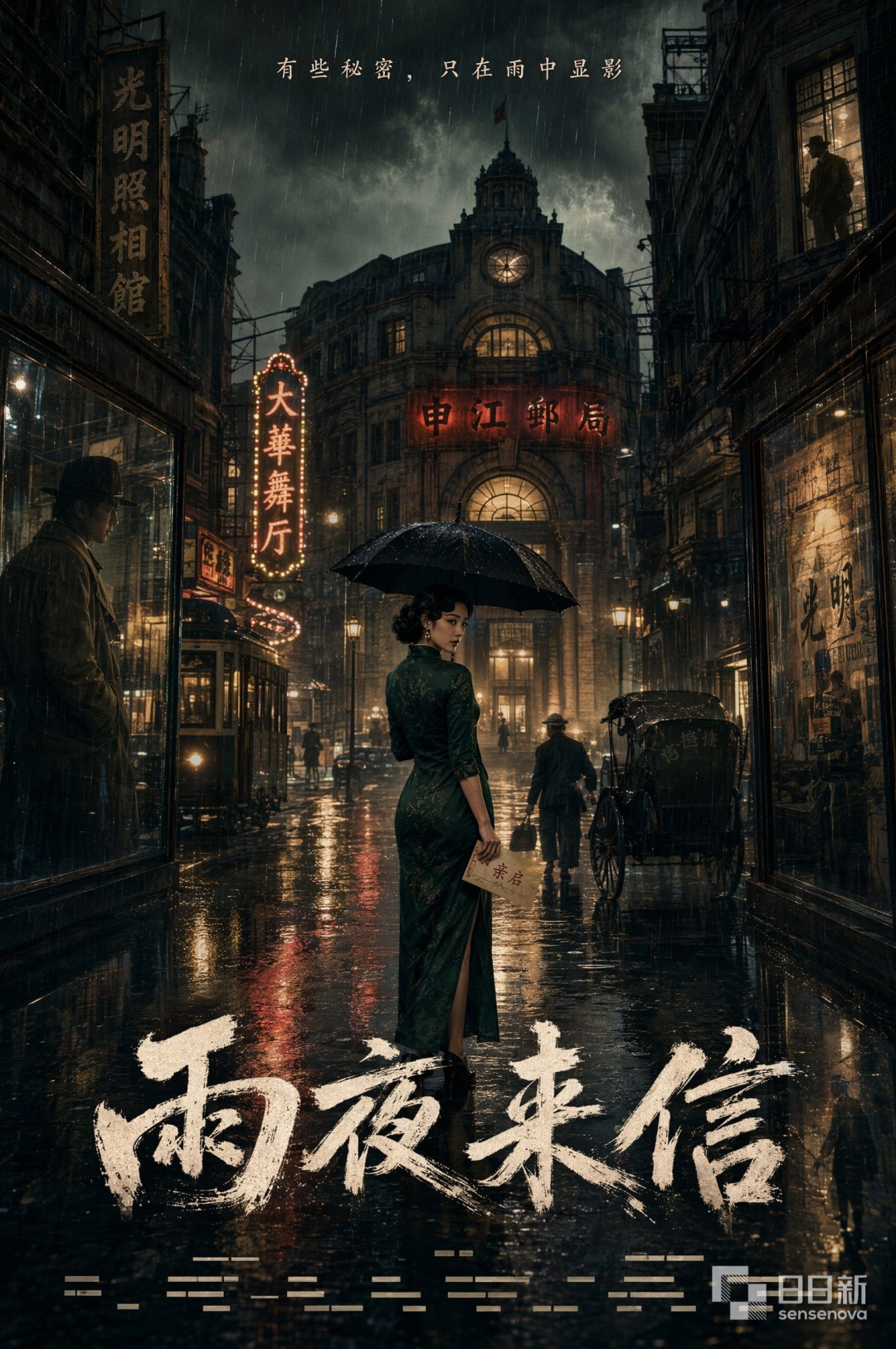
The composition uses rain, glass reflections, fog, street lighting, and multiple characters at different depths.
The point of the example is not just photorealism. The model needs to understand how visual elements support a narrative:
- Which figure is the focal subject.
- Which figures should remain partly hidden.
- How reflections relate to real space.
- Where the title belongs.
- How the environment creates suspense.
- How supporting text should remain secondary.
Another example, Chang’an Never Sleeps, uses five musicians, five instruments, distinct costumes, and a gold-red stage composition.
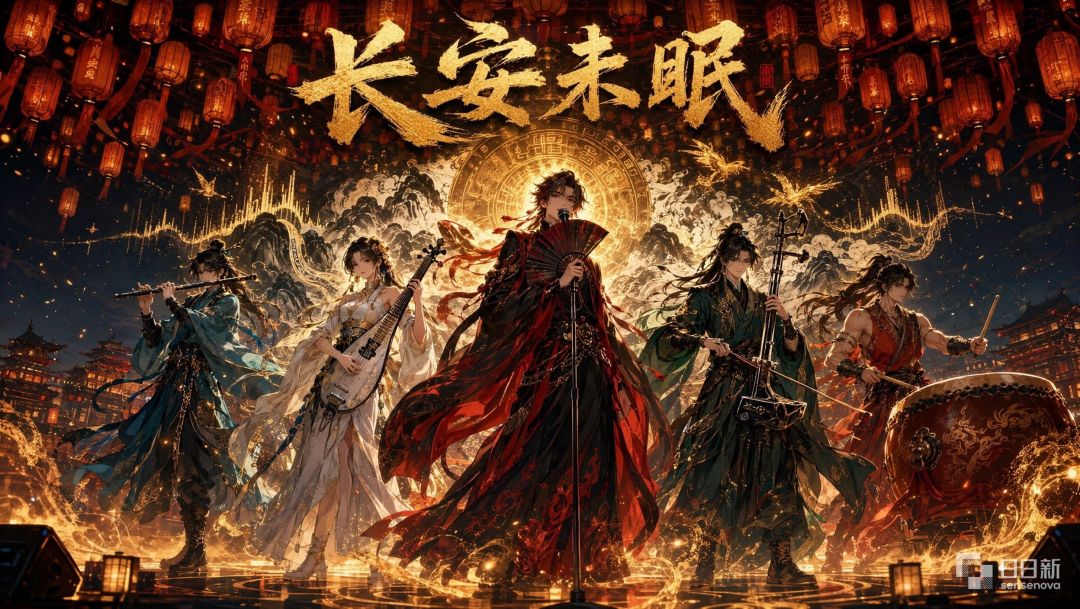
These samples show U1 Pro being used more like a layout and art-direction system than a simple prompt-to-image renderer.
Product Advertising and Material Rendering
Commercial advertising places different demands on a model.
A product visual must preserve:
- Packaging structure.
- Brand hierarchy.
- Readable product names.
- Consistent materials.
- Controlled reflections.
- Accurate perspective.
- Space for marketing copy.
- A composition that directs attention to the product.
The tea advertisement shown in the source material combines matte packaging, gold lettering, white porcelain, wood, tea leaves, and steam.
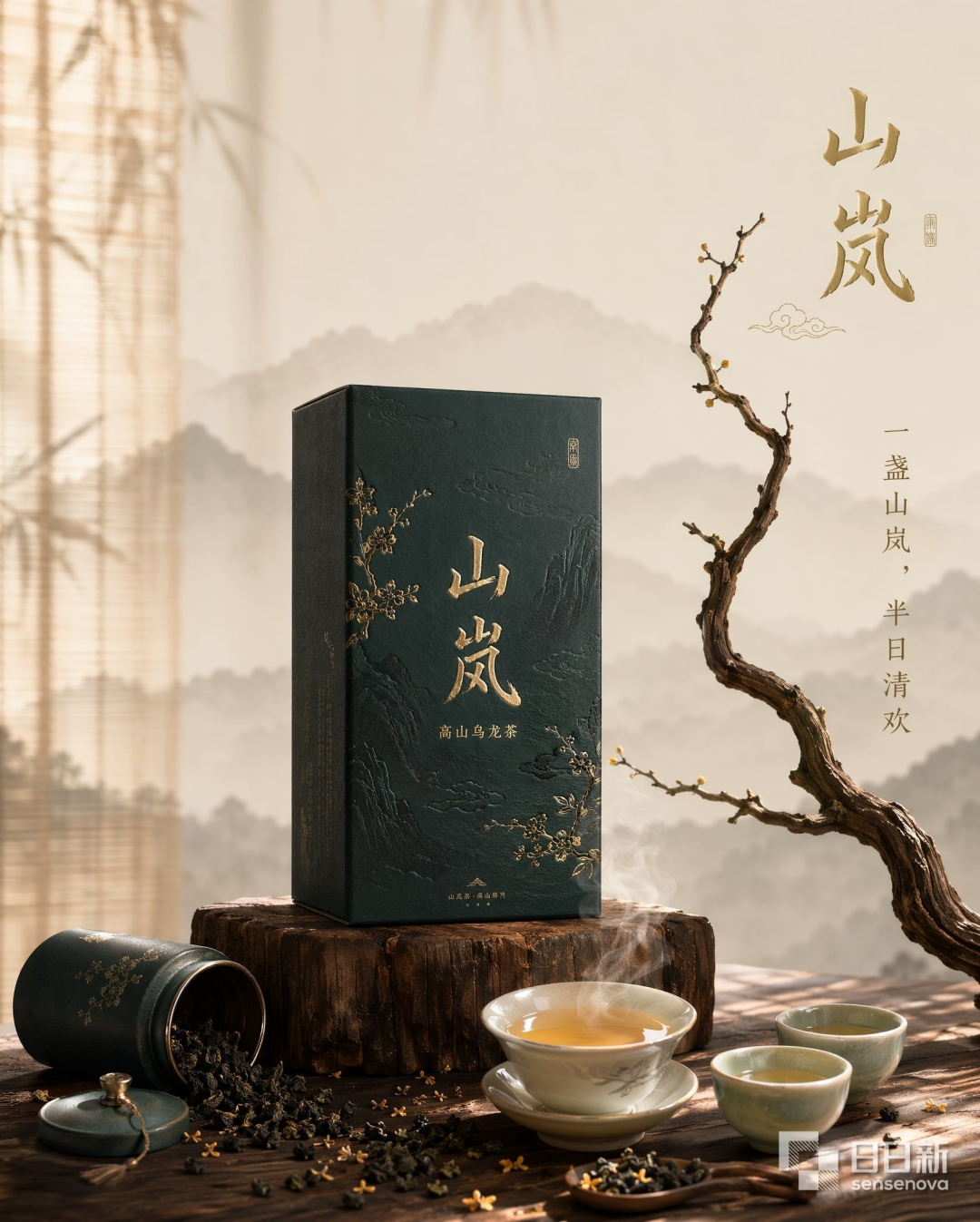
Material inconsistency is easy to notice in advertising. A paper box that looks like plastic or a ceramic cup with incorrect reflections can make the entire result unusable.
SenseTime presents U1 Pro as being able to combine several material types while maintaining a controlled visual style and readable Chinese copy.
Exhibition Posters and Two-Dimensional-to-Three-Dimensional Design
The exhibition poster Mountains and Rivers Enter the Painting combines ink-wash forms with three-dimensional mountains and clouds.
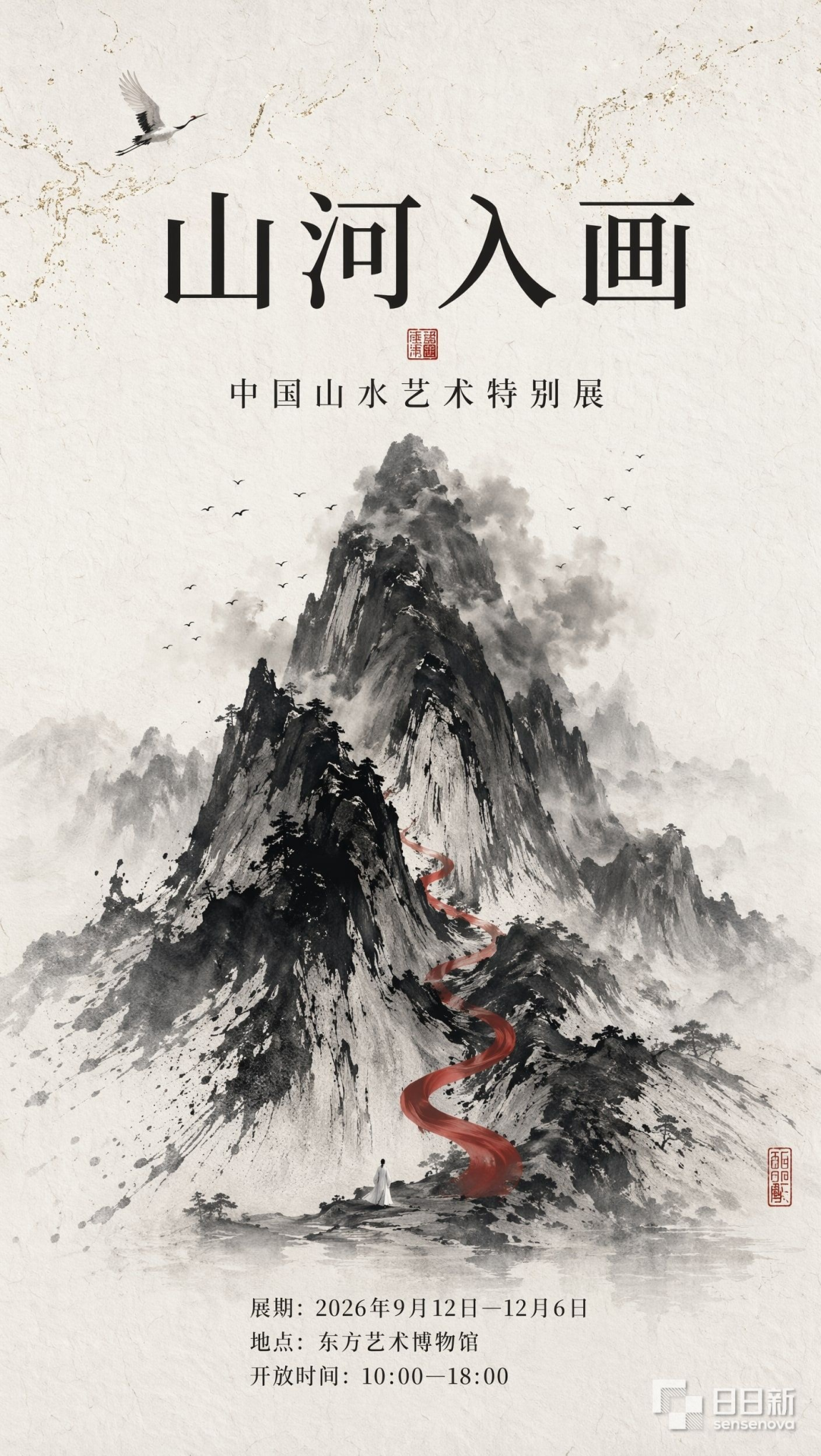
The lower portion begins as ink spreading across paper. The same forms gradually transition into mountains with realistic light and volume.
A red ribbon moves through the landscape and leads the eye toward a small human figure.
The example demonstrates several design capabilities:
- Maintaining one visual concept across the whole poster.
- Combining flat and volumetric rendering.
- Preserving a strong scale relationship.
- Placing event information within the composition.
- Keeping the Chinese title and supporting details readable.
For a production asset, text accuracy matters as much as visual quality. A poster with one incorrect date or character cannot simply be graded as “mostly correct.”
Long Chinese Text and Scientific Logic
Text-rich images remain one of the hardest areas for image-generation systems.
The model must solve two problems at once:
- Render the requested characters correctly.
- Place those characters into a readable information structure.
The moon-phase infographic shown at launch contains a title, explanatory paragraphs, labels, diagrams, and educational cards.
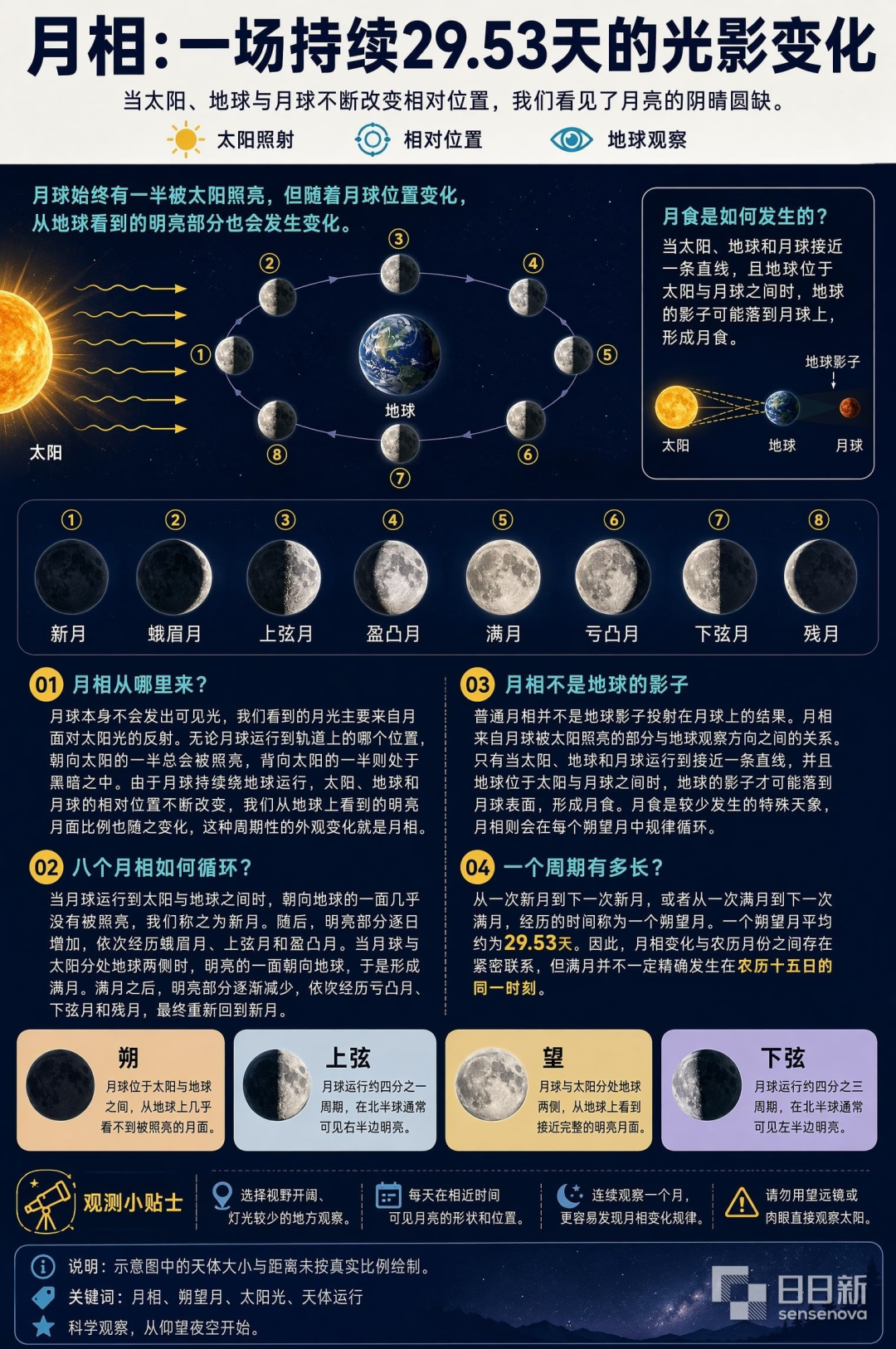
It also needs to represent the Sun–Earth–Moon relationship in a physically meaningful way.
A visually polished infographic can still fail if the scientific relationship is wrong. For this reason, text-rich educational graphics test more than OCR-like character rendering. They also test information organization and domain reasoning.
Another launch example presents the six major categories of Chinese tea in a radial layout.
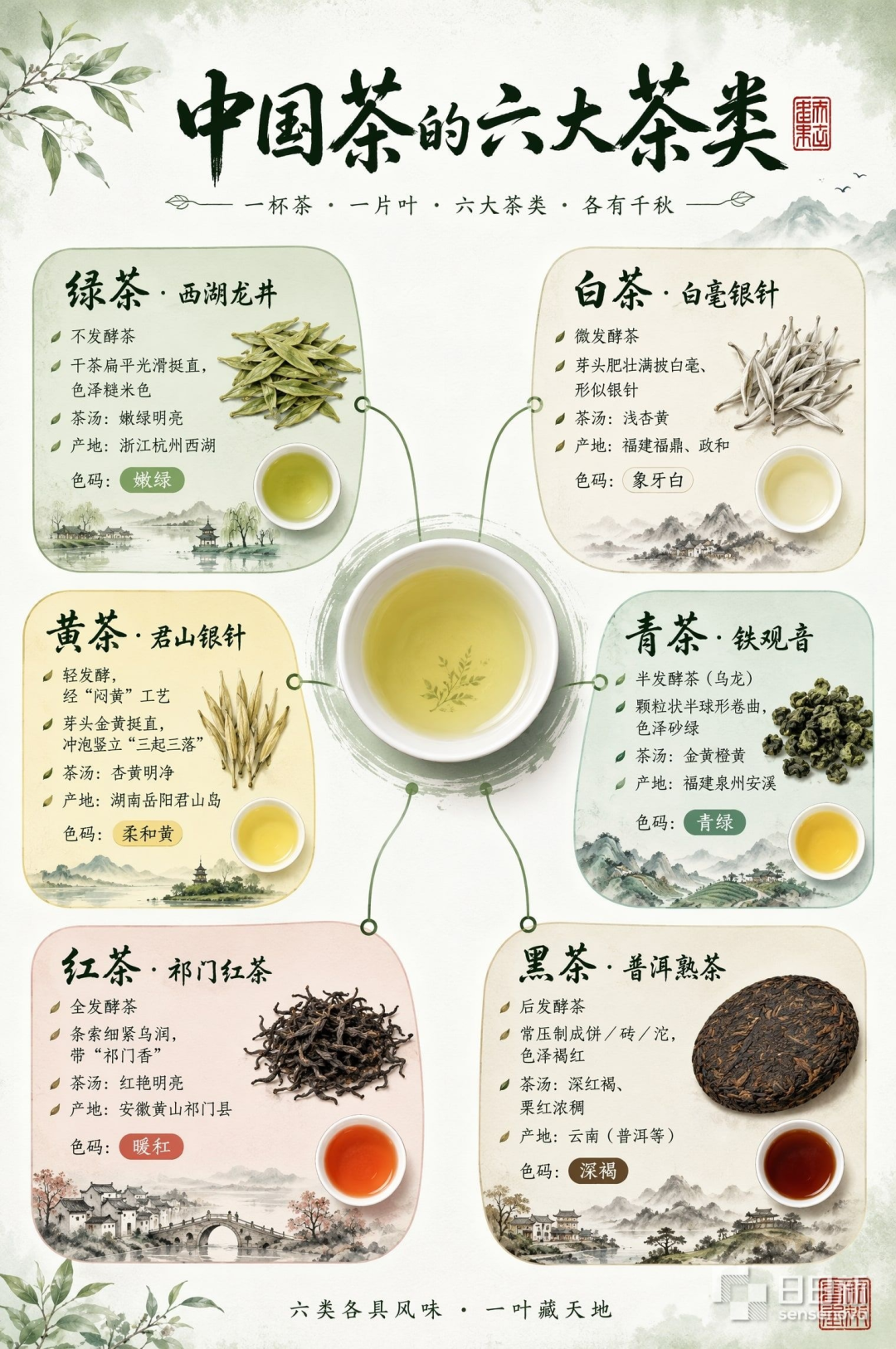
The composition combines:
- Category names.
- Tea-leaf imagery.
- Liquid colors.
- Places of origin.
- Supporting landscape illustrations.
- A central visual anchor.
- Repeated modules with consistent spacing.
SenseTime’s official product page now uses similar high-density infographics to demonstrate U1 Pro’s “precise content expression” capability.
A Model Designed for Delivery, Not Only Generation
SenseTime describes U1 Pro as a system for complex multimodal delivery tasks.
The distinction is important.
A traditional image generator generally follows this process:
Prompt → Image
The user decides whether the result works. If it does not, the user changes the prompt or applies another editing tool.
U1 Pro is presented as using a longer internal creation process:
Understand the request
→ plan the layout
→ generate an initial composition
→ inspect the result
→ revise local regions
→ combine elements
→ refine typography and details
→ deliver the final asset
The official and launch materials refer to this as an Agentic Generation Loop.
The model can use several visual actions rather than relying on one uninterrupted generation pass:
- Generate.
- Edit.
- Repaint a selected area.
- Compose multiple elements.
- Inspect what has already been created.
- Decide what action should happen next.
This design resembles the evolution of coding systems.
A code-completion model predicts the next lines. An agentic coding system can inspect a repository, plan a change, edit files, run tests, read errors, and continue until the task is complete.
SenseTime’s argument is that visual creation is moving in the same direction.
One Wrong Character Can Make the Whole Asset Unusable
Average visual scores can hide production failure.
Suppose an image contains 100 Chinese characters and 99 are correct. A benchmark based on average character accuracy may assign a high score.
A customer-facing poster is different.
If the incorrect character appears in a product name, date, address, scientific statement, or legal notice, the asset may need to be rejected.
This leads to a stricter definition of quality:
A production image is not judged by whether most elements look right. It is judged by whether the complete asset can be delivered.
SenseTime reportedly assembled an internal evaluation panel of 200 art-school students and professional designers.
The question was practical:
Would you be willing to deliver this image to a client?
The source article says that a model was considered qualified when at least 60% of the evaluated outputs were judged directly deliverable. SenseTime reported that U1 Pro and GPT Image 2 were the only systems in its comparison to meet that threshold.
The company further reported that U1 Pro performed particularly well in:
- Chinese text rendering.
- Graphic-design quality.
- Eastern cultural detail.
- High-information-density layouts.
These results come from SenseTime’s internal evaluation methodology. They are useful as product evidence, but they should not be treated as an independently reproduced public benchmark.
NEO-unify: A Native Unified Architecture
U1 Pro is built on SenseTime’s NEO-unify architecture.
The earlier SenseNova U1 models were introduced and open-sourced in April 2026. Their research paper describes a native unified approach to multimodal understanding, reasoning, and generation.
Many multimodal systems are assembled from distinct components:
- A visual encoder converts images into representations for understanding.
- A language model processes text and reasoning.
- A variational autoencoder or similar image decoder handles generation.
- Additional adapters connect the components.
This architecture can work well, but the different modules may learn incompatible internal spaces.
NEO-unify takes a different approach.
SenseTime says it removes the separate visual encoder and VAE from the core architecture, allowing text and image information to share one representation and one Transformer-based computation path.
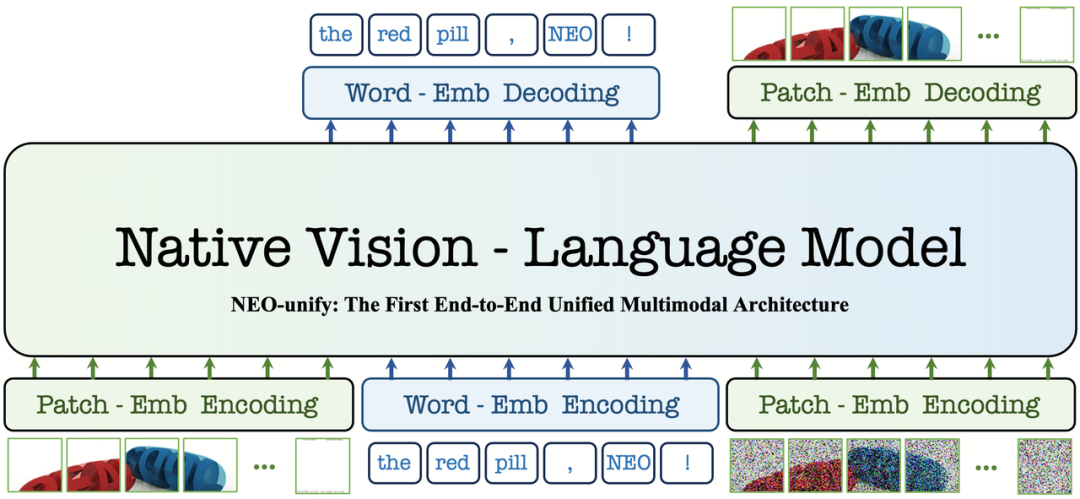
In a simplified view:
- Text enters as word embeddings.
- Images enter as patch embeddings.
- Both are processed inside the same model.
- The model can decode text tokens or image-patch tokens within one autoregressive sequence.
The system does not need a separate external scheduler to decide that one module should stop and another should begin.
The model predicts what comes next. It may continue in text, switch to image tokens, and later return to text.
SenseTime describes this as moving from multimodal integration to native multimodal unification.
What the Open-Source SenseNova U1 Models Established
Before U1 Pro, SenseTime released two main SenseNova U1 variants:
| Model | Base structure | Main role |
|---|---|---|
| SenseNova-U1-8B-MoT | Dense 8B understanding foundation | Unified understanding, reasoning, and generation |
| SenseNova-U1-A3B-MoT | 30B total, approximately 3B active MoE foundation | Larger sparse unified model |
The research project covers:
- Text understanding.
- Visual-language perception.
- Knowledge reasoning.
- Agentic decision-making.
- Spatial intelligence.
- Image generation.
- Text-rich infographic generation.
- Interleaved image-and-text generation.
- Early Vision-Language-Action and world-model tasks.
SenseTime later released infographic-enhanced versions. The official repository currently recommends Infographic V3 for an integrated generation-and-editing workflow.
The open-source U1 family provides public evidence for the underlying unified-model direction. U1 Pro is the larger proprietary flagship focused on higher-end production delivery.
Interleaved Visual-Text Reasoning
A delivery-grade design process usually involves intermediate judgment.
A designer may decide:
- What information is most important.
- Which grid or composition fits the format.
- Where the main subject belongs.
- Which colors should dominate.
- How much space the title needs.
- Which details should be simplified.
- Whether the first version feels balanced.
- Which area requires local correction.
SenseTime says U1 Pro internalizes a similar sequence through interleaved visual-text reasoning.
The model does not need to finish the entire image in one pass. It can alternate between internal analysis and visual actions, repeatedly inspecting the current state.
The training process described in public interviews contains two broad stages.
Instruction-Based Cold Start
The team first organizes professional design judgments into structured reasoning examples.
These examples teach ordering principles such as:
- Establish the layout before refining decoration.
- Set the dominant colors before working on small textures.
- Stabilize the main visual hierarchy before adding secondary text.
- Check information accuracy before final rendering.
Reinforcement Learning with Multi-Dimensional Rewards
The model then receives feedback across many dimensions, including:
- Composition.
- Text correctness.
- Visual aesthetics.
- Consistency.
- Information hierarchy.
- Subject accuracy.
- Material quality.
- Local detail.
- Overall deliverability.
The reward system is intended to help the model learn which action should come next during a long visual-creation task.
This is the central difference between “generate once” and “create through a loop.”
Native 8K Without Uncontrolled Token Growth
High-resolution generation creates a direct computational problem.
When an image is represented as visual tokens, increasing resolution increases the number of tokens. Standard Transformer attention becomes more expensive as the sequence grows.
If the number of tokens doubles, basic full-attention computation can increase by roughly four times.
An 8K image can therefore create a context and compute burden far beyond a standard 1K or 2K output.
Public interviews with SenseTime’s team describe two techniques used by U1 Pro.
Larger 32×32 Image Patches
Many image models use 16×16 patches.
U1 Pro reportedly uses 32×32 patches for high-resolution generation. Each token covers a larger image region, reducing the number of visual tokens to about one quarter of the 16×16-patch count at the same resolution.
This makes long and high-resolution outputs more manageable.
Adaptive Hierarchical Noise Control
Larger patches create another problem: each token must represent more pixels, which can reduce control over small text, texture, and fine edges.
SenseTime says it compensates with adaptive hierarchical noise control.
Regions that need more detail receive more focused generation effort, helping the model recover control over typography and texture without returning to the original token count.
The result, according to the company, is support for native output up to 8K and special aspect ratios without allowing the visual-token sequence to grow uncontrollably.
These details come from the launch article and public interviews rather than a complete U1 Pro technical report. The production model’s full architecture, parameter count, training data, and inference requirements have not yet been publicly disclosed.
Generation Quality Versus Delivery Quality
Image-generation competition has historically focused on several stages.
Stage 1: Make the Image Resemble the Request
Early systems struggled to create recognizable objects and coherent scenes.
Stage 2: Make the Image Look Real
Later systems improved lighting, texture, anatomy, material rendering, and photographic detail.
Stage 3: Make the Image Usable
A usable image requires more than realism.
It may need:
- Correct text.
- Accurate information.
- Professional layout.
- Consistent branding.
- Appropriate dimensions.
- Editable structure or reliable local revision.
- Stable results across multiple attempts.
- Print-quality detail.
- A clear approval process.
SenseTime calls this transition a move from visual generation toward Reasoning Generation and Agentic Creation.
The argument is not that one model has solved every design problem. It is that the evaluation target is changing.
A beautiful image can still be a failed deliverable.
Comparison with GPT Image 2
The source article includes a recipe-poster comparison between U1 Pro and GPT Image 2.
The article preferred U1 Pro’s cleaner composition, more direct hierarchy, and stronger Chinese text rendering, while describing the GPT result as more crowded and containing pseudo-characters in small decorative text.
That comparison should be read carefully.
A single prompt and selected pair of outputs do not establish universal model leadership. Image systems can produce different results across seeds, settings, prompt versions, and editing workflows.
A useful comparison should test:
- Several prompt categories.
- Multiple generations per prompt.
- Text accuracy.
- Layout consistency.
- Editability.
- Reference-image following.
- Cost.
- Latency.
- Resolution.
- Failure rate.
- Human preference.
- Whether the final asset can be delivered.
SenseTime’s internal designer evaluation is more meaningful than one selected pair, but it is still company-run.
The strongest conclusion supported by the available evidence is that U1 Pro appears highly competitive in Chinese typography, dense information design, Eastern visual detail, and native high-resolution composition.
Availability and Release Status
SenseNova U1 Pro has been formally unveiled, and SenseTime has published an official product gallery.
However, it is not yet generally available as a complete public API product.
SenseTime’s official social-media announcement states:
- An invite-only preview is available.
- The official API launch and pricing are planned for August 2026.
As of July 22, 2026, the public product page demonstrates the model’s capabilities but does not provide complete API pricing, throughput limits, or self-hosting instructions.
U1 Pro should not be confused with the open-source SenseNova U1 models.
| Product | Availability |
|---|---|
| SenseNova U1 base models | Open-source weights, code, and paper are available |
| SenseNova U1 Infographic V2/V3 | Open-source enhanced infographic models are available |
| SenseNova U1 Pro | Invite-only preview; official API and pricing planned for August 2026 |
| SenseNova-Vision | Open-source unified computer-vision model and research are available |
Developers who want to experiment immediately can begin with the public SenseNova U1 repository and Hugging Face releases.
What Has Not Yet Been Disclosed
Several important U1 Pro details remain unavailable publicly:
- Parameter count.
- Active parameter count.
- Full training-data description.
- Hardware requirements.
- Generation latency at 8K.
- API rate limits.
- API pricing.
- Supported editing interfaces.
- Commercial data-retention policy.
- Safety-filter behavior.
- Whether model weights will be released.
- Independent benchmark results across a broad prompt set.
The current evidence consists mainly of company demonstrations, the official product gallery, internal evaluation results, public interviews, and the technical foundation established by the open-source U1 family.
Teams considering production use should wait for the API documentation and conduct their own evaluation.
How to Evaluate U1 Pro for Real Design Work
When public access becomes available, a practical evaluation should use real deliverables rather than only artistic prompts.
1. Build a Representative Prompt Set
Include:
- Product advertisements.
- Event posters.
- Educational infographics.
- Character sheets.
- Social-media covers.
- Magazine layouts.
- Scientific diagrams.
- Brand-heavy assets.
- Ultra-wide images.
- Long Chinese copy.
2. Test Exact Text Requirements
Use known text and verify every character.
Measure:
- Title accuracy.
- Body-text accuracy.
- Numbers.
- Dates.
- Addresses.
- Product names.
- Punctuation.
- Repeated labels.
3. Generate Multiple Results
A model that produces one excellent image and nine unusable ones may be less valuable than a slightly weaker model with consistent output.
Track pass rate, not only the best sample.
4. Test Local Revision
Ask the model to change one element while preserving everything else.
Examples:
- Correct one date.
- Replace the product color.
- Move the title.
- Remove one character.
- Change the background.
- Update the venue.
- Keep the layout while translating the copy.
5. Inspect at Final Output Size
Do not judge an 8K asset only from a reduced browser preview.
Zoom into:
- Small text.
- Hands and faces.
- Edge quality.
- Product logos.
- Repeated patterns.
- Fine textures.
- Diagram labels.
- Perspective relationships.
6. Compare Complete Workflow Cost
Include:
- Generation time.
- API cost.
- Number of attempts.
- Human correction time.
- External editing.
- Upscaling.
- Typography repair.
- Approval and export.
The cheapest generation is not necessarily the cheapest deliverable.
From One Image to a Unified Visual System
U1 Pro is currently focused on visual creation, but SenseTime presents NEO-unify as a broader foundation.
The company’s roadmap includes:
- General visual perception.
- Spatial intelligence.
- Vision-Language-Action systems.
- Embodied intelligence.
- World models.
- Urban planning.
- Architecture and industrial design.
SenseTime has already released SenseNova-Vision, which expresses traditional computer-vision tasks through one multimodal generation framework.
The model covers tasks such as:
- Object detection.
- OCR.
- Keypoint estimation.
- Segmentation.
- Depth prediction.
- Surface normals.
- Point maps.
- Camera-pose estimation.
- Multi-view visual geometry.
Rather than adding a separate prediction head for every task, SenseNova-Vision generates text, images, or mixed outputs according to the requested visual task.
This supports SenseTime’s larger “Words to Worlds” direction: language and vision should not remain separate systems connected through adapters. They should develop inside one model capable of understanding, generating, and eventually acting.
What U1 Pro Is Trying to Prove
The launch message can be reduced to one practical claim:
“Looks good” should not be the final standard for AI-generated visual content. “Can be used” should be the standard.
U1 Pro attempts to reach that standard through five connected ideas:
- A native unified architecture for text and images.
- Interleaved reasoning and visual actions.
- A long agentic generation loop.
- High-resolution output up to 8K.
- Evaluation based on complete deliverability rather than isolated beauty.
Whether the model consistently reaches that bar will become clearer after broader API access, independent testing, and real customer workflows.
The launch nevertheless marks an important change in how image models are being positioned.
They are no longer presented only as image generators.
They are being presented as visual-production agents.
Frequently Asked Questions
What is SenseNova U1 Pro?
SenseNova U1 Pro is SenseTime’s flagship native multimodal model for complex visual-creation tasks. It unifies understanding, generation, and action and is designed to produce higher-resolution, text-rich, and more delivery-ready visual assets.
Can SenseNova U1 Pro generate native 8K images?
SenseTime’s official product page says U1 Pro supports output up to 8K and special aspect ratios. Actual resolution options, latency, file formats, and API limitations should be confirmed when the public API documentation becomes available.
Is SenseNova U1 Pro open source?
No public U1 Pro weights have been released. The earlier SenseNova U1 base and infographic models are open source, while U1 Pro is currently a proprietary flagship available through an invite-only preview.
When will the SenseNova U1 Pro API be available?
SenseTime’s official announcement says the API and pricing are planned for August 2026. As of July 22, the public product page is live, but complete public API access and pricing have not yet been published.
What is NEO-unify?
NEO-unify is SenseTime’s native multimodal architecture for unified understanding and generation. It removes the conventional separation between a visual encoder, language model, and image VAE so that text and image tokens can be processed within one Transformer-based system.
What is an Agentic Generation Loop?
It is a multi-step creation process in which the model plans, generates, inspects, edits, repaints, composes, and refines an image before delivery. The model is intended to choose the next visual action based on the current intermediate result.
Is U1 Pro better than GPT Image 2?
SenseTime reports that U1 Pro was competitive with GPT Image 2 in an internal evaluation and performed strongly in Chinese text, design quality, and Eastern cultural detail. Independent broad testing is still needed, and performance will vary by prompt, workflow, and evaluation method.
Can developers try the SenseNova U1 technology now?
Yes. SenseTime has released the SenseNova U1 research paper, GitHub repository, Hugging Face weights, and infographic-enhanced models. These are not identical to U1 Pro, but they provide access to the underlying unified-model direction.
Related Tools
- SenseNova U1 Pro: The official product gallery and capability overview for SenseTime’s flagship creation model.
- SenseNova U1 GitHub Repository: Official open-source code, documentation, model information, and infographic releases.
- SenseNova on Hugging Face: Official model weights, model cards, and research resources.
- SenseNova U1 Infographic V3: The recommended open-source U1 release for infographic generation and editing.
- SenseNova-Vision: SenseTime’s open-source unified computer-vision model and corpus.
- SenseNova Platform: SenseTime’s official model console and developer platform.
Related Links
- SenseNova U1 Pro Official Product Page: Official examples covering 8K output, complex information, professional design, and multiple visual scenarios.
- SenseTime WAIC 2026 Preview: SenseTime’s official announcement previewing U1 Pro and its WAIC launch.
- SenseNova U1 Official Open-Source Announcement: Official introduction to the open-source unified understanding-and-generation model family.
- SenseNova U1 Research Paper: Technical paper describing the NEO-unify architecture and the original U1 models.
- NEO-unify Technical Blog: SenseTime’s technical overview of the native unified architecture.
- SenseNova U1 GitHub Repository: Official code, model links, architecture details, and infographic documentation.
- SenseNova-Vision Research Paper: Research on expressing traditional computer-vision tasks through unified multimodal generation.
Summary
SenseNova U1 Pro is SenseTime’s attempt to move image generation into a more demanding category: production delivery. It combines native multimodal unification, interleaved visual-text reasoning, an agentic creation loop, dense Chinese text rendering, and output up to 8K.
The WAIC scroll and launch examples demonstrate unusually complex layouts, large groups, Chinese typography, scientific infographics, product advertising, and Eastern visual styles. These are selected company examples, and the reported comparison with GPT Image 2 comes from SenseTime’s own evaluation rather than a fully independent public benchmark.
U1 Pro is currently in invite-only preview, with public API access and pricing planned for August 2026. Developers can already explore the open-source SenseNova U1 and infographic models, but those releases are not the same as the Pro system.
The central shift is from asking whether an AI can generate a beautiful image to asking whether it can reliably deliver a complete visual asset.