OpenAI Codex Complete Guide: From AI Coding Assistant to Knowledge Work Automation Platform
OpenAI Codex is evolving from an AI coding assistant into a broader work execution platform for software engineering, code review, documentation, dashboards, internal tools, and knowledge work automation. This complete guide explains what Codex is, how Codex web and Codex CLI work, what makes cloud coding agents different from autocomplete tools, how role-specific plugins expand Codex beyond developers, and why Codex matters for teams building AI-native workflows in 2026.
OpenAI Codex Complete Guide: From AI Coding Assistant to Knowledge Work Automation Platform
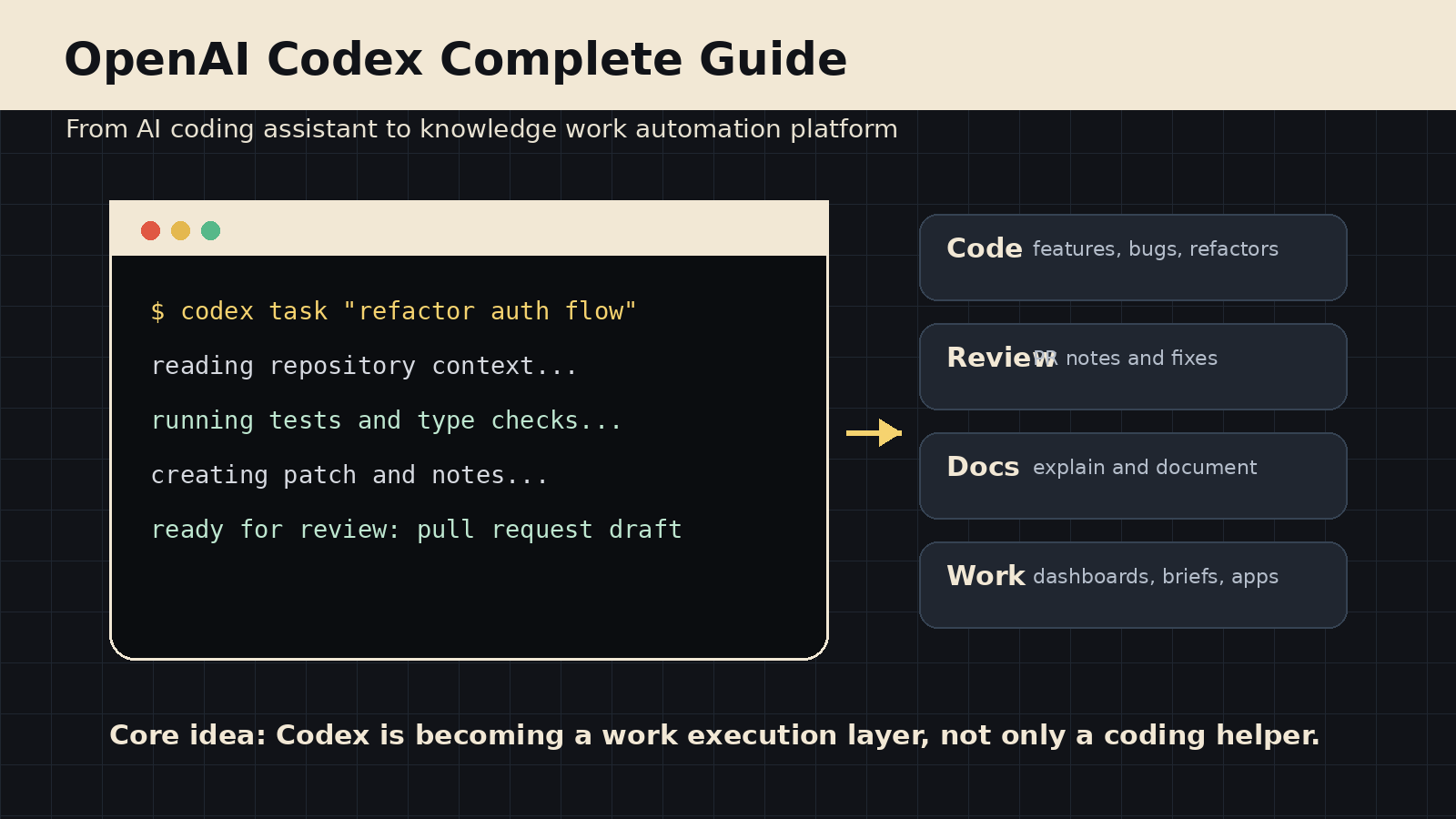
OpenAI Codex is no longer just a simple AI coding assistant. The better way to understand it is as a work execution layer for software teams, and increasingly, for broader knowledge work teams too.
That shift matters because the first generation of AI coding tools mostly helped with suggestions. They completed functions, explained snippets, generated tests, and acted like a smarter autocomplete. Codex is moving into a different category: a coding agent that can take a task, inspect context, run commands, produce changes, and return evidence for human review.
The difference sounds subtle, but it changes the workflow. Instead of asking an assistant to help you write a line of code, you can delegate a scoped task. Instead of copying a model answer into your editor, you can ask an agent to work inside a cloud environment, modify files, run tests, and prepare a result you can inspect.
This is why Codex is becoming more important than a developer feature. It points toward a broader future where AI agents help turn context into work: code, documentation, reports, dashboards, internal apps, prototypes, and operational materials. In short, Codex is moving from coding help to knowledge work automation.
What is OpenAI Codex?
OpenAI describes Codex as a cloud-based software engineering agent that can work on many tasks in parallel. In the original launch, Codex could write features, answer questions about a codebase, fix bugs, and propose pull requests for review. Each task ran in its own cloud sandbox environment preloaded with the user’s repository.
In practical terms, Codex is a delegated engineering assistant. It can read and edit files, run commands, use tests, check linters, and surface logs or test output so a human can verify what happened. That traceability is important. A useful agent does not only produce an answer. It should show how it got there, what it changed, and what evidence supports the result.
The product now spans multiple entry points. Codex web lets teams delegate work in the cloud. Codex CLI runs as a lightweight coding agent in the terminal. GitHub integrations can connect Codex to review comments and pull request workflows. The Codex app is described as a command center for agentic coding, with worktrees and cloud environments that let agents work in parallel across projects.
That is the core idea: Codex is not merely a chatbot that knows code. It is a system for handing off bounded work to an AI agent and then reviewing the result.
Why Codex is different from a normal AI coding assistant
A traditional AI coding assistant usually lives inside the developer’s active context. It helps complete code, explain errors, generate snippets, and answer questions. That is useful, but the human still does most of the orchestration. The human decides what to change, where to run tests, how to interpret failures, and how to package the result.
Codex changes the relationship by becoming more agentic. A task can be assigned, processed independently, and returned with a concrete output. The human moves from constant operator to reviewer and director. That does not remove responsibility. It changes where the responsibility sits. You still need to define the task, inspect the patch, check assumptions, and decide whether the result should land.
This is why the best use of Codex is not vague prompting. It is clear delegation. A weak prompt says, ‘Improve this project.’ A better task says, ‘Refactor the billing webhook handler to separate validation, idempotency, and persistence, then run the existing test suite and summarize any failing tests.’ Codex works better when the task has boundaries, context, and a reviewable definition of done.
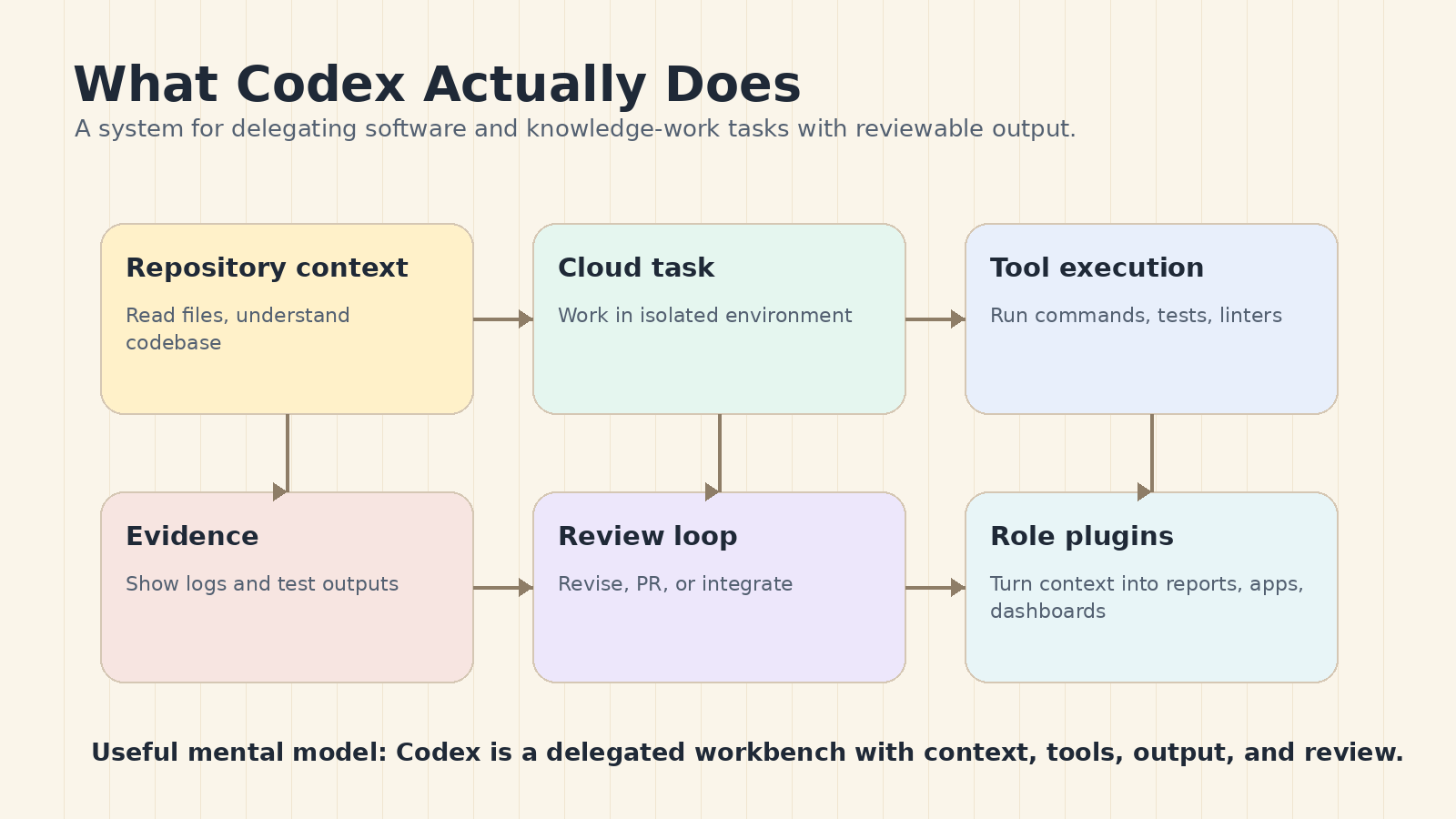
The four layers of the Codex workflow
The first layer is context. Codex needs access to the repository, relevant files, instructions, and sometimes environment setup. This is where AGENTS.md-style guidance, team conventions, and repository-specific instructions become important. Good context turns Codex from a generic model into a project-aware worker.
The second layer is execution. Codex can read and edit files, run commands, and use tools such as tests, linters, and type checkers. This is a major difference from static answer generation. The agent can test its own work and iterate until the output is closer to a reviewable state.
The third layer is evidence. A serious engineering workflow needs more than ‘trust me.’ Codex can provide terminal logs, test outputs, and citations of what it did. This helps reviewers understand the path from task to result. It also helps teams build confidence without pretending that AI-generated work should bypass review.
The fourth layer is integration. A result becomes useful when it can move into a pull request, local environment, documentation page, or shared workspace. Codex is strongest when it fits into the tools the team already uses instead of creating a separate island of AI output.
Codex web, Codex CLI, and GitHub workflows
Codex web is the cloud version of the workflow. It lets users delegate tasks that run in Codex’s own environment. This is useful for larger tasks because the agent can work in the background and, in some cases, in parallel with other tasks. It also separates the agent’s work from the user’s local machine.
Codex CLI brings the agent into the terminal. For developers who live in command-line workflows, this matters. It reduces context switching and lets the user keep Codex close to the actual development process. The open-source Codex repository describes it as a lightweight coding agent that runs in your terminal and can be used with supported ChatGPT plans or with an API key.
GitHub workflows make Codex more collaborative. OpenAI’s developer docs describe how Codex can be triggered in pull request comments for code review, can use pull request context, and can be asked to fix issues when it has permission. That turns Codex from a private assistant into a participant in team review loops.
The strategic point is simple: Codex is most valuable when it is not trapped inside a chat window. It becomes more useful when it touches repositories, pull requests, tests, documentation, and the workflow where work actually lands.
From coding assistant to knowledge work automation platform
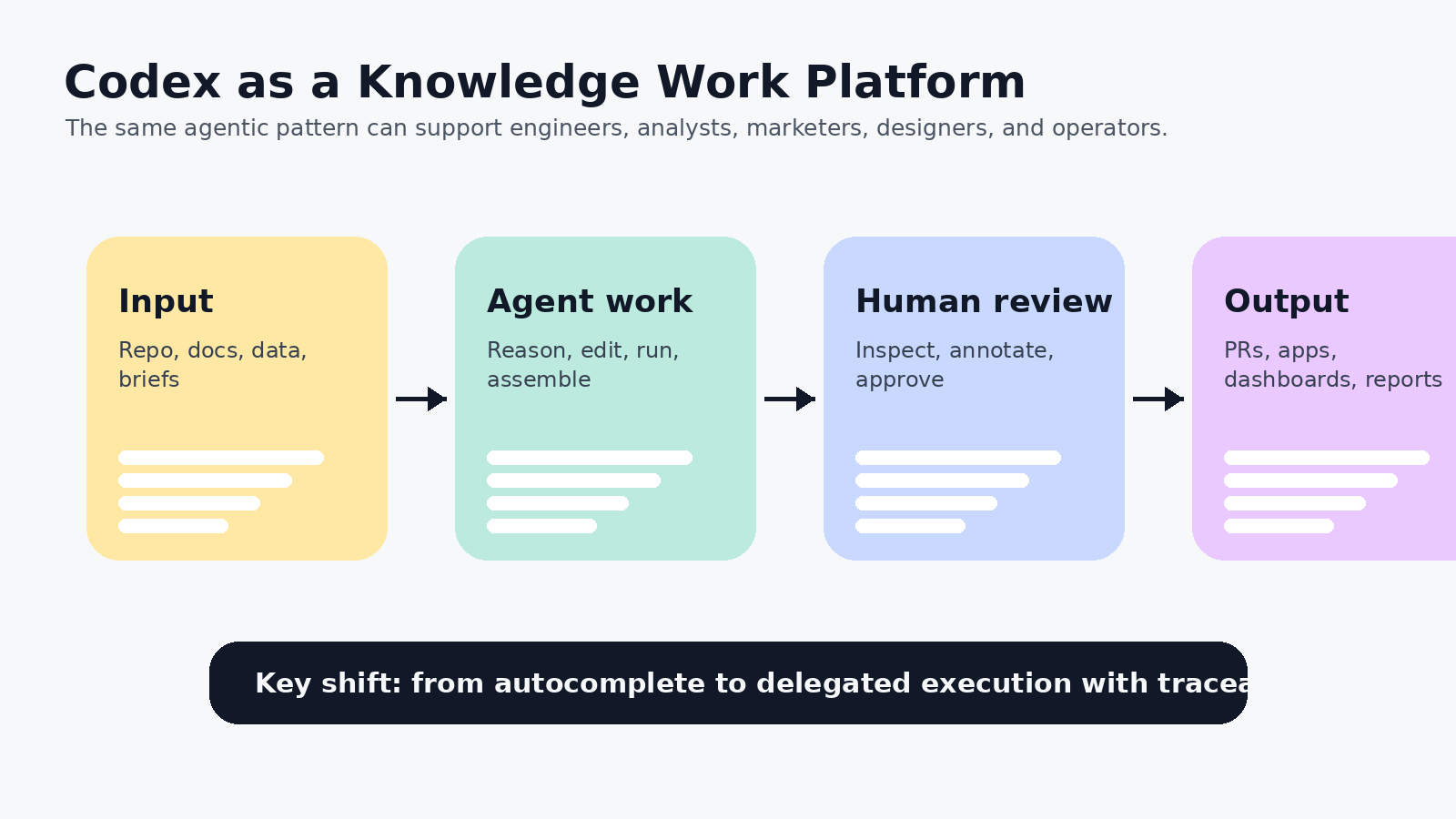
The biggest change is that Codex is expanding beyond traditional developers. OpenAI has introduced role-specific plugins, annotations, and Sites that make Codex useful for more kinds of work. In OpenAI’s own description, non-developers such as analysts, marketers, operators, designers, researchers, investors, and bankers are becoming part of the Codex user base.
This makes sense because the underlying pattern is not limited to writing software. Many knowledge-work tasks follow the same structure: gather context, reason over it, create an artifact, test or validate it, then revise it with human feedback. That artifact might be a pull request, but it might also be a dashboard, a report, an internal app, an executive brief, a data analysis, a prototype, or a structured postmortem.
This is the real platform shift. Codex started as an AI coding assistant, but the architecture is closer to an agentic workbench. If it can connect to the right tools, follow team instructions, produce reviewable work, and support feedback loops, it can automate parts of many roles without pretending to replace the people who own the work.
For companies, this suggests a new operating model. Instead of asking, ‘Can AI write code?’ the better question is, ‘Which repeatable workflows can become delegated, reviewable, and auditable?’ Codex becomes one way to package that delegation.
What Codex can do well
Use case | Best Codex task pattern | Human role |
Feature work | Implement a scoped feature with tests and summary | Define requirements and review behavior |
Bug fixing | Reproduce issue, patch cause, run relevant checks | Verify assumptions and edge cases |
Refactoring | Change structure without changing external behavior | Protect architecture and code style |
Code review | Review pull request for risks, regressions, or standards | Decide severity and approve fixes |
Documentation | Explain code, write docs, update guides | Check accuracy and tone |
Knowledge work | Turn context into dashboards, briefs, reports, or apps | Provide source context and approve output |
Codex is strongest when the task is specific enough to evaluate. It can help with bug fixes, small features, refactors, test generation, documentation updates, codebase Q&A, and pull request review. These tasks have clear inputs and observable outputs.
It becomes weaker when the task is ambiguous, highly strategic, or requires product judgment that has not been written down. Codex can help explore options, but it should not silently decide business requirements. The human should still own intent, quality, risk, and final approval.
The best teams will treat Codex like a junior-to-mid-level agent with unusual stamina, fast reading ability, and tool access. That is powerful, but it still needs task design, guardrails, and review.
Codex Security and the next bottleneck
As AI agents accelerate development, security review becomes a bigger bottleneck. OpenAI has introduced Codex Security as an application security agent in research preview. It is designed to build project context, identify high-confidence vulnerabilities, validate findings, and propose fixes that align with system behavior.
This matters because faster code generation can create more review surface. The future is not simply ‘agents write more code.’ The future is that agents also help inspect, validate, document, and secure the work they create. Codex Security points to that broader direction: AI agents are not only production tools; they are review and governance tools too.
How teams should adopt Codex
Do not start by giving Codex your hardest undefined problem. Start with repeatable work that has a clear review path. Examples include updating tests, fixing a known bug, improving documentation, adding a small feature, reviewing a pull request for a narrow risk, or creating a first draft of an internal tool.
Next, write team instructions. Codex becomes more useful when it knows your conventions: coding style, test commands, review priorities, documentation standards, security expectations, and what not to change. Treat these instructions as part of your engineering system, not as random prompt text.
Then build a review habit. Codex output should be inspected. Tests should run. Logs should be checked. The pull request should be reviewed like any other contribution. The goal is not blind automation. The goal is faster, traceable, reviewable work.
Finally, expand from engineering into adjacent knowledge work only when the workflow is clear. If analysts, operators, marketers, or product teams use Codex, they need the same structure: source context, task boundaries, output format, validation, and human approval.
Why this matters for websites, teams, and future work
Codex is important because it represents a broader shift from AI as a text generator to AI as a work agent. For developers, this means more tasks can move from manual implementation to supervised delegation. For non-developers, it means technical workflows can become more accessible through plugins, apps, and guided outputs.
For businesses building websites, internal tools, dashboards, or content systems, Codex also changes expectations. Teams will increasingly expect AI to create working artifacts, not just advice. This connects to the same growth logic behind platforms like We0.ai: the value is not just generating a page or draft. The value is turning intent into a usable, reviewable asset.
The winners will not be the teams that automate everything blindly. They will be the teams that learn how to design work for agents: clear tasks, good context, strong review, and continuous improvement.
Final takeaway
OpenAI Codex began as a way to help with software engineering tasks, but it is becoming something larger: a command center for delegated, agentic work. It can read code, edit files, run tests, participate in pull requests, support documentation, and increasingly help non-developer teams create useful work products.
That does not make human judgment less important. It makes it more important. The human role shifts toward defining the task, shaping the standards, reviewing the evidence, and deciding what should ship.
The complete guide is this: use Codex not as magic autocomplete, but as a supervised work platform. Give it real context, bounded tasks, reviewable outputs, and clear standards. That is how an AI coding assistant becomes a knowledge work automation platform.
CTA
If your team is thinking about AI agents, do not only ask which model writes the best code. Ask which workflows can become delegated, reviewed, and improved.
Build your AI-ready showcase and growth system with We0.ai: https://we0.ai
FAQ
What is OpenAI Codex?
OpenAI Codex is an AI coding agent that can work on software engineering tasks such as writing features, fixing bugs, answering questions about codebases, running checks, and preparing reviewable changes.
Is Codex just an autocomplete tool?
No. Codex is more agentic than autocomplete. It can work on delegated tasks, use repository context, run commands, and return evidence such as test outputs or logs.
What is Codex CLI?
Codex CLI is the terminal-based version of Codex. It lets developers use Codex closer to command-line workflows.
How does Codex help with knowledge work?
The same agentic workflow can help turn context into reports, dashboards, internal apps, documentation, briefs, and other reviewable work artifacts.
Does Codex replace developers?
No. Codex changes the workflow by letting humans delegate bounded tasks, then review and approve the output. Human judgment still owns product intent, quality, and risk.
Related Tools
- Codex
- CLI
- GitHub
- ChatGPT
- Security
Sources
- Intro
- Codex
- Cloud
- GitHub
- Plugins
- CLI
- Security