Google AI Mode SEO Guide 2026: How Independent Websites Should Adapt to AI Search and GEO
A practical guide to Google AI Mode, the redesigned AI-powered Search box, Gemini 3.5 Flash, multimodal search, AI Overviews, GEO, E-E-A-T and website growth. Learn how independent websites can shift from keyword-first SEO to AI-readable, multimodal, trustworthy content systems that support visibility, citations, leads and long-term growth.
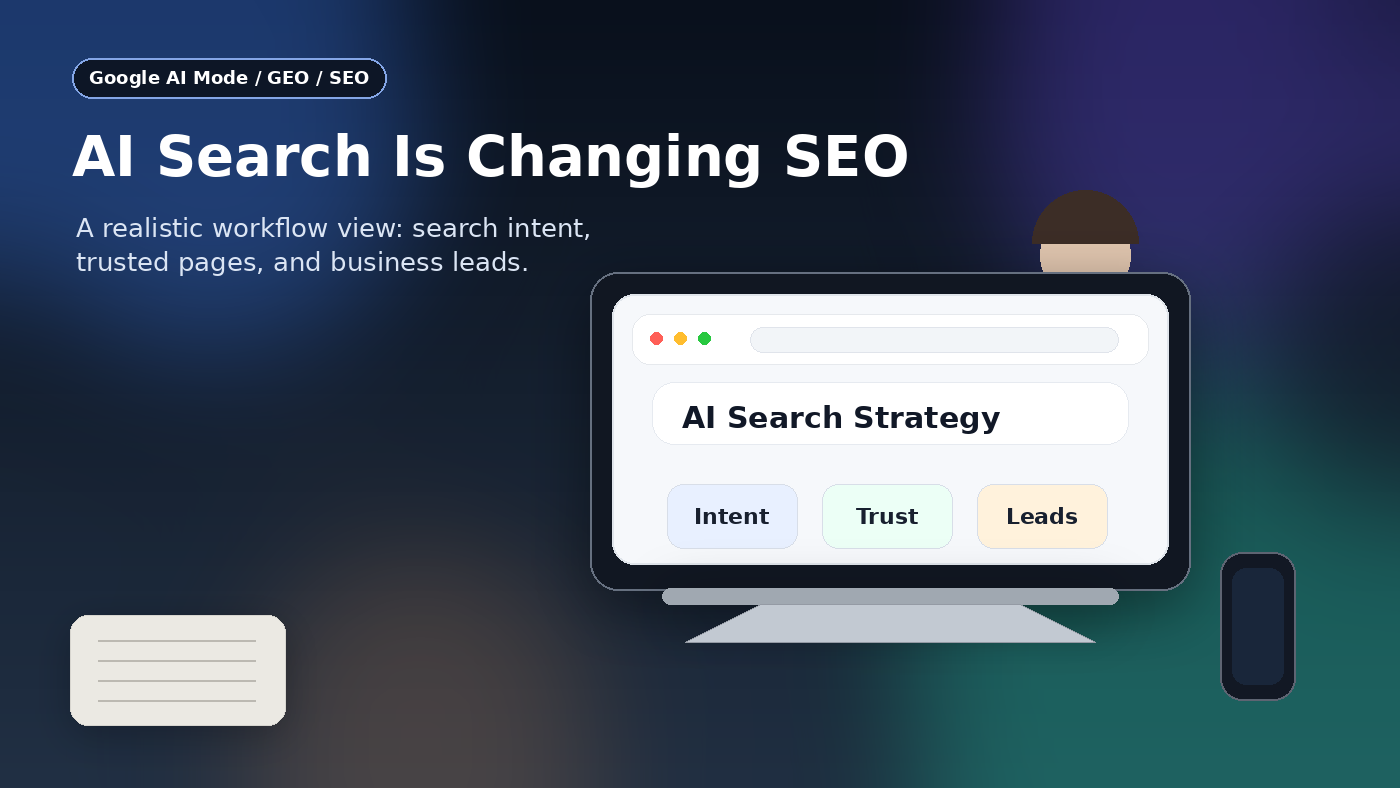
Original illustration: AI Search moves SEO from rankings toward AI citations and lead generation
After 2026, independent website owners can no longer look only at traditional rankings. Google Search is moving from keyword input and blue links toward natural-language questions, AI-generated answers, and multimodal interaction.
This is not a normal search-box redesign. It changes the search entry point, how content is understood, and how visibility is distributed. Google’s I/O 2026 Search updates show that AI Mode is becoming a central part of the Search experience. For independent websites, the question is now: Can your content be understood, cited, explained, and turned into the user’s next action?
A site that still relies on keyword stuffing, templated product pages, and plain-text blog posts will lose ground. A site with real experience, structured information, multimodal proof, trustworthy signals, and clear conversion paths has a better chance of entering AI answers, AI Overviews, AI Mode, and the user decision journey.
1. The search entry point has changed
Traditional SEO was built around short keyword queries. Users typed a few words, received a list of links, and clicked through to compare results. With AI Mode, users are more likely to ask complete questions using text, voice, images, screenshots, files, and complex needs.
The matching logic is therefore no longer just “does this page contain the keyword?” It is “does this page answer a complete real-world problem?” A user may not search only for “wireless earbuds 2026.” They may ask for earbuds under $100 that are good for running, have long battery life, and offer acceptable noise cancellation.
Independent websites need content that can answer long questions, scenario questions, comparison questions, buying questions, and usage questions.
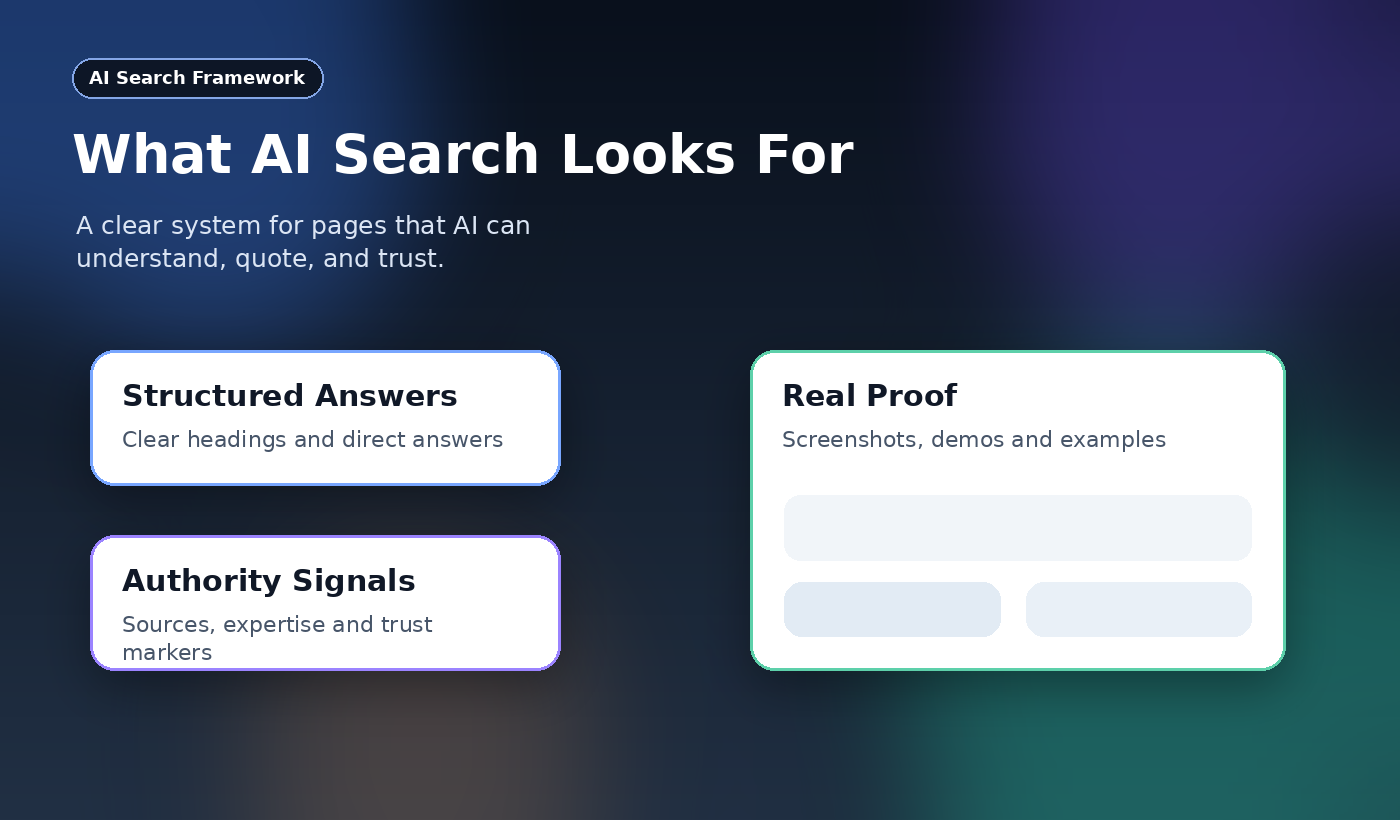
Original illustration: AI Search needs experience, structured answers, multimodal proof and trust signals
2. AI Mode changes the value of clicks and citations
The biggest issue in AI Search is not that traffic disappears. It is that visibility moves closer to the answer layer. AI can generate a response first, and users may click only when the answer needs more detail. Pew Research found that users are less likely to click traditional results when an AI summary appears.
That means website owners should shift from “rank only” to “rank, get cited, build brand memory, and earn high-intent clicks.” A site now needs to behave like a trusted knowledge surface, not a pile of isolated articles.
In AI Mode, a page does not always need to be the first traditional result to matter. If it is complete, credible, visual, and directly useful, it may become part of the AI answer. A thin page with good keyword targeting may still be ignored.
Old SEO mindset | AI Search / GEO mindset |
Optimize short keywords | Answer real questions and complete tasks |
Focus on ranking position | Earn AI citations, answer exposure and brand recall |
Rely mostly on text | Use images, video, tables, FAQs and tools together |
Optimize isolated articles | Build clusters, internal links and structured data |
Convince after the click | Build trust already inside the AI answer layer |
3. Gemini 3.5 Flash makes content understanding faster and deeper
Google announced at I/O 2026 that AI Mode is being upgraded globally with Gemini 3.5 Flash as the default model. A faster and stronger model means website content can be summarized, compared, and evaluated more quickly.
This is both a risk and an opportunity. Helpful content with tests, comparisons, visuals, tables, and clear conclusions can be recognized faster. Low-quality content copied from sources, stuffed with keywords, or missing author and proof signals can also be filtered more easily.
The content strategy for AI Search is therefore not “publish more.” It is “publish content that looks like real experience and verifiable answers.”
4. Common mistakes independent websites make
Many websites already have content, but that content is not ready for AI understanding. Common problems include:
• Product pages that copy supplier specifications without real photos, usage scenarios, experience notes or comparison data.
• Blog posts that rewrite public information without original judgment, tests, cases or methodology.
• Core content hidden behind complex JavaScript, slow loading, or incomplete rendering.
• Missing about pages, contact information, privacy policies, author profiles and real case studies.
• FAQ sections that are too short and keyword-driven instead of decision-driven.
These problems already hurt traditional SEO, but AI Search magnifies them because AI systems decide whether a page can serve as a reliable answer.
5. A practical adaptation plan: content, technology, trust and conversion
1. Content: move from generic content to experience content
Product pages should include scenarios, suitable users, pros and cons, comparison tables, real images, review videos and FAQs. Blog posts should follow the user decision process, not just trends.
2. Technology: make content visible, fast and understandable
Core content should be present in HTML where possible. Images need accurate alt text. Pages should load quickly, and structured data should be accurate. Do not use hidden text, fake Schema markup, or instructions designed to manipulate AI citations.
3. Trust: E-E-A-T becomes an entry requirement
About pages, contact details, author profiles, privacy policies, customer cases, reviews and test data all help AI systems and users decide whether the website is credible.
4. Multimodal: images, videos, tables and tools matter more
AI Search can process more than text. Product images, scenario photos, tutorials, comparison tables, calculators, size tools and selection quizzes can all make a page easier to understand and cite.
5. Conversion: AI Search brings higher-intent users
A user arriving from AI Mode often has a more specific need. Pages should include clear CTAs, forms, case studies, consultation entries and next-step paths.
6. Where We0.ai fits: building AI-readable showcase websites for growth
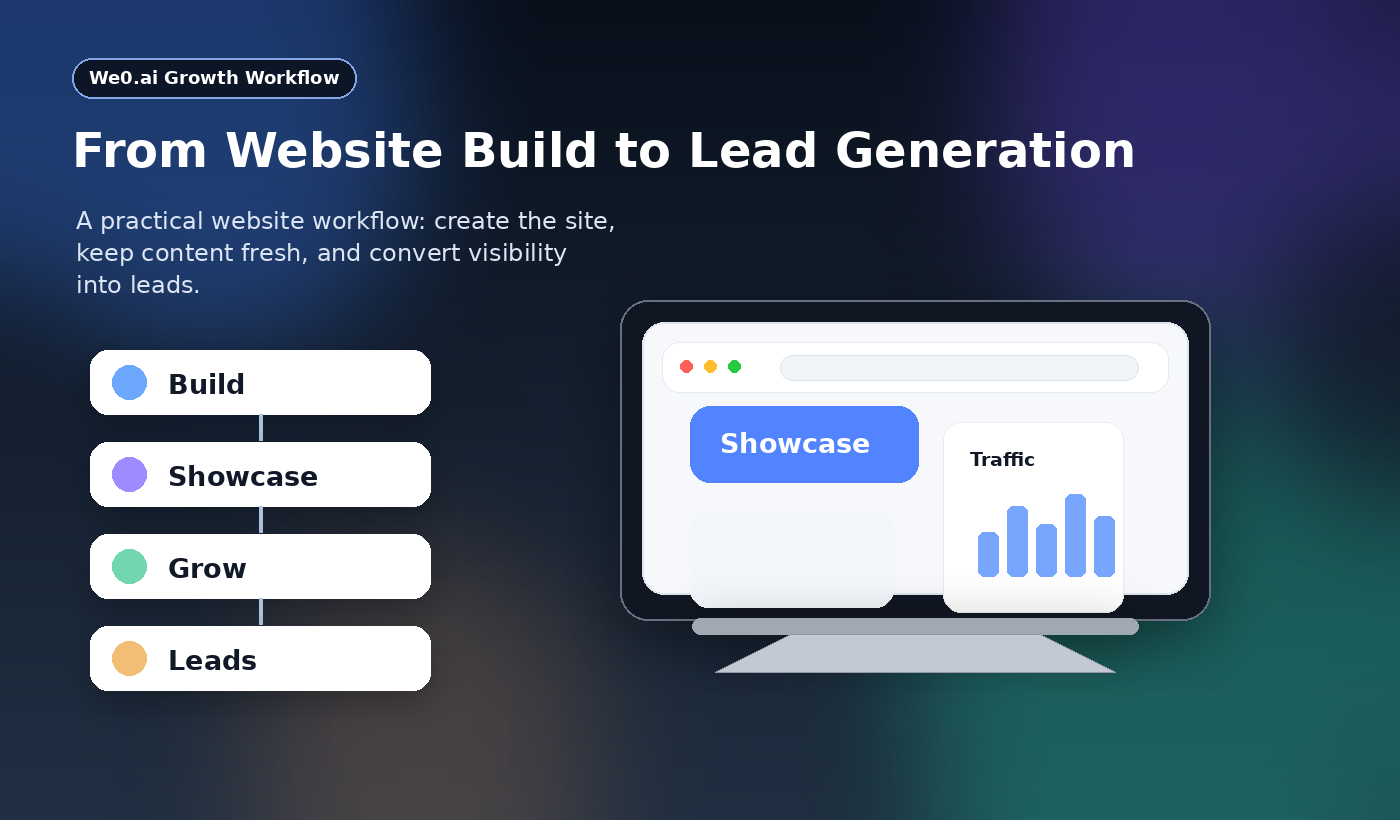
Original illustration: We0.ai turns Build into Showcase, Grow and Leads
This is where We0.ai fits. We0.ai is an AI Showcase Website Growth Platform. It is not only about generating a page quickly; it helps products, brands, services, work and businesses build websites that can be showcased, understood by search, recommended by AI, and converted into leads.
In AI Search and GEO, a showcase website has to do more than look good. It has to explain who you are, what you offer, what proof you have, why users should trust you, and what the next action should be. We0.ai helps organize those elements into a site that functions as a growth system.
Traditional AI website builders solve the “from zero to page” problem. We0.ai focuses on Build → Showcase → Grow → Leads: build the site, showcase the value, grow through SEO/GEO, and convert visibility into leads.
Stage | What AI Search requires | We0.ai value |
Build | Create a clear, accessible and editable site structure | Generate a showcase website direction from natural language input |
Showcase | Explain products, services, cases, FAQs and trust signals | Organize content and page structure |
Grow | Publish articles, cases, comparison pages and answers for SEO/GEO | Make the site easier for search and AI systems to understand |
Leads | Convert high-intent visitors through forms, CTAs and inquiry paths | Turn visibility into conversion opportunities |
7. A 30-day website adaptation checklist
• Week 1: check whether core pages have visible HTML content, clear headings, structured sections and basic trust pages.
• Week 2: rewrite 3-5 core product or service pages with real scenarios, images, comparison tables and FAQs.
• Week 3: publish in-depth content around long-tail questions: how to choose, who it is for, comparisons, tutorials and mistakes to avoid.
• Week 4: add case studies, reviews, author information, internal links and conversion paths.
This does not require complicated black-hat tactics. The goal is simple: make the website more real, complete, understandable, and trustworthy.
Final takeaway
Google AI Mode, AI Overviews, multimodal search and Gemini 3.5 Flash are pushing SEO into a new phase. Keywords still matter, but they are no longer enough. What matters now is whether your website can become content that AI systems cite, users trust, and visitors act on.
For independent websites, the future of SEO is not doing less. It is doing SEO more systematically: better content, clearer structure, multimodal proof, stronger trust signals and clearer conversion paths.
That is where We0.ai becomes relevant: turning a website from a static page into a showcase and growth workflow. Only then can an independent site keep being discovered, understood and chosen in the AI Search era.
FAQ
Will AI Search make SEO irrelevant?
No. Google states that generative AI features still rely on its Search index and quality systems. The change is that SEO must become more complete: content, structure, trust and user intent all matter more.
What is the difference between GEO and SEO?
GEO focuses on whether generative AI systems can understand, cite and summarize your content. SEO focuses on indexing, ranking and clicks. In practice, the two are becoming more connected.
What should independent websites fix first?
Start with core product pages, service pages, case pages, about pages, FAQs and contact paths. These directly affect whether AI systems and users trust the site.
Is multimodal content really important?
Yes. Images, videos, tables, charts and interactive components help AI systems understand pages more completely and can improve user engagement.
What kind of websites is We0.ai best for?
We0.ai is suitable for showcase websites, product sites, service sites, case sites, portfolios, consultant websites, agency sites and business websites that need to present value and generate leads.
Do websites still need blogs in the AI Search era?
Yes, but blogs must become deeper. Reviews, comparisons, tutorials, cases, problem answers and industry guides are more useful than generic short posts.
Related Tools
• We0.ai
Sources
• Google Search I/O 2026 Updates
• Google AI Features and Your Website
• Google AI Search Optimization Guide
• Pew Research: Google Users Click Less When AI Summaries Appear