GLM-5.2 and Low-Cost AI Models Race: Will AI Infrastructure Really Become Cheaper by 2026?
The low-cost AI model competition driven by the GLM-5.2 is transforming the cost structure of building AI-powered websites. However, while web generation has become cheaper, it does not necessarily mean that website growth has become cheaper. This article breaks down what parts of AI website building will actually see price reductions by 2026, as well as the areas where brand websites, showcase sites, SEO/GEO, and acquiring customers still require investment.
Let’s start with the short answer.
Yes, AI website building will get cheaper.
But probably not in the way most people expect.
In 2026, models like GLM-5.2 are pushing long context, reasoning, coding, and tool use into a much lower-cost zone. According to OpenRouter, GLM-5.2 supports a 1M-token context window, with pricing listed at $$0.93 per 1M input tokens and$$3 per 1M output tokens. It is positioned for long-horizon agent workflows, project-level software engineering, and complex multi-step automation.
So what does that actually mean?
Not “every real business website becomes free.”
It means this: the marginal cost of generating a web page will keep falling.
But the real value of a website has never been just “a page exists.”
A page can be cheap.
A website that is launched, positioned, searchable, updated, trusted, and able to generate leads is a different thing.
That is where the 2026 AI website building market gets interesting.
Why GLM-5.2 pushes AI website building costs down
The reason is simple: AI models are moving from “chatting” to “doing work.”
A lot of AI website builders used to sell one simple promise: type a sentence, get a website.
It sounds magical.
But once you actually try to use those sites for a real business, the cracks show up fast:
The page structure is incomplete
The copy feels generic
The design looks okay, but not like your brand
SEO is barely planned
Nothing happens after launch
Revisions break the layout
Content is not maintained
Traffic does not turn into leads
Models like GLM-5.2 can improve part of this. Especially with long context and agentic coding.
They are better suited for project-level tasks: understanding a full website structure, keeping code context, making multi-step edits, using tools, and moving from requirements toward deployment.
That lowers the production cost for AI website tools.
Especially in areas like these:
Website building task | Will it get cheaper in 2026? | Why |
Hero page generation | Yes | HTML, CSS, and component generation gets cheaper |
Basic copywriting | Yes | Generic content production becomes cheaper |
Multiple page drafts | Yes | Reasoning and token costs decline |
Simple landing pages | Very likely | Standardized needs are easier to automate |
Multilingual first drafts | Yes | Translation and rewriting costs drop |
Basic code edits | Yes | Agentic coding gets more mature |
So if the question is: will it become cheaper to create something that looks like a website?
Absolutely.
In fact, it may get so cheap that people start asking whether website building has lost value.
But that is the wrong question.
Cheap page generation is not the same as a cheap website asset.
The expensive part is moving from “page generation” to “growth operations”
As AI website costs go down, the market will split into two layers.
One layer is cheap pages.
The other is growth-ready showcase websites.
Both are called websites. But they are not the same product.
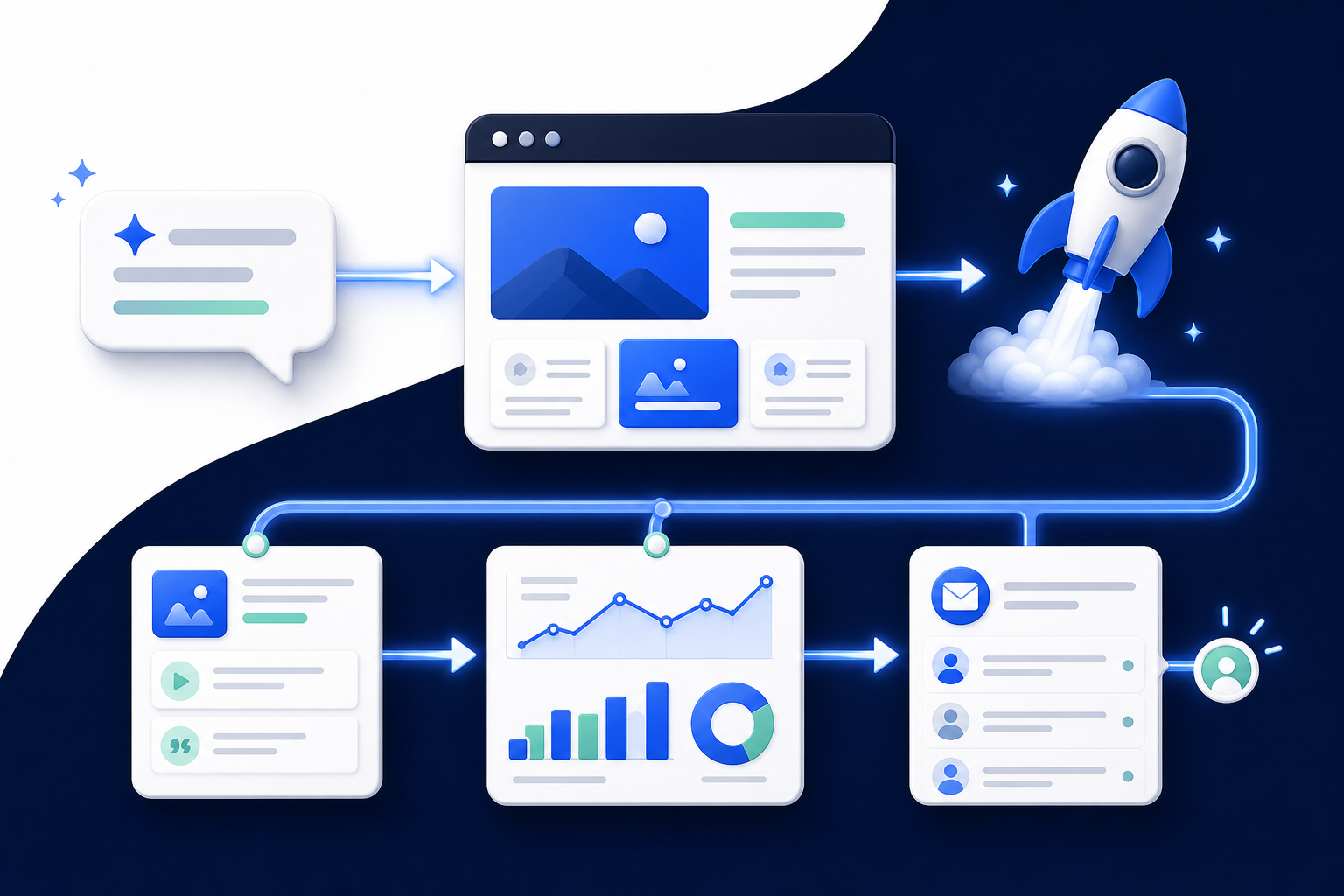
A cheap page answers: do I have a page?
A growth-ready showcase website answers: can people find me, understand me, trust me, and contact me?
That gap is huge.
It includes things like:
How your brand positioning is explained
How your homepage information architecture is arranged
Whether your product page communicates value clearly
Whether your service page earns enough trust
Whether case studies feel real
Whether FAQ pages match real search intent
Whether SEO titles and descriptions are written properly
Whether content can be understood in GEO and AI recommendation scenarios
Whether the site keeps being updated after launch
Which pages get traffic, and which pages are ignored
How visitors turn into leads
A cheaper model does not automatically solve all of that.
Lower model cost reduces the cost of producing raw material.
But turning a website into a growth asset still requires structure, strategy, operations, and review.
That is why We0 AI does not try to position itself as just another AI website builder.
We0 AI is closer to an AI website building and growth platform for showcase websites. Its core flow is not “type one prompt and get a page.” It is:
Build -> Showcase -> Grow -> Leads
Build the website. Showcase the product, service, case studies, or portfolio. Grow through SEO, GEO, content, and page optimization. Then turn that traffic into leads and customers.
That is not the same logic as generating a page.
In 2026, AI website building will have two different prices
I would separate AI website pricing in 2026 into two categories.
1. Page generation pricing will be pushed very low
This layer will be extremely competitive.
Low-cost models are getting stronger. Open-weight models are improving. API pricing is becoming more transparent. Toolchains are more mature.
GLM-4.5 already emphasized reasoning, coding, and agentic capabilities, with open weights available through ecosystems like Hugging Face and ModelScope. GLM-5.2 pushes long-context and long-horizon task capability further into project-level workflows.
This makes “page generation” more like a basic feature.
Once a capability becomes standardized, pricing moves down.
So you will see more products claiming:
Generate a website for free
Build a landing page in 30 seconds
Create a site from one sentence
Let AI write all the copy
Let AI redesign your page automatically
None of this will be surprising.
The real question is: what happens after generation?
2. Growth service pricing will not go to zero
The real cost of a business website is often not the first page version.
It is what comes after:
What you actually need | Why it will not be completely free |
Brand information sorting | AI can write, but it cannot fully decide your trade-offs |
Page structure planning | Requires business, audience, and conversion understanding |
SEO / GEO planning | Requires keywords, search intent, and content architecture |
Ongoing content production | Not one post, but continuous publishing and layout |
Data monitoring | Needs real traffic and conversion feedback |
Page optimization | Should be based on data, not guesses |
Lead conversion | Requires CTA, forms, inquiry paths, and trust content |
So here is the sharper prediction:
AI website building will get cheaper in 2026, but websites that actually generate customers will not become commodity-cheap.
They will become more cost-effective.
Not worthless.
What kinds of website products will GLM-5.2 affect first?
Not every website category changes at the same speed.
The first ones to feel the impact will likely be these.
SaaS and AI product websites
These sites usually have a recognizable structure: Hero, Features, Use Cases, Pricing, FAQ, Docs, Blog.
AI can generate many first drafts and help test different positioning angles quickly.
But conversion still depends on one thing: whether your real value is clear.
Indie hacker and solo founder project pages
Indie hackers need speed.
When a product is new, they need a launch page, waitlist page, feedback page, changelog, and SEO content entry points.
Low-cost models will make these pages faster and cheaper.
But what indie founders often lack is not a page. It is ongoing visibility and a clear conversion path.
Agency, consultant, and service websites
For service businesses, the website is not about showing off tricks.
It is about earning trust.
Case studies, service process, client proof, industry experience, and consultation entry points need to feel specific.
AI can draft. It cannot invent your real experience.
Export and multilingual showcase websites
Multilingual first drafts will become much cheaper.
But the hard part of export websites is market-specific messaging, complete product information, inquiry paths, and search keyword planning.
Cheap models lower the starting cost. They do not replace market judgment.
So where is the opportunity for We0 AI?
If AI website building becomes only a race to generate cheaper pages, the market will turn into a price war.
That is not the path We0 AI should take.
We0 AI is a better fit for users like:
Owners with real products, services, or brands, but weak websites
Indie developers who need fast launch pages and ongoing updates
Consultants, agencies, and creators who need to showcase work and cases
Export companies that need multilingual showcase and inquiry pages
SaaS and AI teams that need website, content, SEO, and GEO to work together
These users are not really asking: “Can you generate a page?”
They are asking:
Can you help me build a site and make it start doing growth work?
That is where We0 AI sits.
Not a normal page builder.
Not a one-time demo generator.
But a connected workflow that combines AI website building, human brand sorting, page planning, launch, SEO/GEO setup, content production, data monitoring, growth suggestions, and continuous optimization.
In simple terms:
Low-cost models reduce production friction. We0 AI helps turn the website into an operable, growable, lead-generating asset.
Key takeaway: AI website building gets cheaper, but cheapness splits into layers
The future can be compressed into three sentences:
Pages will get cheaper. Many basic pages may become close to free.
Launch will get faster. The cycle from idea to first version will shrink.
Growth will not happen automatically. SEO, GEO, content, analytics, and conversion still need ongoing work.
That is the real state of AI website building in 2026.
Not “AI destroys all website cost.”
More like: AI makes low-value repetitive work cheaper, and makes high-value growth work more visible.
For users, that is good news.
You should no longer overpay for a generic page.
But you should still invest in clear positioning, strong structure, launch readiness, operations, and lead generation.
When choosing an AI website builder in 2026, check these 5 things
If you are planning to build a company website, product page, service site, or showcase website with AI, do not only compare prices.
Look at these five things instead:
Decision point | Question to ask |
Cost | Is the cheap price only for page generation, or does it include launch and optimization? |
Quality | Does the site actually match your brand and business message? |
SEO / GEO | Does it help with search and AI recommendation readiness? |
Operations | Can the site keep being updated, monitored, and improved after launch? |
Conversion | Does the site have clear CTAs, inquiry paths, and trust-building content? |
If a tool only generates pages, it should be cheap.
If a platform helps you complete Build -> Showcase -> Grow -> Leads, then its value is not just the page price.
FAQ
Will GLM-5.2 make AI website building free?
Not directly. It can reduce the cost of page generation, code generation, and multi-step automation. But launch, brand messaging, SEO/GEO, content operations, and lead conversion still require real work.
Will AI website builders become cheaper in 2026?
Yes. Simple landing pages, one-page websites, multilingual drafts, and basic redesigns will likely get cheaper. But growth-ready showcase websites will still carry value in operations and customer acquisition.
What does the low-cost AI model race mean for founders?
Founders can test product pages, launch pages, waitlists, and SEO content entry points at lower cost. But getting customers still depends on website structure, content, positioning, and conversion paths.
How is We0 AI different from a normal AI website builder?
A normal AI website builder focuses on generating pages. We0 AI focuses on Build -> Showcase -> Grow -> Leads: building the website, launching it, supporting SEO/GEO, updating content, monitoring performance, and helping turn traffic into leads.
Related Tools
We0 AI: AI website building and growth platform for showcase websites
OpenRouter: model APIs, pricing, and context window information
Z.ai: official GLM model releases and updates
Hugging Face: open model and model weight ecosystem
Google Search Central: SEO fundamentals and documentation
Sources