The GLM-5.2 low-cost model is catching up: Will AI-generated website building and SEO content production become affordable?
Models like the GLM-5.2, which offer high performance at a low cost, are gaining ground. Could AI-generated website construction and SEO content production become affordable? This article examines the aspects of model costs, content quality, website growth, and the We0 AI’s Build -> Showcase -> Grow -> Leads pipeline where actual reductions are possible, as well as areas where prices remain valuable.

There is a very clear signal in the AI model market right now.
Model capability keeps going up, while prices keep getting pushed down.
GLM-5.2 is a good example to watch. Based on public information from Z.ai / Zhipu AI and coverage from VentureBeat, GLM-5.2 is built for long-horizon tasks, coding, and agentic workflows. It supports a 1M-token context window and enters the market with relatively aggressive pricing. VentureBeat reported API pricing at $$1.40 per 1M input tokens and$$4.40 per 1M output tokens, while also noting that GLM-5.2 performs strongly on several long-horizon coding benchmarks.
For AI website building and SEO content production, this is a big deal.
Because many people assume:
AI websites are expensive because models are expensive. SEO content production is expensive because generation is expensive. Once models get cheaper, websites and content will become dirt cheap.
That sounds reasonable.
But here is the uncomfortable answer:
Yes, some parts will get much cheaper. But not everything becomes a commodity.
More precisely:
Generation becomes cheap. Business outcomes do not.
This article is about that line. With low-cost strong models like GLM-5.2 catching up, which parts of AI website building, SEO content production, and GEO content optimization will be priced down? And which parts may actually become more valuable?
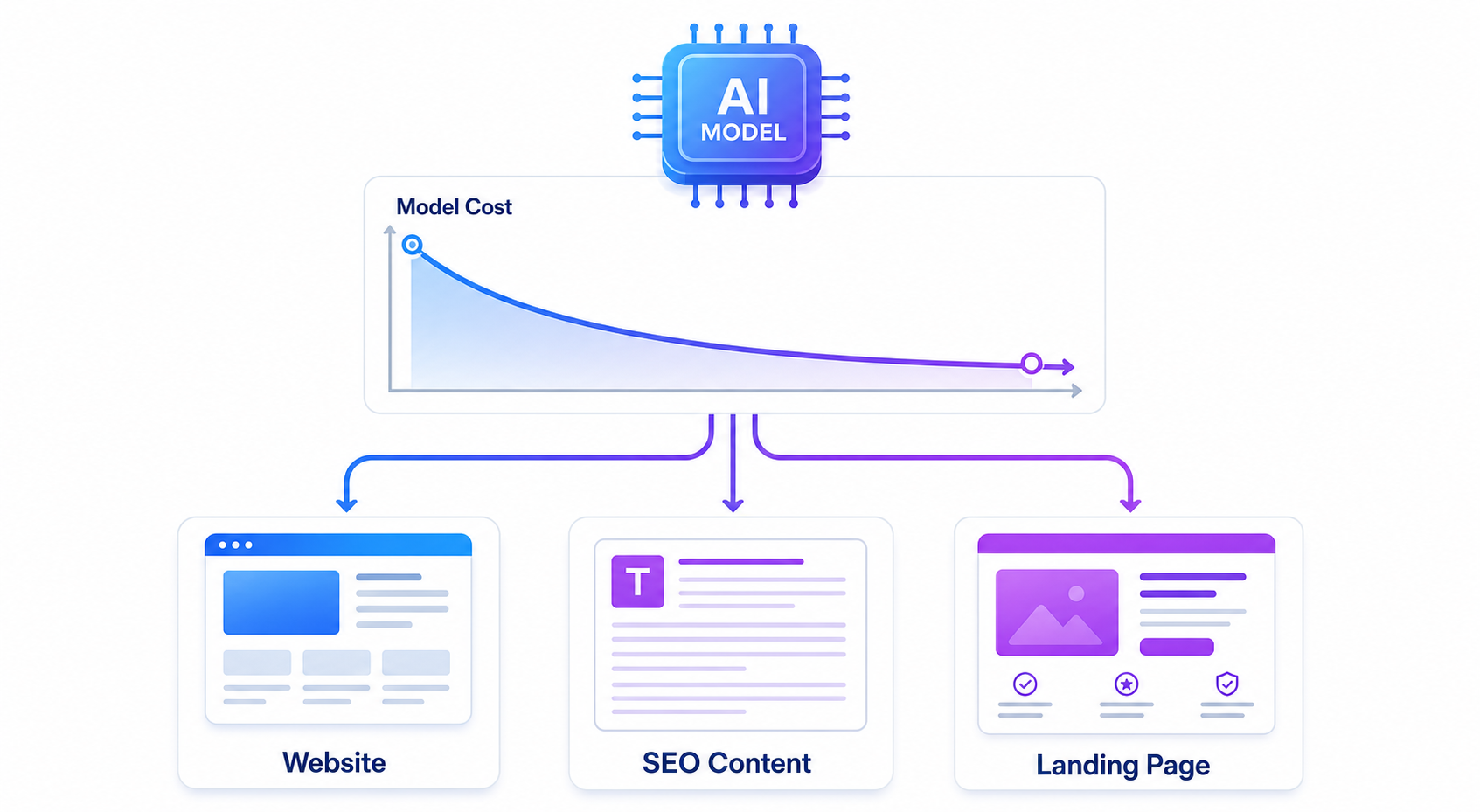
The short answer: “generation” gets cheap, not “business”
Many people reduce AI website building to one sentence:
“Enter one prompt, generate a website.”
They reduce AI SEO content production to another sentence:
“Enter a keyword, generate an article.”
If you only look at those two actions, yes, they will get cheaper.
As model prices drop, inference gets faster, context windows get longer, and agents become better at executing multi-step tasks, the cost of generating a landing page, ten articles, an FAQ section, a feature page, or a blog draft will keep falling.
Maybe very fast.
But real business does not end at generation.
A website has to answer harder questions:
Can visitors understand who you are?
Can they understand what you sell?
Can they trust you?
Can they find the next action?
Can Google understand the page?
Can AI search and recommendation systems cite you?
Is the page updated over time?
Does the content cover long-tail demand?
Do visitors turn into inquiries, signups, bookings, or customers?
These are not solved by lower token prices alone.
Low-cost models make “production of materials” cheaper.
They do not automatically make growth cheap.
Why GLM-5.2 matters for AI websites and SEO
GLM-5.2 is not important only because it is another model launch.
It represents a broader trend: high-capability models are moving into a lower-cost, longer-context, long-horizon-task era.
That directly affects AI website building and SEO content production.
In the past, AI website tools could often generate a few sections: hero, features, pricing, FAQ. But when the context was too short, the output could easily become inconsistent. Brand messages drifted. Page structure felt generic. Product details got lost.
With long-context models, AI can digest more project material:
product documents
user personas
competitor information
brand voice
old website content
FAQ
case studies
keyword lists
search intent analysis
page architecture
internal linking plans
That moves AI from “writing a few sections” to “participating in the whole project.”
The same applies to SEO content.
Old AI SEO content often had obvious problems:
every article sounded templated
content repeated itself
search intent was weak
internal links felt unnatural
titles looked stuffed with keywords
there was no real point of view
the article did not connect to the product
As low-cost long-context models become common, batch production will improve and the content workflow will become more complete.
But here is the twist:
When everyone can generate content cheaply, content itself becomes less scarce.
What will really become cheap?
A lot of things will get cheaper.
Especially low-judgment, low-differentiation, low-risk tasks.
Task | Will it get cheaper? | Why |
First-draft page copy | Yes | Models can quickly generate multiple drafts from product info |
Basic SEO articles | Yes | Keyword-to-article workflows are easy to automate |
FAQ / Q&A | Yes | The format is fixed and search intent is clear |
Translation | Yes | Model capability is already strong enough |
Meta titles / descriptions | Yes | Rules are clear and suitable for batch production |
Simple landing pages | Yes | Structure is relatively fixed |
Competitor comparison drafts | Yes | Research + table generation can be semi-automated |
These will become infrastructure.
Just like cloud hosting became cheaper and people stopped paying a premium just because someone could “deploy a website.”
AI content generation will follow the same path.
In the future, saying “I can generate 20 articles for you” will not sound impressive.
Clients will ask:
What do those 20 articles bring? Can they get indexed? Can they rank? Can they generate leads?
That is the dividing line.
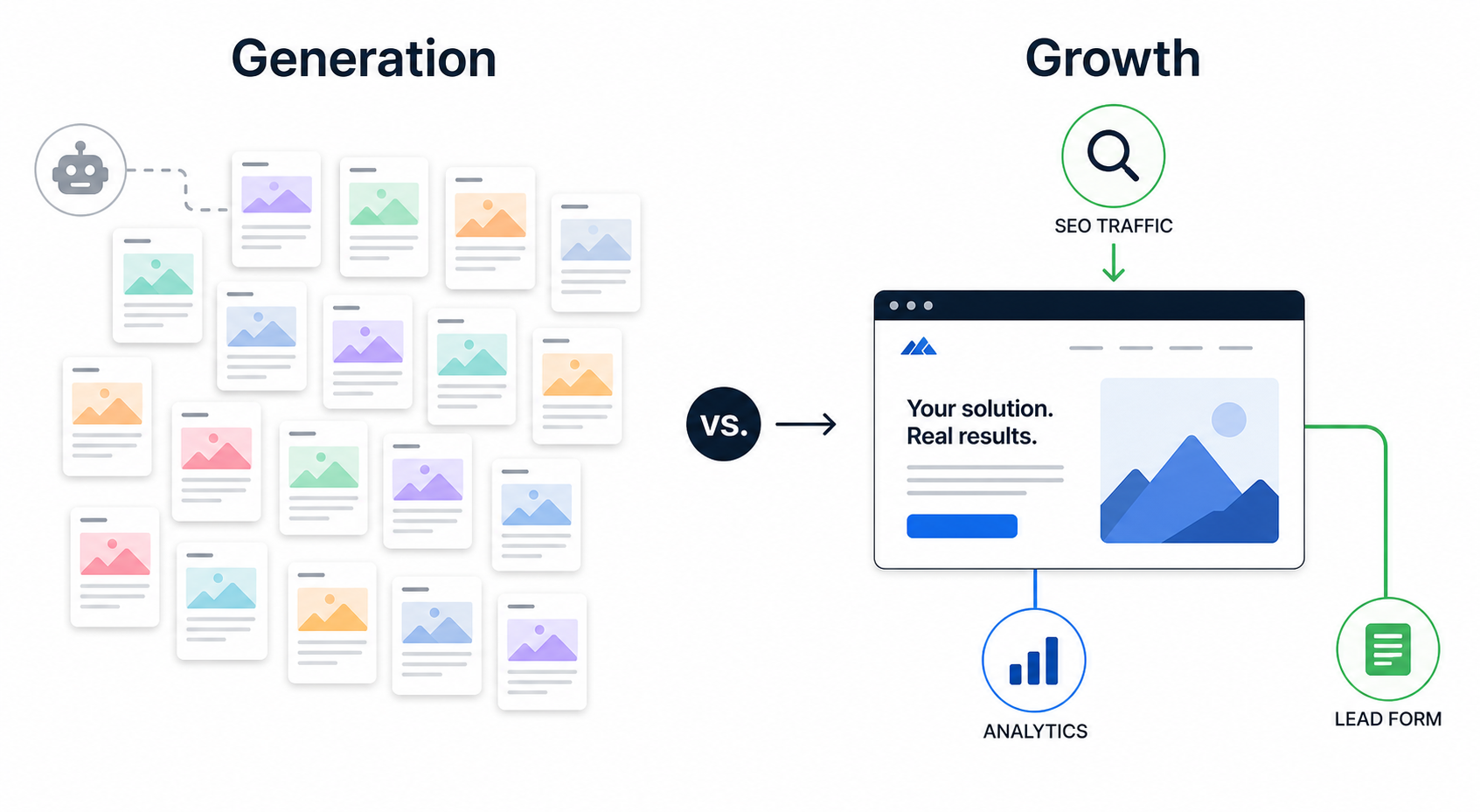
What will not become dirt cheap?
The valuable parts are harder:
positioning decisions
website architecture
search intent mapping
content matrix design
conversion path design
post-launch analytics
content updates and rewrites
brand trust building
human review and iteration
the loop from traffic to leads
These are not solved by “writing more.”
They require judgment, experience, feedback, and iteration.
AI can assist, but it cannot fully own the result for you.
Take SEO content.
Generating an article is cheap.
But these questions are not cheap:
Is this keyword worth targeting?
What does the searcher actually want?
Which product scenario should the article connect to?
Which page should it link to?
When do we review performance after publishing?
If it does not rank, do we change the title, structure, or intent?
If traffic comes but does not convert, is the problem content or CTA?
That is the real SEO work.
SEO is not “writing articles.” It is organizing search demand through content and turning that demand into business outcomes.
AI website building is the same.
Generating a homepage is cheap.
But an operational website needs to answer:
How should the sitemap be structured?
What roles do homepage, feature pages, case pages, pricing pages, and lead pages play?
Which pages capture branded search?
Which pages capture long-tail demand?
Which content is for Google?
Which content is for AI search and LLM citation?
Which pages handle conversion?
Which forms, buttons, and booking paths capture leads?
Page generation becomes cheap. Website growth systems do not become cheap automatically.
Will AI SEO content become brutally commoditized?
Yes. But not in the way people think.
Once low-cost models become common, SEO content production will get more competitive, especially for:
batch tool pages
batch comparison pages
batch FAQ pages
long-tail keyword articles
multilingual content
local service pages
Everyone can produce more, faster, cheaper.
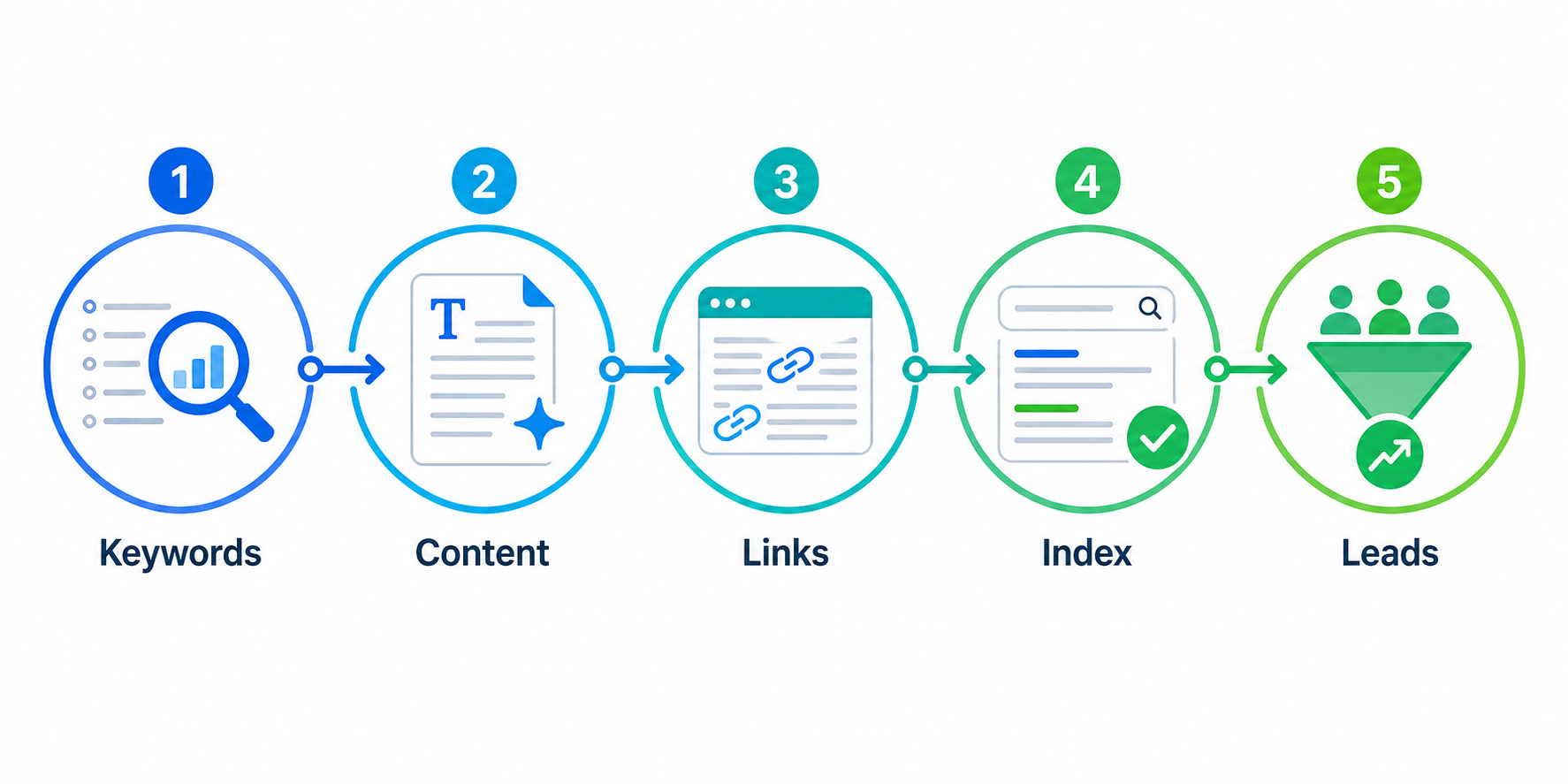
But search engines and AI recommendation systems will not reward you just because you generate fast.
When content supply explodes, platforms will care more about:
real information gain
clear structure
credible sources
user behavior feedback
brand signals
site-level quality
continuous updates
unique judgment and experience
So the competition is not “who writes more.”
It becomes:
Who can connect content, pages, product, data, and conversion into one system?
That is why low-cost models make the middle layer more important.
Before, content was expensive, so people competed on production capacity.
Later, content becomes cheap, so people compete on topic selection, layout, review, and conversion.
Will AI website building become $9.99 commodity work?
If you mean “generate a page that looks okay,” yes.
It may become even cheaper than that.
The marginal cost of page generation will keep falling.
But if you mean:
a launch-ready, operational website that can continuously get traffic and leads,
then no.
Not in a simple way.
Because a website is not a file. It is a business entry point.
A product website has to explain who you are, what you sell, who it is for, why you are credible, and what users should do next.
A service page has to explain the problem, process, cases, proof, and inquiry path.
A portfolio has to show capability, style, projects, results, and contact.
A B2B export inquiry site has to show product specs, use cases, certifications, delivery ability, inquiry paths, and multilingual SEO.
That is not solved by “generate HTML.”
The cheap part is the page shell. The valuable part is business expression and the growth loop.
This is exactly where We0 AI fits
We0 AI does not want to stay in the shallow competition of “AI page generators.”
That layer will become cheap.
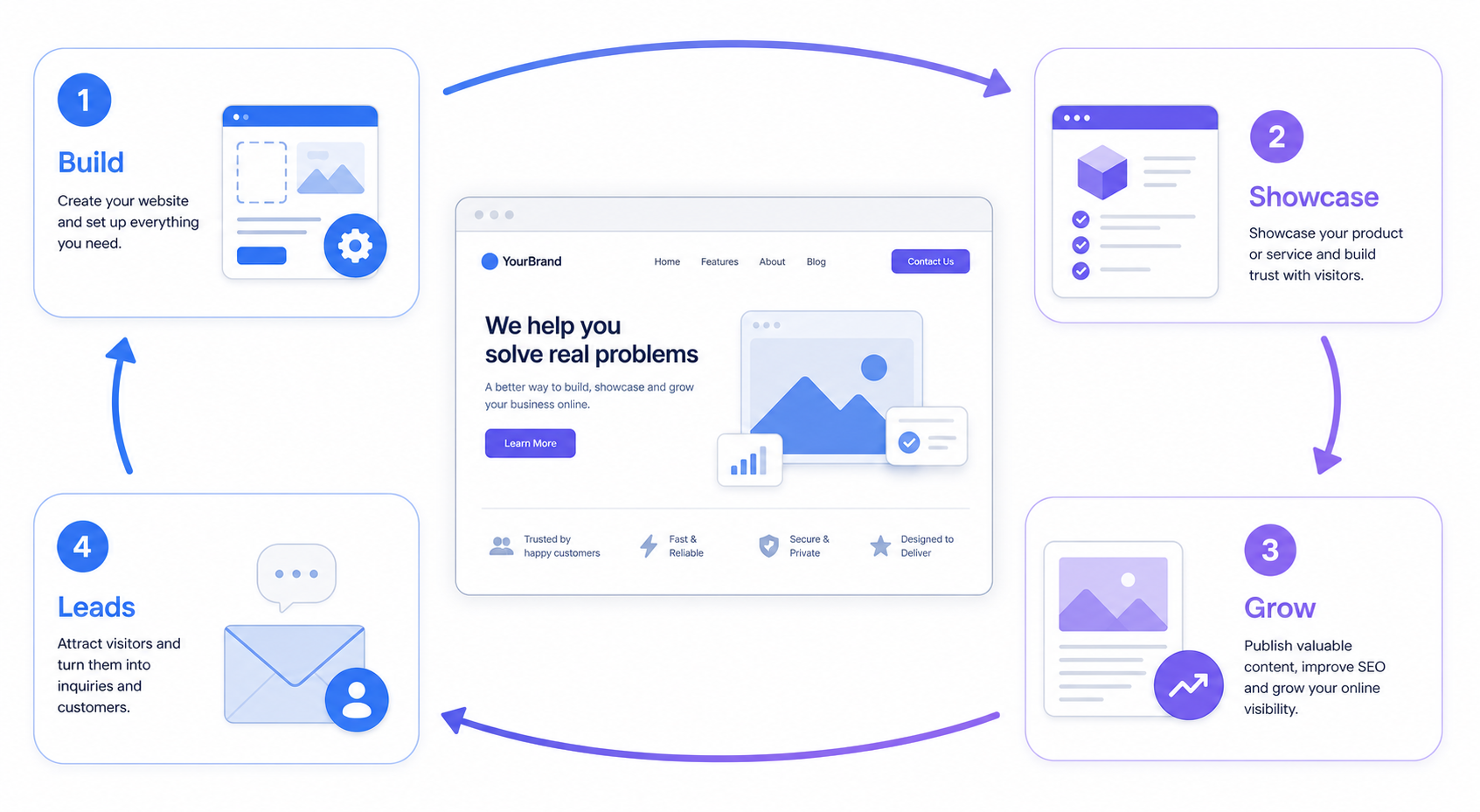
We0 AI focuses on the full workflow of showcase website growth:
Build -> Showcase -> Grow -> Leads
Meaning:
Build: create the website structure, pages, and core content so it can go live
Showcase: present products, services, cases, portfolios, and expertise clearly
Grow: grow through SEO, GEO, content, and long-tail keyword coverage
Leads: turn visitors into inquiries, bookings, signups, or customers
From the GLM-5.2 angle, We0 AI’s position becomes even clearer.
Lower model costs help We0 AI produce faster:
first-draft website structures
page copy
SEO titles and descriptions
FAQs
multilingual pages
blog drafts
content matrix ideas
internal link suggestions
But We0 AI is not only delivering these generated artifacts.
The more important questions are:
Can your site go live?
Does the page explain your value clearly?
Is the content mapped to search intent?
Are SEO/GEO basics configured?
Is content updated after launch?
Is data being reviewed?
Is growth being improved over time?
Do visitors become customers?
That is the difference.
Low-cost models make We0 AI more efficient, but they do not make growth service meaningless.
Instead, they make shallow “page generation only” tools more commoditized.
The cheaper the model, the more dangerous AI junk content becomes
There is another real issue.
The cheaper models become, the more junk content gets created.
That is almost inevitable.
When the cost barrier drops, many sites will mass-produce:
generic how-to articles
reviews without real experience
rewritten comparison pages
keyword-stuffed pages
complete-looking but empty FAQs
tool pages copied from competitor structures
Some may get short-term traffic.
Long term, many will be filtered out by users and search systems.
Because users are not stupid.
If they click in and find no information gain, no judgment, and no practical next step, they leave.
AI search and recommendation systems will also lean more toward content with trust, structure, sources, brand signals, and actual usefulness.
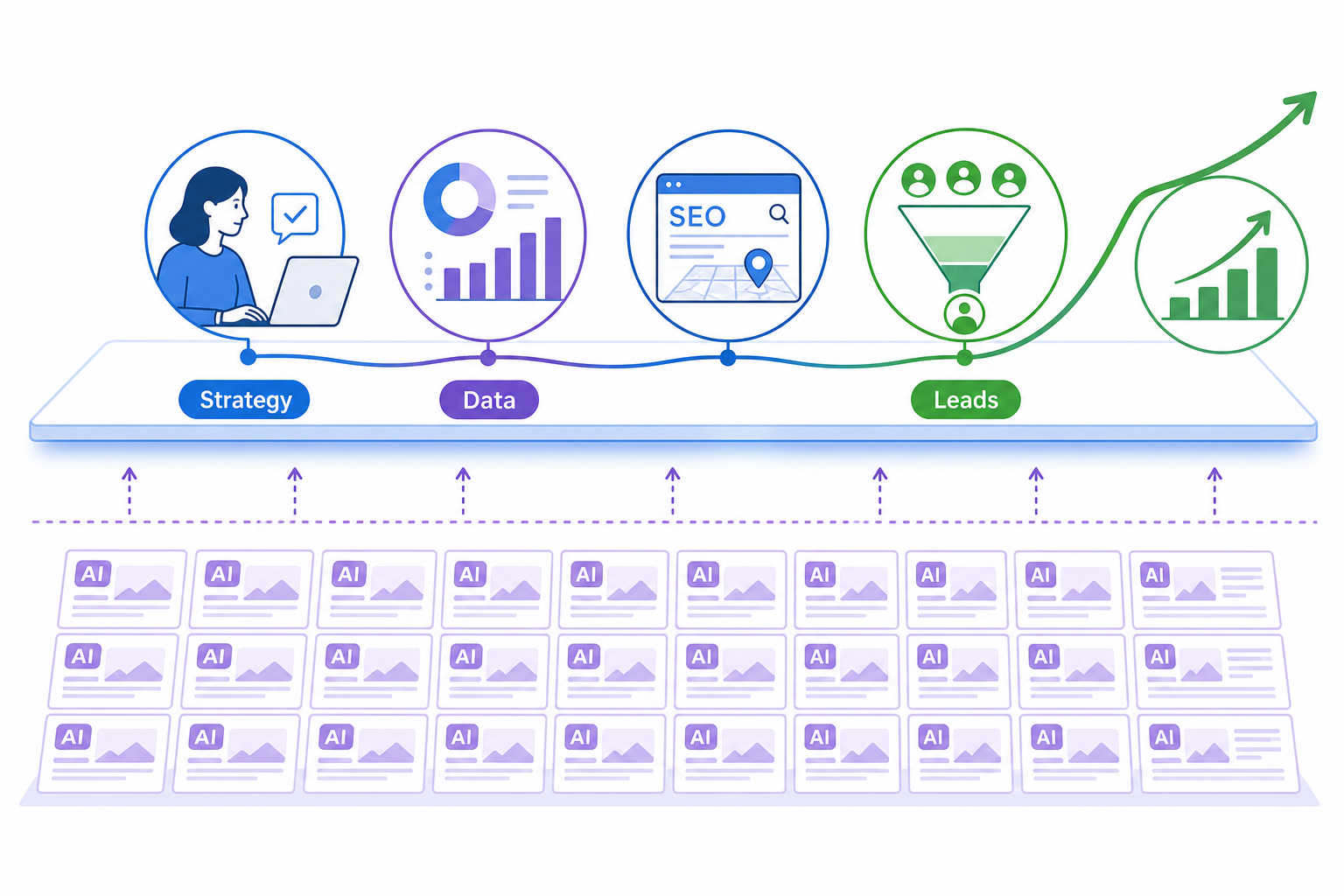
So the opportunity is not “use cheap models to flood the web.”
It is:
use cheap models to reduce production cost, then spend more energy on judgment, structure, review, and conversion.
Advice for founders, indie hackers, agencies, and small teams
If you are a founder, indie hacker, consultant, agency, or export business, do not stare only at model pricing.
Cheap models are good.
But the better questions are:
Question | Why it matters |
What business goal should the website serve? | Without a goal, more pages are just more material |
What are the core pages? | Homepage, service pages, case pages, feature pages, and lead pages do different jobs |
Which keywords should we target? | SEO is not about writing more, but matching real search demand |
How should content form a matrix? | One article rarely creates durable growth; topic clusters matter |
How does the page convert leads? | Without CTA, forms, or inquiry paths, traffic is wasted |
Who reviews data after launch? | Without review, you do not know what to improve |
Do not treat AI as a cheap writer. Treat AI as growth productivity.
Those are very different.
A cheap writer gives you more articles.
Growth productivity gives you a clearer website, a stronger content matrix, faster iteration, and a more stable lead source.
FAQ
1. Will GLM-5.2 make AI website building extremely cheap?
It will make page generation, copy generation, and basic SEO content generation cheaper. But positioning, site architecture, launch, SEO/GEO, content growth, and lead conversion still require strategy, execution, and review.
2. Will AI SEO content production become dirt cheap?
Basic articles will get cheaper, especially FAQs, long-tail articles, multilingual content, and metadata. But a content system that can rank, bring traffic, and convert leads cannot be solved by low-cost generation alone.
3. Will low-cost models create more AI junk content?
Yes. Lower model costs make batch content easier. But search engines and AI recommendation systems will care more about trust, structure, sources, brand signals, and user behavior feedback.
4. How is We0 AI different from a normal AI website builder?
We0 AI is not just a page generator. It focuses on showcase websites and the full Build -> Showcase -> Grow -> Leads workflow, including launch, content, SEO/GEO, analytics, and lead generation.
5. How should small teams use low-cost models like GLM-5.2?
Use them to reduce the cost of drafts, page copy, multilingual content, FAQs, and content matrix planning. But keep strategy, structure, conversion paths, and ongoing optimization in human hands.
Related Tools
Z.ai: The product entry for GLM models and GLM-5.2.
GLM-5.2 Blog: Official GLM-5.2 release and technical overview.
Zhipu AI Open Platform: Zhipu AI’s model platform.
Hugging Face GLM-5.2: GLM-5.2 model weights page.
Google Search Central: Official SEO documentation and search guidance.
We0 AI: An AI website and growth platform for showcase websites.
Sources
Conclusion
Low-cost strong models like GLM-5.2 catching up is good news.
They will keep reducing the base cost of AI website building and SEO content production.
Page drafts, article drafts, FAQs, translation, metadata, and content matrix drafts will all get cheaper.
But that does not mean AI website building and SEO growth become dirt cheap as a whole.
What loses value is: generation without strategy, differentiation, review, or conversion.
What gains value is: a growth system that connects websites, content, SEO/GEO, data, and leads.
So the answer is clear:
AI generation gets cheaper. AI growth does not automatically get cheaper.
Models will continue to drop in price.
But users still buy outcomes.
Not a pile of pages.
Not a pile of articles.
A website asset that can showcase, grow, and bring customers.