From SEO to GEO: How Brands Can Stay Visible When AI Answers Replace Search Clicks
AI answers are changing how people discover brands. Traditional SEO helped websites win rankings and clicks, but generative engine optimization helps brands get mentioned, cited, and trusted inside AI-generated answers from Google AI Overviews, AI Mode, ChatGPT search, Perplexity, and other answer engines. This guide explains how brands can move from SEO to GEO, protect search visibility when clicks decline, and build answer-ready content, entity clarity, proof, citations, and conversion paths that turn AI visibility into leads.
From SEO to GEO: How Brands Can Stay Visible When AI Answers Replace Search Clicks
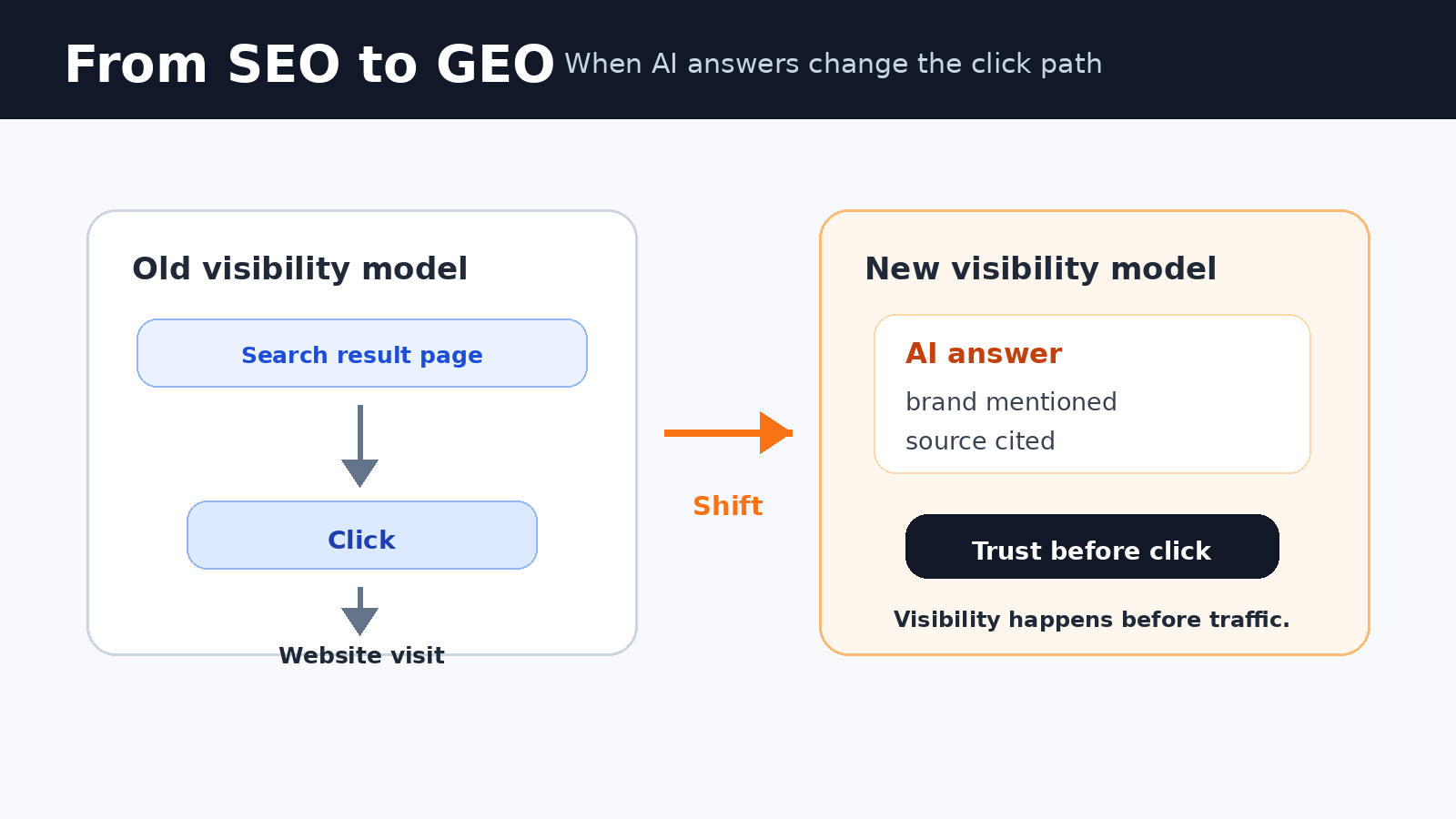
For years, the marketing playbook was built around one simple path: rank on Google, earn the click, and convert the visitor on your website.
That path still matters. But it is no longer the only path.
Today, more people are getting answers directly inside search and AI interfaces. Google has AI Overviews and AI Mode. OpenAI says ChatGPT search can provide fast, timely answers with links to relevant web sources. Perplexity built its product around source-backed AI answers. The result is clear: brands can no longer measure visibility only by website clicks.
This is the shift from SEO to GEO.
SEO helps your website rank in search results. GEO, or generative engine optimization, helps your brand appear inside AI-generated answers, recommendations, summaries, and citations. The goal is not only to get traffic. The goal is to be understood, trusted, and chosen before the user clicks.
That sounds like a small change, but it changes everything about content strategy. If AI answers become the first screen of discovery, your content has to work before the visit happens. Your brand has to be clear enough to mention, credible enough to cite, and useful enough to recommend.
Why SEO alone is no longer enough
Traditional SEO is still the foundation. Google Search Central says SEO is about improving a site's presence in Search and helping search engines crawl, index, and understand content. That basic work still matters: clean pages, helpful content, useful titles, descriptive headings, internal structure, and technical access.
But SEO was designed around search results and clicks. The search engine displayed a list of pages. Users chose one. The website received traffic. Then the brand could educate, persuade, and convert.
AI answers compress that journey. Instead of showing only a list of links, the answer engine may summarize the topic, compare options, and include sources. The user may form an opinion before opening any website. In some cases, the AI answer may satisfy the user completely. In other cases, the cited source gets a more qualified visit because trust was already built in the answer.
That means brands need two layers now. They need SEO to stay discoverable. They need GEO to become usable inside answers.
What GEO really means
GEO is not a magic trick. It is not keyword stuffing for AI. It is the practice of making your content easy for answer engines to understand, extract, verify, and cite.
A GEO-ready page usually does four things well. It answers a specific question directly. It explains the context around that answer. It provides proof, examples, or sources. And it gives the reader a clear next step if they want more depth.
This matters because AI systems do not simply rank pages the way classic search results do. They often retrieve information, compare multiple sources, and generate a synthesized response. If your page is vague, thin, or hard to parse, it may be ignored even if the topic is relevant. If your page has clear definitions, comparisons, tables, examples, and credible proof, it becomes easier to include in an answer.
In SEO, the page is the main unit. In GEO, the content block becomes more important. A definition block, comparison table, FAQ answer, statistic explanation, or case example can all become the part AI systems reuse.
Area | SEO | GEO |
Primary goal | Rank and earn clicks | Be cited and recommended |
Content unit | Web page | Answer block |
Success signal | Traffic and rankings | Mentions and citations |
Main risk | No visibility | Misrepresented brand |
Best asset | Helpful page | Source-worthy page |
What changes when AI answers replace search clicks
The biggest change is that visibility moves upstream. A user may discover your brand inside the answer itself, not after clicking a link. That makes brand mentions, citation quality, and answer framing more important.
A second change is that trust becomes more compressed. In traditional SEO, the user might read your homepage, browse your blog, check your case studies, and then decide. In AI search, the system may summarize your brand in one sentence. If your website does not make your positioning clear, the summary may be incomplete or wrong.
A third change is that content has to serve both humans and machines. Humans want clarity, examples, and confidence. AI systems need structure, consistency, and extractable meaning. The best content does both.
The new visibility metric: can AI explain your brand correctly?
The old question was: do we rank? The new question is: can AI explain us correctly?
Search ranking still matters, but AI visibility introduces a new kind of brand risk. If answer engines describe your company poorly, omit your strongest proof, or cite competitors more often, your brand is losing visibility even if your website traffic looks stable.
Brands should start testing common buyer questions in AI search tools. Ask what the best options are, what the category means, how to compare vendors, what mistakes buyers make, and which tools are recommended. Then look for four things: whether your brand appears, how it is described, what sources are cited, and what gaps are obvious.
This is not about gaming one model. It is about understanding whether your public content gives AI systems enough clean material to represent you accurately.
How brands can stay visible in the AI answer era
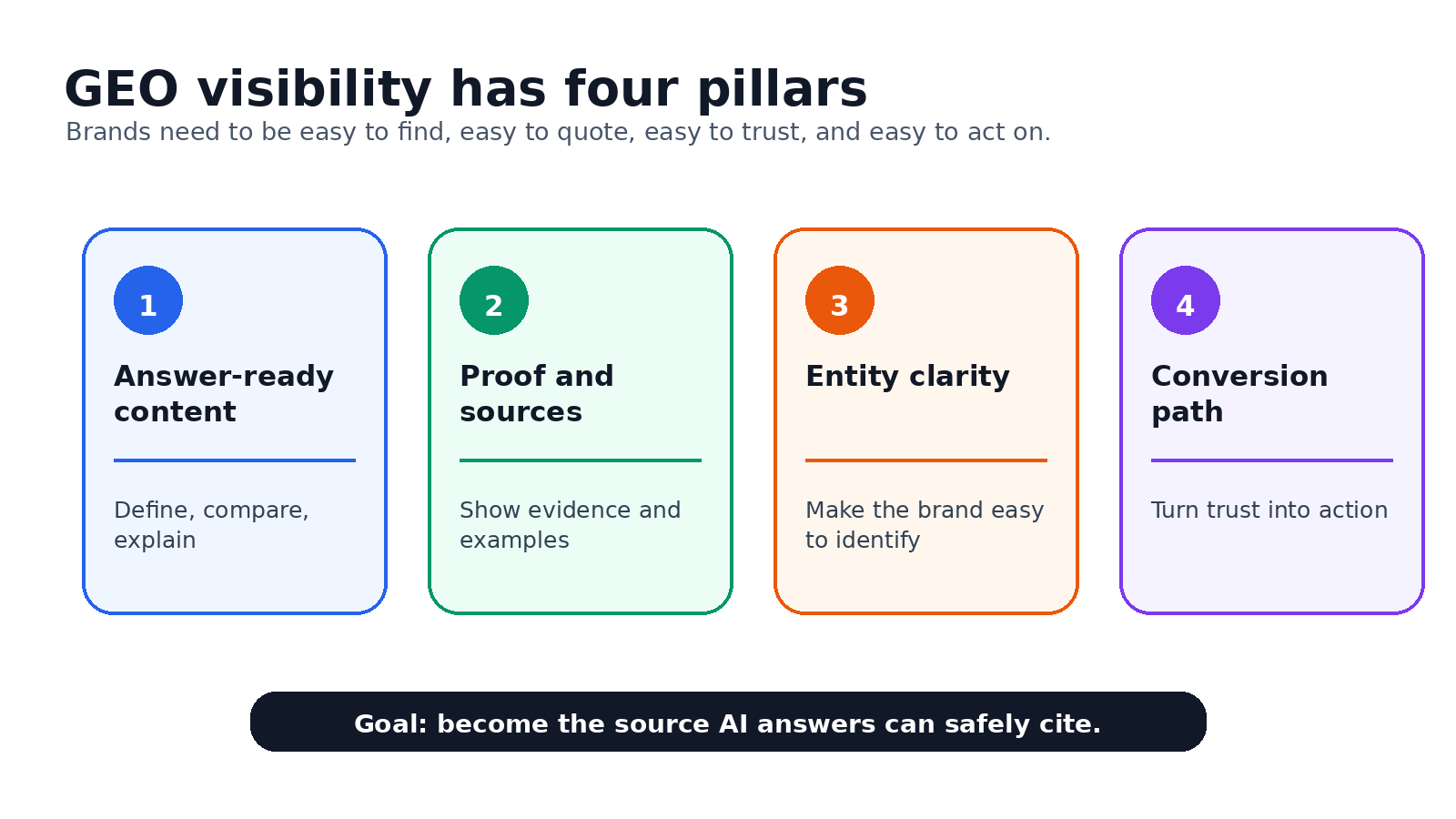
The practical strategy is to build answer-ready content around the questions your audience already asks.
Start with category definitions. If your product or service belongs to a category that buyers do not fully understand, explain the category better than anyone else. Define the term, compare it with adjacent terms, explain why it matters, and show examples.
Then build comparison pages. AI answers often need to compare options, frameworks, products, workflows, and methods. A page that clearly compares alternatives is easier to cite than a vague promotional page.
Next, publish proof. This can include case studies, screenshots, customer examples, numbers, benchmarks, methods, or detailed use cases. AI systems and humans both need evidence. Unsupported claims are weak in traditional SEO and even weaker in GEO.
Finally, create conversion paths. Being cited is not the end. If someone clicks through from an AI answer, they should immediately understand what to do next: read a guide, view a template, book a call, try a product, or compare options.
Why entity clarity matters
One of the most overlooked parts of GEO is entity clarity. An answer engine needs to understand who you are, what you do, and how you relate to a topic.
This means your website should use consistent language across the homepage, product pages, about page, documentation, case studies, and blog content. Your brand should have a clear description. Your core category should be repeated naturally. Your use cases should be specific. Your examples should be tied back to your main positioning.
If your site describes the same product five different ways, AI systems may struggle to classify it. If your content clearly says what the brand is, who it helps, and what problem it solves, you make the brand easier to retrieve and recommend.
Where showcase websites fit into GEO
A showcase website is useful because it turns brand value into structured evidence. It does not only say what the company does. It shows the offer, proof, cases, use cases, comparisons, and next steps.
That makes showcase websites especially relevant in the AI answer era. A basic homepage may not provide enough extractable context. A well-structured showcase website gives both users and AI systems more material to understand the brand.
This is where We0.ai fits naturally. The goal is not only to build a website quickly. The stronger goal is to build a website that supports SEO, GEO, AI visibility, and lead generation. Build the site, showcase the value, grow visibility, and turn attention into leads.
A practical GEO checklist
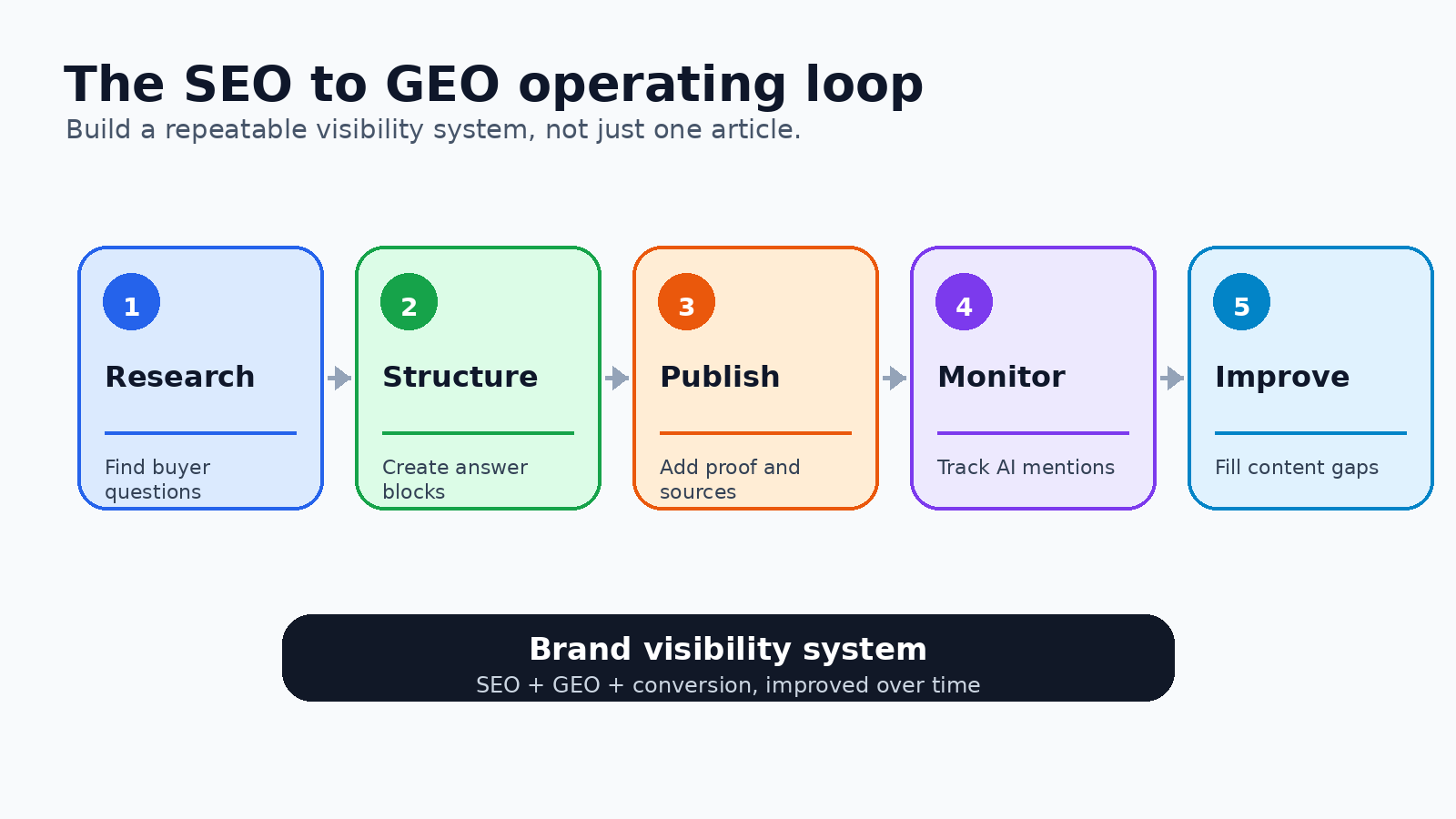
Before you publish a page, ask: does the page answer one clear question? Does it include a direct summary? Does it define key terms? Does it compare alternatives? Does it show proof? Does it cite or link to credible sources where needed? Does it make the brand category clear? Does it include a next step?
If a page cannot pass this checklist, it may still exist online, but it may not be useful for AI answers. GEO rewards clarity, structure, and proof. It does not reward generic brand language.
The best approach is not to abandon SEO. It is to upgrade SEO content so it can work in both environments: search results and AI answers.
Final takeaway
SEO got brands discovered through rankings and clicks. GEO helps brands stay visible when AI answers become the first layer of discovery.
The brands that win will not simply publish more content. They will publish clearer content. They will define their category, organize proof, build source-worthy pages, monitor AI mentions, and connect visibility to a conversion path.
The click is no longer the only moment that matters. The answer matters too. If your brand is not visible inside the answer, you may be invisible before the customer ever reaches a search result.
CTA
If your brand is still optimizing only for search clicks, now is the time to build for AI answers as well. Create answer-ready pages, showcase proof, clarify your category, and give visitors a clear next step.
Build a GEO-ready showcase website with We0.ai
FAQ
What is the difference between SEO and GEO?
SEO focuses on improving visibility in traditional search results. GEO focuses on helping content appear inside AI-generated answers, summaries, citations, and recommendations.
Is GEO replacing SEO?
No. GEO adds a new layer on top of SEO. Brands still need crawlable, helpful, well-structured pages before they can become reliable AI sources.
Why do AI answers reduce search clicks?
AI answers can satisfy some user questions directly inside the search or chat interface, so users may not always need to click through to a website.
How can brands optimize for GEO?
Brands can publish answer-ready content, clear definitions, comparison pages, proof, case studies, FAQs, and strong source-backed explanations.
What should brands monitor in AI search?
Brands should monitor whether they appear, how they are described, which sources are cited, and which competitors are recommended.
How does a showcase website help with GEO?
A showcase website organizes offer, proof, use cases, comparisons, and conversion paths in a way that is easier for users and AI systems to understand.
Related Tools
- ChatGPT
- Ahrefs
- Semrush
- Moz
Sources
- AI Mode