EEAT as the Survival Baseline: Why Trust Is Now the Minimum Requirement for SEO and AI Search
E-E-A-T is no longer just a quality concept for SEO. In the AI search era, experience, expertise, authority, and trust are the baseline for being understood, cited, ranked, and chosen. Learn how to turn your website into a credible growth asset with We0 AI.

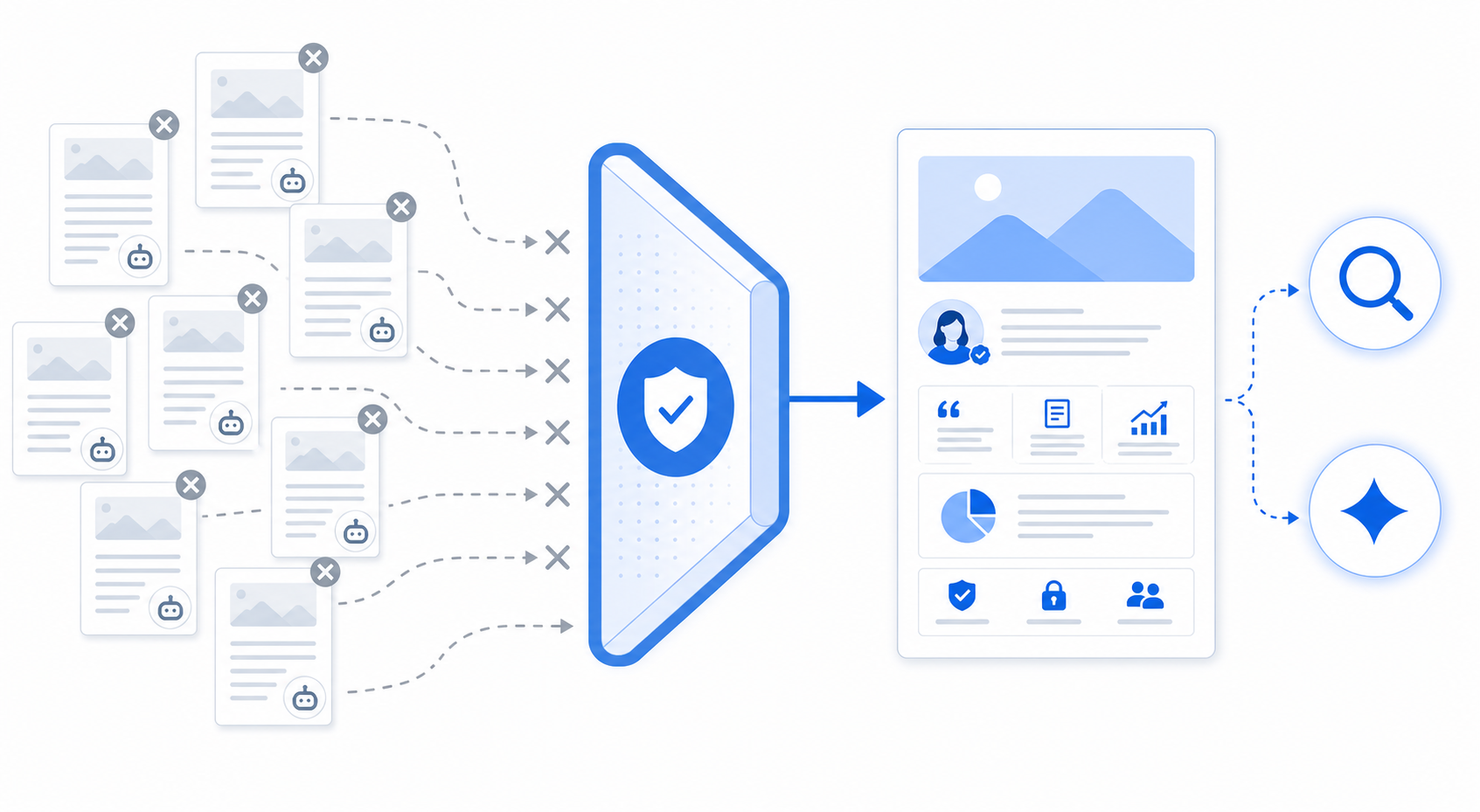
A lot of people still treat E-E-A-T as an “advanced SEO optimization.”
Something you add later.
After the website is done. After the content is published. After rankings don’t move. Then you add an author bio, a few sources, an About page, maybe some customer logos.
That mindset is getting risky.
E-E-A-T is no longer a bonus. It is becoming the survival baseline.
Especially now that AI search, AI Overviews, ChatGPT, Perplexity, and Gemini are becoming stronger answer engines. There is more content, fewer clicks, and less patience from users.
The more realistic situation is this:
If search systems and users cannot tell whether you are credible, you may not even get a serious comparison.
In the past, mediocre content could sometimes win traffic through keywords, backlinks, titles, and freshness.
Now the game is different.
AI can summarize generic information quickly. Google keeps emphasizing helpful, reliable, people-first content. The easier content becomes to mass-produce, the more valuable trust becomes.
This article is not going to explain E-E-A-T like a textbook.
Let’s talk about the real issue:
Why E-E-A-T is becoming the minimum requirement for website growth, and how a brand website, product website, or service website can make trust visible instead of just claiming it.
The short version: without E-E-A-T, your website has no foundation
E-E-A-T stands for four things:
Experience: Have you actually done it, used it, served clients, or learned from real situations?
Expertise: Do you truly understand the field?
Authoritativeness: Do others recognize, cite, mention, or trust you?
Trust: Can users safely believe you, contact you, and buy from you?
Google’s own documentation is clear: E-E-A-T itself is not a single ranking factor, but Google’s systems use a mix of factors to identify content that demonstrates E-E-A-T. And among these elements, Trust is the most important.
That matters.
Because many people misunderstand E-E-A-T.
It is not an SEO plugin you install.
It is not finished by adding “reviewed by an expert” at the bottom of a page.
E-E-A-T is closer to the trust architecture of your website.
It shows up in many places:
Location | What users see | What search/AI may understand |
|---|---|---|
Homepage | Who you are, who you serve, what problem you solve | Whether your positioning is clear |
About page | Team background, experience, method | Whether there is a real entity behind the site |
Product/service pages | Features, process, boundaries, use cases | Whether you are specific and professional |
Case studies | Client problem, process, outcome | Whether you have real experience |
Author pages | Who wrote it and why they can write it | Content responsibility and expertise source |
FAQ | Answers to real questions | Whether you cover user intent |
Sources | Data, references, methodology | Whether claims are reliable and verifiable |
Contact/CTA | How to contact you, what happens next | Whether there is a real business path |
So E-E-A-T is not just an article problem.
It is a whole-website problem.
This is also why We0 AI does not position itself as a normal AI website builder. A useful website is not just a generated page. It should help you organize brand, product, service, cases, content, SEO/GEO, and lead paths into a credible growth asset.
The loop is:
Build -> Showcase -> Grow -> Leads
Build the site. Showcase trust. Grow continuously. Capture leads and customers.
Why E-E-A-T matters more now: AI made generic content cheap
Content used to have at least some friction.
You had to research, structure, write, edit, and publish.
Now?
Anyone can generate a “complete-looking” SEO article in 30 seconds.
It may have a title, subheadings, FAQ, conclusion, and keywords.
But here is the problem:
It has no lived experience, no judgment, no real details, and no responsible source.
It looks full on the page, but it feels empty when you read it.
Users can feel that more and more.
AI search systems also need to decide: Which content is worth citing? Which content is just repetition? Which content was created mainly to chase rankings?
Google’s helpful content documentation warns creators not to produce content mainly to attract search visits, not to use extensive automation across many topics, and not to simply summarize what others have said without adding value.
In plain language:
When content becomes cheap to produce, credible evidence becomes scarce.
That is why E-E-A-T is rising in importance.
Not because Google suddenly likes the acronym.
Because the search environment changed.
E-E-A-T and AI Search / GEO: AI reads signals, not just words
Many teams assume AI search only looks at whether an article is well written.
Not enough.
AI systems, search systems, and users all look at a broader set of signals.
For example:
Does your website have a clear topical focus?
Is your brand message consistent across pages?
Does your content include authors, sources, and update dates?
Do your case studies include process and outcomes?
Do your product pages explain who the product is for and not for?
Does your FAQ answer real questions?
Do external mentions, social profiles, directories, and reviews support your claims?
This is a key point in the GEO era.
SEO helps search engines find you. GEO helps AI answers understand and cite you.
E-E-A-T is the shared foundation of both.
Without E-E-A-T, SEO may struggle to hold stable visibility. Without E-E-A-T, GEO may struggle to enter credible answer chains.
Especially for B2B, SaaS, AI products, consulting, export businesses, and local services, users do not buy after reading one paragraph.
They ask:
Who are you?
Have you done this before?
Do you have examples?
Is your method reliable?
How are you different?
Why should I leave my information with you?
These are not keyword questions. They are trust questions.
Common E-E-A-T fake moves
Many websites now know they should care about E-E-A-T.
But what they do often looks like “performing trust.”
There is movement, but not much substance.
Fake move 1: Adding a random author photo
An author page is not a headshot page.
If there is no background, field experience, previous content, social proof, or project links, it is mostly decoration.
Useful authorship should answer:
Who is this person?
Why are they qualified to write about this topic?
What have they done before?
Was the content reviewed?
Fake move 2: Writing an About page like a vision poster
Many About pages are full of mission, vision, innovation, empowerment, and future.
But users often want simpler things:
Who are you?
Where is the team?
How long have you done this?
Who have you served?
What is your method?
How can I contact you if something goes wrong?
An About page is not brand poetry. It is a trust entry point.
Fake move 3: Showing only logos on case pages
Logos help, but they are not enough.
If a case page does not explain the problem, process, deliverables, and outcome, users still cannot judge what you actually did.
Case studies need evidence.
Fake move 4: Writing FAQ only as sales questions
Questions like “Are you reliable?” “Is your service good?” “Why choose us?” feel too self-serving.
Strong FAQ comes from real search behavior, real sales conversations, and real customer hesitation.
Fake move 5: Chasing trends without serving your audience
Google’s people-first content guidance is direct: don’t write about something only because it is trending. Write because it serves your existing or intended audience.
That matters.
You can ride trends. But you cannot lose focus.
How a showcase website can demonstrate E-E-A-T

If you are an Owner, indie maker, SaaS team, agency, consultant, creator, export company, or local service provider, your website does not need to be complicated from day one.
But it must be credible.
Start with these eight modules.
1. Homepage: explain who you are in one clear sentence
A homepage should not be big and empty.
Don’t just write:
We help businesses grow with AI.
A stronger version is:
We help B2B SaaS teams build showcase websites that explain their product, earn search visibility, and convert qualified leads.
The difference is obvious.
The second version explains who you serve, what you do, and what outcome you help create.
Clarity is the first step toward trust.
2. About: reveal the real entity behind the site
An About page should include:
team or founder background
why the business exists
service experience
methodology
values, but not empty ones
contact or company information
If you are a personal brand, that is fine too.
Personal websites need to make experience, work, customer feedback, and professional path even clearer.
3. Product/service pages: explain use cases, not just features
Many product pages only list features.
But users want to know:
Who is this for?
Who is it not for?
What will be delivered?
What is the process?
How long does it take?
How does pricing or quoting work?
What are the boundaries and risks?
The more specific you are, the more credible you become.
Vagueness weakens trust. Specificity improves conversion.
4. Case studies: show the problem, process, and result
A good case study is not “we built a website for this client.”
It should look more like this:
Case section | What to include |
|---|---|
Background | Who the client is and what problem they had |
Goal | What business problem needed to be solved |
Solution | Page structure, content strategy, SEO/GEO setup |
Process | How decisions were made and trade-offs handled |
Result | Traffic, leads, inquiries, conversions, or qualitative feedback |
Review | What can be reused next time |
This helps users understand your work. It also helps AI systems recognize real experience.
5. Content pages: answer “why should this come from you?”
When writing content, don’t only answer “what is this topic?”
Also answer:
Why is this worth hearing from you?
You can show that through:
projects you have actually done
your own judgment
reliable sources
clear boundaries
practical checklists
business context
connection to your product or service experience
Content without a point of view is easy for AI summaries to replace.
6. FAQ: answer the questions users hesitate to ask
Good FAQ is not filler.
It should remove real sales friction.
For example:
Can I build a website if I don’t have content materials yet?
Will an AI-generated website look too template-like?
How long does SEO/GEO take to show results?
Can a showcase website generate leads?
What happens if I need to update content later?
When FAQ is done well, it is not just an SEO module. It is a conversion module.
7. Sources: do not be afraid to cite external references
Some teams worry that citing external sources will send users away.
Usually, it does the opposite.
Good references make your content more credible.
Especially when writing about SEO, AI search, Google rules, industry data, or market trends, don’t rely only on your own claims.
Credible content does not say “trust me.” It shows where the evidence is.
8. CTA: don’t just add a button, explain the next step
Many websites only have a weak CTA button: Contact Us.
That is not enough.
Tell users:
What happens after they click?
Who should book a call?
What will you help them review?
Do they need to prepare anything?
How soon will they hear back?
CTA is also part of trust.
How We0 AI turns E-E-A-T into website structure
This is where We0 AI fits naturally.
E-E-A-T cannot be fixed with one article.
It has to live inside website structure, page content, case study presentation, FAQ, SEO/GEO setup, data monitoring, and ongoing updates.
We0 AI is not a single-point page generator. It helps turn a showcase website into an operable growth system:
We0 AI capability | E-E-A-T value |
|---|---|
Brand information clarification | Makes positioning clearer and reduces empty language |
Website structure planning | Helps users and search systems understand you |
Page copy optimization | Expresses experience, expertise, and differentiation |
Case/service/portfolio showcase | Strengthens Experience and Trust |
SEO/GEO foundation setup | Helps search and AI understand the site |
Content production and publishing | Covers long-tail questions and real demand over time |
Data monitoring | Shows which content brings visits and leads |
Monthly review and optimization | Keeps the website more credible and effective over time |
That is why We0 AI is better understood as:
A showcase website growth team + an AI website platform.
Not a tool that throws a page at you and disappears.
A partner that helps turn your website into a long-term asset.
A simple E-E-A-T website checklist
If you already have a website, use this checklist directly.
Question | Yes/No |
|---|---|
Does the homepage explain who you serve and what problem you solve within 5 seconds? | |
Does the About page show real team or personal background? | |
Do product/service pages explain use cases, process, and deliverables? | |
Do you have case studies, not just client logos? | |
Does content include author, sources, and update information where appropriate? | |
Does FAQ answer real customer questions? | |
Do you show external references, reviews, or third-party proof? | |
Does the CTA explain what happens next? | |
Is the website continuously updated after launch? | |
Are you considering both SEO and GEO? |
If most answers are no, the problem may not be “not enough SEO technique.”
The problem may be simpler:
Your website has not given users and search systems enough reasons to trust you.
FAQ
1. Is E-E-A-T a Google ranking factor?
Google says E-E-A-T itself is not a single ranking factor. However, Google’s systems use a mix of factors to identify content that demonstrates experience, expertise, authoritativeness, and trust. So it is not a button, but it matters a lot.
2. How is E-E-A-T related to SEO?
SEO helps search engines discover and understand content. E-E-A-T helps that content be seen as credible, useful, and worth surfacing. Without E-E-A-T, SEO can become shallow ranking-chasing.
3. Does AI-generated content hurt E-E-A-T?
AI itself is not the issue. The issue is whether the content provides real value, has clear authorship/process/sources, and is created primarily to help users. Mass-produced content with no experience or responsible source will struggle to build E-E-A-T.
4. Can small teams or personal brands demonstrate E-E-A-T?
Yes. E-E-A-T is not only for big companies. Personal experience, real case studies, clear methods, transparent service processes, and consistent content can all build trust.
5. How does We0 AI help improve E-E-A-T?
We0 AI helps clarify brand information, plan website structure, improve page copy, showcase cases and services, set up SEO/GEO, publish content continuously, and monitor data — turning a website from a page into a credible growth asset.
Related Tools
Sources