DeepMind Lead on Programmer Transition: The Valuable Skill Is Not Using AI, but Making AI Systems Work
A practical rewrite based on Vlad Feinberg’s interview and public career advice: why ordinary programmers can still move toward frontier AI work by building infrastructure, optimizing inference, understanding scaling laws, contributing to open source, and showing concrete proof. The article also connects this career signal to We0.ai’s Build → Showcase → Grow → Leads framework.
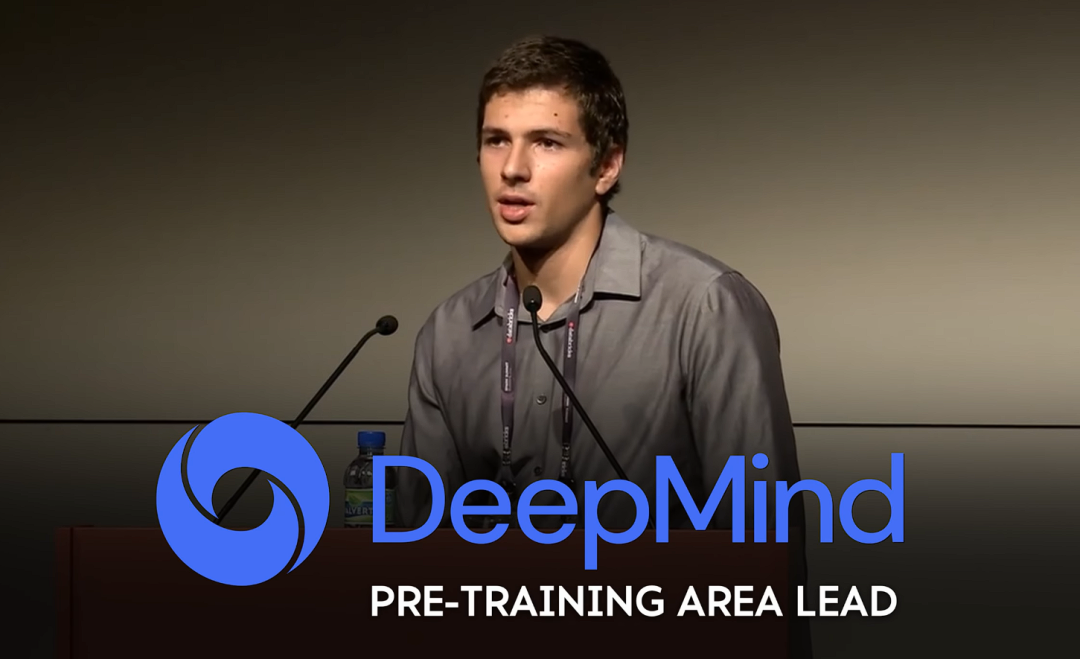
Original article image: related video frame of Google DeepMind pre-training lead
The easiest mistake for programmers in the AI era is thinking the competition is about who uses models better.
Vlad Feinberg’s interview points to a different answer: the valuable skill is not asking AI for more code, but making models, data, compute, inference services, and real products work as a stable system.
This article is not another panic story about programmers losing jobs. It is a more useful reminder: ordinary programmers are not locked out of frontier AI. The entry point has changed. It is no longer just business-code speed. It is infrastructure, inference cost, kernel optimization, distributed systems, reproducible experiments, open-source contribution, and visible proof of work.
The same logic applies to We0.ai. If technical ability stays inside local folders, GitHub commits, or private chats, it is difficult for other people to understand. Once it becomes a showcase website, technical case study, SEO/GEO content, and trusted project evidence, it can become a long-term opportunity asset.
Quick takeaway: AI does not remove programmers, but it weakens passive programmers
Old programmer advantage | New AI-era advantage |
Writing business code quickly | Defining problems, decomposing systems, and validating results |
Knowing frameworks and syntax | Understanding model serving, inference cost, data paths, and reliability |
Delivering requested features | Connecting AI to real products and taking responsibility for the outcome |
Listing project experience on a resume | Showing open-source work, technical writing, case pages, and reproducible demos |
Focusing on job titles | Becoming the person who helps a team make AI actually work |
The practical point is simple: organizations do not pay only for smart answers. They pay for people who can be trusted to make systems work, reduce cost, and own the result.
1. Frontier labs do not only need “researchers” or “engineers”
Many people imagine frontier AI labs as two groups: people who write papers and people who write code. Reality is more complicated. Pre-training, post-training, inference serving, search integration, product evaluation, and reliability all require research judgment and engineering execution at the same time.
Vlad’s point is that the boundary between language models and products is now much blurrier. A model can only become useful when training is stable, inference is affordable, factuality is evaluated, citations are reliable, and latency is low enough for real users.
That means ordinary programmers do not need to invent a new architecture on day one. A more practical entry point is the work around the model: make it faster, cheaper, more stable, and easier to serve.
2. The dirty work may be the most valuable work
One of the most memorable stories is not about a top conference paper. It is about an instant bonus from Jeff Dean. Vlad’s contribution was small in the glamorous sense: supervised fine-tuning, hyperparameter tuning, squeezing memory, and making an early Bard release run on limited hardware.
That may sound unglamorous. But in large model systems, the battlefield often lives there: one less wasted GPU, one fewer failed training run, lower latency, higher throughput, and better utilization.
If you are a backend engineer, this is an opportunity. These problems are deeply connected to traditional engineering skills: distributed systems, caching, queues, load balancing, profiling, storage abstractions, failure recovery, and resource scheduling.
The AI era does not reduce the value of engineering. It pushes engineering deeper into higher-value layers.
3. Gemini versus DeepSeek looks like a model race, but it is also a serving race
The outside world likes to compare Gemini, DeepSeek, OpenAI, and Anthropic through leaderboards. But the interview reveals a more grounded pressure: the model must also be fast, stable, and affordable under real traffic.
For Gemini 2.0 Flash, one challenge was maintaining quality while serving search use cases with low latency. Mixture-of-experts models can increase capacity, but they also create communication and memory pressure. The team had to rethink serving, expert placement, pipeline-style prefill, and how communication could be hidden behind computation.
This is the side most readers rarely see: a model does not win only because it is smart during training. It wins because it can work under real serving constraints.

Original article image: Vlad Feinberg in the interview
4. The transition path: move from using models to integrating models into business
The most useful example for ordinary programmers is Nate Lintz. He reportedly started from backend infrastructure in search rather than a glamorous AI-research background. By helping a product line adopt large models and solve inference and systems problems, he became a key technical contributor inside DeepMind.
That path is realistic. You do not need a frontier lab offer before doing frontier-relevant work. You can start inside your current product: reduce inference cost, build caching, connect LLM services to search, support, operations, content, or development workflows, and make results evaluable and traceable.
Transition direction | Concrete project ideas |
Inference serving | Run throughput, latency, and KV Cache experiments with vLLM, SGLang, or TensorRT-LLM |
Kernel and low-level optimization | Study CUDA, ThunderKittens, and FlashAttention-like ideas through small reproductions |
Business integration | Connect LLMs to search, knowledge bases, support, code review, or content workflows |
Evaluation and factuality | Build source-quality checks, citation flows, hallucination review, and human approval loops |
Technical showcase | Turn experiments into case pages, technical blogs, reproducible demos, and open-source PRs |
5. Do not only write a resume. Create credible signals.
Vlad’s advice to candidates is direct: bring evidence. Implement a Transformer by hand. Work through scaling-law exercises. Record the process. Show the math and the code.
The deeper logic is clear. Frontier teams do not need more people saying they are interested in AI. They need proof that you can decompose hard problems, persist through difficulty, and connect papers, code, systems, and results.
For ordinary developers, that signal does not have to stay inside interview materials. It can become a long-term asset: a technical portfolio, a series of articles, open-source pull requests, a running demo, or a well-structured case-study website.
This is where We0.ai fits. Technical ability needs a Showcase. A showcase website can organize the project background, problem, method, metrics, source code, FAQ, comparison, and contact path, then make it understandable to search engines and AI assistants through SEO and GEO.
6. AI cannot carry legal responsibility. Humans still sign off.
Vlad uses law as a sharp example: a model can read all the cases, but it cannot represent you in court because it cannot lose a law license.
The same principle applies to programmers. AI can write code, fix bugs, and generate tests. But who is responsible when the system goes down? Who investigates the failure? Who signs off on security risk? Who explains business loss? A real person and a real organization must own the result.
So the programmer’s value does not disappear. It shifts. In the past, you may have proven yourself by writing more code. Now you need to prove judgment, validation, architecture, responsibility boundaries, and delivery quality.
7. Do not let fear marketing drive your career
The best message in the interview is that people should stop being pulled around by fear marketing. Instead of worrying endlessly about whether AI will create a permanent lower class, ask a more useful question: can I use AI right now to become more effective, more trusted, and better at solving real problems?
The real move is to build. Run the model. Connect the system. Write down the optimization. Reproduce the experiment. Put your reasoning and results somewhere other people can find them.
Future opportunities will not go only to people who talk about AI. They will go to people who can make complex systems work, explain them clearly, and show the proof.
8. What this means for We0.ai: showcase websites amplify technical signals
In the AI era, many individuals and teams do not lack ability. They lack a structure for showing that ability. GitHub commits, technical notes, screenshots, evaluation data, and customer cases are often scattered across tools and platforms. Scattered proof does not easily become trust.
We0.ai is not just about generating a web page. It helps turn technical capability, products, services, case studies, and growth paths into a showcase website.
The path is Build → Showcase → Grow → Leads. Build the website, showcase capability, gain SEO/GEO visibility, and turn attention into opportunities, inquiries, customers, or career signals.
For programmers, the future question is not “Can I use AI?” It is “Can I use AI to produce credible work and make that work findable, understandable, and trustworthy?”
Final takeaway
The real value of this DeepMind interview is not the dramatic story of five people grinding for forty days. It reveals the deeper logic of large model competition: beyond models, there are engineering, systems, cost, trust, and responsibility.
Ordinary programmers do not need to pretend they are already frontier researchers. A more practical path is to start from engineering strengths and move toward LLM infrastructure, inference serving, evaluation systems, open-source contribution, and real product integration.
If you keep showing those capabilities, they stop being just a line on a resume. They become a searchable, citable, trust-building asset.
FAQ
Will AI replace programmers?
Not simply. Programmers who only wait for tasks may become more passive, but people who can define problems, build systems, validate results, and take responsibility will remain valuable.
Can backend engineers still enter AI?
Yes. Backend infrastructure, inference serving, caching, queues, distributed systems, and performance optimization are all essential to real LLM deployment.
What do frontier AI labs value?
They value research background, mathematical maturity, engineering execution, low-level systems understanding, grit, and concrete proof of useful work.
Why is unglamorous engineering work valuable?
At large model scale, every bit of memory, latency, throughput, and reliability matters. Keeping the system running is itself high-value work.
How can programmers create career signals?
Build reproducible projects, open-source contributions, performance experiments, technical articles, case pages, and technical portfolios that explain the problem, method, result, and code.
How does this relate to We0.ai?
We0.ai can turn technical ability into a showcase website, using SEO/GEO, cases, and growth tools to make projects findable and trusted.
Related Tools
• Gemini
• vLLM
• SGLang
• We0.ai
Sources
• Vlad Feinberg: How to Land a Frontier Lab Job
• Business Insider: The path to a frontier AI job
• The Peterman Pod: Google DeepMind Pre-Training Lead
• Google: Introducing Gemini 2.0